
A Son of Iran’s Late Supreme Leader Is a Possible Candidate to Replace His Father as War Rages

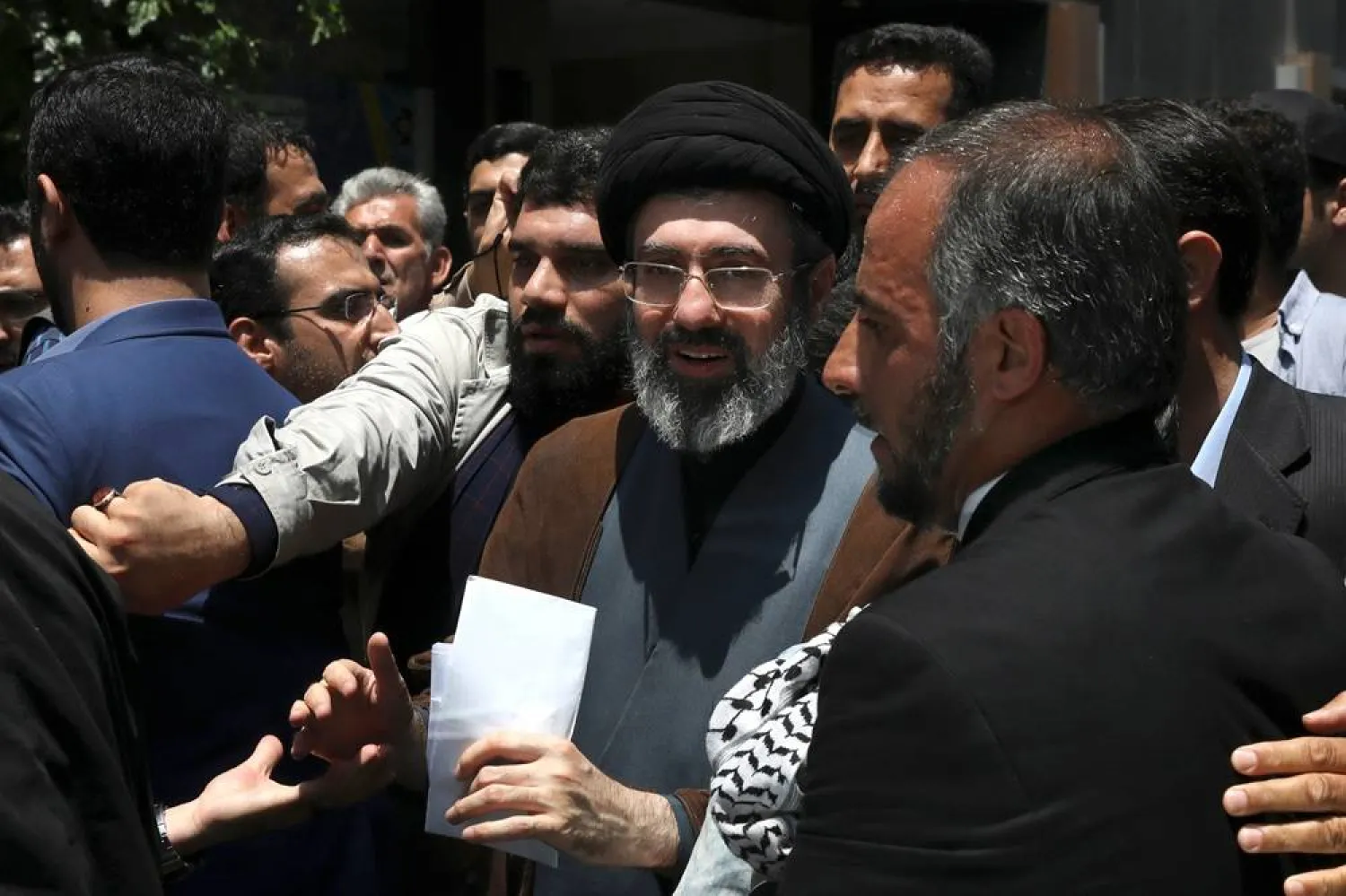
Mojtaba Khamenei, the son of Iranian Supreme Leader Ali Khamenei, center, attends the annual Quds, or Jerusalem Day rally in Tehran, Iran, on May 31, 2019. (AP)
TT

A Son of Iran’s Late Supreme Leader Is a Possible Candidate to Replace His Father as War Rages

Mojtaba Khamenei, the son of Iranian Supreme Leader Ali Khamenei, center, attends the annual Quds, or Jerusalem Day rally in Tehran, Iran, on May 31, 2019. (AP)

Mojtaba Khamenei, a son of Iran's late Supreme Leader Ali Khamenei has long been considered a contender to the post of the country's next paramount ruler — even before an Israeli strike killed his father at the start of the war last week and despite the fact he's has never been elected or appointed to a government position.

A secretive figure within the Islamic Republic, Mojtaba Khamenei has not been seen publicly since Saturday, when the Israeli airstrike targeting the supreme leader's offices killed his 86-year-old father. Also killed were the younger Khamenei's wife, Zahra Haddad Adel, who came from a family long associated with the country's theocracy.

Khamenei is believed to still be alive and has likely has gone into hiding as American and Israeli airstrikes continue to pound Iran, though state-run Iranian media have not reported on his whereabouts.

Profile of Khamenei's son rises after airstrike

Mojtaba Khamenei's name continues to circulate as a possible candidate to replace his father, something that had been criticized in the past as potentially creating a theocratic version of Iran's former hereditary monarchy.

But now with his father and wife considered by hard-liners as martyrs in the war against America and Israel, Khamenei's stock likely has risen with the aging clerics of the 88-seat Assembly of Experts who will select the country's next supreme leader.

Whoever becomes the leader will gain control of an Iranian military now at war and a stockpile of highly enriched uranium that could be used to build a nuclear weapon — should he choose to decree it.

Khamenei had occupied a similar role to that of Ahmad Khomeini, a son of Iran's first Supreme Leader Khomeini — "a combination of aide-de-camp, confidant, gatekeeper and power broker,” according to United Against Nuclear Iran, a US-based pressure group.

Born into dissent

Born in 1969 in the city of Mashhad, some 10 years before the 1979 revolution that would sweep Iran, Khamenei grew up as his father agitated against Shah Mohammad Reza Pahlavi of Iran.

An official biography on Ali Khamenei's life recounts one moment when the shah's secret police, the SAVAK, broke into their home and beat the cleric. Woken up after, Mojtaba and the rest of Khamenei's children were told their father was going on vacation.

“But I told them, ‘There is no need to lie.’ I told them the truth,” the elder Khamenei was quoted as saying.

After the fall of the shah, Khamenei's family moved to Tehran, Iran's capital. Khamenei would go on to fight in the Iran-Iraq war with the Habib ibn Mazahir Battalion, a division of Iran's paramilitary Revolutionary Guard that would see several of its members ascend to powerful intelligence positions within the force, likely with the backing of the Khamenei family.

His father became supreme leader in 1989 and soon Mojtaba Khamenei and his family had access to the billions of dollars and business assets spread across Iran's many bonyads, or foundations funded from state industries and other wealth once held by the shah.

Power rises with his father's

His own power rose alongside his father's, working within his offices in downtown Tehran. US diplomatic cables published by WikiLeaks in the late 2000s began referring to the younger Khamenei as “the power behind the robes.” One recounted an allegation that Khamenei actually tapped his own father's phone, served as his “principal gatekeeper” and had been forming his own power base within the country.

Khamenei “is widely viewed within the regime as a capable and forceful leader and manager who may someday succeed to at least a share of national leadership; his father may also see him in that light,” a 2008 cable read, also noting his lack of theological qualifications and age.

“Mojtaba is, however, due to his skills, wealth, and unmatched alliances, reportedly seen by a number of regime insiders as a plausible candidate for shared leadership of Iran upon his father’s demise, whether that demise is soon or years in the future,” it said.

Khamenei has worked closely with Iran's paramilitary Revolutionary Guard, both with commanders of its expeditionary Quds Force and its all-volunteer Basij that violently suppressed nationwide protests in January, the US Treasury has said.

The United States sanctioned him in 2019 during the first term of USPresident Donald Trump over working to “advance his father’s destabilizing regional ambitions and oppressive domestic objectives.”

That includes allegations that Khamenei from behind the scenes supported the election of hard-line President Mahmoud Ahmadinejad in 2005 and his disputed re-election in 2009 that sparked the Green Movement protests.

Mahdi Karroubi, who was a presidential candidate in 2005 and 2009, denounced Khamenei as “a master's son” and alleged he interfered in both votes. His father reportedly at the time said Khamenei was “a master himself, not a master’s son."

Powers of supreme leader at stake

There has been only one other transfer of power in the office of supreme leader of Iran, the paramount decision-maker since the country’s 1979 revolution. Khomeini died at age 86 after being the figurehead of the revolution and leading Iran through its eight-year war with Iraq.

Now the new leader will come on board after the 12-day war with Israel and as a US-Israeli war with Iran is seeking to eliminate Iran's nuclear threat and military power, hoping also the Iranian people will rise up against the Iranian theocracy.

The supreme leader is at the heart of Iran’s complex power-sharing theocracy and has final say over all matters of state. He also serves as the commander-in-chief of the country’s military and the Guard, a paramilitary force that the United States designated a terrorist organization in 2019, and which his father empowered during his rule.

The Guard, which has led the self-described “Axis of Resistance,” a series of militant groups and allies across the Middle East meant to counter the US and Israel, also has extensive wealth and holdings in Iran. It also controls the country's ballistic missile arsenal.
Beirut Southern Suburbs Residents Live Between Displacement, Return

Vehicles drive on the highway as people leave Beirut's southern suburbs after Israel ordered strikes on Dahiyeh, in Beirut, Lebanon, 01 June 2026. EPA/WAEL HAMZEH
TT

Beirut Southern Suburbs Residents Live Between Displacement, Return

Vehicles drive on the highway as people leave Beirut's southern suburbs after Israel ordered strikes on Dahiyeh, in Beirut, Lebanon, 01 June 2026. EPA/WAEL HAMZEH

The latest Israeli threat threw Beirut’s southern suburbs into turmoil within hours. Schools were evacuated, parents rushed to pull their children out of classrooms, and many residents fled their homes in haste. Roads filled with a new wave of displacement, reviving scenes the Lebanese have endured repeatedly in recent months.

But the threat did not end when the warning did. The alert was lifted, but the anxiety stayed. Some people returned to work, but not to a sense of safety. For many, the question is no longer when the strike will come, but how to live under the constant expectation of the next warning.

The home that is no longer safe

Layla Hassan told Asharq Al-Awsat that the latest threat to the southern suburbs did not end for her when the warning expired. The feeling it left behind still follows her. The problem, as she sees it, is no longer tied to a single security incident, but to a permanent state of uncertainty.

She said the natural bond between people and their homes has changed radically. “The home, which once represented the safe space people turned to in fear or danger, has now become one of the sources of anxiety.”

The warning, she said, made returning more complicated than leaving, especially for those responsible for children or other family members.

Life in displacement, despite its hardship and lack of services, can sometimes feel less cruel than the anxiety of returning, she said. Electricity, water, cramped spaces and the strain of daily life become secondary details beside one overriding concern, keeping the family safe.

She added that repeated displacement gradually pushes people to adapt to abnormal conditions, until the mere feeling of safety becomes a goal in itself, even at the cost of the life they once knew.

People leave Beirut's southern suburbs after Israel ordered strikes on Dahiyeh, in Beirut, Lebanon, 01 June 2026. EPA/WAEL HAMZEH

Every day begins with fear

Fatima Shams has not returned to the southern suburbs since Monday’s threat. She told Asharq Al-Awsat that “the Lebanese are living today in a state of constant anticipation that has made fear part of the daily routine. Every morning begins with a different question, but the meaning is the same, will this day pass safely?”

She described how the latest threat disrupted the daily lives of families. Her sister was at school when exams were halted and students were urgently evacuated. Within minutes, parents had to leave work and head to schools, caught between traffic-clogged roads and fear of a sudden security development.

“The hardest thing people are living through is not only the fear of strikes, but the constant feeling of instability,” she said. “Families are no longer able to plan their day or their week, because any new warning can overturn everything.”

She said the danger no longer feels confined to one area after warnings and tensions spread to different parts of Lebanon, making insecurity more widespread than ever.

Anticipation is wearing people down

Ali Noureddine, from the southern town of Toul and a resident of Beirut’s southern suburbs, described life for residents as “deadly anticipation.”

He told Asharq Al-Awsat that “the crisis is no longer linked to the warning itself, but to the psychological state that follows it. After every threat, people remain trapped between the possibility of returning to normal life and the possibility of a new escalation.”

He said this constant anxiety drains residents more than direct security incidents, because it turns life into an open-ended wait that no one knows when it will end.

The anxiety, he added, is not limited to the southern suburbs. It reaches the south as well, where families follow news of their towns, homes and areas with no clarity over what comes next.

People leave Beirut's southern suburbs after Israel ordered strikes on Dahiyeh, in Beirut, Lebanon, 01 June 2026. EPA/WAEL HAMZEH

We carry our memories in a bag

Layan Abdullah has not returned to the southern suburbs since the latest threat. For the university student, campus life is no longer about lectures, exams and ambitions. It is about displacement and the search for safety.

She told Asharq Al-Awsat that “her life has become a matter of packing belongings into a bag, moving to a new place, then preparing for the possibility of doing it again.”

Her generation, she said, can no longer think about future projects or career plans. The priority has narrowed to getting through the day safely.

She spoke of the harsh feeling that accompanies each displacement, reducing an entire life to a single bag. “A person does not leave behind only walls and furniture, but memories, details and relationships tied to a place.”

She also pointed to the added suffering of families with patients who need continuous medical care. Every move brings new questions about safe roads, access to hospitals and securing treatment, adding another layer of pressure to the psychological burden everyone is carrying.

Displacement from the southern suburbs and fear of losing Bint Jbeil forever

Hassan Bazzi does not describe the latest threat to Beirut’s southern suburbs as a passing security incident. For him, it was a moment that revived deeper fears about his future and the future of his hometown, Bint Jbeil.

He told Asharq Al-Awsat that “he found himself, like thousands of others, facing the prospect of another displacement from the southern suburbs, while carrying the feeling that the distance between him and his southern town, where he had spent years planning to return and settle, is growing day by day.”

“After the latest threat to the southern suburbs, the same feeling returned, that our entire lives have become suspended,” he said. “It is no longer only about where we live today or tomorrow, but about an entire future that we do not know whether we will be able to reclaim.”

He said he owns land and property in Bint Jbeil that he had seen as his life project and source of stability after more than three decades of work. But with the war continuing and the political and military scene growing more complicated, he now feels those plans slipping farther away.

“I imagined I would return to live on my land and take care of what I had built over the years. I thought the hardship of 30 years would give me a chance to rest and settle down. Today, I feel all of that has been postponed indefinitely,” he said.

He said repeated threats and continued displacement from the southern suburbs and the south have left people in a state of accumulated psychological exhaustion, making it hard to think about the future or make any long-term plans.

“I fear our children will grow up not knowing these villages as we knew them, and I fear that waiting to return will become a permanent state,” he said. “That is why displacement from the southern suburbs alone is not what worries me. What worries me more is that a day may come when I feel Bint Jbeil has become just a memory.”


‘Life and Hope’: Lebanon Hospital Resilient After Israeli Attack

02 June 2026, Lebanon, Tyre: Debris and extensive damage are pictured inside the Jabal Amel Hospital in Tyre after Monday's Israeli strike. (dpa)
TT

‘Life and Hope’: Lebanon Hospital Resilient After Israeli Attack

02 June 2026, Lebanon, Tyre: Debris and extensive damage are pictured inside the Jabal Amel Hospital in Tyre after Monday's Israeli strike. (dpa)

In a south Lebanon hospital heavily damaged by deadly Israeli strikes nearby, Dr. Nasser al-Masri held a new-born baby, calling him "a message of life and hope" despite the war.

Israeli strikes near the Jabal Amel hospital in Tyre on Monday killed four people and wounded 127, including four doctors, 27 nurses, and eight administrative employees, Lebanon's health ministry said.

They also caused "severe and extensive damage" to the facility, it added.

"Despite everything that happened yesterday, there was a scheduled delivery today... (and) the mother insisted on delivering at the hospital," Masri said.

"This baby was born today, he's just a few minutes old... He brought us a message of life and a message of hope for the future."

Glass was scattered across some hospital rooms on Tuesday, while dust and debris covered beds and tables.

Medication was strewn on corridor floors, and staff tried to work as others cleaned up around them.

"We're taking in any patient that comes to us," Masri said, adding that "even two hours after the raids, we were able to work normally, and the administration is determined to stay and work".

Around the hospital, the devastation was stark: a nearby building had been levelled, others were severely damaged and debris was scattered round near parked ambulances.

The roof of the hospital's parking collapsed, crushing several vehicles. Bulldozers worked to clear away the rubble.

- 'Steadfast' -

Inspecting the damage, Mohammad Derbaj, head of the hospital's maintenance department, said that "the civilian buildings were not the intended target, but rather Jabal Amel was targeted in order to put it out of service, but we are steadfast".

"What happened has increased our determination and strength," he added, as the hospital administration "made a decision yesterday that the hospital will return... We will work day and night to restore the hospital to what it was".

Israeli strikes have not spared Lebanese hospitals since the start of the latest Israel-Hezbollah war on March 2.

The health ministry says 17 hospitals have been damaged, with three forced to close, and 128 rescuers and medical personnel have been killed.

The Lebanese Italian hospital in Tyre was also damaged by an Israeli attack in April.

A strike last month near the city's Hiram hospital wounded 13 staff and damaged it, according to the ministry.

At Jabal Amel hospital on Tuesday, Hussein Qassir, head of the intensive care unit, told AFP they transferred patients from one ICU ward after it sustained significant damage in the airstrikes.

"We were expecting a strike near or adjacent to the hospital... but I didn't expect that the intensive care unit would be this damaged (but) the situation could have been so much worse.

"Despite this, we continue... it is our duty."

- 'Criminality' -

Abdinasir Abubakar, World Health Organization Representative to Lebanon, said on Tuesday that "two out of three hospitals" in the Tyre district, Jabal Amel and Hiram, "are damaged although continuing to function, and the third hospital is overwhelmed as it deals with an influx of injured patients".

The historic city in southern Lebanon, which still hosts thousands of displaced people from nearby areas, has been subject to repeated Israeli strikes that have continued despite an April 17 ceasefire agreement that has not been respected by either Israel or Hezbollah.

Israel's military has repeatedly warned residents of Tyre and its surroundings to evacuate in preparation for what it said are operations against Hezbollah.

Staffer Khalil Mustapha, displaced from the border town of Aitaroun, took shelter in the hospital after losing his home.

"I no longer have a home. Israel destroyed it and I came to the hospital. I never expected their level of criminality would reach this point," he said.

Zainab Fakih, who works in the laboratory, was sitting with her colleagues when the attack came.

"We were terrified... We opened the doors and rubble rained down on us, but luckily no one was hurt," she said.

"We didn't think they would bomb the area around the hospital. But we come here because this is our job, even though our families object", fearing for their safety.


Iran War Hands Syria Windfall as Airlines Reroute over Its Airspace

A Jazeera Airways Airbus A320neo takes off from Damascus International Airport, as regional airlines resume their flights to Syria after a hiatus because of the war, in Damascus, Syria, May 31, 2026. Syria's General Authority of Civil Aviation/Handout via REUTERS
TT

Iran War Hands Syria Windfall as Airlines Reroute over Its Airspace

A Jazeera Airways Airbus A320neo takes off from Damascus International Airport, as regional airlines resume their flights to Syria after a hiatus because of the war, in Damascus, Syria, May 31, 2026. Syria's General Authority of Civil Aviation/Handout via REUTERS

Syria recorded nearly 12,000 aircraft transits in May as regional airlines rerouted around airspace disrupted by conflict in the Middle East and into skies that most carriers had avoided for more than a decade.

Figures from Syria's General Authority for Civil Aviation show 11,801 flights crossed Syrian airspace, more than double the 4,267 recorded in February, the last full month before the Iran war disrupted regional aviation. Overflights in May were about 375% higher than in the same month last year.

Syria's airspace was a no-go zone throughout the 14-year civil war that ended with the ousting of President Bashar al-Assad in late 2024.

The turnaround is potentially lucrative for Syria, which increased the fees it charges airlines early this year.

Based on a flat fee of $499 per flight introduced by Syria's new government, last month's traffic could ‌have generated as much ‌as $5.9 million in overflight revenue, according to Reuters calculations.

The General Authority for Civil ‌Aviation ⁠declined to comment on ⁠revenue potential and the new fees.

Airlines were forced to reassess Syria after US and Israeli airstrikes began the Iran war on February 28 the airspace over Iraq and the Gulf that airlines previously relied upon was shut during March.

A ceasefire led to the reopening of airspace in April, but the majority of flights to Europe from Dubai and Doha - two of the world's busiest aviation hubs - have since crossed central Syria rather than Iraq, according to flight-tracking services Flightradar24 and AirNav.

Flying over Syria cuts journey times and fuel costs as airlines try to lessen the impact of the surge in international oil ⁠prices caused by the disruption linked to the Iran war.

SYRIA IS STILL HIGH RISK

Syria ‌upgraded infrastructure at Damascus International Airport after receiving advanced radar and ‌navigation systems from Türkiye late last year, according to Turkish Transport Minister Abdulkadir Uraloglu.

Even so, OPSGroup, an aviation risk monitoring advisory body, said ‌that airspace over Syria is still considered risky and is operating with "procedural control only" - the most basic level ‌of air traffic control.

Traffic remains less than half the levels before Syria's war, according to aviation officials, and the increase in traffic is largely limited to Gulf carriers as Europe's aviation safety agency still recommends airlines avoid flying over the country and region due to the Iran conflict.

Asian and North American carriers are also largely avoiding Middle Eastern airspace.

Syrian authorities, however, are upbeat.

"The increase ‌in overflight traffic reflects the beginning of a real shift in how airlines view Syrian airspace, as a viable and dependable route once again within the regional ⁠air traffic network," General Authority ⁠for Civil Aviation head Omar al-Hosari told Reuters.

He said GACA had updated air routes, reassessed traffic patterns and strengthened navigation, surveillance and air traffic control systems and adopted risk-based safety assessments in line with standards set by the International Civil Aviation Organization.

As part of an overhaul of the payment systems for overflights, GACA has outsourced the collection of charges to Syrian handling agents, as well as OPSGroup and International Flight Planning Solutions, a private Lebanese flight-planning firm.

Syria's flat fee of $499 per flight - divided between a $430 charge and a $69 communication fee - is regardless of aircraft type, size or operation type, according to a GACA document reviewed by Reuters and FAS Aero, one of the handling agents contracted by the government. Handling agents often add further fees on top.

Under Assad, Syria charged $75 for smaller aircraft to fly over the country, or about $1 to 1.25 per metric ton for larger planes, according to OPSGroup and a Syrian aviation official, who spoke on condition of anonymity.

The GACA document also shows a 50% reduction in levies for domestic flights and aircraft registered in Syria, and full exemptions for aircraft belonging to heads of states, official delegations, and search and rescue operations.