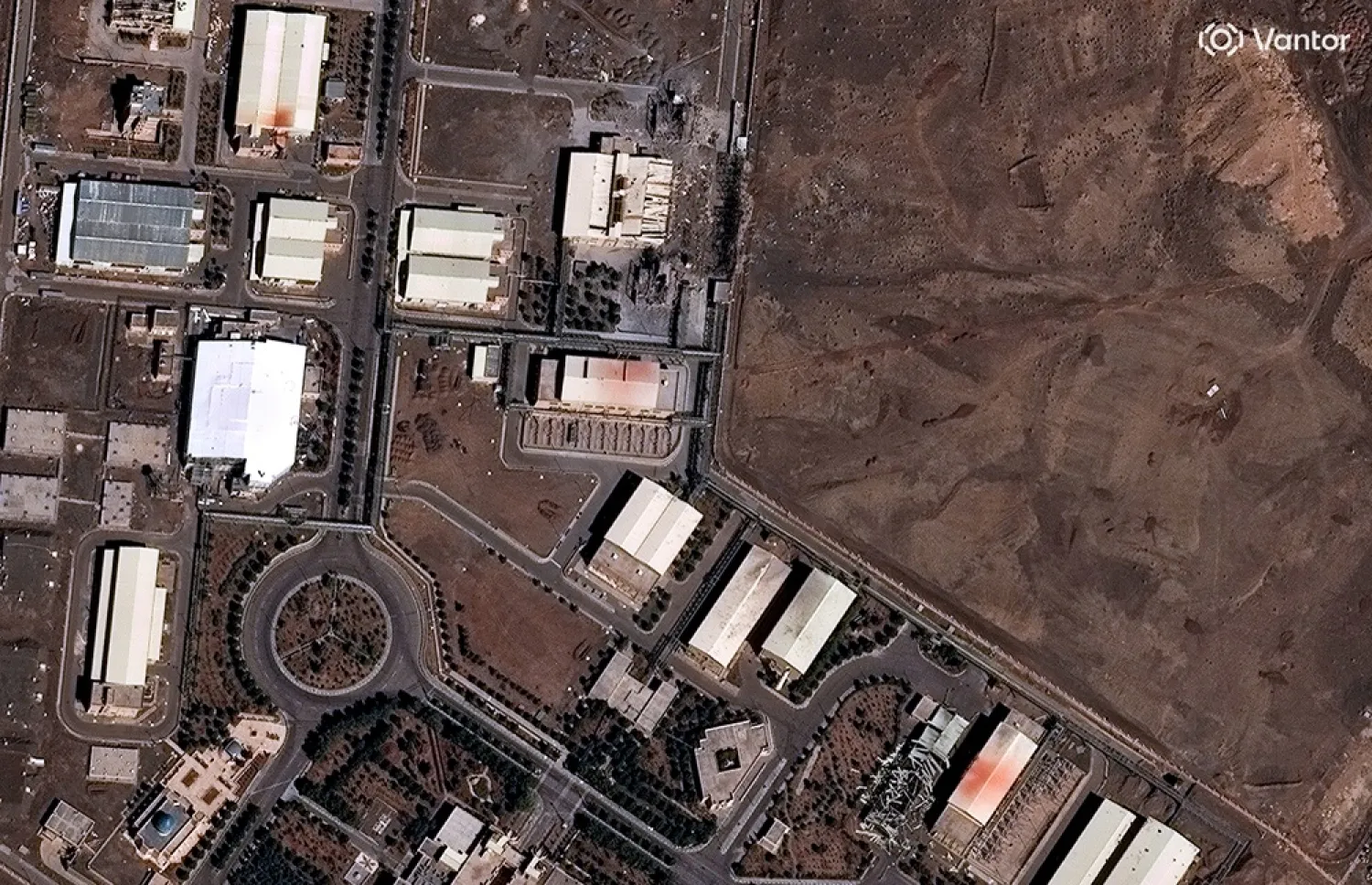
UN Watchdog Says No Damage to Iran Sites Housing Nuclear Material

A satellite image shows a closer view of the Natanz Nuclear Facility with new building damage, amid the US-Israeli conflict with Iran, near Natanz, Iran, March 2, 2026. (Vantor/Handout via Reuters)
TT

UN Watchdog Says No Damage to Iran Sites Housing Nuclear Material

A satellite image shows a closer view of the Natanz Nuclear Facility with new building damage, amid the US-Israeli conflict with Iran, near Natanz, Iran, March 2, 2026. (Vantor/Handout via Reuters)

The UN nuclear watchdog IAEA said Wednesday facilities housing nuclear material in Iran suffered no damage in the recent US-Israeli strikes and there was no risk of a radiation leak.

"Based on analysis of latest available satellite imagery, IAEA sees no damage to facilities containing nuclear material in Iran and therefore no radiological release risk at this time," the agency said on X.

Near the Natanz site near the central city of Isfahan, "damage is visible at two buildings" and there was "no additional impact detected" after "damage at entrances" reported on Tuesday, it said.

IAEA inspectors have had no access to the key Natanz site since it was targeted by bombings in June during the 12?day war triggered by an Israeli attack.

The IAEA reported "no impact at other nuclear sites, including Bushehr" in the southeast.

IAEA Director General Rafael Grossi repeated his call for "utmost restraint" in the conflict to avoid a radiation threat.


China Boosts Military Spending with Eyes on US, Taiwan

China announced a seven percent increase in its military budget for 2026. Florence Lo / POOL/AFP
TT

China Boosts Military Spending with Eyes on US, Taiwan

China announced a seven percent increase in its military budget for 2026. Florence Lo / POOL/AFP

China announced a seven percent boost to its defense budget for 2026 on Thursday as it steadily increases spending to counter the United States and enforce its claims over Taiwan and the South China Sea.

The latest rise keeps China's spending at a third of that of the United States, but the Asian power is working to close the gap.

Beijing plans to spend 1.9096 trillion yuan ($276.8 billion) on defense, according to a report published at the opening of the annual "Two Sessions" parliamentary meeting.

Premier Li Qiang told delegates that China will aim to strengthen the military and "carry out major defense-related projects" over the next five years.

Analysts said the budget will finance military salary increases, training, maneuvers around Taiwan, cyberwarfare capabilities and advanced equipment purchases, among other things, according to the report.

The increase marks a degree of continuity as Beijing pursues a sweeping anti-graft purge of the People's Liberation Army (PLA), which included the ousting of top general Zhang Youxia in January.

"China pursues an independent and self-reliant foreign policy. However, without robust military capabilities and technological prowess, our diplomatic stance would inevitably be subject to coercion or even dictated by certain nations, including the United States," military commentator Song Zhongping, a former Chinese army instructor, told AFP.

"China is unwilling to be a vassal state," said Song, who maintained that, by comparison, Japan and South Korea "only submit to American dictates".

The PLA must also strengthen its capabilities, he said, to "fully restore" Chinese jurisdiction over the disputed Spratly Islands, a chain of reefs and atolls in the South China Sea that are also claimed by the Philippines and where there are believed to be vast natural resources.

The United States is the world's biggest military spender, shelling out $997 billion in 2024, according to the Stockholm International Peace Research Institute (SIPRI).

- 'Proportionate' -

China has maintained a steady increase in military spending of around seven to eight percent each year since 2016.

However, its military spending as a percentage of GDP remains modest.

China's defense budget stood at 1.7 percent of GDP in 2024, well behind the US figure of 3.4 percent and Russia's 7.1 percent, according to SIPRI.

"That is proportional to its economy and legitimate defense needs," said Niklas Swanstrom, director of the Stockholm-based Institute for Security and Development Policy.

China claims its defense policy is solely aimed at protecting its territory, which it says includes self-ruled Taiwan.

It has only one military base abroad, in Djibouti, in contrast to the several hundred held by the United States.

"However, the absolute spending level (second globally) and rapid capability development concern neighbors," Swanstrom told AFP.

China's military buildup is fuelling an arms race in Asia and prompting some countries, particularly those with territorial disputes with China, to draw closer to Washington.

In Taiwan, leader Lai Ching-te wants to increase military spending in response to Beijing, which does not rule out the use of force to take control of the island.

The Philippines has also granted US access to more of its military bases.

Japan has been shedding its strict pacifist stance, with a record defense budget worth $58 billion approved in December for the coming fiscal year to expand its military capabilities.

Beijing vs Washington

The question of whether China could win a conflict against the United States remains unanswered.

The Chinese navy is considered to have more ships than any other country, but it lags behind the US Navy in tonnage, nuclear-powered submarines and aircraft carriers.

"The US remains the world's first-class armed forces both in terms of its military hardware and the hard operational experience of its personnel," said James Char, a Chinese military specialist at Nanyang Technological University in Singapore.

Swanstrom noted that the United States benefits from its superior global logistics, more advanced submarines and stealth technology, a larger nuclear arsenal, combat-experienced personnel and extensive alliance networks.

However, the balance would be radically different closer to China's shores if the US Navy were to intervene militarily, for example, to support Taiwan against Beijing.

"Most critically, neither side could 'win' meaningfully," Swanstrom said.

"Economic devastation, casualties, and nuclear escalation risks would be catastrophic for all parties."


Canada PM Carney Says Can't Rule Out Military Participation in Iran War

Canadian Prime Minister Mark Carney speaks to the media during a joint press conference with Australian Prime Minister Anthony Albanese at Parliament House in Canberra, Australia, 05 March 2026. EPA/LUKAS COCH
TT

Canada PM Carney Says Can't Rule Out Military Participation in Iran War

Canadian Prime Minister Mark Carney speaks to the media during a joint press conference with Australian Prime Minister Anthony Albanese at Parliament House in Canberra, Australia, 05 March 2026. EPA/LUKAS COCH

Canadian Prime Minister Mark Carney said Thursday that he couldn't rule out his country's military participation in the escalating war in the Middle East.

Carney's visit to Australia this week has been overshadowed by expanding war in the Middle East, sparked by a massive US-Israeli strike on Iran that killed its supreme leader, Ali Khamenei.

Speaking alongside local counterpart Anthony Albanese in Canberra, Carney was asked whether there was a situation in which Canada would get involved.

"One can never categorically rule out participation," he said, while stressing the question was a "hypothetical" one.

"We will stand by our allies," said Carney, adding that "we will always defend Canadians."

Carney had said the US-Israeli strikes on Iran were "inconsistent with international law".

However, he supports the efforts to stop Iran from obtaining a nuclear weapon -- a position that Canada takes "with regret" as it represented "another example of the failure of the international order".

The Canadian leader reiterated on Thursday his call for a "de-escalation" of the conflict.

Carney's trip is part of a multi-country tour of the Asia-Pacific aimed at reducing reliance on the United States -- a hedge against what he has described as a fading US-led global order.

The Australia leg of the tour is aimed at bringing in investment and deepening ties with a like-minded "middle power" partner.

- 'Middle power' rallying cry -

On Thursday morning he issued a rallying cry in Australia's parliament to "middle powers", urging them to work together in an increasingly hegemonic world order.

Nations like Australia and Canada faced a stark choice -- work together to help write the "new rules" of the global order or have great powers do it for them, he said.

"In this brave new world, middle powers cannot simply build higher walls and retreat behind them. We must work together," he said.

"Great powers can compel, but compulsion comes with costs, both reputational and financial," the former central banker added.

"Middle powers like Australia and Canada hold this rare convening power because others know we mean what we say and we will match our values with our actions."

The Canadian leader also said the two countries would together as "strategic collaborators" to pool their vast combined rare earth mineral resources.

And he detailed renewed cooperation in areas from defense to artificial intelligence.

"We know we must work with others who share our values to build solid capabilities," he told parliament.

Otherwise, he warned, they risked being "caught between the hyperscalers and the hegemons".

The Canadian leader has frequently clashed with US President Donald Trump, who has repeatedly threatened to annex Canada and slapped swingeing tariffs on the country.

In a speech to political and financial elites at the World Economic Forum in January, Carney warned the US led global system of governance was enduring "a rupture".


Canada Working to Repatriate More than 2,000 Citizens from Middle East

A Canadian flag is pictured on Frobisher Bay in Iqaluit, Nunavut February 23, 2012. REUTERS/Chris Wattie/File
TT

Canada Working to Repatriate More than 2,000 Citizens from Middle East

A Canadian flag is pictured on Frobisher Bay in Iqaluit, Nunavut February 23, 2012. REUTERS/Chris Wattie/File

The Canadian government is working to repatriate citizens who are stranded in the Middle East by organizing seats on commercial flights, contracting charter flights and offering ground transportation options to neighboring countries, Canada's foreign affairs minister said on Wednesday.

More than 2,000 Canadians have requested assistance from the Canadian government to leave the region since the US and Israel attacked Iran, Foreign Minister Anita Anand said, with around half of those inquiries coming from Canadians in the United Arab ‌Emirates, 237 from ‌Qatar, 164 from Lebanon, 93 from Israel and 74 from ‌Iran.

Anand ⁠said she had ⁠directed her office to enter into contracts to charter flights out of the United Arab Emirates in the coming days, contingent on approval from the UAE government to use its airspace.

The government secured 75 seats on a flight leaving Beirut on Wednesday, and will be offering more seats in the coming days for people wishing to leave Lebanon, Anand said. Two hundred Canadians with plane tickets were being bussed from Qatar ⁠to Saudi Arabia, she said, and the government is "engaging" ground transportation ‌for other Canadians who want to leave ‌Qatar.

Officials are providing information to Canadians in Israel about a bus service to Egypt operated ‌by the Israeli government where passengers can be taken to open airports in ‌that country, she said.

Commercial air traffic remained largely absent across much of the region on Wednesday, with major Gulf hubs - including Dubai, the world's busiest airport for international passengers - largely shut for a fifth straight day, in the biggest travel disruption since the COVID pandemic.

Repatriation flights chartered ‌by other countries, including Britain and France, were due to leave on Wednesday, while the United Arab Emirates opened safe ⁠air corridors to ⁠allow some citizens to return home. Under normal circumstances, thousands of commercial flights would depart the region each day.

"I want to speak directly now to Canadians in the Middle East and the Gulf region. Your government is with you. We are working hard for you, and we are arranging options for you to leave the region," Anand said at a news conference.

Canada cannot arrange ground transportation out of Iran because it does not have a diplomatic presence there, but it has sent officials to border crossings to meet Canadians who cross the border and assist them with visas and onward travel, Anand said.