


Azerbaijan Accuses Neighbor Iran of a Drone Attack and Vows to Retaliate

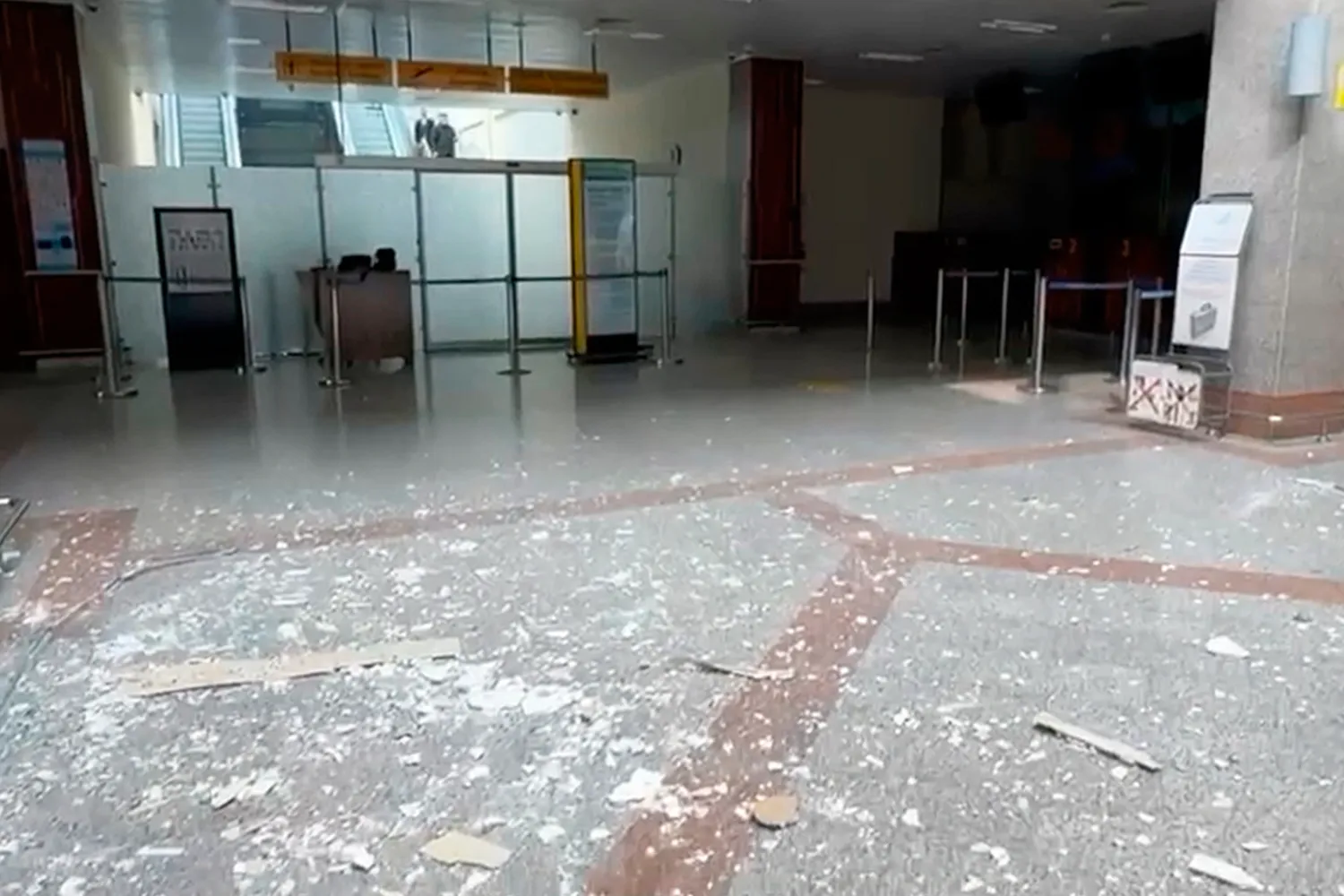
 This image taken from a video shows damages at the Nakhchivan International Airport following what Azerbaijan's Foreign Ministry said was a drone attack carried out by Iran on its exclave of Nakhchivan, Azerbaijan, Thursday, March 5, 2026. (AP)
This image taken from a video shows damages at the Nakhchivan International Airport following what Azerbaijan's Foreign Ministry said was a drone attack carried out by Iran on its exclave of Nakhchivan, Azerbaijan, Thursday, March 5, 2026. (AP)
TT

Azerbaijan Accuses Neighbor Iran of a Drone Attack and Vows to Retaliate

 This image taken from a video shows damages at the Nakhchivan International Airport following what Azerbaijan's Foreign Ministry said was a drone attack carried out by Iran on its exclave of Nakhchivan, Azerbaijan, Thursday, March 5, 2026. (AP)
This image taken from a video shows damages at the Nakhchivan International Airport following what Azerbaijan's Foreign Ministry said was a drone attack carried out by Iran on its exclave of Nakhchivan, Azerbaijan, Thursday, March 5, 2026. (AP)

Azerbaijan on Thursday accused Iran of a drone attack on its territory that injured four civilians, and it vowed to retaliate as the war in the Middle East reached into another country. 

Azerbaijan’s Foreign Ministry said in a statement that Iranian drones attacked its exclave of Nakhchivan and damaged an airport building. 

President Ilham Aliyev accused Iran of carrying out "a groundless act of terror and aggression," and said his military has been told to prepare and implement retaliatory measures. The Caspian Sea nation halted truck traffic across the nearly 700-kilometer (over 400-mile) border with Iran. 

Iran’s general staff of the armed forces denied it had launched a drone toward Azerbaijan's territory. Iran has repeatedly denied targeting oil infrastructure and other civilian targets in the war, despite its drone and missile fire hitting those sites. 

The incident highlighted Azerbaijan's complicated relationship with neighboring Iran, at a time when Baku also has developed military and economic ties with Israel. 

Iran has grown increasingly concerned about the US and Israel potentially leveraging the country’s various minority ethnic groups to destabilize the country as it comes under attack. Iran has a large Azeri population and Tehran has accused Baku of allowing Israeli intelligence to operate from there. Azerbaijan, in turn, has sought to give assurances that its territory won't be used for an attack on "neighborly and friendly" Iran. 

Drones crash in Nakhchivan  

Azerbaijan's Foreign Ministry said an Iranian drone crashed near the airport in Nakhchivan, and another one hit near a school. The Defense Ministry said four drones were fired by Iran toward Nakhchivan, and while one was disabled by Azerbaijani forces, the others targeted civilian facilities, including a school where classes were underway. 

It was unclear if it was deliberate or an accident. 

The country’s Prosecutor General’s office said four people were injured. 

Nakhchivan is separated from the rest of Azerbaijan by a swath of Armenia about 40 kilometers (25 miles) wide. Nakhchivan accounts for about 6% of the country's territory, bordering Azerbaijan’s close ally Türkiye and Iran. 

"We will not tolerate this groundless act of terror and aggression committed against Azerbaijan," Aliyev said at a meeting of his country's Security Council in remarks carried by the Azertac news agency. "Iranian officials must provide an explanation to the Azerbaijani side, an apology must be offered, and those who committed this terrorist act must be held criminally liable." 

He said Azerbaijan's military has been instructed "to prepare and implement retaliatory measures." 

The Defense Ministry vowed that Iran’s "attacks will not go unanswered," adding it was preparing the "necessary response" to protect "the territorial integrity and sovereignty of our country, ensure the safety of civilians and civilian infrastructure." It didn’t elaborate. 

Aliyev stressed that Azerbaijan "is not participating in operations against Iran -– neither previously nor this time -– and will not do so." 

He added: "We have neither interest in conducting any operations against neighboring countries, nor does our policy allow it." 

The Foreign Ministry said Iran's "actions contradict the norms and principles of international law and contribute to increased tension in the region," and summoned the Iranian ambassador to lodge a protest. 

Baku demanded that Iran "provide an explanation and take the necessary urgent measures to prevent the recurrence of such incidents," the statement said. 

Turkish President Recep Tayyip Erdogan called Aliyev to condemn the Iranian drone attack and express support. The Turkish Foreign Ministry urged a halt to strikes that target "third countries in the region and increase the risk of the war spreading." 

A complicated relationship  

Azerbaijan in recent years has developed ties with Israel and the United States, with Iran's influence in the South Caucasus region diminishing. US President Donald Trump hosted Aliyev and other top officials at the White House last year for a three-way summit with Armenia. 

Aliyev and Armenian Prime Minister Nikol Pashinyan signed a deal aimed at ending a decades-long conflict between the countries, which included an agreement to create a transit corridor to the Nakhchivan exclave through Armenia to be called the "Trump Route for International Peace and Prosperity." 

The proposed corridor "remains a thorn in the Tehran’s side, which could partially explain" the attack on the exclave, said Mario Bikarski, senior Eastern Europe and Central Asia analyst at risk intelligence company Verisk Maplecroft. 

Without the US-financed corridor, the main overland route to Nakhchivan and Türkiye from the main part of Azerbaijan is through Iran, which gives Tehran leverage, Bikarski said. If the corridor materializes, Iran’s regional influence would be weakened because the route would facilitate Baku's normalized trade and diplomatic relations with Türkiye and Armenia, and "open up the South Caucasus to increased US presence," he added. 

Aliyev also met Trump last month at the World Economic Forum in Switzerland, as well as Israeli President Isaac Herzog. He later hosted Israeli Foreign Minister Gideon Saar in Azerbaijan and met with US Vice President JD Vance last month. 

Bikarski said tensions between Iran and Azerbaijan have somewhat decreased since 2024 following the election of Iranian President Masoud Pezeshkian, who has an Azeri father and a Kurdish mother. Still, Azerbaijan’s close ties with Israel makes it "a plausible target of hostile Iranian actions," he added. 

Azerbaijan had offered condolences on Khamenei's death  

In recent days, however, Baku appeared to try to assuage any concerns Iran might have over its ties with Israel and its possible role in the war, which began Feb. 28 when the US and Israel unleashed a series of strikes and killed Iranian Supreme Leader Ali Khamenei. 

Aliyev was among world leaders who sent a message of condolence over Khamenei's killing to Pezeshkian. On Wednesday, Aliyev visited the Iranian Embassy in Baku to offer his condolences personally to Ambassador Mojtaba Demirchilou. 

On Sunday, Azerbaijan's Foreign Minister Jeyhun Bayramov spoke with his Iranian counterpart, Abbas Araghchi and expressed "serious concern over the tragic escalation of the situation in the region." He also said he hoped for "the prompt cessation of military actions" and stressed that Azerbaijan's territory "cannot be used by any country against neighboring and friendly Iran." 

Bikarski said in his written comments that it is unclear whether the drones "were sent deliberately, but given one of the areas hit was a regional airport, it is likely that Azerbaijan was indeed deliberately targeted." 

He added: "Azerbaijan’s close ties with Israel means it a plausible target of hostile Iranian actions."  


Dozens Missing, 5 Dead after Migrant Boat is Found Drifting Near Spain’s Canary Islands

Rescuers help a migrant disembarking from a Spanish coast guard vessel at the port of Arguineguin, on the island of Gran Canaria, Spain, September 3, 2026. REUTERS/Borja Suarez
TT

Dozens Missing, 5 Dead after Migrant Boat is Found Drifting Near Spain’s Canary Islands

Rescuers help a migrant disembarking from a Spanish coast guard vessel at the port of Arguineguin, on the island of Gran Canaria, Spain, September 3, 2026. REUTERS/Borja Suarez

At least five people died and dozens more were feared dead after a boat carrying West African migrants ran into trouble in the Atlantic Ocean. Forty-four people were brought to safety in the Canary Islands.

Spain’s Maritime Rescue Service said Thursday that one of its planes had spotted a “precarious” boat drifting some 120 km (74 miles) south of the island of Gran Canaria on Wednesday afternoon.

Three survivors were immediately evacuated by helicopter to a hospital on the island. The remaining 41 migrants were brought to safety by boat and disembarked early Thursday in the port of Arguineguín, where they were cared for by the Red Cross. All survivors were men, some underage, and came from Mali or Senegal, said José Antonio Rodríguez Verona, a spokesperson for the Red Cross in the Canaries.

In a phone interview with The Associated Press, Rodríguez Verona said survivors were disoriented and dehydrated, with many collapsing or vomiting upon reaching land. While it was difficult to get precise information given their fragile state of health, migrants reported leaving Gambia and being stranded at sea for “many, many days.” Some estimated they had been at sea for nearly a month. Running out of provisions, they fell ill from drinking seawater.

Survivors also told the Red Cross that more than 100 people were originally on board, including women and a baby. As people died on the journey, their bodies were tossed in the ocean until they had no more strength to do so.

In an emailed statement, Spain’s Maritime Rescue Service said that it was not able to retrieve the remains of the five dead found inside the boat due to strong winds and waves that were 2.5 metres (8 feet) high.

Separately, Helena Maleno, founder of the migrant rights group Walking Borders, which monitors deaths and disappearances on migration routes to Spain, reported that 83 people had died on the voyage, including three women and a baby. In a post on X, Maleno said the boat had departed Gambia 27 days ago.

Maleno and her NGO are frequently contacted by relatives of missing migrants and often relay calls for help and rescue to Spanish authorities. The AP reached out to Maleno and Walking Borders seeking further details but has not yet received a response.

The West African Atlantic route to Spain’s Canary Islands is one of the deadliest crossings to Europe. While arrivals to the Spanish archipelago have fallen significantly in the past year, tens of thousands of people have died or gone missing in recent years, with several migrant boats getting lost and drifting all the way across the Atlantic to the Americas.


Iran Media Says 6 Navy Personnel Killed in US Attacks

Video footage released by Iran's Sepah News on July 14, 2026 allegedly showing a drone being launched towards US targets in Bahrain and Kuwait. © AFP via Sepah News screengrab
TT

Iran Media Says 6 Navy Personnel Killed in US Attacks

Video footage released by Iran's Sepah News on July 14, 2026 allegedly showing a drone being launched towards US targets in Bahrain and Kuwait. © AFP via Sepah News screengrab

Iran's Tasnim news agency on Thursday said six members of the Iranian army's naval forces were killed by US attacks during renewed fighting this week.

The six died during a wave of US attacks on Tuesday, the report said, without specifying where they were killed.

"During the criminal attacks carried out by the US terrorist army two nights ago on September 1 on the south of the country, six members of the Islamic Republic of Iran Army Navy were martyred," it said, AFP reported.

At least 19 Iranians were killed on Tuesday and Wednesday, official media have said, during extensive US bombardment across Iran.

Seven people were killed in the southwestern province of Khuzestan, and four members of the Revolutionary Guard died in Kermanshah province, Iranian media said.

Three paramilitaries were killed on Lavan island in the Gulf and another died in Fars province, they said.

Iranian officials and media also blamed the attacks for the deaths of four people at a wedding party in Hormozgan province.

It wasn't immediately clear if the six naval personnel were among the seven already reported dead in Khuzestan.


Iran Attacks US Targets Despite Trump Threats

Trump said the US military was prepared to attack Iran 'any time we want'. US NAVY/AFP
TT

Iran Attacks US Targets Despite Trump Threats

Trump said the US military was prepared to attack Iran 'any time we want'. US NAVY/AFP

Iran attacked US military bases in Kuwait on Thursday, despite President Donald Trump threatening further strikes in a fresh flare-up six months into the war.

The new clashes, which began with US raids on Sunday, deepen the ongoing impasse in the war, as Iran maintains a stranglehold on the strategic Strait of Hormuz and the US presses its counter-blockade of Iranian ports.

Trump said his military was prepared to attack Iran "any time we want" after extensive US bombardment of sites across the country left at least 19 Iranians dead between Tuesday and Wednesday.

Tehran has once again retaliated with strikes across the Middle East this week, saying it targeted US bases and forces in the United Arab Emirates, Kuwait, Bahrain, Jordan and Iraq's Kurdistan region.

Iran's security chief Mohsen Rezaei warned the United States on Wednesday that Iran had adopted a "new strategy" in the war that "will shatter your foundations".

Iran's pummeling of US military targets across the region came after a US attack that hit a wedding in the country's south, prompting fury from Tehran.

The Iranian Red Crescent said shrapnel from the missile attack in the coastal town of Kuhestak killed four people, including a child, and wounded more than 50.

The US military did not address the attack directly.

US Central Command (CENTCOM) spokesman Tim Hawkins said "the US military never targets civilians, unlike the IRGC", referring to Iran's Revolutionary Guards.

Kuwait's army on Thursday said it was intercepting a missile and drone attack from Iran, with the Iranian army saying it hit "the Ahmad al-Jaber Air Base in Kuwait with missiles and drones".

- 'Maximum pressure' -

Kuwait called the attacks "a direct threat to its security and stability, and the safety of its citizens and residents on its territory, and a grave breach of the rules of international law".

Aside from military action, Washington has vowed to choke Iran's economy, threatening to slap sanctions on its trade partners.

Energy Secretary Chris Wright pledged on Wednesday that a US plan for expanded sanctions targeting the Iranian republic's economic partners would deliver "absolutely maximum pressure".

Trump also suggested on Wednesday renaming the Strait of Hormuz, a major shipping lane that Tehran has effectively shut for six months, as "Trump Strait" -- although he implied later that he wasn't serious.

"Now that we have it under U.S.A. control, should we change the name Hormuz Strait to TRUMP STRAIT???" the US president wrote on Truth Social.

- 'Acts like Satan' -

Iran's top negotiator Mohammad Bagher Ghalibaf lashed out at Washington over the wedding attack, calling the United States "Satan".

"If a power acts like Satan, picks targets like Satan, and kills like Satan, it's Satan," he posted on X.

Iranians meanwhile expressed dismay over the return to hostilities.

Hossein Moazami, 50, who is self-employed, called the attacks "truly distressing".

"I hope they all return to the negotiating table because the only people suffering from this are the Iranian people," he said. "The Americans are on the other side of the world and nothing happens to them."

A video shared by an Iranian government account showed debris and damage at what it said was the wedding site in Kuhestak following the US strike, with people heard screaming in the background.

"It is a very saddening incident," Ali Mallahi, father of the bride and owner of the building that was hit, said in a video carried by state TV.

"Thank God the casualties were not higher."

The war erupted on February 28 with US-Israeli attacks on Iran that killed its supreme leader Ali Khamenei.

A fragile ceasefire collapsed in July after attacks on commercial ships in the Strait of Hormuz, through which one-fifth of world oil supplies previously flowed.

Israel's defense minister meanwhile said his country was prepared to respond "with great force" if attacked by Iran over the Jewish high holiday season, which begins in mid-September.

"For now, they are striking throughout the region except us," Israel Katz said.
