


Rising Fuel Prices Lash Airline Sector as Iran Conflict Widens

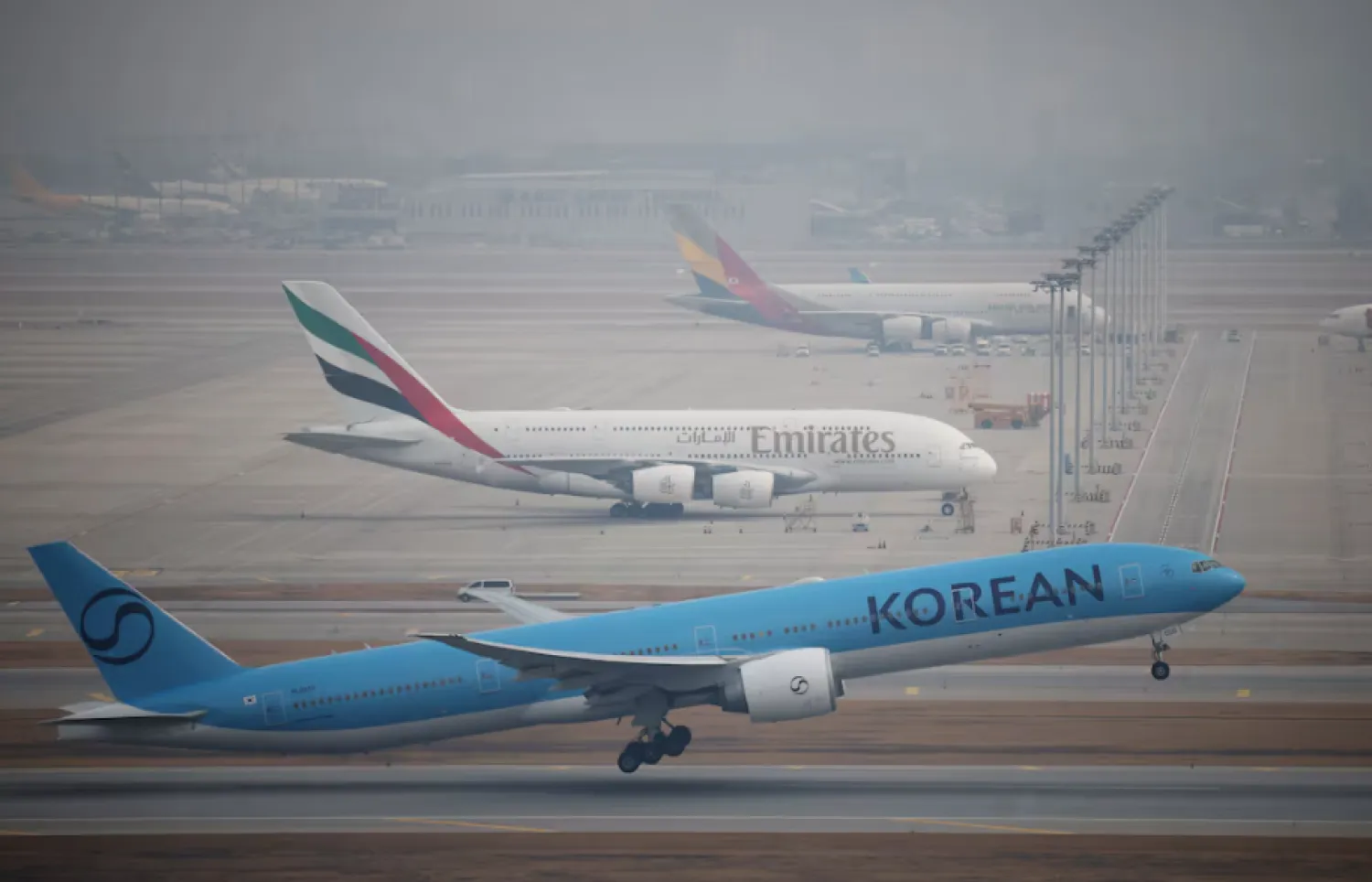
An Emirates Airbus A380 aircraft that has remained parked at the airport after the flight was cancelled, amid the U.S.-Israel conflict with Iran, at Incheon International Airport in Incheon, South Korea, March 5, 2026. REUTERS/Kim Hong-Ji
TT

Rising Fuel Prices Lash Airline Sector as Iran Conflict Widens

An Emirates Airbus A380 aircraft that has remained parked at the airport after the flight was cancelled, amid the U.S.-Israel conflict with Iran, at Incheon International Airport in Incheon, South Korea, March 5, 2026. REUTERS/Kim Hong-Ji

Airline shares seesawed on Thursday, as some regained ground on more flights taking off from the Middle East while others dipped on spiking oil prices after US-Israeli strikes on Iran sparked major disruption across the global aviation industry.

Governments have scrambled to arrange flights out of the Middle East for tens of thousands of citizens stranded by the intensifying conflict, which has closed most of the region's airspace due to the risk of missiles hitting planes.

Takeoffs from Dubai International Airport more than doubled on Wednesday, the latest data from Flightradar24 show, as activity slowly restarts at the world's busiest travel hub, which was brought to a near standstill amid the conflict.

Traffic remains far below normal levels, with global aviation disruption likely to take some time to normalize as the conflict shows little sign of easing. Air cargo has also been hit, disrupting the movement of perishables and aircraft parts.

"The past few days have been unprecedented," Dubai Airports CEO Paul Griffiths said on Thursday on LinkedIn in his first public remarks since the airstrikes began, adding that teams were pulling together and "navigating with confidence".

In a sign of the ongoing threat to airlines, Azerbaijan - part of one key flight corridor from Asia to Europe - temporarily closed part of its airspace near Iran after a drone strike in the southern Nakhchivan area near the Iranian border.

Flights appeared to still be crossing the country further to the north, according to realtime tracking from Flightradar 24.

The war has pummelled airline stocks since initial strikes last weekend on fears a protracted conflict could block key routes and raise fuel costs. Carriers have varying levels of Middle East exposure and different hedging strategies.

Some stocks rebounded on Thursday. Cathay Pacific Airways , Qantas Airways and Korean Air Lines rose. Japan Airlines edged down 1%.

Major Chinese carriers such as Air China, , China Eastern Airlines and China Southern Airlines fell between 1% and 4% in both Hong Kong and Shanghai.

Gary Ng, a senior economist at Natixis, said Asian airlines were sensitive to Iran's situation given the impact on routes, revenue and costs.

In Europe, Air France KLM was slightly higher, but Lufthansa, British Airways-owned IAG and budget carrier Ryanair dipped. Wizz Air, which flagged a $58 million hit to profits from the conflict, tumbled 10%.

Wizz Air's CEO told Reuters the financial hit should be limited to its current financial year that ends this month and said that the firm was shifting its capacity towards Europe.

REPATRIATION FLIGHTS RAMP UP

Emirates and Etihad are now operating limited services from Dubai and Abu Dhabi through safe air corridors. An Emirates spokesperson said more than 100 flights should depart from Dubai with passengers and cargo on Thursday and Friday.

Qatar Airways said it would run limited relief flights from Thursday for stranded passengers, departing from Muscat in Oman to six European destinations including London, Berlin and Rome as well as from Riyadh to Frankfurt.

Governments from the US to Canada and across Europe have arranged charter flights and helped secure seats on commercial services to repatriate citizens. More than 17,500 Americans have returned to the US since February 28.

A flight carrying Kenyans and others fleeing the UAE arrived in Nairobi on Thursday, including 13 children and their teachers who had been on a school trip to the Gulf.

"We were stuck there for five days ... it was scary, every day we would get alerts and the children would just lose it," school director Olive Tindika told Reuters, saying the children arrived in tears at teachers' hotel rooms whenever explosions lit up the sky.

"It was a very, very traumatising experience."

AIRLINE SECTOR OUTLOOK TIED TO IRAN CONFLICT

Jet fuel prices have soared globally since the strikes on Iran, hitting an all-time high in Singapore on concerns over supply disruption, S&P Global Platts said on Thursday.

Many Asian airline shares have rebounded or pared double-digit declines in recent days, though analysts said the gains may not last.

"I consider this rebound to be primarily short-term in nature," said Kenny Ng, a securities strategist at China Everbright Securities International. "Its sustainability will still depend on the ongoing situation in the Iranian conflict."

Restrictions on airspace have forced airlines to reroute flights, load extra fuel or make additional refuelling stops to guard against sudden diversions or longer flights on safer routes. Prices on some key global routes have risen sharply.

Marooned tourists and some expatriates have also tried to find their own way out of the Middle East through Saudi Arabia or Oman, where airspace remains open.



Saudi GDP Grows 2.8% in First Quarter

The Saudi capital, Riyadh (SPA)
TT

Saudi GDP Grows 2.8% in First Quarter

The Saudi capital, Riyadh (SPA)

Saudi Arabia's real gross domestic product grew 2.8% in the first quarter, year-on-year, preliminary government estimates showed on Thursday.

Non-oil activities grew 2.8% in the quarter, and oil activities increased 2.3% from the prior-year period, the General Authority of Statistics data ⁠showed.

On a quarterly basis, growth shrank 1.5% in the three months to March 31 compared to the fourth quarter, driven by a decline in oil activities.

Oil activity decreased 7.2% from the fourth quarter, while non-oil activity was almost flat.


IMF Warns Asia to Keep Policy in Balance Amid Energy Disruptions

FILE PHOTO: A view of the International Monetary Fund (IMF) logo at its headquarters in Washington, D.C., US, November 24, 2024. REUTERS/Benoit Tessier/File Photo
TT

IMF Warns Asia to Keep Policy in Balance Amid Energy Disruptions

FILE PHOTO: A view of the International Monetary Fund (IMF) logo at its headquarters in Washington, D.C., US, November 24, 2024. REUTERS/Benoit Tessier/File Photo

Asian countries will need to keep their powder dry in preparation for future shocks even as they tackle an energy crisis caused by the Iran War, IMF Director for Asia Pacific Krishna Srinivasan said on Thursday.

With energy supplies running short due to the logjam in the Strait of Hormuz, southeast Asian economies have budgeted significant sums to cushion the impact of surging prices, and have also introduced measures to conserve energy, including work from home plans.

But Srinivasan, speaking at a media roundtable, warned countries against ramping up energy subsidies.

"If you give generalised subsidies, it's very hard to pull it back," he said, adding that countries should instead provide budget neutral ⁠and targeted fiscal ⁠support, and maintain fiscal discipline.

"In other words, cut elsewhere to support people who are being hit by the energy shock," Reuters quoted him as saying.

Srinivasan said that while some markets, such as Thailand and China, can hold off on tightening monetary policy because they are in deflationary territory, markets already above their inflation targets, including Australia, need to start now.

He also ⁠noted that some markets, such as the Philippines, have decided to tighten preemptively to anchor inflation expectations, but he added that the IMF's advice would have been to see through the shock and wait to see if inflation really picks up in a meaningful way.

"You may want to take insurance upfront or you may want to wait and see so that you don't hurt growth ... it's a very difficult balance to strike as a central bank governor," he said.

The IMF cut its global GDP outlook for 2026 to 3.1% on April 14, assuming ⁠a short-lived Middle ⁠East conflict and oil prices normalising in the second half of the year.

However, IMF chief economist Pierre-Olivier Gourinchas warned that the fund's "adverse scenario" of 2.5% growth looked increasingly likely, with continued energy disruptions and no clear path to end the conflict.

Srinivasan said that if the Strait of Hormuz remains closed beyond the next three months and oil prices stay elevated for the rest of the year, the IMF's more severe growth scenarios will become more likely.

There are still downside risks to growth, with a number of uncertainties facing the world economy, including the duration of the energy crisis and the severity of fertiliser shortages, which could create a food supply shock, he said.


Euro Zone Inflation Soars Further Above ECB Target

FILE -Clouds cover the sky over the headquarters of the European Central Bank in Frankfurt, Germany, Sept. 11, 2025. (AP Photo/Michael Probst, File)
TT

Euro Zone Inflation Soars Further Above ECB Target

FILE -Clouds cover the sky over the headquarters of the European Central Bank in Frankfurt, Germany, Sept. 11, 2025. (AP Photo/Michael Probst, File)

Euro zone inflation surged further in April on soaring energy costs, Eurostat data showed on Thursday, adding to the case for interest rate hikes, even if benign underlying price growth figures ease the urgency of any move.

Inflation in the 21 countries sharing the euro currency jumped to 3.0% this month from 2.6% in March, moving further above the European Central Bank's 2% target, with energy costs accounting for the vast majority of the increase.

A closely watched figure ⁠on underlying or 'core' ⁠inflation, which excludes volatile food and energy prices, meanwhile slowed to 2.2% from 2.3% a month earlier.

Services inflation, a stubbornly high component of the price basket over the past several years, slowed to 3.0% from 3.2% while inflation for non-energy industrial ⁠goods, a key drag on prices picked up to 0.8%.

The figures are a mixed bag for the ECB, which is meeting on Thursday and will likely keep interest rates unchanged, even if it signals that policy tightening is increasingly likely, Reuters reported.

The high headline inflation print strengthens the argument for interest rate hikes but the underlying figures suggest that the initial energy shock is not yet creating major ⁠second round effects.

The ⁠ECB is largely powerless against an energy shock but must step in if these second round effects become visible as they risk creating a hard-to-break self-sustaining inflation spiral.

This is why investors expect the ECB to hike its 2% deposit rate already in June and see at least two more moves before the end of the year.

This outlook is volatile, however, and largely depends on developments in the Iran war and oil prices, which hit a four-year-high of $124 on Thursday.