


Pezeshkian’s Apology to Neighbors Triggers Backlash in Iran

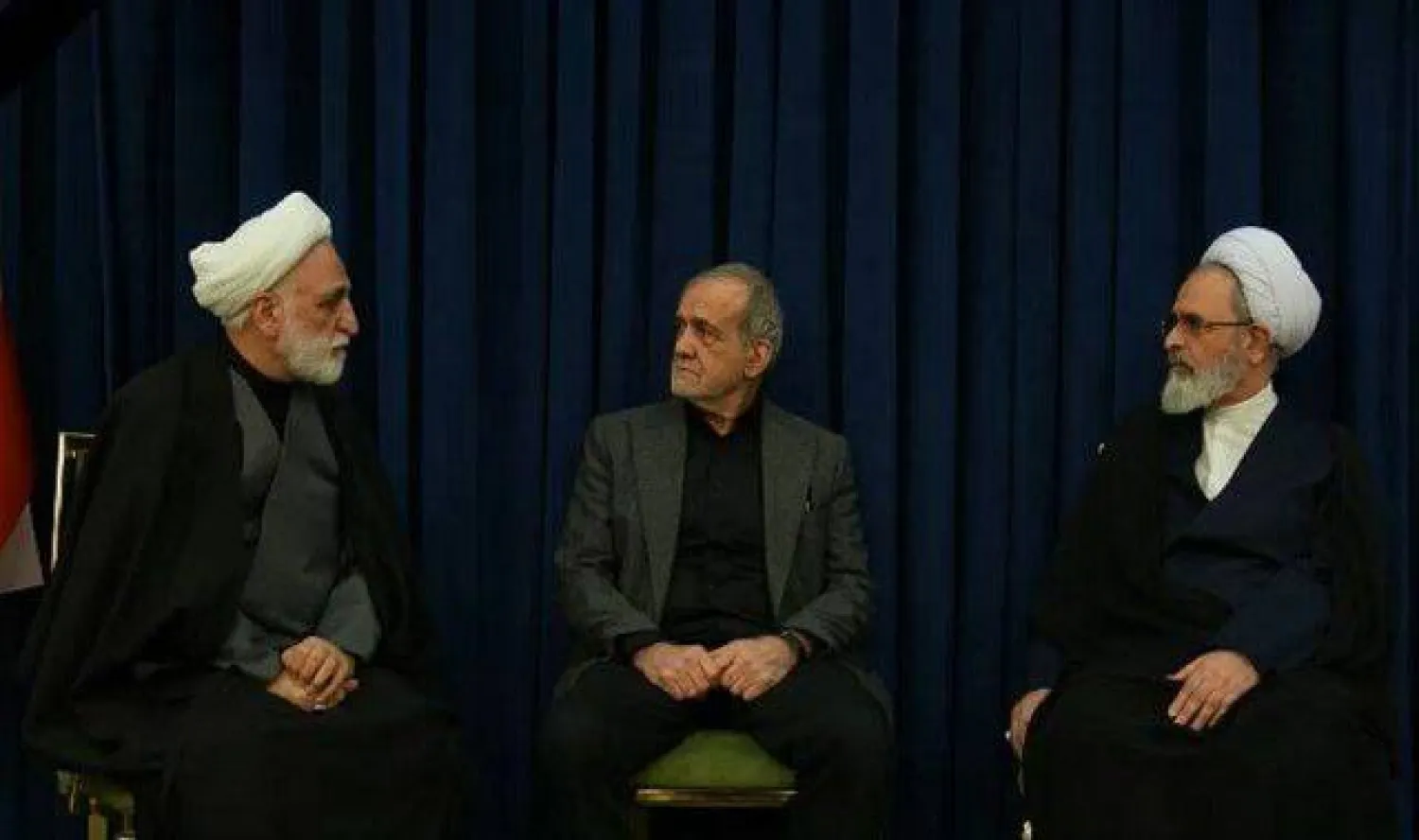
Iranian President Masoud Pezeshkian attends a leadership council meeting with judiciary chief Gholamhossein Mohseni-Ejei and Guardian Council member Ali Reza Arafi last week. (Iranian Presidency)
TT

Pezeshkian’s Apology to Neighbors Triggers Backlash in Iran

Iranian President Masoud Pezeshkian attends a leadership council meeting with judiciary chief Gholamhossein Mohseni-Ejei and Guardian Council member Ali Reza Arafi last week. (Iranian Presidency)

An apology by Iranian President Masoud Pezeshkian to neighboring countries for attacks that struck parts of their territories - and his pledge to halt such strikes unless their soil is used to attack Iran - has triggered sharp political debate within Tehran’s ruling establishment.

Lawmakers swiftly condemned the remarks, while military and judicial officials reiterated that US and Israeli interests across the region would remain legitimate targets. The dispute is unfolding at a delicate moment for Iran, following the killing of Supreme Leader Ali Khamenei.

Pezeshkian framed the apology as a political signal intended to reassure neighbors and prevent a wider regional confrontation. Critics, however, called it “an unjustified concession in the middle of an open war.”

Military and judicial leaders stressed that any US or Israeli base or interest used against Iran would remain a legitimate target — even if located on the territory of other regional states.

The episode has turned the president’s apology from a diplomatic gesture to contain tensions into the center of an internal power struggle, highlighting divisions within Iran’s leadership over the limits and management of the war.

Following Khamenei’s killing, a temporary leadership council assumed his duties. The body consists of Pezeshkian, judiciary chief Gholamhossein Mohseni-Ejei and Guardian Council member Alireza Arafi.

In a televised address, Pezeshkian said the council had decided not to target neighboring states or fire missiles at them unless Iran was attacked from their territory.

“I apologize in my name and on behalf of Iran to neighboring countries that Iran attacked,” he said, adding that Tehran does not intend to assault any state.

He said the Iranian Revolutionary Guard Corps had acted in recent days “based on a field decision” after senior commanders and the supreme leader were killed at the start of the war.

The comments quickly drew pushback. Mohseni-Ejei said evidence gathered by Iran’s armed forces showed that “the geography of some countries in the region has openly or secretly been placed in the service of the enemy,” allowing their territory to be used for attacks against Iran.

“Severe attacks on these targets will continue,” he said, adding that the strategy was already under way and backed by the government and other pillars of the system.

Iran’s military signaled little appetite for de-escalation. The command of Khatam al-Anbiya Headquarters, the joint operations center under the armed forces’ general staff, said that although it had “not carried out any aggression” against neighboring states so far, all US and Israeli bases and interests across land, sea and air in the region remained primary targets.

In a statement, the command said the armed forces “respect the interests and sovereignty of neighboring countries and have not carried out any aggression against them so far.” But it warned that if hostile actions continued, all military bases and interests belonging to the United States and the “Zionist entity” would face powerful strikes from Iranian armed forces.

A spokesman for the headquarters said any location from which attacks against Iran are launched would be considered a legitimate target, warning that any attempt to enter the region “will end at the bottom of the Gulf” and that Tehran “will not retreat” in confronting the United States and Israel.

In parliament, Mohammad Manan Raisi, a lawmaker representing Qom, said the president’s “strange apology to neighboring countries is regrettable.”

Addressing Pezeshkian, he wrote: “When will it be time for you to apologize to the Iranian people for these humiliating positions?”

Raisi added that the Assembly of Experts must urgently announce a new supreme leader, saying the president’s “humiliating statements” showed the need to select one as soon as possible.

“Is it not true that neighboring countries placed their land, property and hotels at the service of our enemies?” he said. “Should our military not have attacked these bases and enemy properties that you now apologize for striking in such a humiliating manner?”

Conservative lawmaker Jalal Rashidi Kouchi wrote on X: “With all due respect, Mr. President, an apology is offered when a mistake has been made... but we made no mistake.”

He said the president’s message lacked firmness, appearing weak in wording, delivery and even body language.

Iran’s foreign ministry also warned regional states against allowing their territory or resources to be used for attacks on Iran.

In a statement, it said international law prohibits using a country’s territory, directly or indirectly, to harm another state, citing UN General Assembly Resolution 3314 defining aggression.

Countries whose territory is used to launch military attacks against a third state bear international legal responsibility, including compensation for direct and indirect damages, the ministry said.

It added that Iran had been compelled, under its “inherent and natural right” of self-defense, to carry out necessary and proportionate defensive operations against the bases and facilities of aggressors in the region.

Those operations target facilities and capabilities that serve as sources or launch points for hostile acts against the Iranian people, the ministry said, adding that US bases in the region had not strengthened security but had instead supported “American aggressors and the Zionist entity.”

The ministry stressed that Iran seeks to maintain and develop friendly relations with regional states based on mutual respect, good neighborliness and respect for sovereignty and territorial integrity. Iranian defensive operations against US bases in the region, it added, should not be interpreted as hostility toward neighboring countries.

Parliament speaker Mohammad Bagher Ghalibaf also weighed in, writing on X that the Islamic Republic’s defense policies are “constant” and rooted in “principles.”

“As long as there are US bases in the region, its countries will not see stability,” he wrote, adding that “all officials and the people are united around this principle.”

The presidency later sought to clarify the president’s remarks. Mehdi Tabatabaei, head of public relations at the presidential office, said the message was straightforward: if regional states do not cooperate with US attacks on Iran, Tehran will not target them.

“The Islamic Republic will not bow to pressure,” he wrote on X. “Our armed forces will respond firmly, according to rules of engagement, to any attack launched from US bases.”




Iran, US Race to Find Crew Member of Crashed American Fighter Jet

A US Air Force F-16 Fighting Falcon aircraft refuels from a KC-135 Stratotanker aircraft during a mission supporting Operation Epic Fury during the Iran war at an undisclosed location, April 2, 2026.  US Air Force/Handout via REUTERS
A US Air Force F-16 Fighting Falcon aircraft refuels from a KC-135 Stratotanker aircraft during a mission supporting Operation Epic Fury during the Iran war at an undisclosed location, April 2, 2026. US Air Force/Handout via REUTERS
TT

Iran, US Race to Find Crew Member of Crashed American Fighter Jet

A US Air Force F-16 Fighting Falcon aircraft refuels from a KC-135 Stratotanker aircraft during a mission supporting Operation Epic Fury during the Iran war at an undisclosed location, April 2, 2026.  US Air Force/Handout via REUTERS
A US Air Force F-16 Fighting Falcon aircraft refuels from a KC-135 Stratotanker aircraft during a mission supporting Operation Epic Fury during the Iran war at an undisclosed location, April 2, 2026. US Air Force/Handout via REUTERS

Iranian and American forces raced each other Saturday to recover a crew member from the first US fighter jet to go down inside Iran since the start of the war.

Tehran said it had shot down the F-15 warplane and US media reported United States special forces had rescued one of its two crew members, with the other was still missing.

Iran's military also said it downed a US A-10 ground attack aircraft in the Gulf, with US media saying the pilot of that plane was rescued, reported AFP.

The war erupted more than a month ago with US-Israeli strikes on Iran that killed supreme leader Ali Khamenei, triggering retaliation that spread the conflict throughout the Middle East, convulsing the global economy and impacting millions of people worldwide.

US Central Command did not immediately respond to a request for comment on the loss of the F-15, but White House Press Secretary Karoline Leavitt said: "The president has been briefed."

President Donald Trump told NBC the F-15 loss would not affect negotiations with Iran, saying: "No, not at all. No, it's war."

On Saturday, there were fresh strikes on Israel, Lebanon and Iran, as well as on Gulf states.

An AFP journalist saw a thick haze of grey smoke covering Tehran's skyline after hearing several blasts over the capital. It was not immediately clear what had been targeted.

- 'Valuable reward' -

A spokesperson for the Iranian military's central operational command earlier said "an American hostile fighter jet in central Iranian airspace was struck and destroyed by the IRGC Aerospace Force's advanced air defense system".

"The jet was completely obliterated, and further searches are ongoing."

An Iranian television reporter on a local official channel said anyone who captured a crew member alive would "receive a valuable reward".

Retired US brigadier general Houston Cantwell, who has 400 hours of combat flight experience, said a pilot's training would likely kick in before he or she parachutes to the ground.

"My priority would be, first of all, concealment, because I don't want to be captured," he told AFP.

Mohammad Ghalibaf, the speaker of Iran's parliament, mocked the Trump administration.

He wrote on X: "After defeating Iran 37 times in a row, this brilliant no-strategy war they started has now been downgraded from 'regime change' to 'Hey! Can anyone find our pilots? Please?'

"Wow. What incredible progress. Absolute geniuses."


Explosion Hits Pro-Israel Center in the Netherlands

Rotterdam Police officers. (Getty Images/AFP)
TT

Explosion Hits Pro-Israel Center in the Netherlands

Rotterdam Police officers. (Getty Images/AFP)

A blast hit a pro-Israeli center in the Netherlands, police said Saturday, adding it caused minimal damage and no injuries.

A police spokeswoman told AFP no one was inside the site run by Christians for Israel, a non-profit, in the central city of Nijkerk when the explosion went off outside its gate late on Friday.

An investigation was ongoing.

The incident comes after a string of similar night-time attacks on Jewish sites in the Netherlands and neighboring Belgium in recent weeks that has heightened concerns in the wake of the war in the Middle East.


Iran Says Strike Hit Close to Its Bushehr Nuclear Facility, Killing a Guard and Damaging a Building

Iran's Bushehr nuclear reactor (Reuters)
TT

Iran Says Strike Hit Close to Its Bushehr Nuclear Facility, Killing a Guard and Damaging a Building

Iran's Bushehr nuclear reactor (Reuters)

Iran’s atomic agency says an airstrike has hit near its Bushehr nuclear facility, killing a security guard and damaging a support building. It is the fourth time the facility has been targeted during the war.

The agency announced Saturday’s attack on social media.

The US AP’s military pressed ahead Saturday in a frantic search for a missing pilot after Iran shot down an American warplane, as Iran called on people to turn the pilot in, promising a reward.

The plane, identified by Iran as a US F-15E Strike Eagle, was one of two attacked on Friday, with one service member rescued and at least one missing. It was the first time the United States lost aircraft in Iranian territory during the war, now in its sixth week, and could mark a new turning point in the campaign.

The conflict, launched by the US and Israel on Feb. 28, has rippled across the region. It has so far killed thousands, upended global markets, cut off key shipping routes, spiked fuel prices and shows no signs of slowing as Iran responds to US and Israeli airstrikes with attacks across the region.