


AI Agent 'Lobster Fever' Grips China Despite Risks

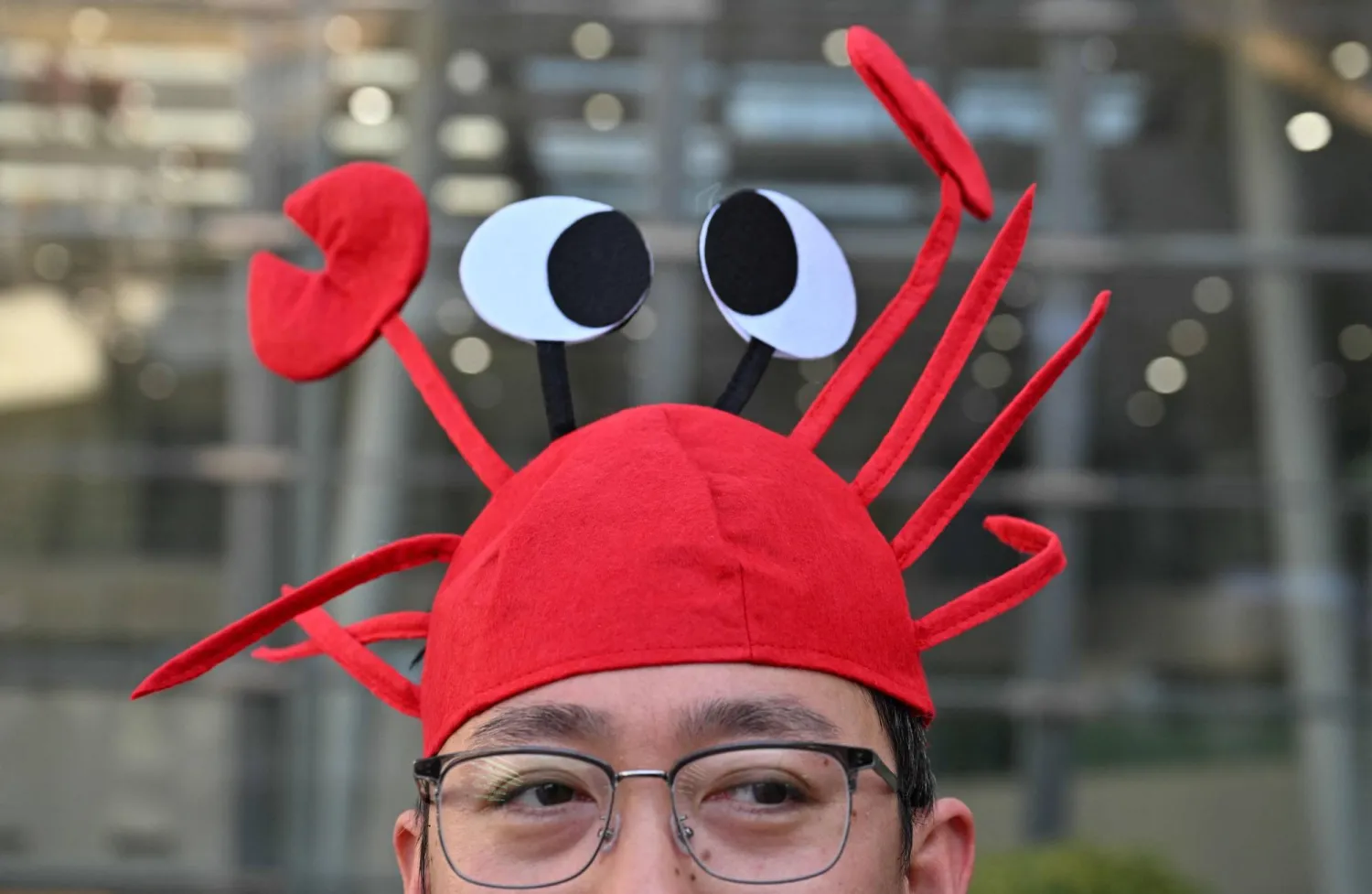
A man wears a lobster hat that represents the OpenClaw logo, an open-source AI assistant at the Baidu headquarters in Beijing on March 11, 2026. (Photo by ADEK BERRY / AFP)
TT

AI Agent 'Lobster Fever' Grips China Despite Risks

A man wears a lobster hat that represents the OpenClaw logo, an open-source AI assistant at the Baidu headquarters in Beijing on March 11, 2026. (Photo by ADEK BERRY / AFP)

Chinese entrepreneur Frank Gao used to spend long hours running his social media accounts but now outsources the chore to AI agent tool OpenClaw, which is taking the country by storm despite official warnings over cybersecurity.

OpenClaw, created in November by an Austrian coder, differs from bots like ChatGPT because it can execute real-life tasks such as sending emails, organizing files or even booking flight tickets.

"Since January, I've spent hours on the lobster every day," Gao told AFP, referring to OpenClaw's red crustacean mascot. "We're family."

After downloading OpenClaw, users connect it to existing artificial intelligence models of their choice, then give it simple instructions through instant messaging apps, as if to a friend or colleague.

The tool has fascinated tech circles worldwide but particularly in China, gripping tech-savvy companies and individuals keen to keep up with the next big thing in AI.

Hundreds of people queued at tech giant Baidu's Beijing headquarters this week for an OpenClaw event where engineers helped attendees set up their "little lobsters".

It was one of many similar meetups to experiment with the tool, which are drawing crowds from Shanghai to Shenzhen.

Some municipalities, including the eastern cities of Wuxi and Hangzhou, have pledged hundreds of thousands of dollars to support the adoption and development of OpenClaw and other AI agents.

But the lobster fever, as it has been dubbed, has also sparked security concerns.

"What's truly scary about agents like OpenClaw is this: once they have your digital keys, they can theoretically access all the services you've authorized, and can autonomously decide when to activate them," Gao warned.

"The attacker effectively gains a 'master key' to your digital identity," said the engineer, who has named his OpenClaw agent "Q" after his business name QLab.

- 'Use with caution' -

Chinese national cybersecurity authorities and Beijing's ministry of industry and IT have warned of the risks of OpenClaw hacks.

"Use intelligent agents such as 'lobster' with caution," national IT research institute expert Wei Liang advised government agencies, public institutions, companies and individuals in a message on state media.

The mixed signals of rolling out policy incentives while issuing warnings "reflects the authorities' cautious tolerance towards 'lobster fever'," Zhang Yi, founder of tech consultancy iiMedia, told AFP.

Austrian programmer Peter Steinberger, who built OpenClaw to help organize his digital life, was hired last month by ChatGPT maker OpenAI.

Meanwhile, a separate team of coders that made Moltbook, a Reddit-like pseudo social network where OpenClaw agents converse, are joining Meta.

Top Chinese tech companies have also been quick to get involved.

The likes of Tencent, Alibaba, ByteDance and Baidu are offering simplified installation and affordable coding plans to help users who want to host OpenClaw agents on their cloud servers -- seen as safer than downloading it onto a personal computer.

In recent days AI companies big and small have also launched their own competing agent tools, such as ByteDance's ArkClaw, Tencent's WorkBuddy and Zhipu AI's AutoClaw.

The relatively low cost for cloud deployment of OpenClaw in China, subsidised by big tech firms, is one factor behind its popularity, said Gao Rui, a senior product manager at Baidu AI Cloud.

"For most people, it's likely just the price of a cup of coffee... which is why people will probably be keen to give it a try," she told AFP.

- FOMO -

Fear of missing out is also a big driver behind OpenClaw's success in China, said Chen Yunfei, an AI developer who created a popular online guide for using the tool.

"Most Chinese people are quite studious and forward-looking, so when confronted with new things, they might have stronger feelings" of so-called FOMO, he said.

Xie Manrui, a programmer whose latest project is a visualized system for managing OpenClaw agents, said the tool had arrived "at the right moment" to change perceptions in China of what AI can do.

"For many, AI is merely a clever chatbot that talks all the time but cannot act," he said.

Either way, it has piqued the curiosity of many young users.

At the Baidu event in Beijing, 24-year-old college student Zheng Huimin was waiting patiently in line with her friends.

"I'd like to give it a go to see what tasks it can actually help me accomplish," she told AFP.


Billionaire Elon Musk Enters Courtroom Showdown with OpenAI

Elon Musk arrives at the 10th Breakthrough Prize Ceremony on April 13, 2024, at the Academy Museum of Motion Pictures in Los Angeles. (AP)
TT

Billionaire Elon Musk Enters Courtroom Showdown with OpenAI

Elon Musk arrives at the 10th Breakthrough Prize Ceremony on April 13, 2024, at the Academy Museum of Motion Pictures in Los Angeles. (AP)

Jury selection is to begin Monday in a high-profile legal battle between billionaire Elon Musk and artificial intelligence startup OpenAI, which he accuses of betraying its non-profit mission.

The clash in a courtroom across the bay from San Francisco pits the world's richest man against a startup that Musk once backed and now competes against in the booming AI sector.

OpenAI's ChatGPT is a formidable rival to the Grok chatbot made by Musk's xAI lab.

While the lawsuit filed by Musk is part of a feud between him and OpenAI chief executive Sam Altman, it spotlights a debate whether AI should ultimately benefit the privileged few or society as a whole.

Court filings lay out how Altman tried to convince Musk to back OpenAI in 2015, acting as a co-founder for a non-profit lab whose technology "would belong to the world."

Musk pumped some $38 million into the lab before he left.

OpenAI is now valued at $852 billion, with Microsoft among its backers, and is preparing to go public on the stock market.

The judge presiding over the trial is aiming for a jury to decide by late May whether OpenAI broke a promise to Musk in its drive to be a leader in AI or just smartly rode the technology to glory.

- Musk duped? -

Musk argues in his lawsuit that he was deceived about OpenAI's mission being altruistic.

The tycoon cites an email from Altman in 2017 claiming that he remained "enthusiastic about the non-profit structure" of their AI venture after Musk threatened to cut off funding for the lab.

Just a few months later, however, OpenAI established a commercial subsidiary in the face of needing to invest hundreds of billions of dollars in data centers to power its technology.

Over the course of the following two years, Microsoft pumped billions of dollars into OpenAI and the tech stalwart's stake in the startup is now valued about $135 billion.

Microsoft chief executive Satya Nadella is among those slated to testify at the trial.

- Aimed at Altman -

Along with calling for OpenAI to be forced to revert to a pure nonprofit, Musk's suit urges the ousting of Altman and OpenAI co-founder and president Greg Brockman.

Musk is also seeking as much as $134 billion in damages and to have the court make OpenAI sever ties with Microsoft.

During pre-trial hearings, US Judge Yvonne Gonzalez Rogers mused that Musk team seemed to be "pulling numbers out of the air" when it came to calculating damages.

If the jury sides with Musk, it will be left to Rogers to determine any remedies or payment.

In what OpenAI has dismissed as a public relations stunt, Musk has vowed that any damages awarded in the suit will go to the startup's nonprofit foundation.

- Quest for control? -

OpenAI internal communications brought to light by the lawsuit reveal tensions that culminated with the temporary ouster of Altman as AI chief executive in late 2023.

Musk's legal team highlighted a 2017 entry in Brockman's personal journal reasoning that it would be lying if Altman publicly asserted OpenAI would stay a nonprofit but became a corporation a short time later.

OpenAI now has a hybrid governance structure giving its nonprofit foundation control over a for-profit arm.

In court filings, OpenAI countered that its break-up with Musk was due to his quest for absolute control rather than its nonprofit status.

"This case has always been about Elon generating more power and more money for what he wants," OpenAI said in a post on X, a platform Musk owns.

"His lawsuit remains nothing more than a harassment campaign that's driven by ego, jealousy and a desire to slow down a competitor."

The startup noted that days after Musk entered the AI race in 2023 he called for a 6-month moratorium on development of advanced AI.


SDAIA Showcases Saudi Arabia’s AI Governance Model at UN Session in Geneva

The Saudi Authority for Data and Artificial Intelligence (SDAIA)
TT

SDAIA Showcases Saudi Arabia’s AI Governance Model at UN Session in Geneva

The Saudi Authority for Data and Artificial Intelligence (SDAIA)

The Saudi Data and Artificial Intelligence Authority (SDAIA) participated in the 29th session of the United Nations Commission on Science and Technology for Development, held in Geneva from April 20 to 24. Under the theme "Science, Technology, and Innovation in the Age of AI," the session gathered global representatives from governments, international organizations, and the private sector.

During the summit, SDAIA presented the Saudi model for regulating and developing the AI sector, highlighting the Kingdom's leadership in data governance and the creation of reliable AI systems. SDAIA emphasized Saudi Arabia's active role in shaping international governance frameworks and its commitment to utilizing AI to achieve the UN Sustainable Development Goals (SDGs) 2030.

Coinciding with the Year of AI 2026, this participation reinforces the Kingdom’s position as a global hub for emerging technologies.

By sharing national expertise and expanding international cooperation, SDAIA continues to support the adoption of responsible AI practices, aligning with Saudi Vision 2030 to build an integrated national system driven by data and innovation.


China's DeepSeek Releases Long-awaited New AI Model

A man takes photos of a DeepSeek display at a shopping mall in Hangzhou, in China's eastern Zhejiang province on April 23, 2026. (Photo by CN-STR / AFP)
TT

China's DeepSeek Releases Long-awaited New AI Model

A man takes photos of a DeepSeek display at a shopping mall in Hangzhou, in China's eastern Zhejiang province on April 23, 2026. (Photo by CN-STR / AFP)

Chinese startup DeepSeek released a new artificial intelligence model with "drastically reduced" costs Friday, more than a year after it stunned the world with a low-cost reasoning model that matched the capabilities of US rivals.

The AI race has intensified the rivalry between China and the United States, with the White House on Thursday accusing Chinese entities of a massive effort to steal artificial intelligence technology. Beijing called the claim "baseless".

Hangzhou-based DeepSeek burst onto the scene in January last year with a generative AI chatbot, powered by its R1 reasoning model, that upended assumptions of US dominance in the strategic sector.

DeepSeek-V4 "features an ultra-long context", the company said in a statement on social media platform WeChat, hailing it as "world-leading... with drastically reduced compute (and) memory costs" in a separate announcement on X.

V4 supports a context length of one million "tokens" -- small components of text including words or punctuation -- putting it on par with Google's Gemini.

Context length determines how much input a model is able to absorb to help it complete tasks.

The new V4 is released as two versions, DeepSeek-V4-Pro and DeepSeek-V4-Flash, with the latter being "a more efficient and economical choice" because it has smaller parameters.

In terms of "world knowledge", a benchmark for reasoning, V4-Pro trails only the latest Gemini model, DeepSeek said.

A "preview version" of the open source model is now available, the company said, without indicating when a final version would be released.

Experts say V4's arrival marks an "inflection point" in terms of hardware and cost.

"This addresses the long-standing issues of slower performance and higher costs associated with long context lengths, marking a genuine inflection point for the industry," Zhang Yi, the founder of tech research firm iiMedia, told AFP.

"For end users, this will bring widespread, accessible benefits. For instance, if ultra-long context support becomes a standard feature, long-text processing is expected to move beyond high-end research labs and enter mainstream commercial applications," he said.

V4-Pro has 1.6 trillion parameters while the V4-Flash has 284 billion parameters, which refine models' decision-making ability.

The model has also been "optimized" for popular AI Agent products such as Claude Code, OpenClaw, OpenCode and CodeBuddy, the DeepSeek statement said.

It can also run on chips manufactured by Chinese tech giant Huawei, the company added.

Huawei -- sanctioned by the US since 2019 over national security -- said in a statement Friday that the full range of its Ascend SuperPoD products are supporting DeepSeek's V4 series.

DeepSeek's latest release is a "milestone" for Chinese firms, said veteran AI industry analyst Max Liu.

"It's a good thing for the entire domestic AI industry. It can provide better models for domestic users and we can now expect a lot more things -- more products (and a) more competitive market," he told AFP.

"This is no less shocking than when DeepSeek first came out" if its new model indeed matches the performance of leading models from Western labs, he added.

Last year's so-called "DeepSeek shock" sparked a sell-off of AI-related shares and a reckoning on business strategy in what was also described as a "Sputnik moment" for the industry.

The chatbot performed at a similar level to ChatGPT and other top American offerings, but the company said it had taken significantly less computing power to develop.

However, its sudden popularity raised questions over data privacy and censorship, with the chatbot often refusing to answer questions on sensitive topics such as the 1989 Tiananmen crackdown.

DeepSeek's AI tools have been widely adopted by Chinese municipalities and healthcare institutions as well as the financial sector and other businesses.

This has been partly driven by DeepSeek's decision to make its systems open source, with their inner workings public -- in contrast to the proprietary models sold by OpenAI and other Western rivals.

But the White House has accused Chinese firms of vying to "steal" American technology, ahead of an expected summit between Donald Trump and Xi Jinping in Beijing next month.

"The US has evidence that foreign entities, primarily in China, are running industrial-scale distillation campaigns to steal American AI," Trump's science and technology chief advisor Michael Kratsios said in a post on X.

Distillation is a common practice within AI development, often used by companies to create cheaper, smaller versions of their own models.

"The US claims are entirely baseless," Chinese foreign ministry spokesman Guo Jiakun told a news conference in Beijing. "They are a slanderous smear against the achievements of China's artificial intelligence industry."
