


Israelis Demand Netanyahu Clarify War’s Exit Strategy

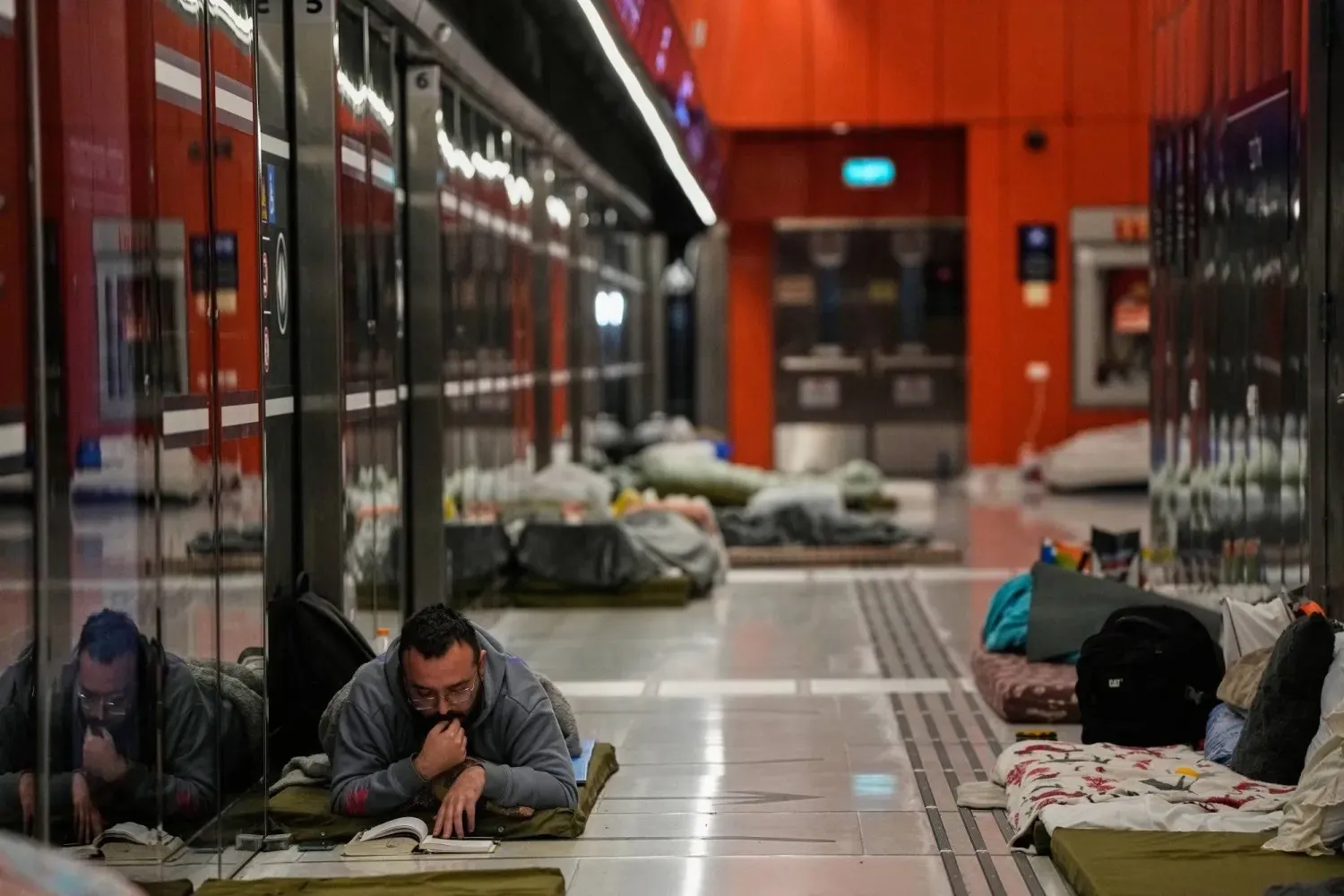
Israelis take shelter in a subway station as sirens warn of incoming Iranian missiles over Tel Aviv on March 7 (AP)
TT

Israelis Demand Netanyahu Clarify War’s Exit Strategy

Israelis take shelter in a subway station as sirens warn of incoming Iranian missiles over Tel Aviv on March 7 (AP)

Growing public unease in Israel over the war with Iran has prompted mounting calls for Prime Minister Benjamin Netanyahu to clarify the conflict’s objectives and trajectory.

The demands follow conflicting statements about when the war might end, coupled with Netanyahu’s continued refusal to answer questions from the press. Instead, the prime minister has released daily video statements as the conflict entered its 13th day. Government ministers have also reportedly been instructed not to speak with journalists.

Media outlets sharply criticized the government on Thursday, arguing that the public is being left in the dark about the war’s goals or its possible duration.

Some commentators say both Netanyahu and US President Donald Trump entered the conflict without a clear exit strategy. Trump has suggested that the war’s objectives have largely been achieved, while Netanyahu has said the fighting will continue “as long as necessary,” without specifying a timeline.

Tensions ran high overnight Wednesday after rumors spread of a major coordinated missile attack by Iran and Hezbollah. Israeli journalists who investigated the reports found that the information appeared credible. However, attempts to publish the story were blocked by Israel’s military censor.

Reporters initially assumed the censorship was intended to protect intelligence sources. But within an hour, the same information appeared on the American network CNN, citing security sources in Tel Aviv, prompting anger among Israeli journalists.

As rumors circulated, fear among residents quickly escalated into panic, with some people rushing to shelters even though no air-raid sirens had sounded.

The incident triggered sharp criticism of the military censor in Israeli media. Journalists and analysts accused authorities of withholding critical information from the public.

Nitzan Shapira, a correspondent for Channel 12 whose report was blocked, said the decision deprived citizens of the opportunity to prepare calmly for incoming missiles.

“Instead of Israeli citizens receiving timely information that would allow them to move to shelters in an orderly way, the censor intervened and withheld the information until people heard it from foreign sources,” he said. “This is an absurd situation.”

A military commentator on the right-leaning Channel 14 went further, accusing the army of weakness. He argued that intelligence warnings about a potential wave of Hezbollah rocket fire should have prompted stronger military action, including strikes on Hezbollah strongholds in southern Beirut.

Meanwhile, Israeli social media circulated statements attributed to Iran’s Revolutionary Guard Corps claiming Tehran could launch large-scale attacks using Kheibar, Qader, and Khorramshahr missiles capable of striking wide-ranging areas for hours.

Israeli military officials said they had no evidence that simultaneous activity from Iran and Lebanon was part of a coordinated campaign. Still, the possibility of attacks on two fronts heightened public concern.

Local leaders in Israel’s northern Galilee region, returning from a meeting with Home Front Command, urged residents to remain close to shelters and maintain heightened readiness.

There has also been growing unease along Israel’s northern border. Since Hezbollah joined the conflict, it has carried out repeated rocket attacks. Although fewer in number than earlier barrages before the last ceasefire, some reportedly included precision missiles with ranges of up to 165 kilometers.

Yet, Israeli army spokesman Effie Defrin sought to calm the public, saying the military was aware of concerns about a possible escalation.

“There is no change in the protective guidelines issued by the Home Front Command,” Defrin said, urging Israelis to follow civil defense instructions.

In Israeli media, Defrin has become the main official voice addressing the public, while many journalists say they remain constrained by censorship.

Some now openly question whether such restrictions are appropriate for what they describe as a Western democracy in 2026.



Russian Missile Kills Three on Bus in East Ukraine

This photograph shows residential buildings heavily damaged by a Russian air strike at the beginning of the full-scale invasion, where more than 50 people were killed, in the center of the city of Izium, Kharkiv region on March 10, 2026, amid the Russian invasion of Ukraine. (AFP)
TT

Russian Missile Kills Three on Bus in East Ukraine

This photograph shows residential buildings heavily damaged by a Russian air strike at the beginning of the full-scale invasion, where more than 50 people were killed, in the center of the city of Izium, Kharkiv region on March 10, 2026, amid the Russian invasion of Ukraine. (AFP)

A Russian strike in eastern Ukraine on Friday killed three people on a bus near the embattled town of Kupiansk, which Moscow's army is battling to recapture, investigators said.

The wider Kharkiv region, which borders Russia, was partly occupied when Russian forces invaded in February 2022, but was largely liberated by Ukraine months later.

"Three people were killed as a result of the strike: the bus driver and two passengers," local investigators announced.

The bus was near the village of Nova Oleksandrivka when it was hit by an Iskandr missile, they added. Investigators posted images of a red bus with its windows blown out.

There was no immediate comment from the Kremlin, which claims its forces do not target civilians.

Peace talks spearheaded by the United States aiming to halt more than four years of fighting have been derailed by the US-Israeli war with Iran.

Russia's invasion sparked the bloodiest war in Europe since World War II, forcing the displacement of millions and leaving hundreds of thousands of soldiers and civilians dead on both sides.


Türkiye Says Third Ballistic Missile from Iran Shot Down

 This handout photograph taken and released on March 9, 2026, by Turkish news agency DHA (Demiroren News Agency) shows part of a second Iranian ballistic missile destroyed by NATO in Turkish airspace. (Photo by Handout / DHA (Demiroren News Agency) / AFP)
This handout photograph taken and released on March 9, 2026, by Turkish news agency DHA (Demiroren News Agency) shows part of a second Iranian ballistic missile destroyed by NATO in Turkish airspace. (Photo by Handout / DHA (Demiroren News Agency) / AFP)
TT

Türkiye Says Third Ballistic Missile from Iran Shot Down

 This handout photograph taken and released on March 9, 2026, by Turkish news agency DHA (Demiroren News Agency) shows part of a second Iranian ballistic missile destroyed by NATO in Turkish airspace. (Photo by Handout / DHA (Demiroren News Agency) / AFP)
This handout photograph taken and released on March 9, 2026, by Turkish news agency DHA (Demiroren News Agency) shows part of a second Iranian ballistic missile destroyed by NATO in Turkish airspace. (Photo by Handout / DHA (Demiroren News Agency) / AFP)

Türkiye’s defense ministry on Friday said a ballistic missile from Iran had been shot down in Turkish airspace by NATO forces in the third such incident of the Middle East war. 

"A ballistic munition launched from Iran and entering Turkish airspace was neutralized by NATO air and missile defense assets deployed in the eastern Mediterranean," a ministry statement said. 

Hours earlier, sirens wailed at Türkiye’s southern Incirlik airbase, a key NATO facility where US troops are stationed, state news agency Anadolu reported. 

Local media also reported sirens in Batman, 600 kilometers (370 miles) further east. 

NATO air defenses shot down a first ballistic missile fired from Iran on March 4, with a second intercepted on Monday. 

Residents of the southern city of Adana, next to Incirlik, were woken by sirens at 3:25 am (0025 GMT) and several posted footage of a fast-moving object that appeared to be on fire, the Ekonomim business news website reported. 

Separately, sirens sounded in Batman around 4:00 am, with reporters saying the alarm appeared to be coming from a military drone base next to the city's airport. 

Monday's incident prompted Washington to close its consulate in Adana and urge all US citizens to leave southeastern Türkiye. 

Iranian President Masoud Pezeshkian denied the missile had been fired from Iran in a phone call to Türkiye’s Recep Tayyip Erdogan. 

Since the US-Israeli war on Iran started on February 28, Tehran has retaliated with strikes across the Middle East. 

Incirlik is an important NATO facility used by US troops for decades, but which also hosts military personnel from Spain and Poland, its website says. 

US troops are also stationed at Kurecik, a base in the central Malatya province, where they man an early-warning radar system NATO describes as a "key element" of its missile shield that can detect Iranian missile launches. 

Although Ankara has categorically denied radar data has ever been used to help Israel, its presence has rattled Tehran. 

On Tuesday, Türkiye said a Patriot missile defense system was being deployed in Malatya just days after NATO moved to strengthen its "alliance-wide ballistic missile defense posture". 


Russia Says It Doesn't See Iran Crisis Reducing US Interest in Ukraine Peace Talks

FILE PHOTO: Kremlin spokesman Dmitry Peskov attends a meeting of Russian President Vladimir Putin with Palestinian President Mahmoud Abbas at the Kremlin in Moscow, Russia, January 22, 2026. REUTERS/Ramil Sitdikov/Pool/File Photo
TT

Russia Says It Doesn't See Iran Crisis Reducing US Interest in Ukraine Peace Talks

FILE PHOTO: Kremlin spokesman Dmitry Peskov attends a meeting of Russian President Vladimir Putin with Palestinian President Mahmoud Abbas at the Kremlin in Moscow, Russia, January 22, 2026. REUTERS/Ramil Sitdikov/Pool/File Photo

Russia is not concerned at this point that the Iran crisis will reduce US interest in mediating ‌peace talks ‌on Ukraine, ‌Kremlin ⁠spokesman Dmitry Peskov said ⁠on Friday.

"No, there are no such concerns at ⁠this time; our ‌contacts with ‌our American ‌counterparts provide ‌no grounds for such doubts," Peskov told reporters in ‌response to a question.

Russia is ⁠expecting ⁠a new round of negotiations, but has nothing to announce yet on the timing, he said.