


Why France is Bolstering Military Presence in the Middle East, as Macron Prepares for Postwar Talks

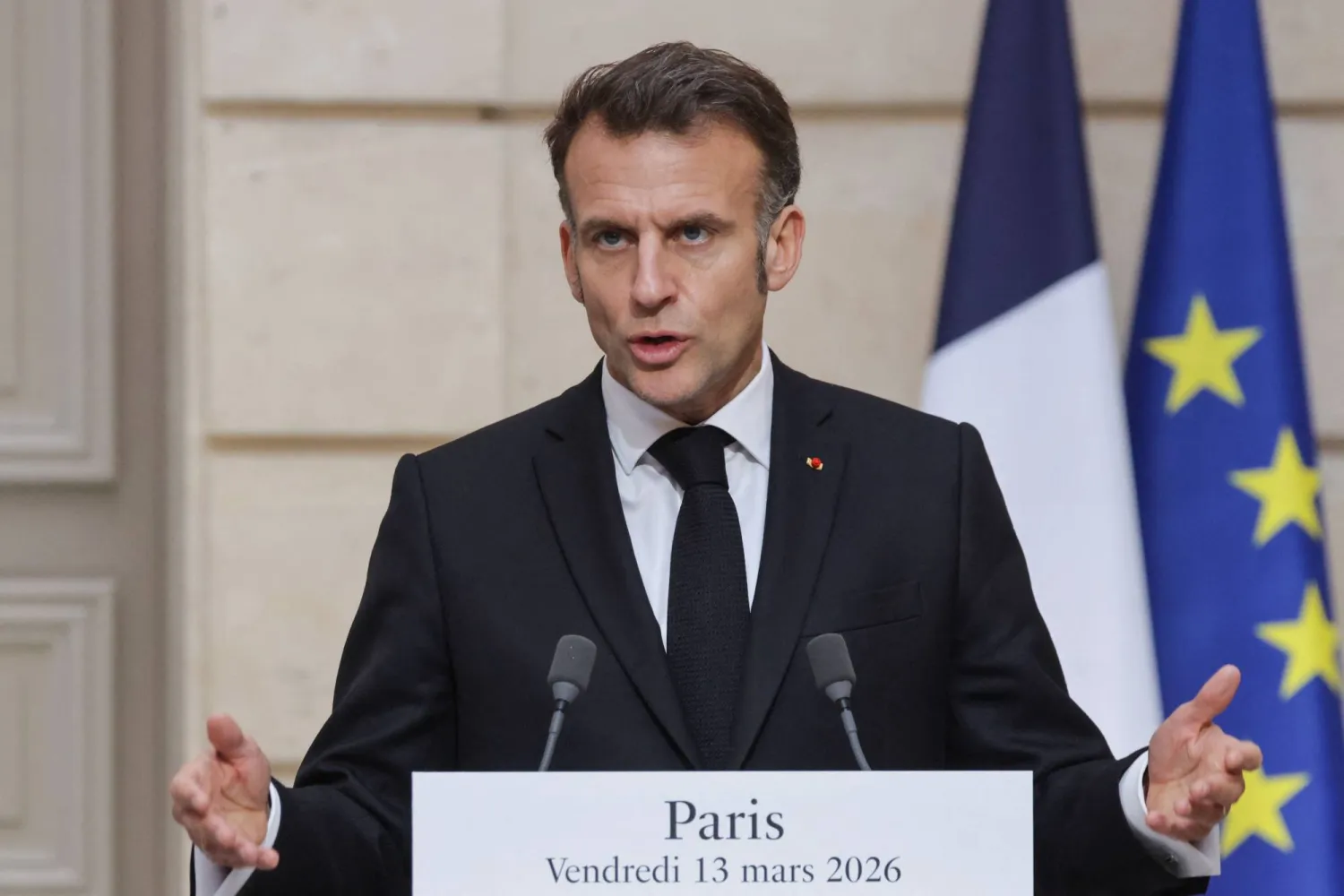
France's President Emmanuel Macron delivers a speech during a joint press conference with Ukraine's President Volodymyr Zelensky (unseen) following talks focused on the support from France and European partners to help Ukraine defend itself, and on ways to increase pressure on Russia, at the Elysee Presidential Palace in Paris on March 13, 2026. (Photo by Ludovic MARIN / POOL / AFP)
TT

Why France is Bolstering Military Presence in the Middle East, as Macron Prepares for Postwar Talks

France's President Emmanuel Macron delivers a speech during a joint press conference with Ukraine's President Volodymyr Zelensky (unseen) following talks focused on the support from France and European partners to help Ukraine defend itself, and on ways to increase pressure on Russia, at the Elysee Presidential Palace in Paris on March 13, 2026. (Photo by Ludovic MARIN / POOL / AFP)

France's government is bolstering the country's military presence in the Middle East, dispatching its aircraft carrier and other warships, while President Emmanuel Macron engages with key players in the conflict, including Iran, in a bid to position Paris for future diplomatic talks.

Macron said that France’s military involvement is strictly “defensive” and aims to avoid making the country a party to the war, The Associated Press said.

He reaffirmed that position after one French soldier was killed Thursday in a drone attack in Iraq.

“We are not at war with anyone,” Macron said.

Still, the large-scale deployment of the French navy — which he described as “unprecedented” — has made France the European nation with the most prominent presence in the region.

Visiting the Charles de Gaulle aircraft carrier last week, Macron said that its presence in the Mediterranean demonstrates “France’s strength: a balancing power, a force for peace.”

Here’s what to know about Macron' strategy.

France’s large naval deployment Macron announced the deployment to the eastern Mediterranean and the wider Middle East of eight warships, two helicopter carriers and the nuclear-powered aircraft carrier Charles de Gaulle with its 20 Rafale fighter jets.

The French frigate Languedoc arrived off Cyprus, a fellow European Union member, to bolster anti-drone and anti-missile defenses. Cyprus and France signed a new strategic partnership in December. Macron also said that two French frigates have been dispatched to the Red Sea to help ensure maritime security and freedom of navigation.

Macron said that the warship deployment is intended to allow France “to respond to emergency situations” and evacuate French nationals if necessary.

France has more than 400,000 citizens in the Middle East — more than any other European country — including more than half in Israel and over 60,000 in the United Arab Emirates.

Other European nations, including Spain, Italy, the Netherlands and Greece, have deployed frigates in the region.

The French navy’s swift deployment contrasts with the United Kingdom's delay in sending the HMS Dragon destroyer, which left Portsmouth, England, on March 10.

UK opposition parties have accused Prime Minister Keir Starmer's government of moving too slowly to protect British bases in Cyprus and allies in the Middle East. The UK government also has sent Typhoon and F-35 fighter jets, helicopters and air defense systems to the region to help intercept Iranian missiles and drones.

Defending Gulf allies France has key defense agreements with several countries in the region, including Qatar, Kuwait and the UAE, where it maintains a permanent base in Abu Dhabi. France's military, which has air and naval forces there, doubled the number of Rafale fighter jets stationed on site to 12.

French authorities acknowledged that Rafale jets intercepted drones targeting the UAE since the beginning of the war.

“We stand by the side of our allies and our friends,” Macron said during his visit to the Charles de Gaulle. “There have been some interceptions that have continued in recent days.”

“We do so within the framework of our partnerships,” he said, without providing further details.

French forces are also deployed in Jordan and Iraq.

On Thursday, one French soldier was killed and several others injured in a drone attack in the region of Irbil, in northern Iraq. They were training Iraqi units as part of a multinational counterterrorism mission in the country.

Former President François Hollande, who led France from 2012 to 2017, said that it was important for France to show it can protect its nationals and reassure its partners, but warned of the risks.

“We must be careful — it’s always a risky operation — to make sure our warships are not targeted,” Hollande said. “Because if they are attacked, we have to fire back.”

Historic ties with Lebanon Macron is leading a diplomatic effort to try to halt the conflict in Lebanon, where at least 850 people have been killed and hundreds of thousands displaced as the Hezbollah militant group entered a new round of fighting with Israel. Macron urged Hezbollah to stop fighting and called on Israel to renounce any ground offensive.

France supports the Lebanese military as authorities have pledged to “take control” of positions held by Hezbollah and assume full responsibility for security in the country, Macron said. Hezbollah’s arsenal notably includes exploding drones, similar to the ones used by Iran.

France has traditionally been a key supporter of Lebanon, a former French protectorate, and maintains 800 troops in the UN peacekeeping force there. The French government provided the country with armored vehicles and operational military support.

France sent 60 tons of emergency aid to Lebanon last week on a humanitarian flight to Beirut, authorities said. The shipment included medicines, medical equipment, a mobile health unit, shelter materials, basic necessities and infant formula.

Maintaining contact with Iran Macron was the first Western leader to speak with Iranian President Masoud Pezeshkian since the war began.

He said he urged Iran to halt strikes against countries in the region. Since the phone call on March 8, this appeal had gone unanswered.

Macron stressed that “a diplomatic solution” is needed to end the escalation and said that he and Pezeshkian agreed to remain in contact.

Macron also spoke with Israeli Prime Minister Benjamin Netanyahu and US President Donald Trump, though there were no signs of de-escalation.

France hopes diplomatic efforts could bear fruit once the most intense phase of the conflict subsides, which could take weeks or months.

Macron is also promoting an international effort to secure the Strait of Hormuz, a key energy corridor, so oil, gas and goods can flow freely again “when circumstances permit.” He has suggested countries could use warships to escort tankers and container ships once fighting eases.

Political analyst Bertrand Badie, an international relations professor at Sciences Po Paris, said Macron has long sought to assert France’s role on the global stage.

With low approval ratings at home and about a year left in his term, Macron may have the most to gain among European leaders by pursuing diplomacy, Badie said.

“At this point, we are forced to scale back our expectations — drastically,” he said. “From a diplomatic standpoint, what leverage does France really have?”

“My assessment is that this crisis cannot be resolved by French remedies,” Badie said. “There is no point in having any illusions.”



Appeal Trial Opens for France’s Sarkozy Over Alleged Libyan Funding

FILED - 17 June 2011, Berlin: Then French President Nicolas Sarkozy speaks at a press conference in the Chancellery in Berlin. Photo: Michael Kappeler/dpa
TT

Appeal Trial Opens for France’s Sarkozy Over Alleged Libyan Funding

FILED - 17 June 2011, Berlin: Then French President Nicolas Sarkozy speaks at a press conference in the Chancellery in Berlin. Photo: Michael Kappeler/dpa

Former French president Nicolas Sarkozy was back in court Monday for a retrial on charges he sought Libyan financing for his 2007 election, in a case that last year saw him become France's first modern-day head of state to go to prison.

A lower court in September found the right-wing politician -- who was president from 2007 to 2012 -- guilty of seeking to acquire funding from Muammar Gaddafi's Libya for the campaign that saw him elected.

Sarkozy -- who has denied any wrongdoing -- in October entered a Paris prison, serving 20 days before he was released pending the appeal, AFP reported.

The 71-year-old entered the Paris Appeal Court ahead of Monday's hearing, shaking hands with police and lawyers before taking his seat in the front row of the dock.

In the retrial, set to run until June 3, the former head of state is once again presumed innocent.

Sarkozy has faced a series of legal issues since leaving office and has already received two definitive convictions in other cases.

In one, he wore an electronic ankle tag for several months, until it was removed in May last year, after being convicted for trying to extract favours from a judge.

And in the other, he will have to serve more time over illegal financing of his failed 2012 re-election bid.

In the so-called "Libyan case", he has appealed a five-year prison sentence.

A lower court in September convicted Sarkozy of criminal conspiracy over what it said was a scheme to acquire Libyan funding for his 2007 presidential run.

But it did not conclude that Sarkozy received or used the funds for the campaign.

His legal team immediately appealed, but the lower court ordered him to be sent behind bars, citing the "exceptional gravity" of the conviction.

On October 21, he became the first former head of a European Union state to be incarcerated.

- Prison diaries -

In the initial trial, prosecutors had argued Sarkozy's aides, acting in his name, struck a deal with Gaddafi in 2005 to illegally fund his victorious presidential election bid two years later.

Investigators believe that in return, Gaddafi was promised help to restore his international image after Tripoli was blamed for the 1988 bombing of a passenger jet over Lockerbie, Scotland, and another over Niger in 1989, killing hundreds of passengers.

Members of Sarkozy's circle did not wish to comment before the retrial.

Sarkozy published a hastily written book about his time in prison titled "Diary of a Prisoner", with supporters lining up around a city block in Paris to buy a copy when it came out in December.

In the 216-page book, he recounts his mundane struggles with noise and low-quality food.

But he also hints at a possible alliance between the traditional right-wing Republicans party he once headed and the country's main far-right party to "rebuild the right".

He and his wife, singer and model Carla Bruni, face another possible trial over allegations that they tried to bribe a key prosecution witness in the Libya campaign financing case with the help of a paparazzi boss. They deny wrongdoing.


Spain Rules Out Participating in Military Operations in Strait of Hormuz

FILE PHOTO: An LPG gas tanker at anchor as traffic is down in the Strait of Hormuz, amid the US-Israeli conflict with Iran, in Shinas, Oman, March 11, 2026. REUTERS/Benoit Tessier/File Photo
TT

Spain Rules Out Participating in Military Operations in Strait of Hormuz

FILE PHOTO: An LPG gas tanker at anchor as traffic is down in the Strait of Hormuz, amid the US-Israeli conflict with Iran, in Shinas, Oman, March 11, 2026. REUTERS/Benoit Tessier/File Photo

Spain will not take part in any military mission in the Strait of Hormuz because it considers the US-Israeli war on Iran to be illegal, Madrid's defense and foreign affairs ministers said on Monday. The leftist coalition government led by Prime Minister Pedro Sanchez has criticized the offensive and banned participating US aircraft from using jointly operated bases in southern Spain.

Defense Minister Margarita Robles rejected a demand by US President Donald Trump for military support to secure the waterway - which Tehran has de facto blocked to oil tanker traffic - and his threats of a "very bad future" for NATO allies failing to do so.

"Spain will never accept any stopgap measures, because the objective must be for the war to end, and for it to end now," Robles said.

The situation in the strait is a matter of grave concern for Europeans, but the European Union's position should be that the war must end regardless of economic considerations, Foreign Minister Jose Manuel Albares said, Reuters reported.

"We mustn't do anything that would add even more tension or cause the situation to escalate further," he told reporters in Brussels.

Some EU members such as Germany, Italy or Greece have also signalled they will not join military operations in the strait, while others including Denmark have yet to make a decision.


UK PM Starmer Says Work to Reopen Strait of Hormuz Will Not Be NATO-led

13 March 2026, Ireland, Cork: UK Prime Minister Keir Starmer meets student researchers at the Tyndall National Institute in Cork. Photo: Cathal Mcnaughton/PA Wire/dpa
TT

UK PM Starmer Says Work to Reopen Strait of Hormuz Will Not Be NATO-led

13 March 2026, Ireland, Cork: UK Prime Minister Keir Starmer meets student researchers at the Tyndall National Institute in Cork. Photo: Cathal Mcnaughton/PA Wire/dpa

British Prime Minister Keir Starmer said on Monday that ongoing work to reopen the Strait of Hormuz would not be a NATO mission but would involve a broad alliance ‌including Gulf ‌partners as well ‌as ⁠European countries and the ⁠United States.

"We are working with others to come up with a credible plan for the Straits ⁠of Hormuz to ‌ensure ‌that we can reopen shipping and ‌passage through the ‌Strait. Let me be clear, that won't be and it's never been envisioned ‌to be a NATO mission," Starmer told reporters.

"That ⁠will ⁠have to be an alliance of partners, which is why we're working with partners, both in Europe, in the Gulf, and with the US."