


Hamas Holds Consultations in Cairo to Revive Gaza Agreement

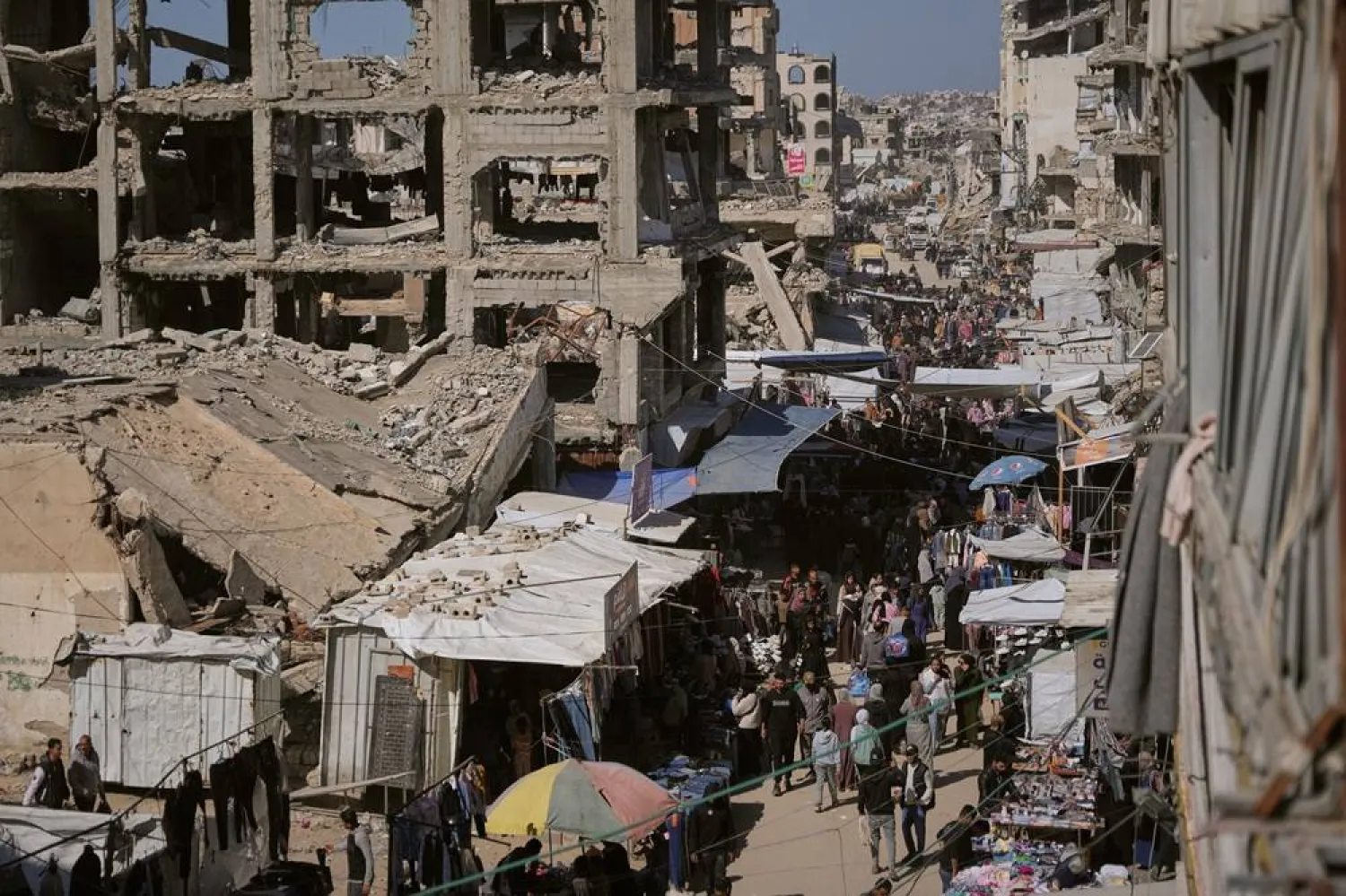
 Palestinians shop at a market in preparation for Eid al-Fitr in Khan Younis, southern Gaza Strip, Tuesday. March 17, 2026. (AP)
Palestinians shop at a market in preparation for Eid al-Fitr in Khan Younis, southern Gaza Strip, Tuesday. March 17, 2026. (AP)
TT

Hamas Holds Consultations in Cairo to Revive Gaza Agreement

 Palestinians shop at a market in preparation for Eid al-Fitr in Khan Younis, southern Gaza Strip, Tuesday. March 17, 2026. (AP)
Palestinians shop at a market in preparation for Eid al-Fitr in Khan Younis, southern Gaza Strip, Tuesday. March 17, 2026. (AP)

Hamas Holds Consultations in Cairo to Revive Gaza Agreement

With Israel preoccupied with the war on Iran, Hamas has kicked off consultations in Cairo to overcome obstacles in implementing the second phase of the Gaza ceasefire agreement.

The second phase was supposed to start in mid-January, but has since stalled for various reasons, including the war on Iran.

Experts told Asharq Al-Awsat that Hamas officials are seeking new ways forward that would set the agreement on the right path, put a stop to Israeli violations and reach solutions to daily crises caused by the Israeli siege on the enclave.

Hamas officials held a series of meetings with Egyptian intelligence members and United Nations envoy Nikolay Mladenov that tackled political and field developments in Gaza, reported Egyptian and Qatari media. Egypt and Qatar have played the role of mediator in reached the ceasefire.

Two sources close to Hamas told Asharq Al-Awsat that the movement’s delegation was led by Nizar Awadallah and includes leading Hamas member Ghazi Hamad.

They discussed the Israeli violations, efforts to merge Hamas members with the police, operating the Rafah border crossing and the Gaza committee that is supposed to take over control of the enclave from Hamas.

The sources revealed that Hamas’ disarmament was on the table, but discussions over it will be resumed once Palestinian police and international stabilization forces are deployed in Gaza.

A member of the committee told Asharq Al-Awsat on Tuesday that it did not meet with the Hamas delegation, declining to name the reason.

‘Board of Peace’

Three sourced told Reuters on Monday that envoys from US President Donald Trump's "Board of Peace" have met representatives of Hamas in Cairo in an effort to safeguard the Gaza ceasefire, under serious strain since the United States and Israel began bombing Iran.

The weekend meeting is the first publicly reported since the start of the Iran war between the movement and the board, a new international body personally headed by Trump, which has been tasked with overseeing post-war Gaza.

Following the meeting, Israel announced on Sunday that it would soon reopen the sole crossing for pedestrians between Gaza and Egypt, shut since the Iran bombing campaign began. One of the sources said he believed the Israeli announcement was a direct result of the meeting between Hamas and the board.

Prior to the war in Iran, Trump's plan for Gaza was his flagship initiative for ‌the Middle East.

The ‌sources said the Hamas representatives warned the board that the movement ‌could ⁠back away from ⁠its previous promises under the Gaza ceasefire if Israel maintains new restrictions on Gaza imposed during the Iran war.

Israel shut Gaza's borders after the war's launch on February 28, saying crossings could not be operated safely. It later resumed the limited flow of goods and aid but kept shut the sole crossing for pedestrians into Egypt, at Rafah on Gaza's southern edge. On Sunday it announced it would reopen the crossing later this week following a "security assessment".

Reuters has previously reported that talks on the disarmament of Hamas - meant to be a focus of the next phase of Trump's plan - have been ⁠on hold since the start of the Iran war.

Further meetings expected this week

One ‌of the sources said Trump's board was represented at the talks with ‌Hamas by Aryeh Lightstone, an American aide to Trump's special envoy Steve Witkoff. The other two sources said meetings that included ‌Lightstone were on the agenda although they were unable to confirm whether Lightstone had attended yet.

Further meetings ‌were expected this week. The sources spoke on the condition of anonymity because they were not authorized to speak publicly.

A US official said that Lightstone had attended Gaza-related meetings in Cairo in the past several days, without confirming whether he met with the Hamas delegation. US negotiators were continuing to meet with regional partners to fulfil Trump's 20-point plan for Gaza, the US official added.

Israel's ‌government did not immediately respond to a request for comment on whether its decision to reopen the Rafah crossing was a result of the Cairo meeting. ⁠Hamas declined to comment.

Continued Israeli strikes on Gaza

Trump's plan for Gaza began with an October ceasefire that left Israel controlling more than half the enclave's territory, with nearly all its more than 2 million people crammed into a narrow strip of land under Hamas control.

The initiative had appeared to gain momentum in the month leading up to the war with Iran, including new pledges for reconstruction and the reopening of Rafah.

Israel's military has continued to strike Gaza during the broader regional war, including attacks on Sunday that killed 12 people, including nine police officers. The military has cited threats or fire by Hamas for its attacks.

A Palestinian official with knowledge of the Cairo talks said that Hamas believed Israel was exploiting the war on Iran to slip away from its obligations under Trump's plan. Israel rejects this.

Trump's Gaza plan has hinged in part on whether Hamas fighters would lay down their arms in exchange for amnesty, a step intended to pave the way for reconstruction and further Israeli military withdrawals.

None of the sources said whether disarmament would be discussed in Cairo talks this week.


Lebanon Truce Becomes Open Battlefield Between Hezbollah, Israel

 Israeli military vehicles move inside Lebanese territory near the border - Reuters
Israeli military vehicles move inside Lebanese territory near the border - Reuters
TT

Lebanon Truce Becomes Open Battlefield Between Hezbollah, Israel

 Israeli military vehicles move inside Lebanese territory near the border - Reuters
Israeli military vehicles move inside Lebanese territory near the border - Reuters

The confrontation between Israel and Hezbollah widened on Thursday as Israeli strikes moved beyond southern border villages into the western Bekaa, while new evacuation warnings reached populated towns farther from the front line.

Hezbollah responded with rocket fire and drone attacks targeting Israeli troops and vehicles, hours before the first direct negotiating session between Lebanese and Israeli representatives was due to open in Washington.

The Israeli army issued evacuation warnings for eight villages and towns in southern Lebanon and the western Bekaa, some about 40 kilometers from the border. They included Lebaya, Sohmor, Yohmor, and Ain al-Tineh in the western Bekaa, and Teffahta, Kfar Melki, Houmine al-Fawqa, and Mazraat Sinai in the south.

The number of warnings raised to 95, the number of towns and villages ordered to evacuate since the ceasefire agreement took effect on April 17, driving large waves of displacement, particularly from the districts of Nabatieh, Sidon, the western Bekaa, and Zahrani.

In its latest warning, the Israeli army said that “in light of Hezbollah’s terrorist violation of the ceasefire agreement, the Israel Defense Forces is forced to act against it forcefully. The IDF does not intend to harm you.”

“For your safety, you must evacuate your homes immediately and move at least 1,000 meters away from the villages and towns to open areas,” it added. “Anyone near Hezbollah members, facilities, and combat equipment is putting their life at risk.”

The warnings recalled the early weeks of the war, as Israel’s alert policy expanded to towns relatively far from the border strip, signaling a broader target bank and turning evacuation warnings into a fixed feature of the daily battle.

Thousands of violations since the truce

Figures from Lebanon’s National Council for Scientific Research showed about 8,200 Israeli attacks between March 2 and April 16. Since the ceasefire took effect on April 17 and until May 11, the council recorded 3,318 violations, along with 2,324 air violations.

The numbers suggest the truce has effectively become an open-ended management of the confrontation, with airstrikes, reciprocal shelling, and expanding field operations continuing on both sides of the border.

Heavy strikes

Israeli warplanes intensified strikes on southern Lebanon from the morning, hitting Mansouri, Kfar Tebnit, Teffahta, Kafra, Siddiqine, Jabal al-Batm, and Zebqine.

The bombardment later expanded to the western Bekaa, where Lebaya, Sohmor, and Ain al-Tineh were hit hours after receiving Israeli evacuation warnings.

The escalation also reached Hadatha in the Bint Jbeil district and Kfar Melki in the Sidon district, while Israeli drones struck cars and ambulance centers in several parts of the south.

Alongside the airstrikes, Israeli drones stepped up attacks on civilian vehicles and emergency teams. One person was wounded when a pickup truck was hit near the vocational school between Breiqa and Zrariyeh. An Israeli drone also struck a post used by an ambulance team from the Islamic Risala Scout Association in Qsaybeh, Nabatieh.

The same drone later struck an ambulance belonging to the association inside the courtyard of the civil defense center in Qsaybeh, pointing to a widening scope of attacks that now includes relief and emergency teams.

Strikes also hit Jarjouh, Kfar Melki, Qsaybeh and Houmine al-Fawqa, as well as a car in Kfar Seer and a pickup truck in Zrariyeh. Another strike targeted a fuel station in the Bekaa town of Yohmor, amid reports of casualties.

Hezbollah responds with drones

Hezbollah announced a series of operations against Israeli forces, saying they came “in response to ceasefire violations and attacks on southern villages.”

In successive statements, the group said it targeted gatherings of Israeli army vehicles and soldiers in Bayyada, a Merkava tank in Tal Nahas on the outskirts of Kfar Kila, and an Israeli force moving from Bayyada toward Naqoura.

It also said it struck an Israeli force positioned inside a house in Deir Seryan with artillery shells and a rocket salvo. Hezbollah said it also hit a Merkava tank as it moved through Bayyada with a guided missile, saying the strike “achieved a confirmed hit.”

Drone hits Ras al-Naqoura

In a notable development, Israel’s Kan channel said an explosive-laden Hezbollah drone hit the Ras al-Naqoura area, wounding three people, two of them seriously.

Israel’s Army Radio said sirens were not activated and air defenses failed to intercept the drone, raising questions in Israel over the effectiveness of detection and interception systems against low-flying drones.

Israeli concern grows

Yedioth Ahronoth reported that Israeli soldiers moving inside Lebanese territory were wearing body armor and helmets at all times because of growing fears of Hezbollah drone attacks.

The newspaper said drone attacks had wounded 17 Israeli soldiers over the past two weeks, underscoring the growing role of drones in the daily fighting on the northern front.


Accusations, Troop Buildup Raise Fears of Sudan-Ethiopia Clash

Chairman of the Transitional Military Council Abdel Fattah al-Burhan and Prime Minister of Ethiopia Abiy Ahmed Ali  during a previous meeting in Khartoum (Photo courtesy of the Ethiopian prime minister’s office)
TT

Accusations, Troop Buildup Raise Fears of Sudan-Ethiopia Clash

Chairman of the Transitional Military Council Abdel Fattah al-Burhan and Prime Minister of Ethiopia Abiy Ahmed Ali  during a previous meeting in Khartoum (Photo courtesy of the Ethiopian prime minister’s office)

Relations between Sudan and Ethiopia are experiencing an unprecedented escalation after the two countries exchanged political and military accusations over support for armed groups and drone attacks, amid military movements along their shared border and growing fears that the crisis could slide into an open regional confrontation.

The tensions come as Sudan faces extremely complex internal conditions because of the continuing war between the Sudanese army and the Rapid Support Forces, raising questions about Khartoum’s ability to handle a new external crisis and whether the mutual accusations will remain within the bounds of political and security escalation or develop into a direct military clash between the two countries.

Attention has focused on comments by Cameron Hudson, a former US diplomat and expert on Sudan and the Horn of Africa, who warned of deteriorating diplomatic relations between Sudan and Ethiopia and said Khartoum was massing forces near the shared border.

His comments came days after the Sudanese army accused Addis Ababa of involvement in hostile acts targeting Sudan and of allowing Ethiopia’s Bahir Dar base to be used as a launch site for drones operated by the Rapid Support Forces.

US concerns

Hudson said in a post on X that Sudan had “severed diplomatic relations with Ethiopia” and deployed new forces along the border, expressing concern over the consequences of the historic tensions between the two countries and the possibility that they could escalate into a broader confrontation at a time when Sudan is already living through highly sensitive conditions because of the internal war that has continued since 2023.

Although Sudan has not issued an official announcement confirming a complete severing of diplomatic relations, the Sudanese government recalled its ambassador to Ethiopia after the Sudanese army accused Addis Ababa and the United Arab Emirates of involvement in drone attacks targeting Khartoum airport and other sites.

Hudson’s post said Sudan had severed ties, while AP reported that Sudan recalled its ambassador and that Ethiopia denied the accusations as baseless.

The Sudanese army said last week that the latest attacks were launched from Ethiopia’s Bahir Dar airport, an accusation Addis Ababa categorically denied, describing it as “baseless.”

Reuters reported that the Sudanese armed forces accused Ethiopia and the UAE of aiding a drone attack on Khartoum International Airport, and that Ethiopia’s Foreign Ministry rejected the allegation.

These developments came months after an investigative report by Reuters said there was a secret camp inside Ethiopia used to train thousands of fighters from the Rapid Support Forces in the Benishangul-Gumuz region bordering Sudan, citing field sources and satellite images.

Reuters said the camp was evidence that Sudan’s war was expanding regionally, while Ethiopia did not issue an official comment on the report.

In the same context, a report by Yale University’s Humanitarian Research Lab said it had detected indications of Ethiopian military support for the Rapid Support Forces at a base in Asosa last April.

Ethiopia, in turn, responded with counteraccusations. Its Foreign Ministry said Sudan supports hostile groups in the Tigray region and violates Ethiopia’s territorial integrity.

It also accused Khartoum of using Tigrayan rebel elements in the war against the Rapid Support Forces, saying it had previously avoided making these accusations public in order to preserve bilateral relations.

A history of accusations

The current escalation is rooted in a long history of suspicion and undeclared conflict between the two countries.

Ethiopia hosted Sudanese opposition groups at various stages and played a political role in mediating between Sudanese factions, particularly with the Sudan People’s Liberation Movement led by John Garang.

After the current Sudanese war broke out, Addis Ababa hosted Rapid Support Forces commander Mohamed Hamdan Dagalo, as well as meetings of Sudanese civilian opposition groups, including the Taqaddum coalition led by former Sudanese Prime Minister Abdalla Hamdok.

Sudan also played an influential role in Ethiopia’s internal conflicts over past decades. The late Sudanese Islamist leader Hassan Al-Turabi said in media interviews that Ethiopian rebels entered Addis Ababa in Sudanese tanks driven by Ethiopians.

Former Sudanese national security adviser and retired air force Lt. Gen. al-Fatih Erwa said he piloted the plane that flew former Ethiopian President Meles Zenawi from Khartoum to Addis Ababa in 1991 after the fall of Mengistu Haile Mariam’s regime.

Relations between the two countries later entered a period of sharp tension after the attempted assassination of former Egyptian President Hosni Mubarak in Addis Ababa in 1995 while he was attending an Organization of African Unity summit.

Ethiopia and Egypt accused the government of former Sudanese President Omar al-Bashir and the National Islamic Front of involvement in the operation, an accusation Khartoum denied at the time.

The border dispute in the al-Fashqa area of eastern Sudan also remained one of the main sources of ongoing tension between the two countries, especially after the Sudanese army redeployed in the area at the end of 2020, reclaiming land that Ethiopian groups had controlled for years, while Addis Ababa viewed the move as an attempt to exploit its preoccupation with the war in Tigray.

Skirmishes or war?

Amid the current escalation, a central question is whether these mutual accusations could develop into a direct war between the two countries.

Military experts say the chances of a full-scale war remain limited because of the high political, military, and economic costs for both sides, especially as the Sudanese army is already fighting a broad war against the Rapid Support Forces that began in April 2023, while Ethiopia faces internal unrest and complex security challenges in several regions.

Military expert and retired Sudanese army Brig. Gen. Jamal al-Shahid said the escalation between Sudan and Ethiopia had gone beyond traditional diplomatic disputes and entered a phase of strategic signaling and security pressure. But he ruled out a full military confrontation at present.

He said the tensions could lead to limited border skirmishes, especially given the unresolved issues related to al-Fashqa, the Grand Ethiopian Renaissance Dam, and mutual accusations of supporting armed groups.

He said Sudan is currently focused on resolving its internal conflict and restoring national stability, making an external war extremely costly.

Retired Air Force Lt. Col. al-Tayeb al-Malkabi, however, said the current escalation goes beyond political rhetoric and could indicate that a regional confrontation is approaching.

But he ruled out the Sudanese army’s actual readiness to wage an open war with Ethiopia, saying talk of an external threat could also be an attempt to ease pressure stemming from the complexities of the internal war.

Between diplomatic escalation, military movements, a history of border disputes, and mutual interference, Sudanese-Ethiopian relations appear to be facing an extremely dangerous test in a region already suffering from chronic security fragility and overlapping conflicts.

Any slide toward direct confrontation would pose an additional threat to the stability of the entire Horn of Africa.


Lebanon to Press Israel to Ceasefire as Latest Washington Talks Begin

Mourners react over the coffin of Lebanese Civil Defense member, Ahmad Noura, who was killed the previous day in an Israeli airstrike during a funeral procession in the coastal city of Sidon, Lebanon, Wednesday, May 13, 2026. (AP Photo/Mohammed Zaatari)
TT

Lebanon to Press Israel to Ceasefire as Latest Washington Talks Begin

Mourners react over the coffin of Lebanese Civil Defense member, Ahmad Noura, who was killed the previous day in an Israeli airstrike during a funeral procession in the coastal city of Sidon, Lebanon, Wednesday, May 13, 2026. (AP Photo/Mohammed Zaatari)

Lebanon will demand Israel cease fire at face-to-face talks that began in Washington on Thursday, a senior Lebanese official said, as Iran-backed Hezbollah and Israel continued to trade blows despite a US-backed truce declared last month.

A State Department official confirmed that a meeting of Lebanese and Israeli envoys, along with US officials, had started at about 9 a.m. EDT (1300 GMT).

The talks, which are expected to continue on Friday, are the sides' third meeting since hostilities reignited between Hezbollah and Israel on March 2. Beirut is attending despite strong objections from Shi'ite Muslim Hezbollah.

An Israeli government spokesperson said the talks were taking place with the goal of disarming Hezbollah and reaching a peace agreement.

Fought in parallel to the US-Iran conflict, the Hezbollah-Israel war has rumbled on since US President Donald Trump declared a ceasefire on April 16 - though hostilities have largely been contained to southern Lebanon since then. The ceasefire is due to expire on Sunday.

With Lebanon's health ministry reporting 22 people killed in Israeli strikes on Wednesday, including eight children, the senior Lebanese official said the Lebanese delegation would seek "a ceasefire that Israel implements". The Israeli military said an explosive drone launched by Hezbollah fell within Israeli territory near the border and injured several Israeli civilians. Israel has kept troops in a self-declared security zone in south Lebanon, saying this aims to shield northern Israel from attack by Hezbollah, which fired hundreds of rockets and drones at Israel during the war.

The Israeli military said it carried out a new wave of attacks on Hezbollah sites in southern Lebanon on Thursday. Hezbollah said it carried out 17 attacks on Israeli troops in the south on Wednesday.

Lebanese President Joseph Aoun's decision to pursue the talks reflects deep divisions in Lebanon over Hezbollah.

When the April 16 ceasefire was announced, Israeli Prime Minister Benjamin Netanyahu said Hezbollah's disarmament would be a fundamental demand in peace talks with Lebanon.

The Washington meetings mark the highest-level contact between Lebanon and Israel in decades.

Both Lebanon and Israel are broadening their delegations for this round, after the sides were represented by their ambassadors to Washington in the previous two meetings.

The Lebanese health ministry says the war has killed 2,896 people in Lebanon since March 2, including 589 women, children and medics. Its toll does not say how many combatants have been killed.

Some 1.2 million people have been driven from their homes in Lebanon, many of them fleeing from the south.

Israel says 17 of its soldiers have been killed in southern Lebanon, along with two civilians in northern Israel.
