


Stocks Extend Gains and Oil Dips as US, Israel, Iran Continue Strikes

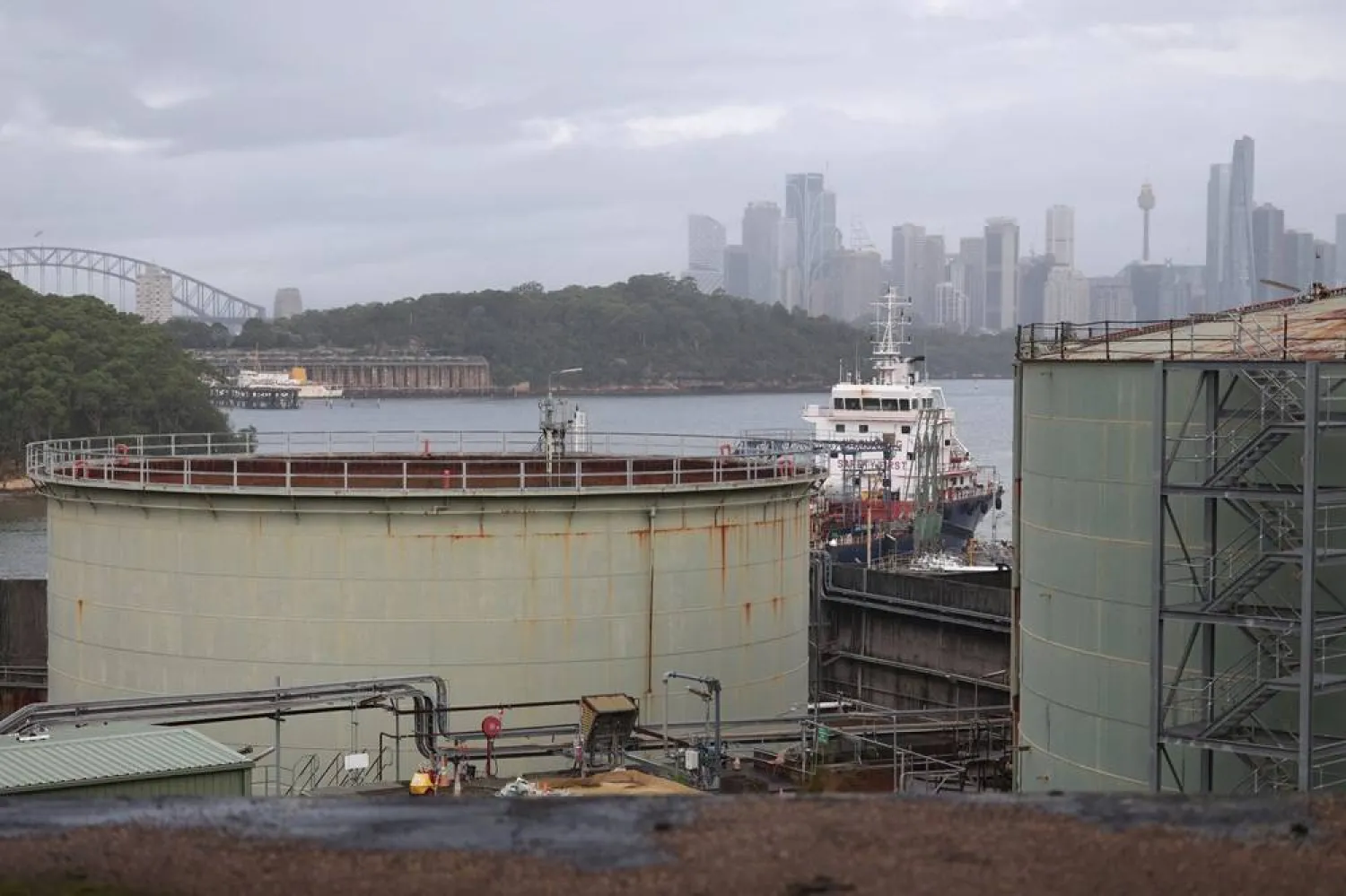
 An oil tanker sits at Viva Energy Australia’s Gore Bay fuel terminal overlooking the city skyline in Sydney, Australia, March 18, 2026. (Reuters)
An oil tanker sits at Viva Energy Australia’s Gore Bay fuel terminal overlooking the city skyline in Sydney, Australia, March 18, 2026. (Reuters)
TT

Stocks Extend Gains and Oil Dips as US, Israel, Iran Continue Strikes

 An oil tanker sits at Viva Energy Australia’s Gore Bay fuel terminal overlooking the city skyline in Sydney, Australia, March 18, 2026. (Reuters)
An oil tanker sits at Viva Energy Australia’s Gore Bay fuel terminal overlooking the city skyline in Sydney, Australia, March 18, 2026. (Reuters)

Oil prices sank Wednesday after Iraq said it had resumed exports through Türkiye, avoiding the effectively closed Strait of Hormuz, while equities rose following another tech-led advance on Wall Street.

The drop in crude, which saw WTI sink more than four percent, came even as the United States hit Iranian missile sites near the key Strait of Hormuz and Tehran struck crude-producing Gulf neighbors.

While the war in the Middle East shows no sign of ending and oil has stuck around $100 a barrel -- threatening to fuel a fresh inflation spike -- equity traders have shifted back into the market after the steep losses suffered at the outset of the conflict.

However, analysts warned the positive mood could fade if the crisis drags on and energy costs spiral with Hormuz -- through which a fifth of global oil and gas flow -- effectively closed by Iran as an economic weapon.

That comes with central banks weighing the need for lower interest rates to support the economy and the prospect of rising prices, which would need higher borrowing costs.

In a bid to ease traffic through the crucial Strait, US forces dropped several 5,000-pound (2,250 kg) bombs on "hardened Iranian missile sites" near the coast, Central Command said.

US President Donald Trump on Tuesday fumed that allies, which have largely distanced themselves from his war, were not lining up to help escort tankers through the waterway.

The attacks came as Israel announced it had killed security chief Ali Larijani, a key force leading Iran since the death of Supreme Leader Ali Khamenei in the first strikes of the war.

Meanwhile, Saudi Arabia intercepted six drones and Kuwait's air defenses responded to a rocket and drone attack, two people were killed by missiles near Tel Aviv, and Qatar said it intercepted a missile attack as blasts were heard in Doha.

Israel also hit a central Beirut neighborhood as it looks to take out the Iran-backed Hezbollah.

Rystad Energy estimated just 12.5 million barrels per day of Middle Eastern oil remains online, down from the 21 million per day pre-war base.

"But the 12.5 million bpd figure is not secure," Rystad said. "If the (Hormuz) situation persists, the drop in departures could start feeding through into additional export losses in the weeks ahead, as producers face growing difficulty moving crude out of the Gulf."

Still, oil prices fell as Iraq said it had resumed limited oil exports through Türkiye.

State-owned North Oil Company said it "has begun operating the Sarlo pumping station to resume pumping and exporting Kirkuk oil to the port of Ceyhan with an initial capacity of 250,000 barrels per day".

West Texas Intermediate lost more than four percent to strike just below $92, while Brent shed almost three percent to just above $100.

Stocks continued to defy gravity following gains on Wall Street that were helped by tech giants including Apple and Amazon.

Seoul jumped more than five percent thanks to a surge in chip giants Samsung and SK hynix. The Kospi, however, is still more than six percent down from the record highs touched before the war broke out.

Tokyo was up 2.9 percent, while Hong Kong, Shanghai, Taipei, Sydney, Singapore, Mumbai, Bangkok and Wellington also rallied.

"Asia is picking up the baton with a cautiously constructive tone... all of it leaning on the signal from Wall Street where the S&P and Nasdaq have now strung together a second day of gains, suggesting the market is actively choosing to look through the geopolitical noise," wrote SPI Asset Management's Stephen Innes.

However, Fawad Razaqzada at Forex.com warned traders might rethink their positions the longer the conflict rumbles on.

"If the war continues then the US and Israel will have to continue alone, because other NATO members have decided against joining the conflict," he wrote.

"This may work in favor of Iran keeping the Strait of Hormuz closed for longer."

Focus is also on the Federal Reserve's policy meeting that concludes later Wednesday.

The bank is expected to keep borrowing costs on hold but it will release its "dot plot" forecast for rates in the coming months, amid speculation it could be forced to hike again.


Arab Startups Attract Investors Despite War-Driven Uncertainty

Riyadh, Saudi Arabia (SPA)
TT

Arab Startups Attract Investors Despite War-Driven Uncertainty

Riyadh, Saudi Arabia (SPA)

At a time when geopolitical tensions and regional conflicts cast a shadow over the broader landscape, the Middle East and North Africa's startup ecosystem is showing strong resilience and the ability to attract both local and international capital.

Investment in technology is no longer a complementary option, but a strategic bet, driven by accelerating digital transformation and the stability fostered by leading governments in the region.

“The best time to invest and seize opportunities is when there is fear and uncertainty,” Hassan Haidar, founder and managing partner at Plus VC, told Asharq Al-Awsat.

The firm has backed more than 250 startups across 15 countries in the Middle East and said late last year it plans to fund around 40 startups in 2026, with a focus on deals in Saudi Arabia.

Haidar said the technology and digital services sector continues to benefit, adding that even war cannot halt the region’s rapid shift toward digital services.

Regional tensions have pushed many to rely more on digital tools and online delivery services, creating significant opportunities for startups offering innovative solutions, he said.

Venture capital surge

Startups in the region raised $3.8 billion across 688 deals in 2025, up 74% year on year, according to Magnitt company. Saudi Arabia and the United Arab Emirates took the largest share, with nearly half of the capital coming from international investors.

Haidar said investment is driven not only by current opportunities but also by the ecosystem's growing maturity.

“The past decade was about proving that venture capital can succeed in the region; the next decade will be about proving the scale of these opportunities,” he said.

Structural transformation

Haidar, who began investing in the region in 2010, said the startup landscape has changed fundamentally, from fewer than 100 startups annually across the region about 15 years ago to around 2,000 today.

Markets have become more structured, with governments supporting capital flows and helping establish local and international investment funds. Clearer paths to initial public offerings have emerged, alongside secondary transactions that provide liquidity for investors and founders.

“Markets such as Saudi Arabia and the United Arab Emirates have become regional pillars, belief in the ecosystem is attracting founders, capital and global attention,” he said.

Untapped opportunities

Haidar said the region’s appeal lies in vast untapped opportunities and in key sectors that are still in the early stages of digitization. A generation of ambitious founders with international experience is returning to build technology ventures that address both local and global challenges.

This momentum is backed by clear, strategic government support that gives investors confidence, he said.

Compared with other emerging markets, regions such as Southeast Asia face challenges in exit pathways and liquidity shortages. The Arab region, particularly Saudi Arabia, stands out by offering viable exit channels through public listings and structured secondary transactions.

Trends strengthening competitiveness

Haidar outlined four trends boosting the region’s competitiveness.

First, investors are becoming more financially mature, shifting from development-driven funding to performance-based investment focused on real returns.

Second, exit pathways are becoming more dynamic, supported by strong liquidity, with IPOs and secondary markets offering flexible options to recycle capital.

Third, artificial intelligence is moving beyond hype to real-world applications, addressing complex operational challenges in sectors such as logistics and enterprise software.

Fourth, deep tech and hardware are gaining ground, with a new wave of companies developing advanced solutions to critical issues such as energy security, water and advanced manufacturing, attracting investors willing to back long-term projects.

Challenges and outlook

Despite this progress, access to funding remains a structural challenge. Venture capital still accounts for less than 0.1% of regional GDP, compared with around 1% in the United States, highlighting significant untapped potential.

Still, Haidar expressed strong optimism about the region’s ability to move forward, pointing to the role of governments in maintaining stability.

“We hope for a positive shift and a return to normal conditions, but we strongly believe in our governments’ ability to navigate these difficult times and provide a stable environment that gives us the confidence to continue,” he said.

He said venture capital has moved beyond the stage of doubt.

“We are no longer asking whether startups are important to our economy; we have entered a new strategic phase focused on how to scale and multiply, and on proving the full potential of this ecosystem on the global stage,” he said.


Many in Egypt Struggle as the Costs of a Distant War Drive up Prices in Local Markets

Cars are seen on a road at Nasr City, a suburb of Cairo, Egypt May 3, 2021. REUTERS/Mohamed Abd El Ghany
TT

Many in Egypt Struggle as the Costs of a Distant War Drive up Prices in Local Markets

Cars are seen on a road at Nasr City, a suburb of Cairo, Egypt May 3, 2021. REUTERS/Mohamed Abd El Ghany

Sayyed Ragheb was already struggling to keep his family afloat, earning less than $100 a month. Now he fears it will get even worse after Egypt hiked fuel prices because of the Iran war.

The father of four school-age children works day-to-day in cafes and sometimes in construction. With prices of meat and produce jumping just the past week, he worries about meeting his family’s basic needs, The AP news reported.

“This means a price increase for everything,” said Ragheb, as he served hot drinks at a cafe on a recent evening in Cairo. “This is catastrophic for someone like me.”

Egypt is one of the few countries in the Middle East not directly affected by the war, now in its third week with no sign of abating. It’s not part of the US-Israeli campaign against Iran, and it hasn’t been targeted by Iranian missile and drone fire, like Arab Gulf nations, or by Israeli bombardment, like Lebanon.

But the nation of over 108 million people is feeling the conflict’s repercussions. Soaring energy prices forced the government to implement a steep hike in the prices of subsidized fuel and cooking gas.

That is having a domino effect on the prices of other goods and services in Egypt's struggling economy. Moreover, it comes during the Muslim holy month of Ramadan, when families traditionally hold large dinner gatherings, and ahead of the holiday of Eid al-Fitr, a major shopping season when people buy new clothes, especially for children.

Egypt is vulnerable to fuel price hikes World energy prices have surged since the US and Israel launched the war on Feb. 28. Iran retaliated by attacking oil and gas infrastructure across the Persian Gulf and effectively blocking traffic through the Strait of Hormuz, where a fifth of the world's traded oil passes.

Brent crude, the international benchmark, soared from less than $70 a barrel on Feb. 27 to a peak of nearly $120 early March 9. It was hovering around $104 on Wednesday.

The jump is particularly painful for Egypt because the government dedicates a large part of its already strained budget to subsidizing gasoline, fuel and electricity.

Energy prices aren’t its only vulnerability.

Traffic through the Suez Canal, a major source of government income, had started to recover after two years of attacks on Red Sea shipping by Yemen's Houthis. Now some shipping companies are again routing traffic away from the Middle East because of the latest turmoil, and the government says it expects more losses.

Egypt, home to the ancient pyramids, also earns considerable foreign income from tourism. But arrivals are expected to plunge as travelers steer clear of the region.

If the conflict is prolonged and continues to drive up prices and reduce government revenues, the short-term economic pain could become a broader political and economic crisis, said Alexandra Blackman, an expert in Mideast politics at Cornell University.

“That will be more challenging for the regime to manage and control,” she said.

Egypt's president says the price hikes were ‘inevitable’ On March 10, the government announced a 15% hike in the price of gasoline, a 22% hike in cooking gas and a 17% hike in diesel, widely used in commercial and public transport.

President Abdel-Fattah el-Sissi acknowledged the pressure on people but said the increases are “inevitable” and “the least expensive” option to protect the economy.

“The requirements of the reality sometimes necessitate taking difficult measures ... to avert harsher options and more serious consequences,” he said over the weekend at an Iftar event, breaking the daily sunrise-to-sunset Ramadan fast.

He said Egypt’s consumption of oil products costs $20 billion annually, including fuel used to operate power plants.

The government imports 28% of its gasoline needs and 45% of its diesel needs, which puts pressure on the budget, said Petroleum Minister Karim Badawy.

The government announced a series of measures aimed at mitigating the impact, including reducing official overseas trips and tightening fuel consumption across the public sector. It also announced salary increases starting in July.

Egypt’s poor and middle class have already seen their purchasing power shrink over the past decade under government austerity measures. The measures included the slashing of subsidies and devaluation of Egypt’s currency as part of an ambitious reform program in 2016.

Inflation jumped from 10% in January to 11.5% in February of this year, according to official figures. The price increases are rippling across the economy in a country where a third of the population is below the poverty line, according to government statistics.

Since the new fuel prices took effect, the cost of meat has jumped 25% and fruit and vegetables rose 15-30%, according to merchants at three markets in Cairo.

Hussein Rashad, a grocer in a poorer district, said customers have become more selective, and most have reduced the amount of vegetables they buy. Some have stopped buying fruit altogether, he said.

“Many things have become out of their reach,” he said.

Ragheb, the cafe worker, said his family has tightened its budget, including resorting to the cheapest food staples. He won't be buying new clothes for his children for the upcoming Eid.

“One has no other option,” he said.


Gold Falls 2% as Inflation Fears Bolster Hawkish Fed Bets

Gold bars after being inspected and polished at a refinery in Sydney (AFP)
TT

Gold Falls 2% as Inflation Fears Bolster Hawkish Fed Bets

Gold bars after being inspected and polished at a refinery in Sydney (AFP)

Gold prices fell to a one-month low on Wednesday as investors weighed the risk of a more hawkish US Federal Reserve policy stance, with high oil prices fuelling concerns about inflation.

Spot gold fell 2% to $4,903.19 per ounce as of 1216 GMT, its lowest level since February 18. US gold futures for April delivery also dropped 2% to $4,907.40, according to Reuters.

"Investors are worried about rates staying 'higher-for-longer' due to elevated energy prices ... the longer the Iran conflict goes on, the more likely that scenario," said Jamie Dutta, market analyst at Nemo.money.

While gold is viewed as a hedge against inflation and uncertainty, high interest rates curb its appeal by raising the cost of holding bullion and boosting returns on yield-bearing assets.
The Middle East conflict, in its third week, saw Iran target Tel Aviv with missiles in retaliation for Israel's assassination of its security chief, Ali Larijani, Iranian state television reported on Wednesday.

Benchmark Brent futures prices have been above $100 per barrel for the past four sessions.

Meanwhile, the Fed is widely expected to hold rates steady later in the day.

Investors will parse Fed Chair Jerome Powell's remarks to assess the central bank's policy view for the rest of 2026, with futures markets seeing only one quarter-percentage-point rate cut this year, in September, and another cut in late 2027.

"Long-term drivers like central bank buying, stagflation risks and diversification demand remain. That should mean higher (gold) prices by end of 2026," Dutta said.

Spot silver fell 1.2% to $78.29 per ounce, spot platinum was down 2.9% at $2,063.69, and palladium lost 2.6% to $1,560.50.
