
Both Sides in Iran War Ratchet up Attacks on Energy Facilities, as Oil Prices Surge

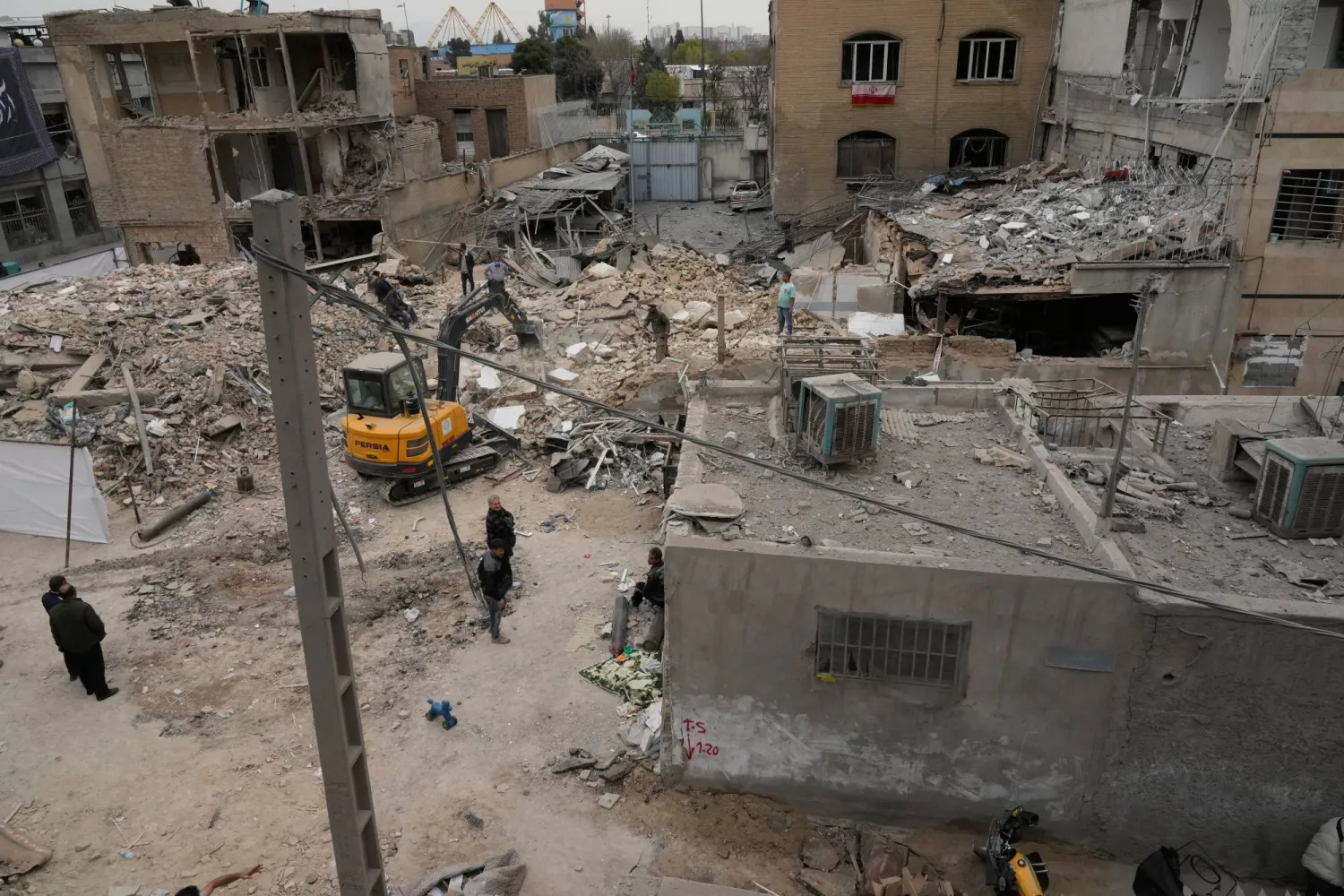
Destroyed buildings of a police station and nearby houses are seen after Friday's US-Israeli strike in Tehran, Iran, Sunday, March 15, 2026. (AP Photo/Vahid Salemi)
TT

Both Sides in Iran War Ratchet up Attacks on Energy Facilities, as Oil Prices Surge

Destroyed buildings of a police station and nearby houses are seen after Friday's US-Israeli strike in Tehran, Iran, Sunday, March 15, 2026. (AP Photo/Vahid Salemi)

Israel kept up its campaign of targeting Iran’s leaders on Wednesday, killing the country’s intelligence minister, and an Iranian offshore natural gas field was struck in a sign of the war’s mounting pressure – from both sides -- on the region's economic lifeblood: energy. 

Iran has been taking aim at its Gulf neighbors’ energy facilities since the war started on Feb. 28, and has made the Strait of Hormuz shipping channel — through which one-fifth of the world's oil travels — nearly impassable.  

The price of oil surged another 5% to over $108 a barrel on international markets, increasing the price of gasoline and other goods, and putting pressure on consumers and economies around the world. The price of Brent crude, the international benchmark for oil, is now up close to 50% since the start of the war. 

As the Trump administration looks for ways to boost oil supplies and lower prices, the Treasury Department on Wednesday eased sanctions on Venezuela, saying US companies will be allowed to do business with the country's state-owned oil and gas company. 

Israeli Defense Minister Israel Katz said Iranian Intelligence Minister Esmail Khatib had been killed in an overnight strike and promised “significant surprises” to come. Iran retaliated by unleashing attacks against its Gulf neighbors and Israel, where two people were killed near Tel Aviv. 

Iranian state television confirmed the killing of Khatib, who the US sanctioned in 2022 for alleged cyber-related activities against the US and its allies. A day earlier, Israel killed top Iranian security official Ali Larijani and the head of the paramilitary Revolutionary Guard’s Basij force, Gen. Gholam Reza Soleimani. 

Iranian Supreme Leader Mojtaba Khamenei expressed condolences for the slaying of Larijani, according to a written statement published in Iranian media. 

“Undoubtedly, the assassination of such a person shows the extent of his importance and the hatred of the enemies towards him,” Khamenei said. “All blood has its price that the criminal murderers of the martyrs must pay soon.” 

It wasn’t immediately clear who led the attack on Iran’s massive South Pars natural gas field, although Qatar, which shares the field with Iran, blamed Israel. 

Iran keeps up strikes on Gulf countries' oil facilities 

Iran has been targeting the energy infrastructure of its Gulf Arab neighbors, as well as military bases, as part of a strategy to drive up oil prices and put pressure on the US and Israel to back down. 

Iran attacked Saudi Arabia’s vast Eastern Province, as well as Kuwait, Bahrain, Qatar and the United Arab Emirates on Wednesday. 

Iran has vowed to continue to crimp shipping traffic through the Strait of Hormuz, which leads from the Gulf to the open ocean. Since the war started, a few ships have gotten through — some Iranian, but also vessels from India, Türkiye and elsewhere. Iran insists the waterway is open, just not to the US or many of its allies. 

US President Donald Trump has expressed growing frustration that no allies have stepped forward to send ships to help open the strait. On Tuesday, he posted on social media: “WE DON’T NEED THE HELP OF ANYONE!” 

Iraq, which paused operations at its main oil terminal on the Gulf last week, said Wednesday it had reached a deal with the autonomous northern Iraqi Kurdish administration to begin exporting 250,000 barrels of crude oil daily via pipeline to a port in Türkiye. 

Saudi Arabia is also bypassing the Strait of Hormuz, sending some of its oil by pipeline across the country to be shipped from a Red Sea port. 

Iran launches multiple-warhead missiles at Israel  

Responding to the killing of Larijani, the paramilitary Revolutionary Guard said Wednesday it had targeted central Israel with multiple-warhead missiles that have a better chance of evading defense systems. Footage filmed by The Associated Press showed at least one such missile releasing a cluster of munitions over Israel. 

Larijani was a senior policy adviser to the late Supreme Leader Ali Khamenei on strategy in nuclear talks with the Trump administration. He was sanctioned by the US Treasury in January for his role “coordinating” Iran’s violent suppression of nationwide protests. Gen. Soleimani was also sanctioned by the US and other nations for his role in suppressing dissent for years. 

Israel's airports authority said Wednesday that three private aircraft at Ben Gurion International Airport were damaged in recent days by shrapnel after Iranian missiles were intercepted. Airport traffic across the region has been severely curtailed since the war started. 

Renewed strikes in Iran  

The Iranian judiciary’s Mizan news agency said an airstrike hit a courthouse complex in Larestan, a county in southern Iran, and that at least eight people were killed. More than 1,300 people have been killed in Iran since the conflict started, according to the Iranian Red Crescent. 

Mizan also reported that Iran executed a man on charges of spying for Israel’s Mossad intelligence agency. The report identified him as Kourosh Keyvani and alleged he “provided images and information on sensitive locations” to Israel. 

Sweden’s Foreign Ministry condemned what it said was the execution of a Swedish citizen on Wednesday in Iran. The citizen, whose name was not made public, was arrested last year but additional details were not available. 

Israel pressures Hezbollah in Lebanon  

In Lebanon, Israel kept up intense pressure on Iran-backed Hezbollah, hitting multiple apartment buildings in Beirut and killing at least a dozen people. Hezbollah began firing rockets into northern Israel after the war in Iran had begun. 

Israel flattened an apartment building in central Beirut about an hour after issuing an evacuation notice — the fourth time the building was targeted. Israel’s military claimed it was being used by Hezbollah to store “millions of dollars intended to finance its activities,” without providing evidence. 

Overall, 10 people were killed in Israeli airstrikes in central Beirut, according to Lebanon’s Health Ministry. Another two people were killed in an airstrike in Lebanon’s western Bekaa Valley, it said. 

Israeli strikes have displaced more than 1 million Lebanese — roughly 20% of the population — according to the Lebanese government, which says 912 people have been killed and 2,221 wounded. 

In Israel, 14 people have been killed by Iranian missile fire. At least 13 US military members have been killed. 


Pentagon: US Navy Secretary Leaving Post 'Immediately'

FILE - Secretary of the Navy John Phelan listens as President Donald Trump speaks at his Mar-a-Lago club, Dec. 22, 2025, in Palm Beach, Fla. (AP Photo/Alex Brandon, file)
TT

Pentagon: US Navy Secretary Leaving Post 'Immediately'

FILE - Secretary of the Navy John Phelan listens as President Donald Trump speaks at his Mar-a-Lago club, Dec. 22, 2025, in Palm Beach, Fla. (AP Photo/Alex Brandon, file)

The Pentagon announced Wednesday that the Secretary of the Navy John Phelan would leave "immediately.”

It gave no reason for his sudden departure, the latest removal of a senior officer under President Donald Trump's combative Pentagon chief, Pete Hegseth.

Under orders from Trump, the US Navy is attempting to block vessels heading to or from Iranian ports, seeking to ramp up pressure on the Iranian economy even without all-out war.

Iran's vow not to reopen the Strait of Hormuz -- so long as a US naval blockade remained in place -- was held into Thursday despite a ceasefire extension.


Military Planners Discuss in London Reopening of Hormuz

FILED - 22 May 2025, United Kingdom, London: UK Defense Secretary John Healey listens to questions  during a press conference at Strategic Command Headquarters, in Northwood, Greater London. Photo: Thomas Krych/PA Wire/dpa
FILED - 22 May 2025, United Kingdom, London: UK Defense Secretary John Healey listens to questions during a press conference at Strategic Command Headquarters, in Northwood, Greater London. Photo: Thomas Krych/PA Wire/dpa
TT

Military Planners Discuss in London Reopening of Hormuz

FILED - 22 May 2025, United Kingdom, London: UK Defense Secretary John Healey listens to questions  during a press conference at Strategic Command Headquarters, in Northwood, Greater London. Photo: Thomas Krych/PA Wire/dpa
FILED - 22 May 2025, United Kingdom, London: UK Defense Secretary John Healey listens to questions during a press conference at Strategic Command Headquarters, in Northwood, Greater London. Photo: Thomas Krych/PA Wire/dpa

Military planners from more than 30 countries held two-day talks in London on Wednesday to advance a mission to reopen the Strait of Hormuz and draw up detailed plans, the British government said.

More than a dozen countries said last week they were willing to join an international mission, led by Britain and France, to protect shipping in the ⁠Strait of Hormuz ⁠when conditions permit.

The commitment came after some 50 countries from Europe, Asia and the Middle East joined a video conference aimed at sending a signal to Washington after US President ⁠Donald Trump said he did not need allies' help.

Britain's Ministry of Defense said in a statement the meeting that started Wednesday would build on progress made at last week's talks, Reuters reported.

"The task, today and tomorrow, is to translate the diplomatic consensus into a joint plan to safeguard freedom of navigation in the Strait and support ⁠a ⁠lasting ceasefire," said UK defense minister John Healey.

"I am confident that, over the next two days, real progress can be made."

Britain said the talks would advance military plans to reopen the Strait of Hormuz once conditions allow, following a sustainable ceasefire.

Participants were expected to discuss military capabilities, command and control arrangements, and how forces could deploy to the region.


Iran War Means More Orders for US Defense Giants

ARLINGTON, VIRGINIA - APRIL 21: Under Secretary of War Jules Hurst III (C) and Director of Force Structures Lt. Gen. Steven Whitney (R) hold a press briefing to discuss the Department of War's FY27 budget request at the Pentagon on April 21, 2026 in Arlington, Virginia. Chip Somodevilla/Getty Images/AFP
TT

Iran War Means More Orders for US Defense Giants

ARLINGTON, VIRGINIA - APRIL 21: Under Secretary of War Jules Hurst III (C) and Director of Force Structures Lt. Gen. Steven Whitney (R) hold a press briefing to discuss the Department of War's FY27 budget request at the Pentagon on April 21, 2026 in Arlington, Virginia. Chip Somodevilla/Getty Images/AFP

US defense companies are reporting a surge in demand for military equipment, as the war in the Middle East prompts fresh orders from governments around the world.

Earnings Tuesday signaled that 2026 will be another strong year after a robust 2025 in the wake of continuing conflicts in Gaza and Ukraine, Russian incursions into European airspace, Chinese maneuverings towards Taiwan and Red Sea tensions.

More governments are ordering military equipment amid rising geopolitical strife. For those who are already in conflict, there is a need to spend more to replenish stocks or maintain machinery.

US defense companies RTX, Northrop Grumman and GE Aerospace all reported increased orders in the first quarter, AFP said.

While hoping for a "sustained resolution" to the Middle East conflict, RTX CEO Chris Calio told a Wall Street analyst call the company was working with the Pentagon "to accelerate munitions production."

US officials have announced new agreements in recent months to increase production of the Tomahawk, Patriot and GEM-T missiles, among other weapons systems.

RTX unit Raytheon previously announced five "landmark" Pentagon agreements that Calio described as "vitally important for national security."

The company has already invested nearly $900 million to expand capacity.

"The current landscape clearly underscores the need for munitions, depth, integrated air and missile defense technology and more advanced capabilities to counter evolving threats," Calio said.

"We're seeing really, really strong demand, both domestically and internationally," he added as the company raised several full-year financial projections.

Similarly, GE Aerospace described its first quarter as "strong," with revenues jumping 25 percent in light of what Chief Executive Larry Culp described as a "dynamic geopolitical landscape."

Culp said on a conference call the company expects the Middle East war and its effects to persist through the summer.

In its defense programs, GE Aerospace continues "to execute with speed against high-priority military needs in support of US and allied warfighters," Culp added.

But the company, which builds engines for Boeing and Airbus, also suffered some ill-effects from the war. Cutbacks in travel in the Middle East hit the company's maintenance business.

At Northrop Grumman, the objective is also to deliver as quickly as possible on orders for weapons systems.

The company has added 20 new manufacturing facilities in the United States over the last two years, according to CEO Kathy Warden.

"Clearly the conflict with Iran has created a heightened sense of urgency," she said.

Calio of RTX said the recent contracts with the Pentagon "will give the kind of long-term visibility that the supply chain will need to invest, which is critically important."

US undersecretary of defense Jules Hurst said President Donald Trump's fiscal 2027 budget requested $1.5 trillion, describing the demand as a "generational investment in the United States military, the arsenal of freedom," he said at a Pentagon briefing.

"This 42 percent increase will supercharge our defense industrial base by expanding production of major weapon systems while strengthening supply chains and supporting tens of thousands of small- and medium-sized businesses," Hurst said.

Boeing, which also has a defense business, will report earnings Wednesday, while Lockheed Martin is set to release results on Thursday.