


The Platypus is Even Weirder than Thought, Scientists Discover

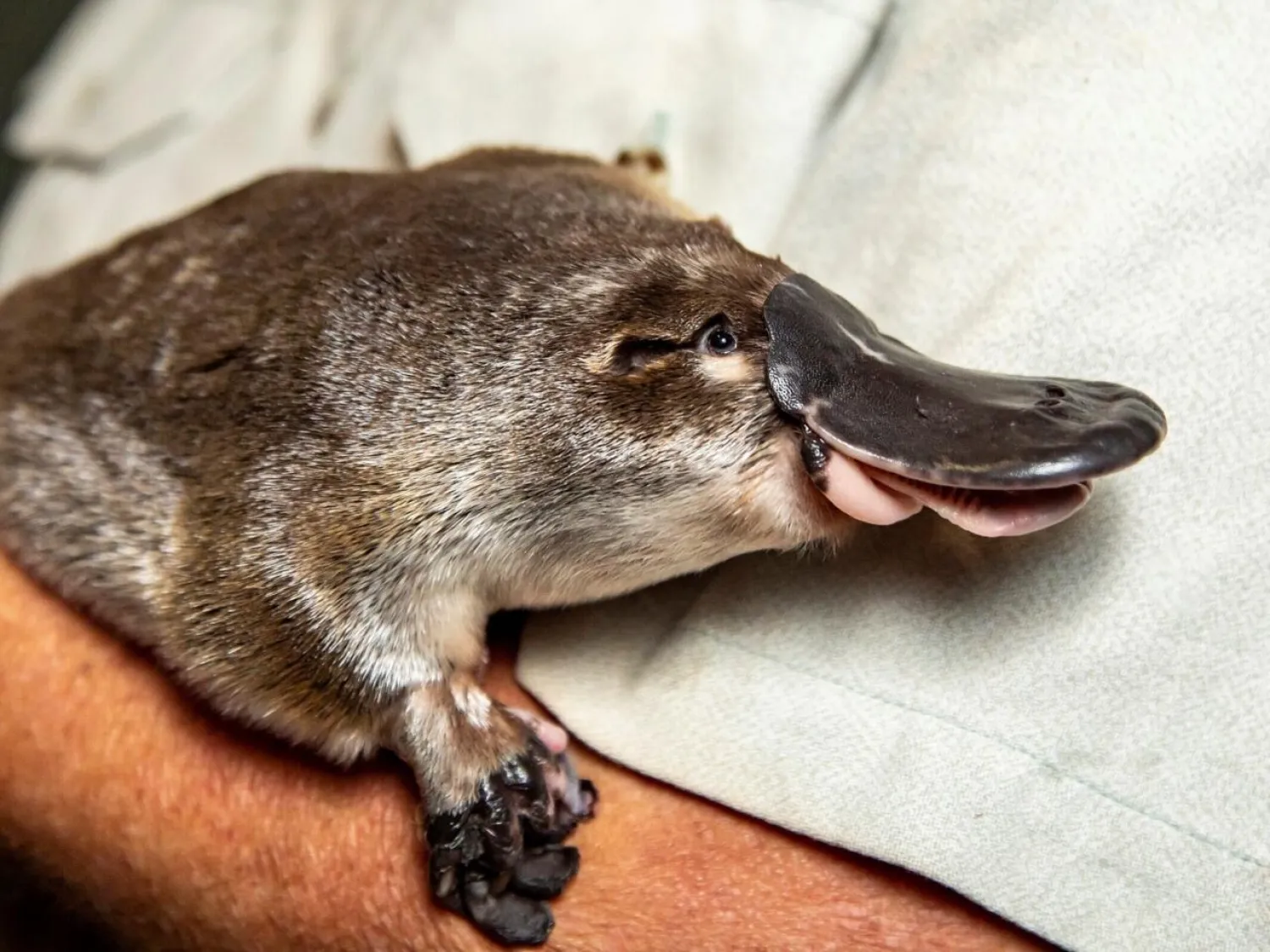
Weird guys: The platypus has found yet another way to stand out in the animal kingdom. RICK STEVENS / TARONGA ZOO/AFP/File
TT

The Platypus is Even Weirder than Thought, Scientists Discover

Weird guys: The platypus has found yet another way to stand out in the animal kingdom. RICK STEVENS / TARONGA ZOO/AFP/File

They already have the bill of a duck, the tail of a beaver, lay eggs like reptiles and have venom like snakes.

Yet the humble platypus, a small creature which quietly swims in the rivers of eastern Australia, has found yet another way to amaze scientists, AFP said.

It is the only mammal that has hollow structures of the pigment melanin, a trait normally found in birds, biologists said in a new study on Wednesday.

When the first taxidermied specimen of a platypus was brought back from Australia in 1799, European naturalists began looking for the seams -- they assumed it was a hoax.

The animal has been surprising scientists ever since.

The platypus is one of only five mammal species that lay eggs, which are called monotremes. The other four are all types of echidna -- spiny creatures that waddle through the Australian bush.

It is also one of the few poisonous mammals -- males have a spur on their hind legs that releases venom at their enemies.

Now another oddity has been added to the unusual platypus characteristics, according to the study published in the Biology Letters journal of the UK's Royal Society.

In animals with spines, called vertebrates, the pigment called melanin protects against UV radiation, helps regulate body temperature and is responsible for the color of skin, fur or feathers.

Melanin is contained in tiny, specialized structures inside cells called melanosomes, the shape of which is linked to their color.

For example, eumelanin -- which produces black, grey and dark brown hues -- is usually found in elongated melanosomes.

Pheomelanin, which produces reds, reddish-browns and some shades of orange and yellow, is found in spherical melanosomes.

And in mammals, these melanosomes are always solid.

However in birds, sometimes the structures are hollow or flat, with only a thin layer of melanin. This helps birds have the dazzling and varied colors seen across the world.

Birds also have melanosomes that are organized into smaller "nanostructures" which create iridescent colors that interact with light, such as the feathers of a peacock.

'Surprising and exciting'

Jessica Leigh Dobson, a biologist at Ghent University in Belgium and the study's lead author, told AFP the team was compiling a database of mammal melanosomes when they made an "extremely surprising and exciting" discovery.

Platypus melanosomes were mostly spherical -- which should give it reddish-orange fur. But the animal is merely dark brown.

Then the scientists discovered that some of its melanosomes are hollow -- like those of birds.

They checked their database for other mammals, including marsupials, rodents and primates.

"To the best of our knowledge, this is the only example of hollow melanosomes in mammals," Dobson said.

The melanosomes were "scattered randomly throughout the hair cortex" and do not create iridescence, she said.

"Further work is definitely needed to find out why they have them," Dobson added.

Why these animals evolved these unusual features in the first place is also unclear.

The ancestors of the platypus and echidna are thought to have been aquatic burrowing animals, so their hollow melanosomes could have helped them adapt to life in the water, giving them warmer insulation.

But this theory raises more questions.

If this was the case, why is this trait "not more widespread among aquatic mammals?" the study asked.



'Pinprick of Light': Artemis Crew Witnesses Meteorite Impacts on Moon

In this image provided by NASA, the Artemis II crew captured this view as the Earth sets behind the Moon during a lunar flyby, Monday, April 6, 2026. (NASA via AP)
TT

'Pinprick of Light': Artemis Crew Witnesses Meteorite Impacts on Moon

In this image provided by NASA, the Artemis II crew captured this view as the Earth sets behind the Moon during a lunar flyby, Monday, April 6, 2026. (NASA via AP)

During their historic lunar flyby, astronauts on NASA's Artemis II mission witnessed meteorites striking the rugged surface of the Moon, a sight that has piqued scientists' curiosity.

"That was definitely impact flashes on the moon. And Jeremy (Hansen) just saw another one," mission commander Reid Wiseman reported on Monday while flying around the Moon -- the first such journey by humans in more than half a century.

"Amazed," replied Kelsey Young, the mission's lunar science lead, as she followed the spacecraft from more than 250,000 miles (400,000 kilometers) away on Earth.

"I don't know if I expected to have the crew see any on this mission, so you probably saw the surprise and shock on my face," she said, recounting the strikes at a press briefing the next day.

Among NASA's team in Houston, there were "audible screams of delight" from scientists when the crew described flashes of light caused by meteorite impact, Young said.

The phenomenon is "something that we have not witnessed often," the mission's backup astronaut Jenni Gibbons told AFP.

"They were really high priority science for us, so the fact that they saw four or five was just outstanding."

As the astronauts hurtled towards home, NASA asked them on Tuesday about the meteorite strikes they saw during their nearly seven-hour observation period.

"Were they prolonged? And did you notice any color?" Young asked.

"It's a pinprick of light," replied Canadian crew member Hansen. "I would suspect there were a lot more of them."

"I would say they were a millisecond, like the fastest a camera shutter can open and close," added Wiseman, who said the flashes were "white to bluish white."

"To me there was no doubt we were seeing it, and we were all seeing it," he added.

According to NASA's tally, the team -- which broke the record for the furthest distance from Earth during their flyby -- reported a total of six meteorite impacts on the lunar surface.

Ground crews are now working to match these observations with data from a satellite orbiting the Moon, said Young, adding that the majority of the sightings took place during a solar eclipse, when the Moon passed in front of the Sun.

"I'm personally... surprised they would see that many, although they (had) been trained to look for them," said Bruce Betts, chief scientist at the Planetary Society.

According to Betts, the descriptions will allow scientists to "get some idea of the frequency of impact" as well as the size of the projectiles.

One question was what size an object needed to be to create a flash visible to the astronauts, Betts said.

"It's not a piece of dust, but it's not a meter-size boulder, either."

The observations raise questions and show that the "daily flux of meteors should be monitored more closely in the future before a lunar base is established," said Peter Schultz, Professor Emeritus of Geological Sciences at Brown University.

On Earth, smaller objects "burn up high in the... atmosphere due to friction" before they reach the ground, noted Betts, which is not the case on Earth's natural satellite.

"There is more of a challenge on the Moon," he said.


Greece to Ban Social Media for Under 15-year-olds

FILE PHOTO: Instagram app icon is seen on a smartphone in this illustration taken October 27, 2025. REUTERS/Dado Ruvic/Illustration/File Photo
TT

Greece to Ban Social Media for Under 15-year-olds

FILE PHOTO: Instagram app icon is seen on a smartphone in this illustration taken October 27, 2025. REUTERS/Dado Ruvic/Illustration/File Photo

Greece will ban access to social media for children under 15 from January 1, 2027, Prime Minister Kyriakos Mitsotakis said on Wednesday.

"We have decided to go ahead with a difficult but necessary measure: ban access to social media for children under 15-years-old," he said in a video posted on TikTok.

"Greece is among the first countries in the world to adopt such a measure," the prime minister said, adding that he would put pressure on the European Union to follow suit.

Mitsotakis said he used social media to make the announcement so he could address teenagers and children directly: "I know that some of you are going to be angry.... Our aim is not to keep you away from technology but to combat addiction to certain applications that harms your innocence and your freedom."

"Science is clear: when a child is in front of screens for hours, their brain does not rest," he said.

Australia in December became the first country in the world to require TikTok, YouTube, Snapchat and other top sites to remove accounts held by under-16s, or face heavy fines.

Indonesia began enforcing a social media ban for users under the age of 16 in March, and has already issued summons letters to Google and Meta over their failure to comply with the law.

Austria announced last month it would soon ban social media for children up to the age of 14, with a plan to present a new law "as early as this summer."

Spain and Denmark have also announced their intention to introduce a digital age of majority for social networks.


11-Year-old UK Girl Turns Marsh Trees Into Quirky Characters

There are currently 16 trees in Hackney Marsh's which feature stories
TT

11-Year-old UK Girl Turns Marsh Trees Into Quirky Characters

There are currently 16 trees in Hackney Marsh's which feature stories

Visitors taking a stroll along the River Lea in Hackney Marshes may spot a series of signs fixed to the trees, each sharing an eccentric, whimsical tale.

An 11-year-old girl is behind the notices and over the past year has spent her family walks inventing backstories for each tree.

Niovi's project, called the Talking Tree Collective, now features characters.

Among them is Humble Dick. His story reads: “In the war of 1952 between the local gang of sting nettles and a group of young saplings over a patch of scrubland, the brave Professor Humble Dick the Fourth was the last shoot standing.”

Other characters include Bernard the litter picking tree who is described as a “descendant of a legendary environmentalist lineage” inspired by nature documentaries.

Niovi told BBC London “it started like a year ago when we walked around the marshes and we saw funny looking trees. We would make stories for them and then we eventually gave them personalities and names.”

Each tree's backstory comes from its appearance - for example, if a tree has a dent, she will imagine how it might have got it.

What started as a simple game during family walks with Coco the dog has since grown into a small, unofficial literacy trail.

The signs are anonymous, attributed only to the “Talking Tree Collective,” leaving their author a mystery until Niovi came forward.

Her father, Doug, helped her make the signs but leaves most of the creativity to Niovi.

Doug said: “I've mostly been consigned to laminating and printing, so I leave the imagination to Niovi. I think news is pretty tough at the moment, so it's nice to do something which is a bit more joyous.”

The signs are expected to remain in place for a few weeks, giving passers by a brief glimpse into Niovi's world.
