


US Allows 30-Day Sale of Iran Oil at Sea in Bid to Tame Prices

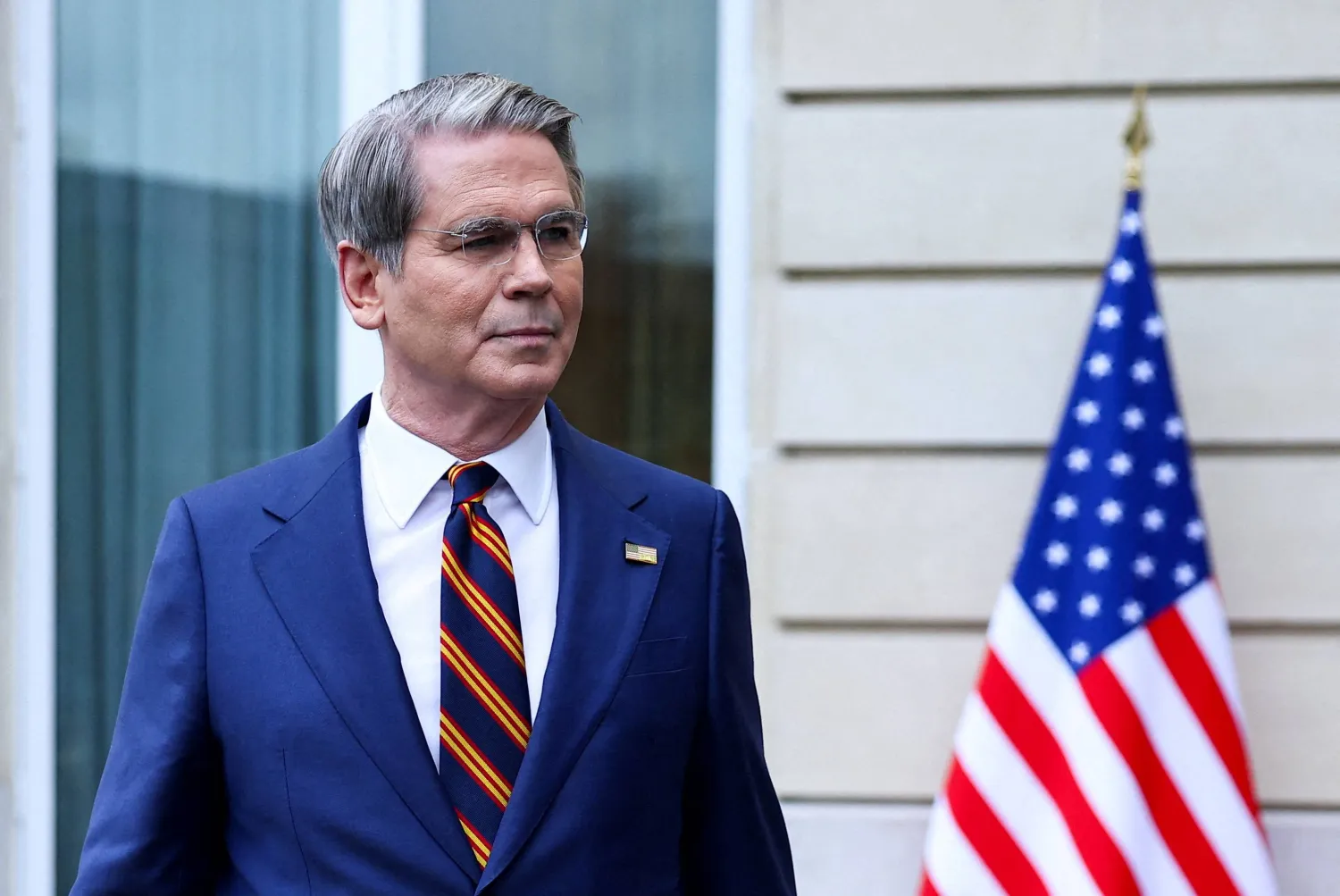
US Treasury Secretary Scott Bessent looks on as he speaks to the media after two days of meetings with a Chinese delegation, in Paris, France March 16, 2026. (Reuters)
TT

US Allows 30-Day Sale of Iran Oil at Sea in Bid to Tame Prices

US Treasury Secretary Scott Bessent looks on as he speaks to the media after two days of meetings with a Chinese delegation, in Paris, France March 16, 2026. (Reuters)

The Trump administration waived sanctions on the purchase of Iranian oil at sea for 30 days on Friday in its latest attempt to ease oil prices that have been driven up by the US-Israeli war on Iran.

The waiver will bring some 140 million barrels of oil to global markets and help relieve pressure on energy supply, Treasury Secretary Scott Bessent posted on X.

The move reflects White House worries that the surge in oil prices after nearly three weeks of US and Israeli strikes on Iran will hurt US businesses and consumers ahead of the November midterm elections, when President Donald Trump's fellow Republicans hope to retain control of Congress.

THIRD SANCTIONS WAIVER DURING IRAN WAR

The license, posted to the Treasury Department's website after market hours, says Iranian oil can be imported into the United States under the waiver when necessary to complete its sale or delivery.

The US has not meaningfully imported Iranian oil since Washington imposed ‌measures after the ‌1979 revolution. It was unclear whether any Iranian oil would end up in the country ‌as ⁠a result of the ⁠waiver.

Cuba, North Korea and Crimea are among regions excluded from the license, which will remain in effect until April 19.

The move is expected to benefit Asia, the top buyer of Middle Eastern oil. Energy Secretary Chris Wright said supplies could get to Asia within three or four days and hit the market after being refined over the coming month and a half.

Independent Chinese refiners have been the main buyers of sanctioned Iranian oil, taking advantage of deep discounts as others avoided such purchases. India, South Korea, Japan, Italy, Greece, Taiwan and Türkiye were also major buyers of Iranian crude before US sanctions were reimposed in 2018.

This is the third time the Treasury Department has temporarily waived ⁠sanctions on oil from US adversaries in a little more than two weeks. The moves ‌are part of the administration's attempts to tame energy prices that have soared above $100 ‌a barrel to the highest levels since 2022.

The US previously eased sanctions on Russian oil and on Friday issued a general license allowing ‌the sale of Iranian crude oil and petroleum products loaded on vessels by Friday.

"In essence, we will be using the ‌Iranian barrels against Tehran to keep the price down as we continue Operation Epic Fury," Bessent said.

Bessent had telegraphed the move in an interview with Fox Business on Thursday, saying the release of the sanctioned Iranian oil into global supplies would help keep oil prices down for 10 to 14 days.

He said on Friday that Iran will have difficulty accessing any revenue generated by the move and Washington will maintain maximum pressure on Iran and ‌its ability to access the international financial system.

'RUNNING OUT OF OPTIONS'

Oil prices have jumped about 50% since the US and Israel launched their attacks on February 28. Tehran has responded ⁠with attacks on Israel and Gulf ⁠states that host US bases.

Vital energy infrastructure in Iran and neighboring Gulf states has been attacked, and Iran has effectively closed the Strait of Hormuz, conduit for some 20% of the world's oil and liquefied natural gas.

In its effort to tame oil prices, the Trump administration on Wednesday announced a 60-day waiver of the Jones Act shipping law, temporarily allowing foreign-flagged vessels to move fuel, fertilizer and other goods between US ports.

Energy analysts including Brett Erickson, a managing principal at Obsidian Risk Advisors, have said the administration's efforts to control prices will not have a meaningful impact until the strait is opened to vessels.

"The easing of sanctions raises concerns about the rapid depletion of Washington's economic toolkit," to dampen oil prices, Erickson said. "If we've reached the point of loosening sanctions on the country we are at war with, we're really running out of options."

The US issued a 30-day waiver for countries to buy sanctioned Russian oil stranded at sea after a 30-day license on March 5 specifically for India to buy Russian oil.

Mark Dubowitz, CEO of the Foundation for the Defense of Democracies, a nonprofit research institute considered hawkish on Iran, praised the decision.

"We've worked on sanctioning Iran’s oil industry for years. This is a smart move ... to help win the fight against the regime," Dubowitz said on X.



Russia Opposes Hormuz Blockade, Interfax Reports

The reactor building of Iran's nuclear power plant and electricity poles are seen, at Bushehr, Iran, 750 miles (1,245 kilometers) south of the capital Tehran, Iran, Feb. 27, 2005. (AP Photo/Vahid Salemi, File)
TT

Russia Opposes Hormuz Blockade, Interfax Reports

The reactor building of Iran's nuclear power plant and electricity poles are seen, at Bushehr, Iran, 750 miles (1,245 kilometers) south of the capital Tehran, Iran, Feb. 27, 2005. (AP Photo/Vahid Salemi, File)

Russia opposes any blockade of the Strait ‌of ‌Hormuz but ‌says ⁠such issues must ⁠be viewed in ⁠the context ‌of ‌the broader ‌global ‌situation, Interfax reported ‌on Monday, citing the ⁠Russian Foreign ⁠Ministry.

In a statement the Ministry said: “We hope the United States acts wisely and not threaten Bushehr nuclear power plant”.

US President Donald Trump and Iranian leaders traded threats over the key Strait of Hormuz, amid threats that the US-Israel war on Iran could last several more weeks.

With the conflict now in its fourth week and showing no sign of ending, the head of the International Energy Agency warned of the worst global energy crisis in decades and said the world economy was under "major threat" from it.

Observers, meanwhile, have also raised the prospect of a surge in inflation that could force central banks to hike interest rates, while the choking off of fertilizer shipments has also fanned concerns about global food security.

The US president on Saturday gave Iran 48 hours to reopen the Strait of Hormuz to shipping or face the destruction of its energy infrastructure.

The ultimatum, made just a day after the US leader said he was considering "winding down" military operations, came as the waterway -- through which a fifth of global oil and gas flows -- remained effectively closed.


Japanese National Returns Home After Monthslong Detention in Iran

 Japan's Minister of Foreign Affairs Toshimitsu Motegi delivers his opening remarks at the 28th ASEAN Plus Three Summit in Kuala Lumpur, Malaysia, Monday, Oct. 27, 2025. (Reuters)
Japan's Minister of Foreign Affairs Toshimitsu Motegi delivers his opening remarks at the 28th ASEAN Plus Three Summit in Kuala Lumpur, Malaysia, Monday, Oct. 27, 2025. (Reuters)
TT

Japanese National Returns Home After Monthslong Detention in Iran

 Japan's Minister of Foreign Affairs Toshimitsu Motegi delivers his opening remarks at the 28th ASEAN Plus Three Summit in Kuala Lumpur, Malaysia, Monday, Oct. 27, 2025. (Reuters)
Japan's Minister of Foreign Affairs Toshimitsu Motegi delivers his opening remarks at the 28th ASEAN Plus Three Summit in Kuala Lumpur, Malaysia, Monday, Oct. 27, 2025. (Reuters)

Japan's top government spokesperson said Monday that one of two Japanese nationals detained in Iran has safely returned home in good health.

Chief Cabinet Secretary Minoru Kihara's confirmation came one day after Foreign Minister Toshimitsu Motegi announced the person's release.

Motegi, speaking on a Fuji Television talk show Sunday, said the person had been detained since last year and was released on Wednesday. He said the person took a flight from Azerbaijan.

Kihara, at a regular news conference Monday, confirmed that the former detainee returned to Japan on Sunday in good health.

Kihara said another Japanese national who was arrested earlier this year is still in custody but “we have confirmed that there is no problem with the safety and health" of the person and that Japan is continuing to press Iran for a release as soon as possible.

Motegi said the release came after his repeated demands to Iranian Foreign Minister Abbas Araghchi and that he is “working to win an early release” of the other detainee while communicating with his family and other concerned parties.

The Committee to Protect Journalists has named the person detained in Iran in January as a journalist at Japan’s public broadcaster NHK. The CPJ said the NHK journalist was arrested Jan. 20 by the Iranian Revolutionary Guard Corps and was transferred Feb. 23 to Evin Prison, quoting unidentified sources citing fear of persecution.

Motegi did not identify either of the people detained but said the released Japanese national was detained in 2025.

The Foreign Ministry said earlier this month the detainees were safe and in good health, but only acknowledged that one was detained last year and the other one in January.

The ministry has given no further details and did not say whether the two cases were related.


French Far Right Fails to Win in Major Cities in Boost to Mainstream Rivals

Socialistes et Apparentes' MP and Paris' Mayoral candidate Emmanuel Gregoire (C) celebrates during the party's rally after winning the second round of France's 2026 municipal elections, at the Rotonde Stalingrad in Paris on March 22, 2026. (AFP)
TT

French Far Right Fails to Win in Major Cities in Boost to Mainstream Rivals

Socialistes et Apparentes' MP and Paris' Mayoral candidate Emmanuel Gregoire (C) celebrates during the party's rally after winning the second round of France's 2026 municipal elections, at the Rotonde Stalingrad in Paris on March 22, 2026. (AFP)

France's far-right National Rally (RN) failed to win control of any major city in Sunday's nationwide municipal election, a setback that gave hope to embattled mainstream parties ahead of next year's presidential election.

Marine Le Pen's nationalist euroskeptic party lost out in big target cities including Marseille and Toulon, although an ally, Eric Ciotti, who heads his own staunchly conservative UDR party, won in Nice, France's fifth-largest city.

The municipal votes were a test of both the depth of the far right's support base a year ahead of presidential elections to replace centrist Emmanuel Macron, and the resilience of mainstream parties in a fragmented political landscape.

Opinion polls project both Le Pen and her young protege Jordan Bardella would perform strongly in the 2027 race. Le Pen is awaiting a ruling in her appeal against an embezzlement conviction before deciding whether she will run for ‌a fourth time.

The 35,000 ‌separate municipal ballots typically focus on local issues and their outcome does not ‌offer ⁠a neat forecast ⁠of who will succeed Macron.

But they show trends in popularity and in the type of alliances that can be struck in an increasingly fragmented political landscape, and senior politicians from all parties were quick to claim Sunday's outcome was good news for them.

In Paris, Socialist Party candidate Emmanuel Gregoire fended off a challenge from conservative former minister Rachida Dati and ensured the French capital remains in left-wing hands.

NEXT STEP: THE PRESIDENTIAL ELECTION

Senior RN officials rejected suggestions the party's defeat in Toulon showed it had hit a "glass ceiling" ahead of the presidential election, saying it had won dozens of local constituencies where it ⁠previously had no presence.

"The National Rally and its candidates have achieved tonight, in this ‌municipal election, the biggest breakthrough in its entire history," RN chief ‌Bardella said.

His anti-immigration party held onto the southern city of Perpignan and won in other towns such as Menton and Carcassonne, also ‌in the south.

But the RN's failure to win larger cities, and in particular in Marseille, its most ‌coveted prize, may show limits to its growing popularity.

Meanwhile, with wins in Paris and Marseille, the Socialist Party, long weakened nationally, saw reasons for hope.

"Paris will be the heart of the resistance" to any union of the mainstream right and far-right, Socialist winner Gregoire said after he crossed Paris on a bicycle - a nod to the left's green policies in the French capital.

Senior politicians ‌on the mainstream right said the municipal elections showed they needed to be united to win - especially in next year's presidential election.

Former Prime Minister Edouard Philippe was ⁠re-elected mayor in his port ⁠city of Le Havre, in a boost to his hopes of running for president in 2027.

Philippe, a center-right politician who served as prime minister under the centrist Macron, said "there were reasons to be hopeful" in the values of France and that the extremes can be beaten.

MARSEILLE, PARIS

In the second-biggest city Marseille, the incumbent, Socialist Mayor Benoit Payan, was re-elected with 54% of the votes. He had been neck-and-neck with the RN in the first round, and was boosted after his hard-left rival pulled out of the run-off to prevent a far-right victory.

"This city, which some believed lost, showed its most beautiful face, showed that it was capable of resisting," said Payan.

The Socialist Party said it had also beaten Francois Bayrou, a center-right former prime minister of Macron, in the city of Pau.

The hard-left France Unbowed (LFI) won in the northern city of Roubaix, a city of nearly 100,000 and in the Saint-Denis suburb of Paris. The party put forward its highest number of candidates in local elections.

"Traditional parties are losing ground," Manuel Bompard, of LFI, said.