Attack on Iraqi Intelligence HQ Ends Opportunities for Dialogue between Govt, Armed Factions

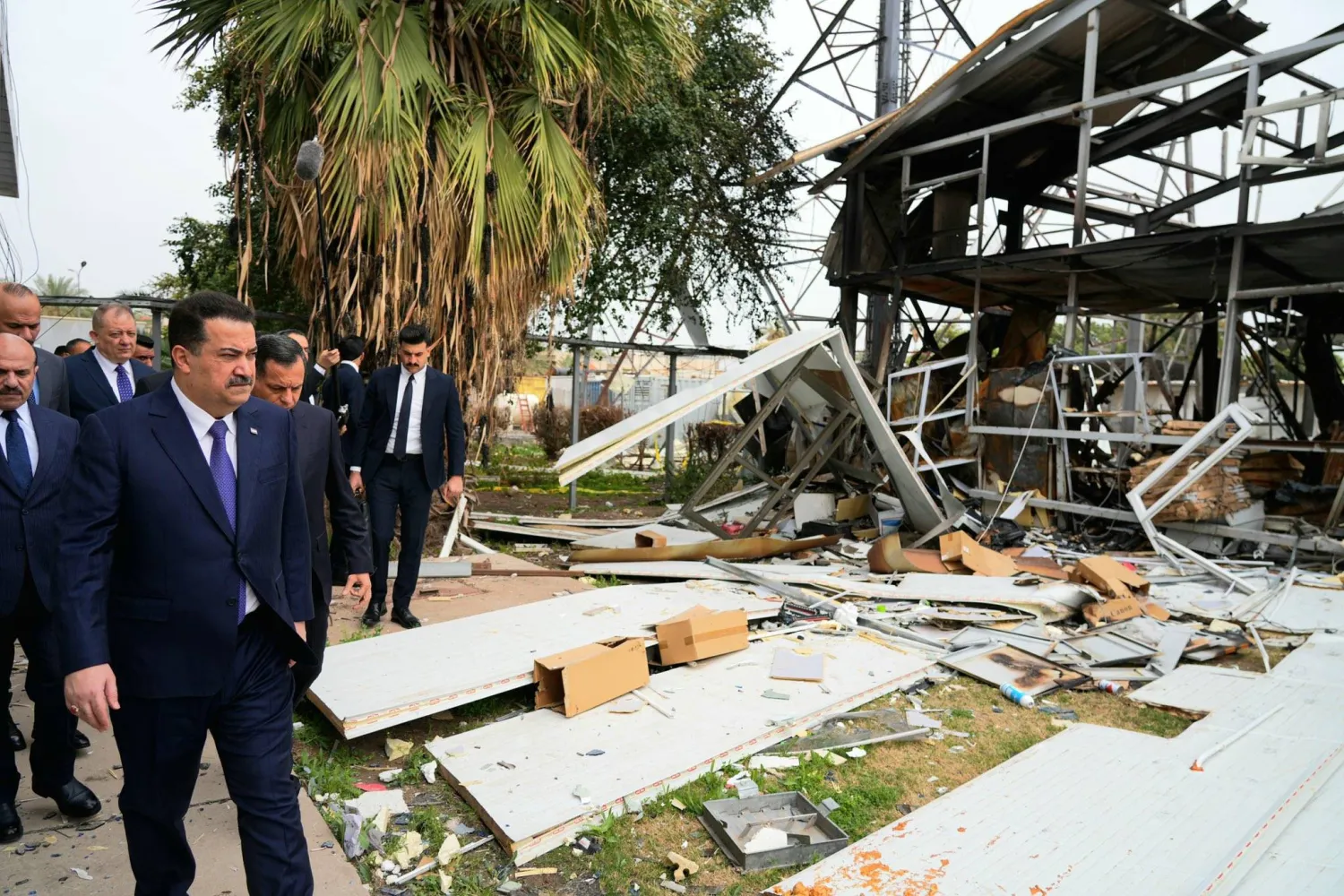
Iraqi Prime Minister Mohammed Shia al-Sudani visits the intelligence HQ in Baghdad on Sunday after Saturday's attack. (Iraqi Prime Minister’s Office)
TT

Attack on Iraqi Intelligence HQ Ends Opportunities for Dialogue between Govt, Armed Factions

Iraqi Prime Minister Mohammed Shia al-Sudani visits the intelligence HQ in Baghdad on Sunday after Saturday's attack. (Iraqi Prime Minister’s Office)

Iraqi Prime Minister Mohammed Shia al-Sudani slammed on Sunday the attack by a “cowardly” armed faction against an intelligence headquarters in Baghdad.

His position effectively puts an end to opportunities to hold dialogue between his government and the factions to stop their attacks on various US interests in Iraq and Kurdistan in solidarity with Iran in its war with Washington and Tel Aviv.

One officer was killed and other intelligence personnel were wounded in Saturday’s drone attack.

Sudani called on the political forces to take a “clear and frank” stance against the attacks on state institutions, a reference to some members of the pro-Iran Shiite Coordination Framework that have yet to make their position clear about the attacks.

The factions continue to target the US embassy in Baghdad and have struck a diplomatic logistics support base affiliated with the embassy at Baghdad airport and the US consulate in the Kurdistan Region capital Erbil.

Sudani visited the intelligence headquarters on Sunday, urging the concerned agencies to investigate the “heinous terrorist” attack.

He called on them to not hesitate in exposing the truth and bringing the perpetrators to justice.

“The perpetrators are a cowardly group that have violated Iraqi blood and state institutions. Whoever dares to do so does not represent Iraq. There can be no justification for this crime,” he added.

“The government is acting wisely and responsibly, but it will not stand idly as the country’s higher interests are violated,” he went on to say.

Sudani called on the political forces to “assume their responsibilities and issue clear and frank statements against the violations that are gambling with the future of the country.”

“Some party gave itself the right to control decisions of war and peace. We declare that this decision is the state’s alone. It alone sets and protects Iraq’s interests,” he stressed.

The national intelligence agency said outlaws had carried out Saturday's “terrorist” attack.

Sudani also denied reports that he had tasked national security advisor Qasim al-Araji to hold dialogue with the armed factions to make them stop attacks on US interests and residential neighborhoods in Baghdad.


Egypt Permanently Lists Muslim Brotherhood as Terrorist Organization

A scene from a previous trial of Muslim Brotherhood members in Egypt (File photo: AFP). 
TT

Egypt Permanently Lists Muslim Brotherhood as Terrorist Organization

A scene from a previous trial of Muslim Brotherhood members in Egypt (File photo: AFP). 

Egyptian authorities have permanently placed the Muslim Brotherhood on the country’s list of terrorist entities, according to decisions by the Public Prosecution published in the Official Gazette on Monday.

The Brotherhood has been designated a terrorist organization in Egypt since 2013 and has been placed on the country’s terrorist entities list several times.

Most of its senior leaders, including Supreme Guide Mohamed Badie, remain in Egyptian prisons in cases involving violence and murder following the group’s removal from power that year.

Other Brotherhood members wanted by Egyptian authorities remain abroad, where they continue to lead the organization amid deep internal divisions, according to observers.

Under the latest decisions, the Public Prosecution terminated the effects of two temporary listings issued in 2022: Decision No. 6 concerning terrorist entities and Decision No. 13 concerning individuals designated as terrorists. Both were published in Egypt’s official legal gazette, Al-Waqa’i Al-Masriyya, on January 3, 2023.

Prosecutors also ordered the Brotherhood’s permanent inclusion on the list of terrorist entities.

The decision permanently added three Brotherhood figures convicted under final, binding court rulings to the list of designated terrorists.

They were identified as Abdel Rahman Hassan Mohamed Meligy, Jamal Abdel Hamid Jomaa and Osama Ibrahim Mohamed Mostafa.

The Public Prosecution cited Law No. 8 of 2015, governing lists of terrorist entities and individuals, and its subsequent amendments as the legal basis for the decisions.

A judicial source familiar with the procedures explained that listing an individual as a terrorist automatically triggers measures including asset freezes, travel bans, placement on arrival watchlists and the withdrawal or cancellation of passports.

According to observers, publication of the decision in the Official Gazette also activates a range of restrictions against the Brotherhood, including a ban on the organization, suspension of all its activities and closure of its premises.

The measures prohibit direct or indirect financing, fundraising and the collection of material donations on its behalf, as well as civic or religious outreach activities conducted under any name.

Local media reports on Monday explained that the main distinction between temporary and permanent designation lies in their legal basis.

Temporary listing follows a judicial decision issued at the request of the prosecutor general, while permanent designation is based on a final criminal conviction against an organization or individual.

International Campaign Against Brotherhood Expands

The campaign against the Muslim Brotherhood has expanded across the Arab world and internationally in recent months.

In May, US President Donald Trump’s administration discussed a national counterterrorism strategy that focused primarily on the Brotherhood, portraying it as the ideological source of modern extremist terrorism.

The move followed Washington’s designation in January of the Muslim Brotherhood in Egypt and its branches in Jordan and Lebanon as terrorist organizations.

In March, the United States added the Brotherhood’s Sudanese branch to the same list.

Argentina also moved earlier this year to designate the Brotherhood’s branches in Egypt, Jordan and Lebanon as terrorist organizations.


Palestinians Await Eisenkot Govt While Not Expecting Radical Change

Israeli Prime Minister Benjamin Netanyahu (second from left) and Palestinian President Mahmoud Abbas (second from right) at a meeting in New York in 2009. (AFP/Getty Images)
TT

Palestinians Await Eisenkot Govt While Not Expecting Radical Change

Israeli Prime Minister Benjamin Netanyahu (second from left) and Palestinian President Mahmoud Abbas (second from right) at a meeting in New York in 2009. (AFP/Getty Images)

Palestinian leaders are closely watching Israeli Prime Minister-designate Gadi Eisenkot’s efforts to form a government and unseat Benjamin Netanyahu, hoping for a shift in Israeli policy after four years of hostility.

Although the Palestinian Authority (PA) has refrained from commenting publicly on Israel’s election results, officials are scrutinizing Eisenkot’s statements and political moves for signs of a possible change in relations.

The PA has maintained its longstanding position that Israeli elections are an internal matter. Yet few have more at stake in the outcome after four years in which Netanyahu’s government waged an unrelenting campaign against the Palestinian Authority and Palestinians in the West Bank and Gaza Strip.

Palestinian officials, including President Mahmoud Abbas, declared before the elections that they were prepared to engage with any Israeli government. They have stopped short, however, of speaking of a new chapter in relations.

Judging policies, not personalities

Mahmoud al-Habbash, an adviser to Abbas, stressed that the PA would judge any incoming Israeli prime minister by their policies and positions on the Palestinian issue.

“It is too early to judge Eisenkot,” Habbash told Asharq Al-Awsat. “We do not judge individuals. Frankly, the names of those governing Israel do not matter to us.”

“What matters are their actual positions, policies and programs concerning the Palestinian issue, and their commitment to international legitimacy and international law,” he stressed.

These factors will determine the PA’s relationship with any Israeli prime minister or government, he added.

Habbash declined to say whether Eisenkot was the PA’s preferred candidate, reiterating that it was premature to assess him or a government he had yet to form.

Nevertheless, he said: “We hope for a different Israeli leadership that respects international legitimacy and the agreements signed, beginning with Oslo, the Paris Agreement and subsequent accords.”

Such a leadership should have the willingness, determination and political program to put negotiations back on track toward an agreement ending the current situation, he said.

Eisenkot opposes the establishment of a Palestinian state, the PA’s central political objective. However, he has shown greater openness than Netanyahu toward strengthening the PA and transferring withheld Palestinian revenues.

He has also previously argued against Israel directly ruling millions of Palestinians in the West Bank and Gaza as an occupying power.

Habbash stressed that relations between Palestinians and the Israeli government involve interconnected political, economic and administrative issues.

“These range from everyday matters affecting people’s lives and needs to clearance revenues, compliance with signed agreements and, ultimately, Israel’s position on our legitimate national rights,” he explained.

“If Eisenkot translates his words into action, we will respond positively and remain open to dialogue,” Habbash affirmed.

‘Anyone is better than Netanyahu’

Behind closed doors, PA officials said that almost any alternative would be preferable to Netanyahu, whom they accuse of seeking to dismantle the Authority, displace Palestinians and eliminate their national cause.

They have avoided making such views public for fear their statements could be exploited in Israel’s domestic political struggle.

“It is not about Eisenkot. Any Israeli would be better for us than Netanyahu and his current government,” a senior Palestinian official told Asharq Al-Awsat. “This is the most hostile government Palestinians have ever known - a government of extermination.”

During Israel’s 2022 elections, the PA reportedly sought to help defeat Netanyahu, prompting Israel’s domestic security agency, Shin Bet, to warn against interference in the electoral process.

This time, the PA did not seek to intervene, but maintained various channels of communication with Arab party leaders.

Palestinian officials have expressed pride in the number of seats won by Arab parties in the Knesset, whose electoral gains effectively prevented Netanyahu from remaining in power.

Improve conditions

At a minimum, Palestinian officials hope Eisenkot will ease economic pressures and improve security conditions in the occupied territories.

“We are not suggesting that Eisenkot is a savior. We know he will not lead us to statehood,” an informed Palestinian source told Asharq Al-Awsat.

“But many other crucial issues are at stake: the future of the PA, the economy, clearance revenues, the West Bank, security conditions, settler violence, the future of Gaza, reconstruction and governance.”

The source hoped for progress on these issues, describing any improvement as a potential foundation for further engagement. Nevertheless, the Palestinian leadership remains cautious and does not expect a decisive policy shift.

Change in form, not substance

Palestine Liberation Organization Executive Committee member Wasel Abu Yousef was more skeptical, saying that a change in Israeli leadership would affect appearances rather than fundamental policy.

“There may be change, but it will be in form, not substance,” he told Asharq Al-Awsat.

“They agree on legitimizing settlements, preventing the establishment of a Palestinian state, separating the Gaza Strip and rejecting international resolutions. They are pursuing the Greater Israel project and, to varying degrees, denying the rights and existence of the Palestinian people.”

Meaningful change would require recognition of Palestinian self-determination and the establishment of an independent state in the West Bank, Gaza Strip and East Jerusalem, he said.

Habbash similarly reiterated the PA’s willingness to engage while insisting that economic relief alone could not resolve the conflict.

“Our cause is not merely about daily living conditions or improving livelihoods. It is about political rights, foremost among them the establishment of a Palestinian state and an end to the occupation.”


Lebanese Army Chief’s Remarks Spark Political Row

Lebanese President Joseph Aoun, Army Commander Gen. Rodolphe Haykal and security chiefs inspect a State Security building struck by Israel (File photo: Lebanese Presidency). 
TT

Lebanese Army Chief’s Remarks Spark Political Row

Lebanese President Joseph Aoun, Army Commander Gen. Rodolphe Haykal and security chiefs inspect a State Security building struck by Israel (File photo: Lebanese Presidency). 

Remarks by Lebanese Army Commander Gen. Rodolphe Haykal on the military’s role and national policy have sparked a political dispute over the army’s authority, its relationship with the government and who has the right to define patriotism.

Addressing troops, Haykal declared: “The army’s policy is the national policy, and anyone who does not agree with it is on the other side.”

He added: “Anyone who speaks ill of their country’s army is not suited to Lebanon and has no right to be here.”

The comments drew criticism from lawmakers who accused Haykal of overstepping his authority, while supporters defended the military as a pillar of stability and national unity that should remain above political disputes.

Lawmakers Challenge Army Chief

The controversy comes amid accusations that the army leadership has been slow to implement government decisions to place Hezbollah’s weapons under state control.

Supporters of the military command argue that its cautious approach is intended to preserve civil peace and prevent political divisions from undermining the army’s unity.

MP Waddah Sadek questioned whether Lebanon was now “under military rule” in which the army determined who was patriotic.

“Is the Taif Agreement no longer in force? Has the government’s collective authority to determine national policy been taken away?” he asked, calling the situation “extremely dangerous.”

MP Michel Douaihy stressed that Lebanese citizens had both the right and the duty to scrutinize state institutions, including the army, without anyone monopolizing the definition of patriotism or questioning their national allegiance.

Fellow lawmaker Mark Daou insisted that national policy was determined by the president and government and approved by parliament.

“It is not for you to decide what constitutes national policy or who supports or opposes it,” he told Haykal.

“In a democratic state, your duty is to protect all political viewpoints, remain politically neutral and focus on security, where the results so far have been very limited, if not a failure.”

Supporters Defend Haykal

Free Patriotic Movement MP Jimmy Jabbour described Haykal’s remarks as “self-defense” against a sustained political campaign targeting the military through press reports and leaks.

Jabbour told Asharq Al-Awsat that some politicians sought to exploit state institutions for their own interests and were prepared to push the army into confrontation, even at the risk of civil war.

“Those who have no objection to that will have no problem attacking the commander,” he argued, accusing the army’s critics of undermining the sovereignty they claim to defend and seeking to tie Lebanon to Israel.

Hezbollah and Amal Movement lawmakers also defended Haykal.

Hezbollah MP Hassan Fadlallah described the “resistance and the Lebanese Army” as Lebanon’s two pillars of strength and cohesion, essential to liberating territory and protecting the country.

He accused critics of waging a campaign against both institutions to revive plans for sectarian mini-states, which he portrayed as serving an Israeli project to fragment the region.

Fadlallah warned against undermining civil peace and internal unity, arguing that the army was being targeted precisely because it was carrying out its national duty.

Amal MP Qabalan Qabalan thanked Haykal for steering the national debate “in the right direction,” saying his remarks had reassured Lebanese citizens worried about the country’s future.

“Despite all the difficult circumstances, hope remains in the national army to protect the country and its people, safeguard sovereignty and defend our land and national dignity. The army remains the guarantor,” he maintained.

Legal Expert: Army Must Follow Government Policy

Constitutional expert Dr. Said Malek emphasized that the army commander is appointed by Cabinet decree on the defense minister’s recommendation under Article 19 of Legislative Decree 102/83, Lebanon’s National Defense Law.

As a public official, the commander is subject to the Cabinet’s authority and must abide by government policy, Malek told Asharq Al-Awsat.

“The Cabinet alone has the authority to set general policy in all areas, including political, foreign, domestic, security and military affairs,” he explained.

Any departure from government policy would constitute a violation carrying legal consequences, he warned.

“The army commander cannot establish a separate policy for the military. Its policy must follow that of the government, without independent interpretation.”