Rome: By Anya von Bremzen
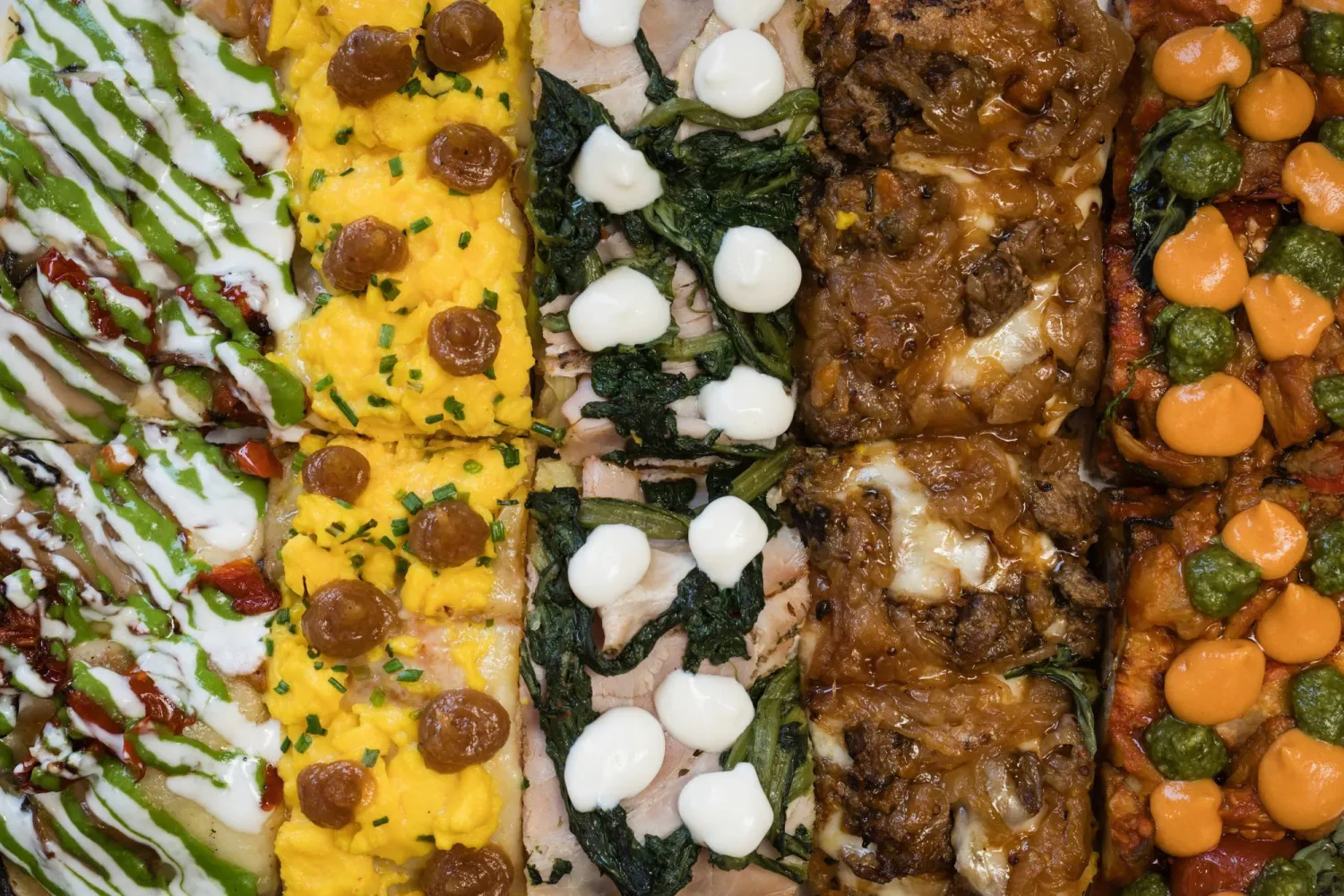
The rectangles of pizza al taglio behind the counter of shoebox-size Frumentario, in Rome’s workaday San Giovanni district, resembled fantastical still lifes.
One was topped with softly scrambled eggs glowing saffron beneath a blizzard of chives; another had spindly wild greens called agretti looping over pink ribbons of ham. A third was a mosaic of earthy tones: cardoncelli mushrooms scattered across a golden crust and punctuated with ruby shards of tomato confit.
Then the young pizzaiolo Alessandro Santilli anointed each order with a last-minute flourish, dolloping onion-and-guanciale jam onto the eggs, drizzling demi-glace over a tableau of fried artichokes, beef and sheep’s milk ricotta. “Frumentario” alludes to the grain laws through which ancient Rome provisioned its masses. “I wanted to offer something creative, but at populist prices,” said Santilli, who usually offers some 20 toppings a day (from 3 euros, or about $3.50, per portion).
Welcome to the new golden age of pizza romana.
For years, the round, puffy-edged Neapolitan pie dominated the Italian pizza narrative. Today, Rome is eclipsing it by reinventing its own traditions, starting with the vernacular pizza al taglio — literally, “pizza by the cut” — those long rectangular slabs or oblongs hacked to order and sold by weight.
Pizza romana originated in bread bakeries as a humble snack, served bianca (plain) or red with tomato sauce, said Pierluigi Roscioli, the third-generation baker behind Antico Forno Roscioli, and part of the family that’s given us the celebrated Salumeria Roscioli.
In the 1960s and ’70s, immigrants from Abruzzo, he said, brought their pizza in teglia (pizza in an iron pan) to the Italian capital, and the two lineages merged.
Roscioli went on to transform pizza bianca into Rome’s most coveted carb unit, with long fermentations of dough and fanatical attention to detail.
In 2003, the star pizzaiolo Gabriele Bonci sparked his own movement when he opened Pizzarium with thick sourdough crusts and toppings like vanilla-scented potatoes.
Now a “Roman pizza 3.0” generation is shaking things up.
And so, during a recent stay in Rome, I succumbed to a delicious carb-on-carb overload in pursuit of the city’s most exciting pizza developments.
“Today, Rome’s best pizza al taglio isn’t just about a beautiful counter display,” said Sara Bonamini, the co-founder of Tulipane bakery and the former editor of Gambero Rosso’s Pizzerie d’Italia guide. “It’s about taking something simple and making it with tremendous care, so that every piece carries a story, a heritage.”
She could have been describing the work of Francesco Arnesano of Lievito.
The 31-year-old baker-pizzaiolo, with two shops in the EUR district, told me that great pizza al taglio is about coaxing the ultimate expression from just a few special ingredients.
I appreciated this wisdom while sampling his rectangles topped with white wine-braised meatballs and emerald seasonal peas, then fluffy Lazio potatoes slow-poached in butter, followed by pizza bianca filled with housemade Fassona roast beef, pickled giardiniera and citrusy mayo (from 3 euros per portion).
The secret to his deeply complex pizza crust? A cuvée of flours milled by the Sicilian grain guru Filippo Drago.
“There is soft wheat for structure,” Arnesano explained with professorial poise, “hard durum for crunch, and whole-grain spelt plus some rye for aroma and flavor.”
“Oh, and Drago’s soft wheat comes from an evolutionary population,” he added, a genetically diverse mix of varieties grown together so the plants adapt naturally to local conditions.
For those unwilling to trek to far-flung quartieri, two of the city’s most exciting addresses are found around Circo Massimo. During a June heat wave, the archaeological site was too scorching to wander. Instead, my partner and I perched on shaded stools outside tiny Ruver Teglia Frazionata, under a red-and-white banner proclaiming: LESS DRAMA MORE PIZZA.
A former Bonci disciple, Alessandro Ruver opened this spot in 2023 at age 29, quickly drawing attention with signature toppings like a ricotta-spinach raviolo reimagined as pizza, and a “Raguver” involving a soulful ragu of Chianina beef roasted for hours.
Inspired by recent visits to Istanbul, Ruver has created an Adana kebab pizza.
I marveled at cumin-scented lamb and veal scattered over roasted eggplant and green friggitelli peppers under drizzles of tangy sheep’s-milk kefir. Was it the coolest cross-cultural mash-up ever to happen to pizza? Or was that his croque madame riff with artisanal ham, organic eggs and a wickedly luscious melt of 30-month Comté cheese (from 2.5 euros per portion)?
By the other side of Circo Massimo, Fratelli Trecca is the latest venture from the brothers Manuel and Nicolo Trecastelli, whose Pantera Pizza Rustica and trattoria Trecca Roma, both in the Ostiense neighborhood, have legions of fans.
Their new pizzeria, all marble tables and AS Roma soccer memorabilia, replaced Circoletto, their natural wine bar. You can still order it here, tucked inside warm pizza bianca, an unctuous, gloriously messy bite.
“We’ve had lots of fun transplanting trattoria dishes onto pizza al taglio,” Manuel said gleefully, meaning tripe in bright tomato sauce, oniony chicken-gizzard ragu, and a faux coda alla vaccinara starring celery instead of braised oxtail (from 2.5 euros per portion).
Trecca’s crust was a small miracle of dough engineering: shatteringly crisp, almost mille-feuille-like, yet sturdy enough for the weightiest toppings. “It took years of tinkering,” Nicolo said, while I devoured a seasonal slice topped with a mélange of raw late-spring tomatoes.
If pizza al taglio is a lunchy snack, at night Romans dine on their own tonda (round) pizza.
The crust? Sottile (thin) and croccante (crispy) — adjectives utterly reviled in Naples.
Romans call this crust scrocchiarella, and they love it so much that it took some heroic maneuvers to score an impossible Saturday-night reservation at 180 Grammi, the current it pizzeria in far-flung Centocelle, a working-class quarter turned foodie enclave on Rome’s eastern edge.
Thirtysomething owner Jacopo Mercuro abandoned a legal career and opened 180 Grammi — named for the weight of a dough ball — in 2018.
Since then he’s won every accolade for his crust with deliciously singed edges that crackle, and toppings ranging from classic to iconoclastic.
We started with a witty creation involving dusky salami, buffalo mozzarella, and a spicy house sauce of honey, fermented chilies and ‘nduja. Just as I thought no carb can surprise, a pizza arrived deconstructing (gulp) ketchup, with a base of roasted tomatoes, blobs of mayo inspired by ketchup’s original ingredients — mushrooms, ginger and soy — plus smoky-paprika crumbs adding texture (pies from 9 euros).
Matilde Serao, the great turn-of-the-20th-century chronicler of Naples, described pizza as the pronto soccorso dello stomaco — the stomach’s first aid for the Neapolitan poor. I contemplated her words over a multicourse pizza degustation at Seu Pizza Illuminati, the sleek, slate-hued Trastevere spot run by the celebrity pizzaiolo Pier Daniele Seu and his wife, Valeria Zuppardo, fresh from launching a pizza bar at the luxe Bulgari Hotel in Paris.
Neither Roman-crispy nor Neapolitan-puffy, Seu’s auteurish creations — feather-light dough blistered in a wood-burning oven — ran to things like a Margherita featuring a 24-hour reduction of San Marzano tomatoes, and a slice topped with a deconstruction of carrots — Cajun-spiced carrots, carrot chips and cream (signature pies from 15 euros; degustation menu from 35 euros).
There was also a dessert pizza riff on tiramisù, along with a killer sparkling wine list, and staff discoursing on esoteric tomato varieties. Yet all around also were big Roman families devouring Margheritas and capricciosas with beer. “We’re still a neighborhood pizzeria at heart,” Seu said.
The New York Times