


Israeli Minister Calls for Annexation of Southern Lebanon

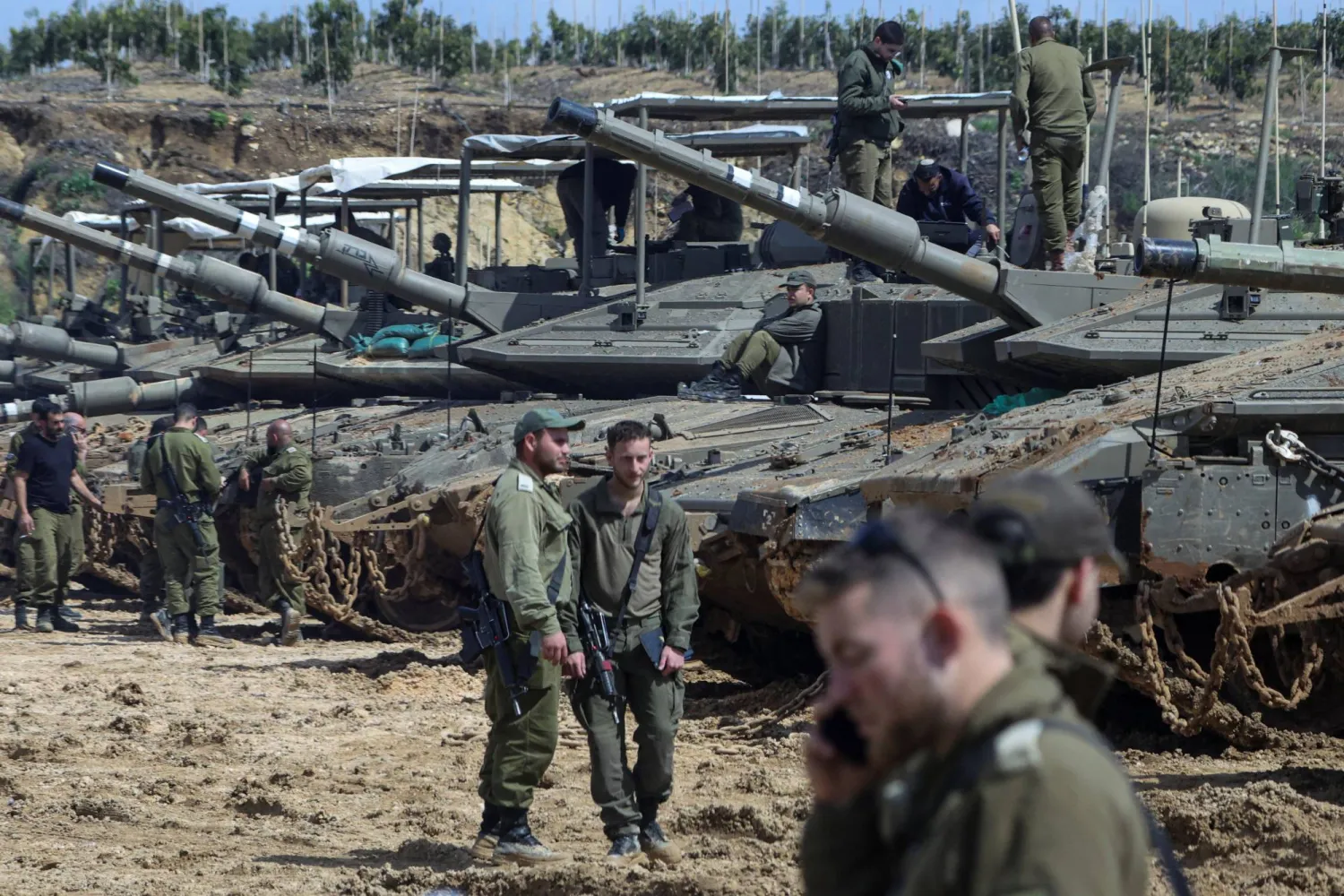
Israeli soldiers stand next to tanks near the Israeli side of the border with Lebanon, March 23, 2026. REUTERS/Tyrone Siu
TT

Israeli Minister Calls for Annexation of Southern Lebanon

Israeli soldiers stand next to tanks near the Israeli side of the border with Lebanon, March 23, 2026. REUTERS/Tyrone Siu

Israel should extend its border with Lebanon up to the Litani River deep inside the country's south, Israel's finance minister said on Monday as Israeli troops bombed bridges and destroyed homes in the area in an escalating military assault.

The comments by Finance Minister Bezalel Smotrich were the most explicit yet by a senior Israeli official on seizing Lebanese territory in a fight Israel says targets Iran-backed Hezbollah militants.

Lebanon was pulled into the regional war on March 2 when Hezbollah fired missiles into Israel. Since then, Israel has ordered all residents to leave the area south of the Litani River as it pummels the area with air strikes, viewing it as a Hezbollah stronghold.

Lebanese authorities say the Israeli air and ground assault has killed more than 1,000 people, and more than a million have been driven from their homes with Israel having ordered residents to flee swathes of the country.

'THE NEW ISRAELI BORDER MUST BE THE LITANI'

Smotrich told an Israeli radio program that the military campaign in Lebanon "needs to end with a different reality entirely, both with the Hezbollah decision but also with the change of Israel's borders."

"I say here definitively...in every room and in every discussion, too: the new Israeli border must be the Litani," Smotrich said.

Smotrich, leader of a small far-right party in Prime Minister Benjamin Netanyahu's cabinet, often makes comments that go beyond official Israeli policy.

Netanyahu's office did not immediately respond to a request for comment on the remarks. Defenسe Minister Israel Katz hinted earlier this month at plans to capture land, saying Lebanon could face "loss of territory" if it did not disarm Hezbollah.

Smotrich's remarks were deeply resonant in Lebanon, which is trying to emerge from a decades-old cycle of invasions and occupations by its neighbor. Israeli forces have launched repeated assaults on Lebanon since 1978 and occupied the south from 1982-2000.

A Lebanese official told Reuters that Beirut was still counting on foreign powers to put enough pressure on Israel to put an end to the war, through an offer from President Joseph Aoun to hold direct talks.

Smotrich also called for Israel to annex territory it now controls in the Gaza Strip, up to an armistice line with Hamas. A ceasefire signed in October left Israel in control of 53% of Gaza, where it has ordered residents out and bulldozed buildings.

The Israeli military says its troops in Lebanon are carrying out ground maneuvers and targeted raids on Hezbollah militants and weapons stores, aimed at protecting residents in northern Israel from Hezbollah fire.

The Lebanese government has outlawed Hezbollah military activity and said it wants to engage in direct talks with Israel.

ROUTES TO NORTH BEING CUT OFF

Over the weekend, Israel struck a main bridge linking south Lebanon with the rest of the country after ordering its military to destroy all crossings over the Litani River and to step up the demolition of homes near the southern border.

International law generally prohibits militaries from attacking civilian infrastructure, and the United Nations human rights chief has criticized Israel's actions in Lebanon, particularly its use of widespread evacuation orders.

Israeli strikes hit two more crossings on the Litani River on Monday -- a road running near a main bridge hit on Sunday and another small bridge on another section of the river.

Hanna Amil, the mayor of Christian border town Rmeish whose residents have refused to leave their homes, told Reuters that it was getting increasingly difficult to move around.

"Once or twice a week, a convoy from the Lebanese army accompanies us as we try to get basic goods from nearby areas," he said.

"Already, we have no state electricity, no water and we have diesel shortages. If all the routes to the north get cut off, who knows what the future could hold for us," Amil said.



Israeli Army Brings in Demolition Contractors to Raze Dozens of Lebanese Villages

Israeli military vehicles and armored units in front of destroyed buildings in southern Lebanon on April 15. (AFP)
TT

Israeli Army Brings in Demolition Contractors to Raze Dozens of Lebanese Villages

Israeli military vehicles and armored units in front of destroyed buildings in southern Lebanon on April 15. (AFP)

The Israeli army is using the ceasefire period to accelerate large-scale destruction in areas it occupies in southern Lebanon, which have been largely emptied of residents displaced by the conflict, according to local accounts.

Working around the clock across an area estimated at more than 800 square kilometers — about 8 percent of Lebanon’s territory — Israeli forces are systematically flattening buildings.

Confronted with the scale of the task and racing against time, the military engineering corps has enlisted private sector “demolition contractors,” some with experience in Gaza, to carry out operations in dozens of villages.

Using heavy machinery, including bulldozers and D9 units, they have begun what sources describe as a coordinated clearing campaign.

The occupied zone stretches from the Litani River to the internationally recognized border and has been divided into three sectors.

The first is a “total destruction” zone running along the entire Lebanese border strip, from the expanded Shebaa Farms area and the town of Khiam in the east, through Deir Siryan, to the coastal town of Bayyada in the west. Its depth ranges from about 3 kilometers at its narrowest point near Odaisseh to as much as 10 kilometers near Khiam.

This area is referred to by the Israeli army as the “yellow belt,” in reference to a similarly named line in Gaza. Civilian presence is effectively prohibited, with entry posing a serious risk to life.

The second sector extends from the “yellow belt” to the Litani River. Israeli forces have positioned this line along hilltops and elevated terrain to maintain direct visual oversight of the river corridor, despite advanced surveillance capabilities. Armed presence is banned in this zone, and civilian presence is strongly discouraged.

The area remains highly volatile, with Israeli troops on constant alert.

Reports indicate sporadic resistance operations, as well as the presence of minefields and ambushes. Tactics developed by Hezbollah since the 2006 war are being employed here. Most Israeli casualties reported in this area — 12 killed and around 30 wounded — occurred in this sector, which has also seen fire reach as far as the Tyre region.

The third sector extends from the Litani River northward to the Zahrani River. While not officially designated as occupied, it is subject to continuous aerial and maritime surveillance.

Israel believes Hezbollah uses this area as a launching ground for operations, including short- and medium-range rocket fire. Drones are reported to operate overhead day and night. Israeli assessments indicate that more than half of the roughly 8,000 rockets and shells fired from Lebanon originated from this zone.

Israeli military doctrine since Oct. 7, 2023, calls for layered security zones along each front — Lebanon, Syria and Gaza — including a fortified area inside Israel, a no-go “security belt” inside enemy territory, and a broader demilitarized zone.

Within Israel’s far-right leadership, some officials have embraced this approach as a precursor to expanding territorial control. Finance Minister Bezalel Smotrich has called for further expansion and the establishment of Israeli military bases elsewhere in the region.

On the ground, Israeli forces appear intent on consolidating control over the “yellow belt” by erasing all structures above and below ground, from homes to schools and public buildings, a strategy critics say is aimed at preventing displaced residents south of the Litani from returning, or ensuring they find nothing left if they do.

The army also faces domestic criticism, particularly from residents of northern Israel, who say it has failed to provide adequate security despite months of fighting. Israeli officials argue that such operations could help secure longer-term calm on the northern front through a political agreement.

The Haaretz newspaper quoted a senior officer as saying the goal is “not a return to rounds of fighting, but achieving long-term security,” adding that Hezbollah has been significantly weakened compared with its position before Oct. 7, 2023.


Hamas Gives ‘Positive Response’ in Cairo, Raising Hopes of Near-Term Deal

Palestinians in Khan Younis, southern Gaza Strip, on Saturday (AFP)
TT

Hamas Gives ‘Positive Response’ in Cairo, Raising Hopes of Near-Term Deal

Palestinians in Khan Younis, southern Gaza Strip, on Saturday (AFP)

Sources within Hamas said the group’s delegation in Cairo has delivered a “positive response” to a revised proposal from mediators, particularly Egypt, potentially paving the way for an agreement on Gaza soon.

Negotiations on the deal remain stalled. Hamas and other factions insist Israel must first meet its phase-one ceasefire commitments, including humanitarian relief and the entry of aid trucks into the enclave, before they undertake further obligations. Israel, backed by the US, is pressing to move directly to the central element of phase two: disarmament.

A senior Hamas source told Asharq Al-Awsat that Zaher Jabarin and Ghazi Hamad, members of the group’s political bureau and its negotiating delegation, have returned to Cairo after leaving last Tuesday for internal consultations. Khalil al-Hayya, who heads Hamas’s negotiating team, remained in Egypt to continue talks.

The delegation returned with a “positive answer” to a proposal for handling phases one and two in parallel, the source told Asharq Al-Awsat.

The mediators’ plan stipulates the immediate start of phase-one steps while discussions continue on phase two, with no second-phase measures implemented before full completion of the first. Progression within phase two would also be conditional on completing each preceding step.

Hamas has set conditions, including the swift entry of a Gaza administrative committee to assume agreed responsibilities, along with “clear and credible guarantees” within a defined timeline to ensure Israel carries out its obligations in both phases.

Sources said Hamas held broad consultations in recent days, inside and outside Gaza, involving all its internal bodies, including religious frameworks that have historically played a key role in decision-making.

They described a “consensus,” including from the group’s armed wing, the Qassam Brigades, in support of the mediators’ proposal and negotiations over potential amendments related to weapons.

Mediators are aiming for rapid negotiations on phase two while phase one is completed, with expectations that international actors, including the US, will press Israel to comply.

A Palestinian faction source in Cairo said “contacts and meetings are ongoing at all levels,” adding that many expect a breakthrough that could lead to a deal.

However, the outcome ultimately depends on Israel’s government, which has signaled through international envoy Nikolay Mladenov and US representatives that acceptance of the bridging proposal should include Hamas agreeing to disarmament.

Sources said mediators had asked the group to approve the proposal, while officials linked to the administration of Donald Trump and Mladenov had pushed for Hamas to sign a disarmament document before negotiations proceed — a demand the group fears could be used to impose terms it opposes.

During discussions, some factions proposed reducing phase two from eight months to three or four to accelerate humanitarian improvements and reconstruction in Gaza, particularly for displaced residents living in harsh conditions.

A senior Hamas official said the group has no objection to shortening the timeline, stressing its priority is to ensure implementation of any agreement to ease civilian suffering, including by enabling the Gaza administrative committee to begin relief and service delivery.


Israeli Military Publishes Map of South Lebanon Territory Under Its Control

 Israeli military vehicles drive in southern Lebanon, near the Israel-Lebanon border, amid a 10-day ceasefire between Lebanon and Israel, as seen from Israel, April 19, 2026. (Reuters)
Israeli military vehicles drive in southern Lebanon, near the Israel-Lebanon border, amid a 10-day ceasefire between Lebanon and Israel, as seen from Israel, April 19, 2026. (Reuters)
TT

Israeli Military Publishes Map of South Lebanon Territory Under Its Control

 Israeli military vehicles drive in southern Lebanon, near the Israel-Lebanon border, amid a 10-day ceasefire between Lebanon and Israel, as seen from Israel, April 19, 2026. (Reuters)
Israeli military vehicles drive in southern Lebanon, near the Israel-Lebanon border, amid a 10-day ceasefire between Lebanon and Israel, as seen from Israel, April 19, 2026. (Reuters)

The Israeli military published ‌for the first time a map of its new deployment line inside Lebanon on Sunday, bringing dozens of mostly abandoned Lebanese villages under its control, days after a ceasefire with Hezbollah took effect.

There was no immediate comment from Lebanese officials or from Iran-backed Hezbollah.

Israel and Lebanon agreed on Thursday to a US-backed ceasefire in fighting between Israel and Hezbollah. The deal, which followed the first direct talks in decades between Israel and Lebanon on April 14, is meant to enable broader US-Iran negotiations but with Israeli forces maintaining positions deep inside southern Lebanon.

Stretching east to west, the deployment line on the ‌map runs 5-10 km ‌deep from the border into Lebanese territory, where Israel ‌has ⁠said that it ⁠plans to create a so-called buffer zone. Israeli forces have destroyed Lebanese villages in the area, saying their aim is to protect northern Israeli towns from Hezbollah attacks.

It has created buffer zones in Syria and in Gaza, where it controls more than half the enclave.

"Five divisions, alongside Israeli Navy forces, are operating simultaneously south of the forward defense line in southern Lebanon in ⁠order to dismantle Hezbollah terror infrastructure sites and to ‌prevent direct threats to communities in northern ‌Israel," the military said in a statement accompanying the map.

Asked whether people who fled ‌the Israeli strikes would be allowed to return to their homes, ‌the Israeli military declined to comment.

Lebanese civilians have been able to access some of the villages that fall on or beyond the Israeli-set line, but Israeli forces still prevent people from accessing most of those south of the line, a Lebanese security ‌source said.

Israeli Defense Minister Israel Katz said on Sunday that homes on the border exploited by Hezbollah would ⁠be demolished and ⁠that "any structure threatening our soldiers and any road suspected of (being planted with) explosives must be immediately destroyed".

Lebanon was dragged into the war on March 2, when Hezbollah opened fire in support of Tehran, prompting an Israeli offensive that has killed more than 2,100 people, including 177 children, and forced more than 1.2 million to flee, Lebanese authorities say.

Hezbollah has not disclosed its casualty figures. At least 400 of its fighters had been killed by the end of March, according to sources close to the group.

Hezbollah has fired hundreds of rockets and drones at Israel. Its attacks killed two civilians in Israel while 15 Israeli soldiers have died in Lebanon since March 2, Israel says.