


Australia, EU Agree Sweeping New Trade Pact 8 Years in the Works

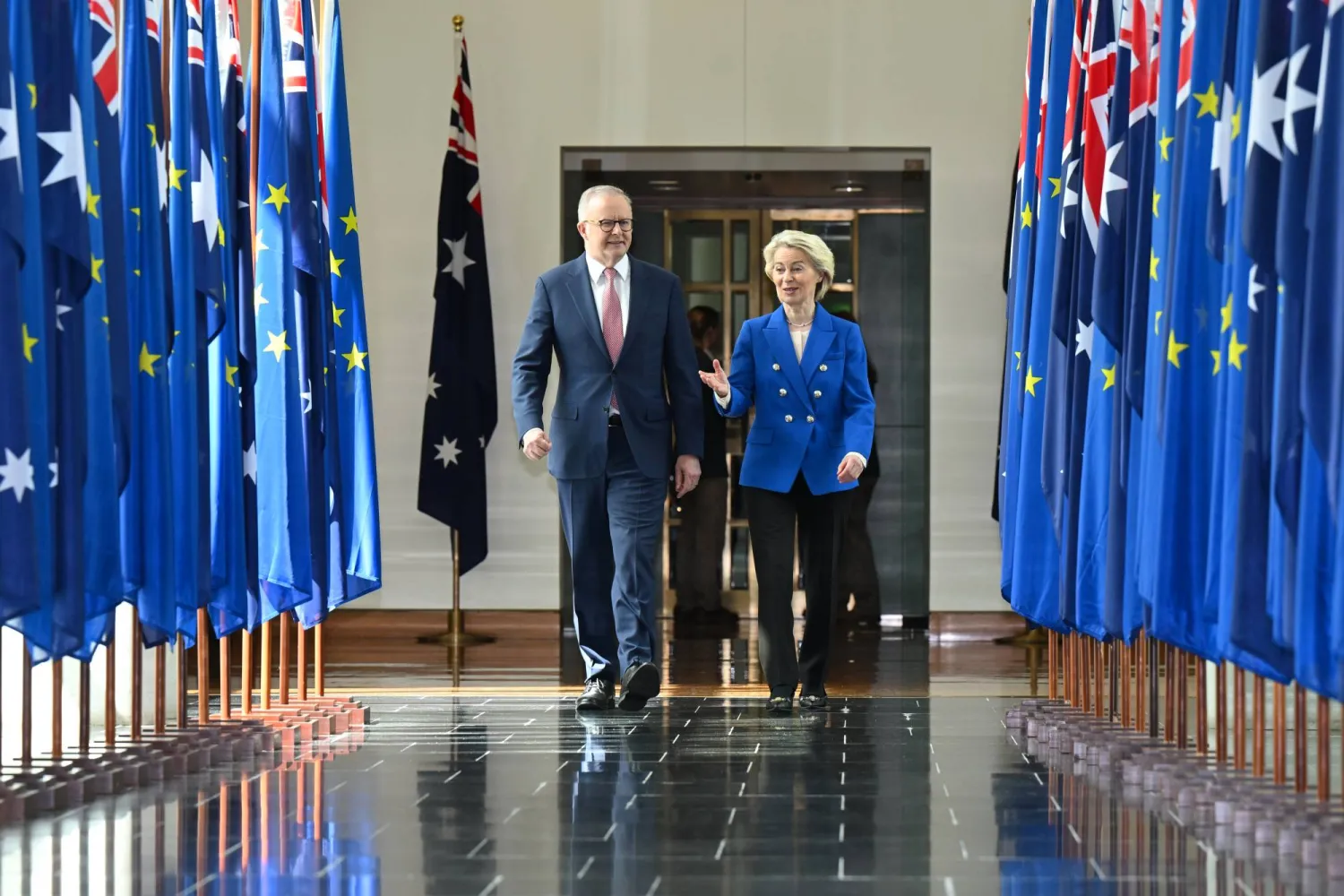
24 March 2026, Australia, Canberra: Australian Prime Minister Anthony Albanese and EU Commission President Ursula von der Leyen walk together after an address to Members and Senators during a joint sitting in the House of Representatives at the Parliament House in Canberra. Photo: Lukas Coch/AAP/dpa
TT

Australia, EU Agree Sweeping New Trade Pact 8 Years in the Works

24 March 2026, Australia, Canberra: Australian Prime Minister Anthony Albanese and EU Commission President Ursula von der Leyen walk together after an address to Members and Senators during a joint sitting in the House of Representatives at the Parliament House in Canberra. Photo: Lukas Coch/AAP/dpa

The European Union and Australia struck a long-awaited free-trade deal on Tuesday, while also agreeing to boost defense cooperation and access to rare earth minerals in the face of global uncertainty over trade.

EU chief Ursula von der Leyen's visit to Australia comes as the 27-nation bloc and the import-reliant nation navigate renewed energy vulnerability sparked by the war in the Middle East.

The accord is the latest agreed by Brussels in a push to diversify trade as Europe faces challenges from the United States and China.

Key sticking points on Australian use of European geographical names as well as how much beef can be exported to the continent were overcome to reach the deal after eight years of negotiations.

Another compromise will see Australian winemakers allowed to use the term "prosecco" domestically, but they must stop using it for exports after 10 years.

Australia will also be allowed to keep using some geographical names, such as feta and gruyere, in cases where producers have used the name for at least five years.

And European car makers will benefit from Australia raising the threshold for a luxury car tax on electric vehicles -- three-quarters will now be exempt.

The two sides also agreed to step up defense cooperation as well as critical raw materials.

Addressing the Australian parliament on Tuesday, von der Leyen described a world that was "brutal, harsh and unforgiving".

In that context, she said the EU and Australia were bound by common values and must work together to mitigate over-reliance on countries like China for critical minerals.

"We cannot be over dependent on any supplier for such crucial ingredients, and that is precisely why we need each other," AFP quoted her as saying.

"Our security is your security, and with our new security and defense partnership, we have each other's back."

She told lawmakers Tuesday's agreement on trade was a "fair deal, and one that delivers for your businesses and one that delivers for our businesses".

Under the deal, the EU said it expected exports to Australia to grow by a third over a decade.

The quota of Australian beef allowed into the bloc will increase more than 10 times the current level over the next decade, although that falls short of what Australian farmers had been seeking.

Australia's National Farmers' Federation said it was "extremely disappointed" by the outcome of the deal.

"What the Australian government has accepted today appears to offer no material change for key agricultural commodities as what the government rightly rejected in October 2023," president Hamish McIntyre said.

EU firms exported 37 billion euros (US$42.9 billion) of goods to Australia last year, and 31 billion euros of services in 2024.

And Australia said the deal could add AU$7.8 billion (US$5.4 billion) to its gross domestic product by 2030.

Australia's largest export market is China and the United States is its largest source of investment.

But Canberra has redoubled efforts to diversify export markets for farmers since a 2020 dispute with Beijing saw agriculture shipments blocked for several years, and last year's global imposition of US tariffs.

Likewise, the European Union is on a drive to strike new partnerships in the face of US levies and Chinese export controls.

Von der Leyen's visit was overshadowed by the war in the Middle East, which has sent oil prices soaring.

The EU chief this month said the conflict had served as a "stark reminder" of Europe's vulnerabilities.

And on Tuesday she called for an immediate end to hostilities in the face of a "critical" situation for energy supply chains globally.

Australia -- which is heavily reliant on fuel from abroad -- has also felt the pressure from the global energy squeeze.



China Shipping Giant Cosco Resumes Bookings to Some Gulf Countries

A cargo ship operated by Cosco Shipping is docked at the foreign trade container terminal of Qingdao Port, operated by Shandong Port Group, in China's eastern Shandong province on March 25, 2026. (Photo by CN-STR / AFP)
TT

China Shipping Giant Cosco Resumes Bookings to Some Gulf Countries

A cargo ship operated by Cosco Shipping is docked at the foreign trade container terminal of Qingdao Port, operated by Shandong Port Group, in China's eastern Shandong province on March 25, 2026. (Photo by CN-STR / AFP)

Chinese shipping giant Cosco said on Wednesday that it was resuming new bookings for container shipments to some Gulf countries, after a three-week suspension in response to the Middle East war.

The state-owned, Shanghai-based firm was among several major shipping groups to pause operations in the Strait of Hormuz, a key waterway through which one-fifth of the world's oil and gas passes normally.

Tehran has said several times it was not targeting friendly nations, but transits through the Strait had nevertheless largely ground to a halt.

Iran said in a statement circulated by the International Maritime Organization on Tuesday that "non-hostile vessels" would be granted safe passage through the waterway.

Cosco "resumed new bookings for general cargo containers for shipments" from the "Far East" to the UAE, Saudi Arabia, Bahrain, Qatar, Kuwait, and Iraq "with immediate effect", according to a company statement.

It did not mention shipments travelling in the opposite direction, from the Gulf.

"New booking arrangements and the actual carriage are subject to change due to the volatile situation in the Middle East region," it added.

Cosco, which operates one of the world's largest oil tanker fleets, announced on March 4 that it would suspend new bookings for services for routes through the Strait of Hormuz owing to the "escalating conflicts in the Middle East region and resultant restrictions on maritime traffic".


Qatar Emir Makes Minor Changes to QIA Board

People visit a mall in Doha on March 23, 2026. (Photo by AFP)
TT

Qatar Emir Makes Minor Changes to QIA Board

People visit a mall in Doha on March 23, 2026. (Photo by AFP)

Qatar's Emir Sheikh Tamim bin Hamad Al Thani issued a decree on Wednesday ⁠making minor changes to ⁠the board of the ⁠Qatar Investment Authority, while keeping Sheikh Bandar bin Mohammed bin Saud Al Thani as chairman and Sheikh ⁠Mohammed ⁠bin Hamad bin Khalifa Al Thani as deputy chairman.

The decision stipulated that QIA’s Board of Directors would be restructured as follows: Sheikh Bandar bin Mohammed bin Saud Al Thani as Chairman, Sheikh Mohammed bin Hamad bin Khalifa Al Thani as Deputy Chairman, Ali bin Ahmed Al Kuwari as a member, Saad bin Sherida Al Kaabi as a member, Sheikh Faisal bin Thani bin Faisal Al-Thani as a member, Nasser bin Ghanim Al Khelaifi as a member, and Hassan bin Abdullah Al Thawadi as a member.

The decision is effective starting from its date of issue and is to be published in the official gazette.


Oil Falls More Than 5% and World Shares Gain Over Possible de-escalation of Iran War

A man fills his car with petrol at the petrol station in Port Dickson, Negri Sembilan, Malaysia, 25 March 2026. EPA/FAZRY ISMAIL
TT

Oil Falls More Than 5% and World Shares Gain Over Possible de-escalation of Iran War

A man fills his car with petrol at the petrol station in Port Dickson, Negri Sembilan, Malaysia, 25 March 2026. EPA/FAZRY ISMAIL

Oil prices fell more than 5% and world shares gained on Wednesday over the possibility of a de-escalation of the Iran war and negotiations between the United States and Iran. US futures were up 0.9%.

In early European trading, Britain's FTSE 100 rose 1% to 10,072.60. France's CAC 40 was up 1.4% to 7,855.31, while Germany's DAX was 1.6% higher at 22,989.80.

Tokyo’s Nikkei 225 was up 2.9% to 53,749.62. South Korea’s Kospi gained 1.6% to 5,642.21.

Hong Kong’s Hang Seng rose 1.1% to 25,335.95, while the Shanghai Composite index was 1.3% higher at 3,931.84. Labubu doll maker Pop Mart's Hong Kong-listed shares fell 22.5%, after it announced annual revenue for last year that was largely in line with analysts’ estimates.

Australia’s S&P/ASX 200 climbed 1.9%. Taiwan’s Taiex was up 2.5%.

US President Donald Trump's claims of progress being made from talks with Iran this week and his postponement on Monday of a deadline to “obliterate” Iran’s power plants over the reopening of the Strait of Hormuz have also fueled optimism that an end to the Iran war could come soon.

Trump's administration has offered a 15-point ceasefire plan to Iran, but an Iranian military spokesperson mocked the US’ attempt at a ceasefire deal Wednesday.

With the Strait of Hormuz being a key waterway for crude oil and liquefied natural gas transport, oil and gas prices have spiked and fluctuated in recent days.

Oil prices fell again on growing hopes for a de-escalation. Brent crude, the international standard, fell 5.2% to $94.97 per barrel. It was around $104 on Tuesday.

Benchmark US crude was down 5.3% early Wednesday to $87.44 a barrel.

While Iran has denied negotiations were taking place, and attacks in the Middle East continued, Pakistan has offered to host talks between Washington and Tehran. And as Trump raised optimism of a de-escalation of the war, at least 1,000 more American troops from the 82nd Airborne Division are said to be deployed to the Middle East in the coming days.

On Tuesday, US stocks closed lower. The S&P 500 lost 0.4% to 6,556.37. The Dow Jones Industrial Average edged down 0.2% to 46,124.06, while the Nasdaq composite was 0.8% lower to 21,761.89.

Shares of Estee Lauder sank more than 9%, following confirmation that the US-listed company is in merger talks with Spanish beauty and perfume group Puig.

In other dealings early Wednesday, gold prices resumed its rise after falling earlier. It dropped in part because of rising US Treasury yields over dimming expectations of a Federal Reserve rate cut after the spike in oil prices threatened to fuel global inflation.

The price of gold was up 3.6% early Wednesday to $4,561.90 per ounce. It was above $5,000 earlier this month.

The US dollar was at 158.84 Japanese yen, up from 158.69. The euro was trading at 1.1602, down from $1.1608.