

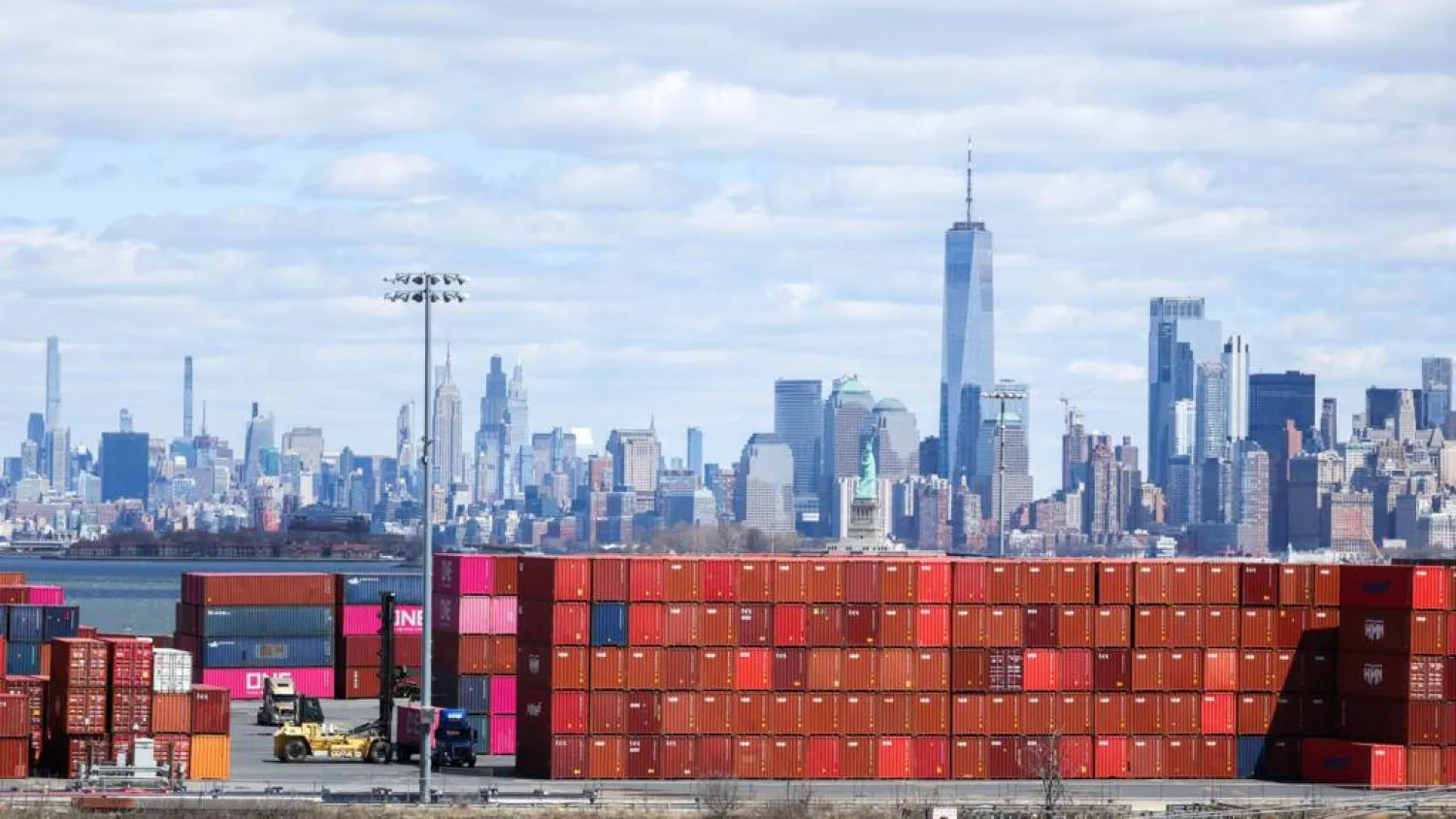

EU to Vote on Trump Tariff Deal -- but Eyes Rest of World

The European Parliament will vote on whether to cut EU tariffs on some US imports. CHARLY TRIBALLEAU / AFP/File
TT

EU to Vote on Trump Tariff Deal -- but Eyes Rest of World

The European Parliament will vote on whether to cut EU tariffs on some US imports. CHARLY TRIBALLEAU / AFP/File

European Union lawmakers are on track to give a green light -- with conditions -- Thursday to the bloc's tariff deal with US President Donald Trump, which Europe hopes to salvage while also racing to diversify its trade ties around the globe.

Brussels and Washington clinched the deal last summer that had set tariffs at 15 percent for most EU goods.

But Trump's 2025 tariff blitz, including hefty levies on steel, aluminium and car parts, has jolted the 27-country bloc into cultivating trade ties around the world.

From deals signed with South America to Australia, the EU has its eyes on many prizes.

But that doesn't mean the EU intends to walk away from the 1.6 trillion euro ($1.9 trillion) relationship with its main trade partner, the United States, AFP reported.

The European Parliament is voting Thursday on whether to cut EU tariffs on some US imports -- as a first step towards implementing the 2025 deal -- but with additional safeguards.

The potential green light comes after months of delay as lawmakers resisted approving the accord due to transatlantic tensions over Greenland -- and then put it on hold again following the US Supreme Court's ruling striking down Trump's levies.

The ball started rolling again after the European Commission, in charge of EU trade policy, said it would stick to the pact despite the US ruling and called on lawmakers to do the same, having received reassurances from Washington.

Trump, however, retaliated after the ruling with a new tariff regime -- pushing EU lawmakers to tighten the existing agreement with numerous safeguards.

- Losing access to US energy? -

Lawmakers leading on trade have added several provisions: making an EU tariff reduction automatically lapse in March 2028, and tying tariff cuts on steel and aluminium goods to similar reductions by the US side.

Not all members of the parliament are convinced. French EU lawmakers from the centrist Renew group have said they will vote against the agreement.

"The only political value this agreement had to offer was stability and predictability, even if many say it's an unfair deal. If it no longer even provides predictability, there's no reason to support the deal, even if it has been improved," said MEP Pascal Canfin.

The United States has urged the bloc to implement the agreement.

Washington's ambassador to the EU Andrew Puzder told the Financial Times that if the bloc delayed further, it risked losing "favorable" access to US liquefied natural gas at a time when the Middle East war has led to surging energy costs.

Before the US tariff deal is implemented by the bloc, it still needs to be negotiated with EU member states -- although Brussels hopes talks will go quickly.

- 'Trump factor' -

It is the EU's vulnerability to the consequences of wars and other shocks that has pushed Commission chief Ursula von der Leyen to make diversifying trading partners a priority, to cut overdependence on the United States and China.

The frenzy began with a long-awaited accord signed with the South American Mercosur bloc in January. Weeks later, Brussels struck another pact with India and just this week clinched a stalled deal with Australia.

"The Trump factor sped up their conclusion, for us as well as for our partners," economist Andre Sapir said.

Spurred by Trump, Sapir said, the EU has been pushing to create the world's largest network of free trade areas -- a strategy with a "defensive dimension" allowing it to resist trade "coercion".

"This free trade network carries weight in our discussions with the two giants, the United States and China," he said.

"These agreements are part of our arsenal," Sapir, of the Bruegel think tank, added. "Our strategic weapons in the international order."


Saudi Arabia Emerges as Global AI Hub as Tech Firms Base Regional Operations in Riyadh

The SAS pavilion at the Global AI Show in Riyadh. (Asharq Al-Awsat)
TT

Saudi Arabia Emerges as Global AI Hub as Tech Firms Base Regional Operations in Riyadh

The SAS pavilion at the Global AI Show in Riyadh. (Asharq Al-Awsat)

Saudi Arabia is no longer preparing for the age of artificial intelligence; it is helping shape it. After designating 2026 as the Year of AI, the Kingdom has evolved from a promising market into a major technology hub, attracting global companies eager to establish regional operations.

Reflecting that momentum, US data and AI company SAS selected Riyadh as its regional headquarters for the Middle East and North Africa a year ago. Founded in 1976, SAS is marking its 50th anniversary this year and is among the world’s leading providers of predictive analytics, data management, and machine learning solutions, serving industries including energy, finance, and healthcare.

Speaking to Asharq Al-Awsat on the sidelines of the Global AI Show, held in Riyadh on June 29-30, Khaled Moussa, Senior Customer Account Manager at SAS, said Saudi Arabia’s Vision 2030 has accelerated the adoption of advanced and sophisticated technologies.

He noted that the Kingdom’s modern digital infrastructure has enabled increasingly complex technological operations, fueling demand for SAS solutions and those of other technology firms across multiple sectors.

“The remarkable growth taking place in Saudi Arabia is attracting significant attention in the United States and beyond,” Moussa said. “That has encouraged international companies to make serious commitments to the market because of its rapid adoption of intelligent technologies.”

Although SAS has operated in Saudi Arabia since 1984, he added, “the market has reached a new level of maturity, both in terms of regulation and technology adoption.”

Moussa said SAS maintains a strong presence across several strategic sectors, particularly energy, through its collaboration with Saudi Aramco, the world’s largest energy company.

The company also works with the Saudi Electricity Company, providing advanced forecasting tools to predict electricity demand and support long-term planning, helping improve operational efficiency and future preparedness. SAS also supplies analytical solutions for the water sector to strengthen sustainability efforts.

Moussa highlighted two areas where predictive analytics deliver particular value. The first is market forecasting, where SAS helps organizations anticipate trends and make data-driven decisions while reducing unnecessary costs. The second is predictive maintenance, which allows industrial operators to identify potential equipment failures before they occur, minimizing downtime and avoiding costly repairs.

He also underlined SAS’s long-term commitment to developing Saudi talent. The company partners directly with universities to offer six-month paid internships, equipping students with practical experience before they enter the workforce.

In addition, SAS extends its training initiatives to schools and universities, teaching students how to apply AI technologies and preparing them for future careers.

The Global AI Show brought together more than 100 experts and global leaders from 80 countries, including government officials, innovators, and digital transformation specialists.

The event attracted more than 10,000 participants, 100 exhibitors and sponsors, and coverage from 200 international media organizations, reinforcing Riyadh’s growing role as a global platform for AI policymaking and international technology cooperation.


China Factory Activity Returns to Expansion Riding AI Global Boom

 A man stands next to a poster of a humanoid robot during the China International Supply Chain Expo (CISCE) in Beijing on June 25, 2026. (AFP)
A man stands next to a poster of a humanoid robot during the China International Supply Chain Expo (CISCE) in Beijing on June 25, 2026. (AFP)
TT

China Factory Activity Returns to Expansion Riding AI Global Boom

 A man stands next to a poster of a humanoid robot during the China International Supply Chain Expo (CISCE) in Beijing on June 25, 2026. (AFP)
A man stands next to a poster of a humanoid robot during the China International Supply Chain Expo (CISCE) in Beijing on June 25, 2026. (AFP)

China's factory activity returned to expansion in June, driven by demand for chips, computers and other AI-related products, as robust export orders and front-loading to the United States to get ahead of tariffs offset weakness elsewhere in the economy.

The data suggest global AI investment is providing an important cushion for manufacturers in China's $20 trillion economy, even as disruption from the Middle East conflict and a prolonged property slump continue to weigh on broader growth.

The official manufacturing purchasing managers' index (PMI) rose to 50.3 in June from 50.0 in May, according to a survey by the National Bureau of Statistics (NBS). It beat a median forecast of 50.0 in a Reuters poll.

"Exports to meet international demand for chips and other AI-related products, as well as front-loading to get ahead of new US Section 301 ‌tariffs due late ‌July and improved domestic demand due to lower upstream costs underpinned the improvement," said ‌Dan ⁠Wang, China director ⁠of consultancy Eurasia Group.

The number of domestic infrastructure projects ticked up over the last month too, she added. US retailers have brought forward orders from China by four to six weeks to secure their inventories for Black Friday and Christmas holiday sales before the expected tariff hikes later this year, shipping executives said.

The sub-index for new export orders returned to expansion in June, rising to 50.1 from 48.6, while the production and overall new orders gauges edged up to 51.4 and 51.2 from 51.2 and 49.9, respectively.

Factory gate prices slipped to 48.2 from 51.9 in May, however, following five months of expansion, with ⁠employment also continuing to trend downward.

"The export strength is set to continue, driven by ‌global AI investment demand," said Xu Tianchen, senior economist at the Economist Intelligence ‌Unit. "Second, more policy easing will come."

"For example, fiscal spending has lagged behind budget arrangements, and it should accelerate in the coming months. There ‌is also room for monetary easing," he added.

The non-manufacturing PMI, which includes services and construction, improved to 50.2 ‌versus 50.1 in May, while the composite PMI came in at 50.6 compared with 50.5 a month earlier.

AI BOOM OR BUST

With the property crisis showing little sign of stabilizing and household spending remaining subdued, policymakers face the challenge of managing a two-speed economy.

There is enormous international demand for semiconductors powering data centers and advanced electronics, playing to China's manufacturing strengths, but there does not seem ‌to be much demand for anything else.

Exports of furniture, for example, grew just 1.9% in value terms year-on-year, according to the latest trade data for May, while shipments of ⁠automated data processing equipment ⁠jumped 60% over the same period.

Furthermore, retail sales, a proxy for domestic demand, fell for the first time in over three years, the most recent data for May showed, along with a faster slump in new home prices.

Julian Evans-Pritchard, head of China Economics at Capital Economics, said the improvement "remains heavily dependent on exports and AI-related tech," and warned that "despite the improvement in activity, the manufacturing sector appears to be slipping back into deflation."

China has set a 2026 growth target of 4.5% to 5.0%, slightly below last year's 5% expansion.

With signs of precautionary buying in the wake of Middle East-related price pressures fading, input costs rising and overseas customers running down inventories while awaiting a ceasefire, Chinese manufacturers may increasingly need demand from the world's largest consumer market to regain momentum.

A closely watched meeting in May between US President Donald Trump and Chinese leader Xi Jinping, however, produced no meaningful breakthroughs, whether on tariffs or Beijing using its influence over Tehran to end the Iran war.

"The sluggish data from the past few months will likely result in a notable slowdown in second-quarter GDP," said Lynn Song, chief economist for China at ING.

"We're looking for a slowdown to 4.6% year-on-year, with risks slightly balanced to the downside."


EU's Side of US Trade Deal to Come Into Force on July 1

FILED - 03 June 2024, Berlin: FILE PHOTO - The European Union flag flies in the wind. Photo: Sebastian Gollnow/dpa
TT

EU's Side of US Trade Deal to Come Into Force on July 1

FILED - 03 June 2024, Berlin: FILE PHOTO - The European Union flag flies in the wind. Photo: Sebastian Gollnow/dpa

The European Union's side of a trade deal struck with the United States last year, which will remove import duties on many US goods, will come into force on July 1, said a formal European Union regulatory filing.

The EU said this ⁠regulation would apply ⁠from July 1 until December 31, 2029, Reuters reported.

"Where appropriate, the Commission shall submit together with the comprehensive assessment a legislative proposal to extend ⁠the period of application of this Regulation," added the regulatory filing.

Under the agreement, the EU agreed to remove import duties on US industrial goods and provide preferential access to US farm produce.

It will also extend duty-free imports of ⁠US lobster, ⁠a mini-deal struck with Trump during his first term as president.

The EU legislation expires at the end of 2029 and includes multiple safeguards that would allow the EU to suspend concessions if the United States breaches the trade deal's terms.