


No ‘Positive Signs’ as Israel Refuses to Tie Ending War on Lebanon to Iran

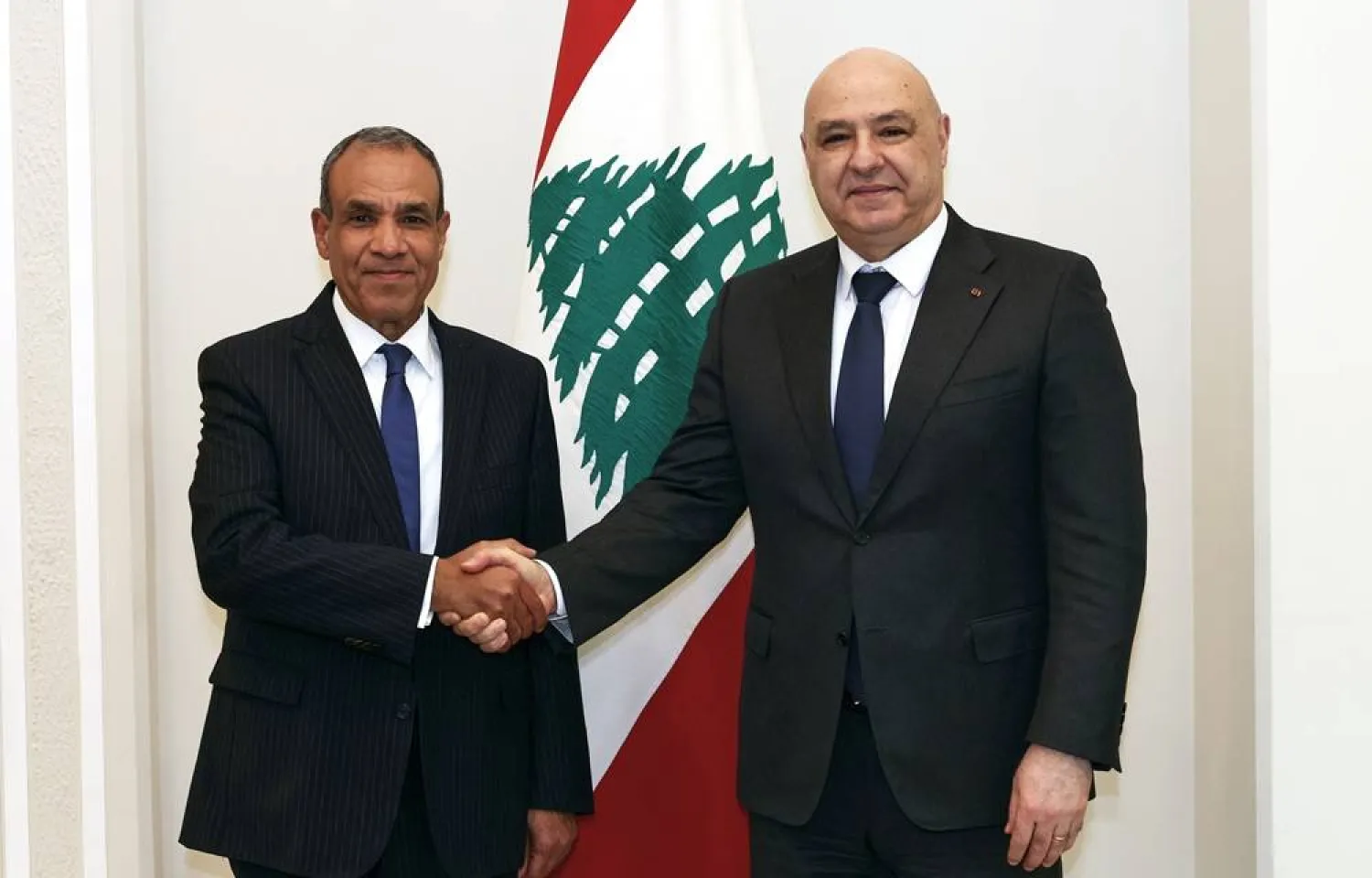
 In this photo released by the Lebanese Presidency press office, Lebanese President Joseph Aoun, right, shakes hands with Egyptian Foreign Minister Badr Abdelatty in Baabda, east of Beirut, Lebanon, Thursday, March 26, 2026. (Lebanese Presidency press office via AP)
In this photo released by the Lebanese Presidency press office, Lebanese President Joseph Aoun, right, shakes hands with Egyptian Foreign Minister Badr Abdelatty in Baabda, east of Beirut, Lebanon, Thursday, March 26, 2026. (Lebanese Presidency press office via AP)
TT

No ‘Positive Signs’ as Israel Refuses to Tie Ending War on Lebanon to Iran

 In this photo released by the Lebanese Presidency press office, Lebanese President Joseph Aoun, right, shakes hands with Egyptian Foreign Minister Badr Abdelatty in Baabda, east of Beirut, Lebanon, Thursday, March 26, 2026. (Lebanese Presidency press office via AP)
In this photo released by the Lebanese Presidency press office, Lebanese President Joseph Aoun, right, shakes hands with Egyptian Foreign Minister Badr Abdelatty in Baabda, east of Beirut, Lebanon, Thursday, March 26, 2026. (Lebanese Presidency press office via AP)

Lebanese President Joseph Aoun reiterated on Thursday the need for the state to impose its authority throughout its territories and impose monopoly over weapons as part of an initiative to launch direct negotiations with Israel to end the war.

Egyptian Foreign Minister Badr Abdelatty said that his country was carrying out “intense” contacts, including relaying messages between Iran and the United States, and communicating with Israel, to ease the tensions and prevent the regional conflict from expanding.

Abdelatty was in Beirut where he met with Aoun and several officials as part of Egypt’s efforts to support Lebanon and contain the regional and international escalation.

He conveyed to Aoun President Abdel Fattah al-Sisi's support and “full solidarity with Lebanon, its leadership and people.”

He stressed that Egypt stands by Lebanon during its plight.

“Cairo will not spare an effort to offer political, diplomatic and humanitarian support and it is constantly working with various concerned parties to ease the tensions and avert a deterioration,” added the FM.

‘Unencouraging’ signs

Sources monitoring Abdelatty’s meetings in Beirut said the signs were “unencouraging” and that the political and military circumstances “are not positive” when it comes to Lebanon, especially with Israeli Prime Minister Benjamin Netanyahu’s refusal that the war on Lebanon be included in US-Iran negotiations on ending the regional conflict.

He is insisting on his position to eliminate Hezbollah regardless if a ceasefire is reached between Washington and Tehran, said the sources, meaning the war on Lebanon will stretch on.

They warned that the Lebanese front may witness further escalation in the coming phase.

Abdelatty echoed these concerns, telling reporters in Lebanon that “diplomacy continues, but it has not reached tangible results.”

“Some sides are seeking calm and exploring the possibility of negotiations, so progress may be achieved in the future,” he revealed.

Aoun

Aoun underscored his initiative aimed at ending the military escalation and the Israeli occupation of southern regions, as well as the Lebanese state imposing its authority throughout its territories.

The initiative is based on consolidating security and stability across Lebanon’s borders and preventing any armed presence outside the state, he added. Illegal weapons will be seized to ensure state monopoly over arms and that it alone has control over decisions of war and peace.

“Lebanon does not want to be an arena for the wars of others,” he declared. “Lebanon’s official position reflects a clear desire to keep the country out of regional conflicts.”

He warned that Israel’s failure to respond to his proposal means that the military escalation will continue, deepening the suffering of the people, especially those in the South.

“The Lebanese people are united in refusing to be dragged to civil war,” Aoun added. The army and security forces are carrying out their duties in preserving civil peace and protecting the people, especially the displaced in shelters.

Referring to the continued escalation, he lamented that “might is still prevailing over reason.”

Humanitarian aid

Abdelatty announced that Egypt has sent nearly a 1,000 tons of humanitarian aid to Lebanon that include medical and food products and shelters for the displaced.

“The aid reflects the Egyptian people’s solidarity with the Lebanese people and their keenness on easing their suffering,” the FM stressed.

“Egypt is ready to meet all the demands of our brothers in Lebanon, on the humanitarian, political or diplomatic levels. It will not relent in maintaining its efforts to end the hostilities and restore calm,” he added.



Over $71 Bn Needed Over Next Decade to Rebuild Gaza, Say UN and EU

Palestinian men stand atop a heavily damaged building in Gaza City on April 20, 2026. (AFP)
TT

Over $71 Bn Needed Over Next Decade to Rebuild Gaza, Say UN and EU

Palestinian men stand atop a heavily damaged building in Gaza City on April 20, 2026. (AFP)

More than $71 billion will be needed over the next decade for recovery and reconstruction in war-ravaged Gaza, according to an EU-UN assessment published Monday.

In their final Gaza Rapid Damage and Needs Assessment (RDNA), the United Nations and the European Union said that more than two years of war in the Palestinian territory "has led to unprecedented loss of life and a catastrophic humanitarian crisis".

"Recovery and reconstruction needs are estimated at around $71.4 billion," said the assessment, developed in coordination with the World Bank.

Much of Gaza -- including schools, hospitals and other civic infrastructure -- has been reduced to rubble by a withering Israeli military offensive following the unprecedented Hamas attack on October 7, 2023.

The final assessment determined that $26.3 billion would be required in the first 18 months to restore essential services, rebuild critical infrastructure and support economic recovery.

"Physical infrastructure damages are estimated at $35.2 billion, with economic and social losses amounting to $22.7 billion," a joint statement said.

Gaza is under a fragile ceasefire agreed last October, which followed two years of devastating conflict sparked by the October 7, 2023 Hamas attack on Israel.

That attack resulted in the deaths of 1,221 people in Israel, mostly civilians, according to official Israeli figures tallied by AFP. Palestinian fighters also abducted 251 hostages.

The retaliatory Israeli military campaign has killed more than 72,000 people in Gaza, also mostly civilians, according to the Hamas-run territory's health ministry whose figures the UN considers reliable.

- 'Immense scale of need' -

According to the RDNA, some 371,888 housing units have been destroyed or damaged, more than 50 percent of hospitals in the territory are non-functional and nearly all schools have been destroyed or damaged.

At the same time, 1.9 million people -- nearly Gaza's entire population -- have been displaced, often multiple times, and more than 60 percent of the population had lost their homes, the assessment found.

Gaza's economy has contracted by 84 percent, it said.

"The scale and extent of deprivation across living conditions, livelihoods/income, food security, gender equality, and social inclusion, have pushed back human development in the Gaza Strip by 77 years," the assessment said.

The UN and the EU stressed that "given the immense scale of need, recovery efforts must run in parallel with humanitarian action" in Gaza, ensuring a "transition from emergency relief toward reconstruction at scale".

They insisted that the recovery and reconstruction needed to be "Palestinian-led", and incorporate approaches that actively support the transfer of governance to the Palestinian Authority, in accordance with UN Security Council resolution 2803.

That resolution, which was adopted last November, welcomed the creation of US President Donald Trump's Board of Peace to support Gaza's reconstruction.

The UN and the EU also emphasised that "a set of enabling conditions" were needed for the resolution to be implemented effectively on the ground.

They included in particular "a sustained ceasefire and adequate security", as well as "unimpeded humanitarian access and immediate restoration of essential services," and "free movement of people, goods, and reconstruction materials, within and between Gaza and the West Bank".

Without such conditions, they warned, "neither recovery nor reconstruction can succeed".


Lebanon, Israel to Hold Second Round of Talks in Washington on Thursday

From left, Michael Needham, counselor for the US Dept. of State, US Ambassador to the United Nations Mike Waltz, Secretary of State Marco Rubio, US Ambassador to Lebanon Michel Issa, Lebanese Ambassador to the US Nada Hamadeh Moawad, and Israeli Ambassador to the US Yechiel Leiter pose for a photo before a meeting at the State Department in Washington, Tuesday, April 14, 2026. (AP)
TT

Lebanon, Israel to Hold Second Round of Talks in Washington on Thursday

From left, Michael Needham, counselor for the US Dept. of State, US Ambassador to the United Nations Mike Waltz, Secretary of State Marco Rubio, US Ambassador to Lebanon Michel Issa, Lebanese Ambassador to the US Nada Hamadeh Moawad, and Israeli Ambassador to the US Yechiel Leiter pose for a photo before a meeting at the State Department in Washington, Tuesday, April 14, 2026. (AP)

Lebanese and Israeli representatives will hold talks in Washington on Thursday, a US State Department spokesperson and an Israeli source speaking on the condition of anonymity told Reuters ‌on Monday.

The ‌US will host ‌the ⁠second round of ⁠ambassador-level talks between the two countries at the Department of State, the State Department spokesperson said.

US Secretary of State Marco Rubio hosted ⁠the first round of talks ‌between Israeli ‌ambassador to the United States ‌Yechiel Leiter and Lebanon's ambassador to ‌Washington Nada Moawad - the first direct talks between Israel and Lebanon in decades - on April 14.

"We ‌will continue to facilitate direct, good-faith discussions between the ⁠two ⁠governments," the spokesperson said.

The second round of talks will mark the first talks between the two countries since a 10-day ceasefire took effect on Thursday.

- Aoun defends talks - 

Lebanese President Joseph Aoun said Monday that planned talks with Israel aim to end hostilities and the occupation in the south, even as Hezbollah and its supporters rejected the negotiations. 

Hezbollah lawmaker Hassan Fadlallah told AFP Monday it was in Aoun's and Lebanon's "interest" to withdraw from the talks, however adding that his group also wanted the ceasefire to last. 

A ceasefire pausing more than six weeks of war between Hezbollah and Israel started on Friday after being announced by US President Donald Trump. 

"It is in the interest of Lebanon, the president of the republic and the government to move away from the path of direct negotiation and return to a national understanding about the best option for Lebanon," Fadlallah told AFP. 

"Perhaps through indirect negotiations, even via the United States of America, we can achieve" Lebanon's goals, Fadlallah stated. 

Aoun said Monday the goal of negotiations was to "stop hostilities, end the Israeli occupation of southern regions and deploy the (Lebanese) army all the way to the internationally recognized southern borders". 

Fadlallah said regional powers including Iran, Pakistan and Saudi Arabia have worked to build a US-Iran diplomatic track, which creates "a regional umbrella that can provide a kind of guarantee for Lebanon. 

"Going into direct bilateral negotiations, alone, amid deep Lebanese divisions and internal disagreements, constitutes a threat to internal consensus." 

He noted that there was no direct communication with the president, while Hezbollah's ministers remain in Lebanon's cabinet. 

Aoun's remarks on Monday came after an address to the nation Friday night, in which he said: "We negotiate for ourselves... we are no longer a pawn in anyone's game, nor an arena for anyone's wars, and we never will be again." 

The truce in Lebanon was also one of Iran's conditions for resuming talks with Washington to extend their separate ceasefire and work out the terms of a lasting peace. 

Lebanon is officially at war with Israel and has no diplomatic relations with its southern neighbor. 

- Aoun faces backlash - 

On the road to Beirut's international airport, in the southern suburbs where Hezbollah holds sway, AFP images showed fresh graffiti attacking Aoun and Prime Minister Nawaf Salam on Monday, following their endorsement of negotiations. 

"Joseph is a traitor, Nawaf is a turncoat," said one spray-painted sign. "Dealing with Israel is forbidden... no to normalization," another read. 

Senior Hezbollah official Mahmud Qamati blasted Aoun on Saturday, saying "defeated, you go to the Israelis and Americans, let's see what you will get out of it". 

Hezbollah supporters also heaped scorn on Aoun on social media. 

"You're going to hand over the south after two days of negotiations?" one user posted on X, adding "we won't let you" sign an agreement. 

"After all our sacrifices this guy wants to speak for us?" another user posted on X, with their profile picture showing a picture of Aoun and Salam with the words "they do not represent me". 

Israeli attacks killed nearly 2,300 people and forced over a million to flee their homes, Lebanese authorities said, since Hezbollah pulled the country into the Middle East war last month. 

"Any outcome of direct negotiations cannot be imposed on the people who made these sacrifices," Fadlallah told AFP. 

- 'I am full of hope' - 

Aoun on Monday named former Lebanese ambassador to Washington Simon Karam to head the negotiations with Israel. 

In December, Karam became the first Lebanese civilian representative to directly speak with Israeli representatives in decades, as part of a ceasefire monitoring mechanism set up at the end of a previous round of fighting between Israel and Hezbollah in 2023 and 2024. 

"Lebanon is facing two options: either the continuation of the war, with all its humanitarian, social, economic, and sovereign repercussions, or negotiations to put an end to this war and achieve lasting stability," Aoun said. 

"I have chosen negotiations, and I am full of hope that we will be able to save Lebanon," he said. 


A Top Paramilitary Commander Defects to Sudan’s Military as War Enters 4th Year

 A boy is seen through the wreckage of a car in Omdurman, Sudan, on the outskirts of Khartoum, Friday, April 17, 2026. (AP)
A boy is seen through the wreckage of a car in Omdurman, Sudan, on the outskirts of Khartoum, Friday, April 17, 2026. (AP)
TT

A Top Paramilitary Commander Defects to Sudan’s Military as War Enters 4th Year

 A boy is seen through the wreckage of a car in Omdurman, Sudan, on the outskirts of Khartoum, Friday, April 17, 2026. (AP)
A boy is seen through the wreckage of a car in Omdurman, Sudan, on the outskirts of Khartoum, Friday, April 17, 2026. (AP)

A high-profile paramilitary commander in Sudan has changed sides and joined the country’s army in a move welcomed by army chief Gen. Abdel-Fattah Burhan shortly after the war entered its fourth year.

Burhan on Sunday welcomed Maj. Gen. al-Nour Ahmed Adam, who defected earlier this month from the Rapid Support Forces. The ruling sovereign council posted a video on social media showing Burhan’s meeting with Adam, who is known as al-Qubba, in Sudan’s Northern province on the border with Egypt.

“Doors are open to all those who lay down arms and join the path of national reconstruction,” Burhan, who chairs the sovereign council, said in a statement.

The RSF didn’t comment on the defection.

Adam fled the RSF-controlled Darfur region earlier this month and joined the military along with dozens of fighters and equipment, according to local media.

The Sudan Tribune news outlet reported that Adam left after “disputes” with the RSF leadership, mainly over not appointing him as a military commander of North Darfur province after the RSF seized control of el-Fashir city in October – the military’s last stronghold in the Darfur region.

Adam is one of the most senior officers to defect from the paramilitaries during the war. In 2024, Abu Aqla Kaikel, who led the Sudan Shield Forces, left the RSF when the military retook the crucial central province of Gezira.

The war broke out in April 2023 when a power struggle between the military and RSF exploded into open fighting in the capital, Khartoum, and elsewhere in the sprawling country.

The war has killed at least 59,000 people, according to the Armed Conflict Location & Event Data Project, known as ACLED. The US-based war tracking group said its toll was almost certainly low given difficulties in reporting.