

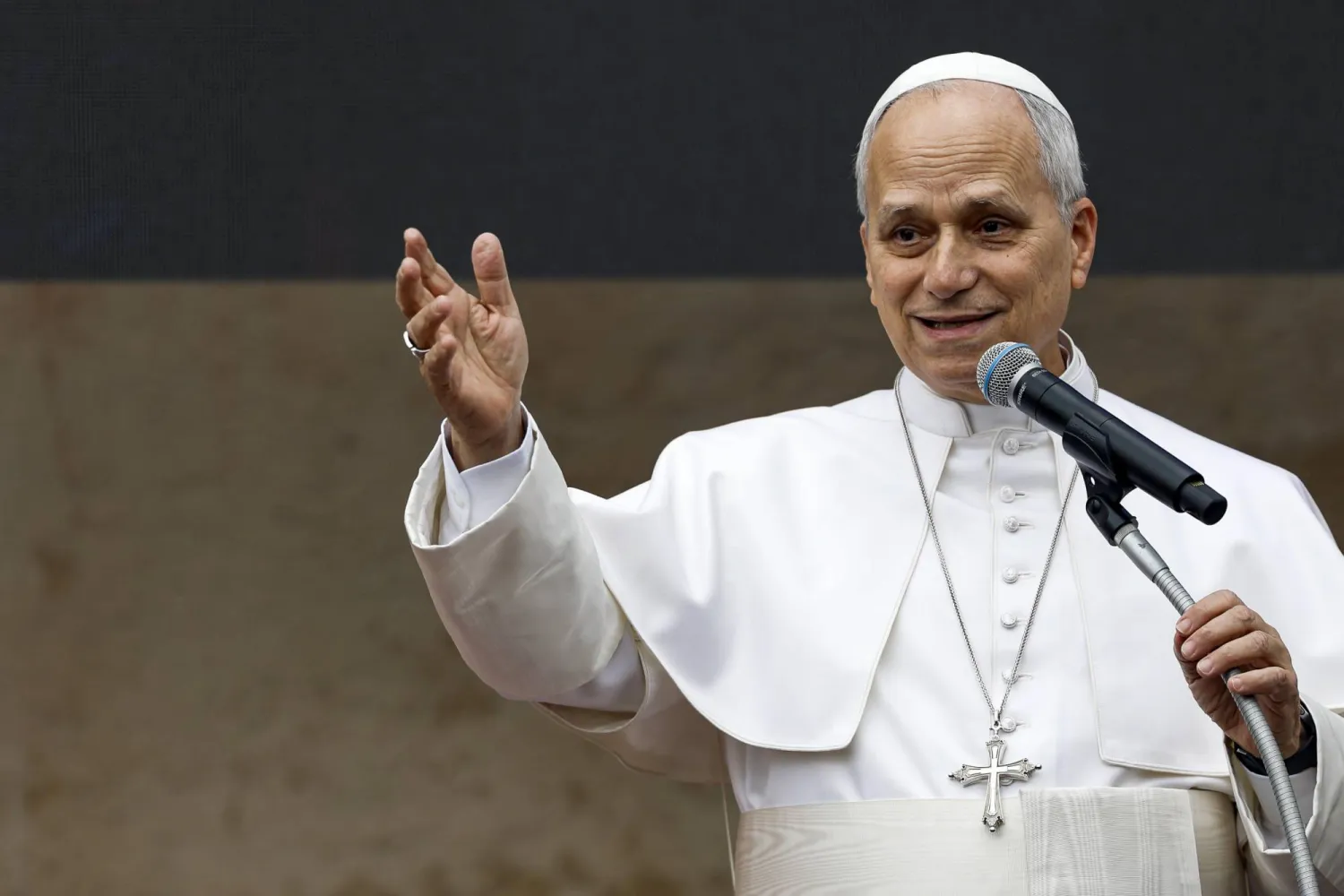

Pope Leo XIV Makes a Rare 1-day Visit to Glitzy Monaco

Pope Leo XIV speaks during his pastoral visit to the Parish of the Parish of 'Sacred Heart of Jesus' in Rome, Italy, 15 March 2026. EPA/ANGELO CARCONI
TT

Pope Leo XIV Makes a Rare 1-day Visit to Glitzy Monaco

Pope Leo XIV speaks during his pastoral visit to the Parish of the Parish of 'Sacred Heart of Jesus' in Rome, Italy, 15 March 2026. EPA/ANGELO CARCONI

Pope Leo XIV travels Saturday to the principality of Monaco, becoming the first pope in nearly five centuries to visit the glitzy Mediterranean enclave and highlighting how small states can punch above their weight on the global stage.

Vatican spokesperson Matteo Bruni said the visit would provide the American pope with his first real chance to speak to all of Europe.

“In the Bible, it is precisely the small ones who play a significant role,” Bruni said.

Monaco is also one of the few European countries where Catholicism is the official state religion. And Prince Albert recently refused a proposal to legalize abortion, citing the important role Catholicism plays in Monaco society.

The decision was largely symbolic, since abortion is a constitutional right in France, which surrounds the coastal principality of 2.2 square kilometers (about 1 square mile).

In refusing to allow it in Monaco, Albert joined other European Catholic royals who have taken a similar stand over the years to uphold Catholic doctrine on an increasingly secular continent. When Pope Francis visited Belgium in 2024, he announced he was putting the late King Baudouin on the path to possible sainthood because he abdicated for a day in 1990 rather than approve legislation to legalize abortion.

Bruni said the “defense of life” would be one of the themes of Leo’s one-day visit Saturday. But he stressed that Leo’s vision would be in the larger context of defending all life, including in wars and conflicts.

An unexpected destination

The visit includes a private meeting with Albert and Princess Charlene at the palace, a meeting with Monaco’s Catholic community in the cathedral and Mass in the sports stadium.

A coastal playground for the rich and famous, Monaco is renowned as much for its tax-friendly incentives and Formula 1 Grand Prix as its glamorous royal family. The son of the late American actress Grace Kelly, Albert spoke in perfect, unaccented English when he visited the Chicago-born Leo at the Vatican on Jan. 17 and invited him to visit.

The trip came together quickly after that, and raised eyebrows about why Leo had chosen Monaco, a hereditary and constitutional monarchy, as his first foreign trip in Europe. Pope Francis also liked to travel to small countries, but Monaco’s glitz factor likely would have turned him off.

“It does raise questions,” conceded Abbe Christian Venard, spokesperson for the diocese of Monaco. “Is it really the place for a pope to go to a principality better known — somewhat caricatured — as a haven for billionaires, even if that is part of Monaco’s reality? I think it reflects some inner freedom from the pope,” he told The Associated Press.

In fact, there are good reasons for Leo to visit, not least because there hasn’t been a pope who visited in 488 years, since Pope Paul III in 1538.

Monaco's population of 38,000 is heavily Catholic and also multinational, with only a fifth of the population actually citizens of the principality.

Short but symbolic trip Leo will be in Monaco for just under nine hours, and the principality is so close to home that he can get there and back to the Vatican by helicopter. But the visit is rich in symbolic significance, since it represents the leaders of the world’s two smallest states coming together to talk about some of the world’s biggest problems.

With Russia’s war in Ukraine raging and the US-Israeli war in Iran spreading, Leo will likely want to repeat his appeal for peace and dialogue to prevail.

"Much like the principality’s role in fostering dialogue and mediation, serving as a laboratory for peace, social friendship, and the responsible use of influence and wealth,” Bruni said.

That is a reference to Monaco's financial support of initiatives to help Christians in the Middle East, including its participation in the Aliph Foundation, which works in particular to rebuild and restore churches and other sites of cultural importance that get damaged or destroyed by conflict.

The government has also been a longtime supporter of church projects in Lebanon organized by l’Œuvre d’Orient, a French-based group that supports bishops, priests and religious orders working in 23 countries.

Albert is also a well-known environmental campaigner, and Monaco hosts regular international conferences, especially on the plight of the Mediterranean. Leo has strongly carried on Francis’ legacy of ecological stewardship, and the environment is expected to be a topic of discussion.

“The fact that Monaco hosts environmental forums, scientific conferences, and thematic summits makes sense and effectively counterbalances the somewhat ‘glitzy’ image that the event might initially convey,” noted François Mabille, director of the Geopolitical Observatory of Religion at the French Institute for International and Strategic Affairs.

Mabille said it is precisely on issues such as the environment where two small states with similar values can work together on the global stage, especially when the Holy See has a tradition of diplomatic neutrality and only enjoys observer status at the United Nations and other international organizations.

“What’s interesting is to realize that there is indeed a Monaco foreign policy that can, in a way, enable or allow the Vatican to go further,’’ Mabille said. “And here, the Vatican’s soft power can find ... a sort of continuity and, in any case, a convergence with another small state — one that, this time, votes and participates."



Israel Army Confirms Struck Two Nuclear Sites in Iran

Emergency responders inspect the site of a residential building damaged by a strike, amid the US-Israeli conflict with Iran, in Tehran, Iran, March 27, 2026. Majid Asgaripour/WANA (West Asia News Agency) via Reuters
TT

Israel Army Confirms Struck Two Nuclear Sites in Iran

Emergency responders inspect the site of a residential building damaged by a strike, amid the US-Israeli conflict with Iran, in Tehran, Iran, March 27, 2026. Majid Asgaripour/WANA (West Asia News Agency) via Reuters

The Israeli military confirmed it struck a heavy water reactor and a uranium processing plant in central Iran on Friday, as it targeted nuclear sites in the country.

"A short while ago, the Israeli Air Force... struck the heavy water plant in Arak, central Iran," the military said in a statement, describing the site as a "key plutonium production site for nuclear weapons".

Iranian media had earlier reported that US-Israeli strikes hit the Khondab heavy water complex, saying they caused no casualties or radiation leak from the site.

Work on the reactor on the outskirts of the village of Khondab began in the 2000s, but was halted under the terms of a now-abandoned 2015 nuclear deal struck between Iran and world powers.

The core of the reactor was removed and concrete was poured into it, rendering it inoperative.

The research reactor was officially intended to produce plutonium for medical research and the site includes a production plant for heavy water.

The Israeli military also confirmed it struck a uranium processing site in central Iran's Yazd on Friday, after the country’s atomic energy organization said US-Israeli strikes hit the facility.

"A short while ago, the Israeli Air Force... struck a uranium extraction plant located in Yazd, central Iran," the military said in a statement, describing the site as a "unique facility in Iran used for the production of raw materials required for the uranium enrichment process".

Iran's atomic energy organization said the strike on the plant "did not result in the release of any radioactive material."

Israel and the US accuse Iran of seeking to acquire nuclear weapons, while Tehran maintains that its program is for civilian purposes.

The heavy water plant in Arak was targeted by Israeli strikes during the 12-day war between Iran and Israel last June, during which the US also carried out bombings.

The International Atomic Energy Agency (IAEA) says the site was "damaged" during the attacks and "is assessed not to have been fully operational since that time."

But the agency said it has not had access to the site since May 2025.

The Middle East was plunged into war on February 28 when the US and Israel launched joint strikes on Iran, triggering retaliatory missile and drone attacks targeting Israel and several countries in the region.


US, Israel Unlikely to Achieve ‘Regime Change’ in Iran, Says Merz

 27 March 2026, Hesse, Frankfurt/Main: Germany's Chancellor Friedrich Merz speaks at the "FAZ" Congress. (dpa)
27 March 2026, Hesse, Frankfurt/Main: Germany's Chancellor Friedrich Merz speaks at the "FAZ" Congress. (dpa)
TT

US, Israel Unlikely to Achieve ‘Regime Change’ in Iran, Says Merz

 27 March 2026, Hesse, Frankfurt/Main: Germany's Chancellor Friedrich Merz speaks at the "FAZ" Congress. (dpa)
27 March 2026, Hesse, Frankfurt/Main: Germany's Chancellor Friedrich Merz speaks at the "FAZ" Congress. (dpa)

The US-Israeli war against Iran is unlikely to lead to "regime change", German Chancellor Friedrich Merz said Friday, as the month-long conflict showed no signs of abating.

"Is regime change really the goal?" he said at a forum in Frankfurt organized by the FAZ newspaper.

"If that's the goal, I don't think you'll achieve it. It's mostly gone wrong" in past conflicts, he said, pointing to the Afghanistan war.

"I have serious doubts as to whether there is a strategy and whether that strategy is being successfully implemented," he added. "In that respect, it could take even longer."

Germany has pushed back at US President Donald Trump's criticisms of NATO members for failing to join the attacks on Iran, insisting that it is not their war.

Merz however said Friday he believed that Trump had accepted this stance.

He also said Germany would be open to helping provide military protection in the Strait of Hormuz, a key route for oil and gas, which has been nearly totally blocked, in the event of a ceasefire.

"This requires an international mandate, it requires approval from the German parliament and, prior to that, a cabinet decision. And we are far from that."


More Than 300 US Troops Injured Since Start of Iran War

US Navy sailors taxi an F/A-18F Super Hornet on the flight deck aboard Nimitz-class aircraft carrier USS Abraham Lincoln in support of the Operation Epic Fury attack on Iran from an undisclosed location March 17, 2026. (US Navy/Handout via Reuters)
TT

More Than 300 US Troops Injured Since Start of Iran War

US Navy sailors taxi an F/A-18F Super Hornet on the flight deck aboard Nimitz-class aircraft carrier USS Abraham Lincoln in support of the Operation Epic Fury attack on Iran from an undisclosed location March 17, 2026. (US Navy/Handout via Reuters)

More than 300 US troops have been wounded since the start of the Iran war on February 28, US Central Command said on Friday.

"Since the start of Operation Epic Fury, approximately 303 US service members have been wounded. The vast majority of these injuries have been minor, and 273 troops have returned to duty," US Navy Captain Tim Hawkins said.

A US official who asked not to be identified told AFP that 10 troops remain seriously wounded.

A further 13 troops have been killed in the war, according to the latest figures, with seven killed in the Gulf and six in Iraq.

In a separate development Friday, Iran's military said that hotels housing US soldiers in the region would be considered targets.

"When all the Americans (forces) go into a hotel, then from our perspective that hotel becomes American," armed forces spokesman Abolfazl Shekarchi told state television on Thursday.

Iran's government has not released an updated casualty toll, but a US-based activist group said on March 23 that some 1,167 Iranian troops had been killed and 658 troops' status is unknown. AFP is not able to independently verify tolls in Iran due to reporting restrictions.

The war began on February 28 when the United States and Israel launched strikes on Iran, killing its supreme leader Ali Khamenei.

Since then, the conflict has spread across the Middle East. Iran has fired drone and missiles at Gulf states home to American military bases and other interests.

US President Donald Trump insisted on Thursday that talks to end the conflict were "ongoing" and "going very well".