


Alireza Tangsiri… The Supreme Leader’s Man in the Shipping Lanes

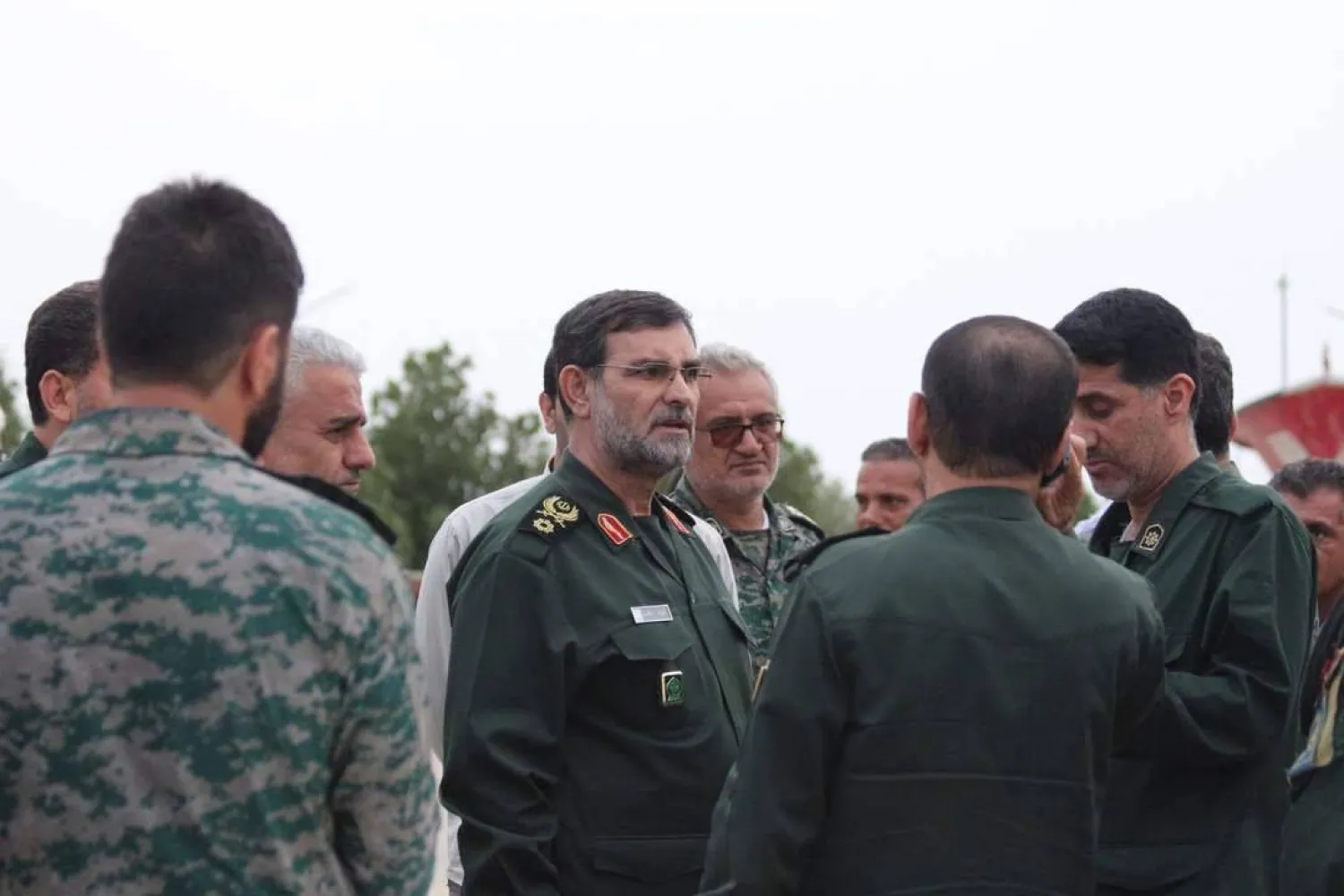
Tangsiri on the sidelines of a field tour along the shores of Bandar Abbas in 2019 (Islamic Revolutionary Guard Corps website) 
TT

Alireza Tangsiri… The Supreme Leader’s Man in the Shipping Lanes

Tangsiri on the sidelines of a field tour along the shores of Bandar Abbas in 2019 (Islamic Revolutionary Guard Corps website) 

When Alireza Tangsiri took command of the naval arm of Iran’s Revolutionary Guard Corps (IRGC) in 2018, he appeared to fit squarely into the role envisioned by Supreme Leader Ali Khamenei: an ideological and confrontational force operating at the frontline of daily tensions with the United States, particularly in the Gulf.

Rather than presenting himself as a conventional naval officer, Tangsiri cast his role in strategic terms, as an enforcer of IRGC plans in the Strait of Hormuz and a key architect of a doctrine that treats waterways, islands and energy routes as tools of both sovereignty and leverage.

His trajectory was shaped by three overlapping arenas: the Iran-Iraq War, which forged a generation of IRGC commanders; the Gulf’s contested waters as a constant zone of friction with US forces; and more recent conflicts that pushed the IRGC Navy into the center of regional escalation.

After the brief but intense war of June 2025, and during the ongoing conflict that erupted on February 28, 2026, Tangsiri emerged as one of Iran’s most prominent field commanders. Israeli media have since reported that he was killed in a strike on Bandar Abbas, although there has been no official confirmation from Tehran.

Son of the coast

Born in 1962 in Tangestan in Bushehr province, Tangsiri grew up in a coastal environment that would define both his outlook and career. His family later moved to Ahvaz, but his southern background remained central to his identity within the military.

Unlike many officers trained in conventional naval academies, Tangsiri belonged to a generation shaped in the field. He joined the IRGC during the Iran-Iraq War and built his experience in maritime units operating in coastal and riverine environments.

His formative years unfolded not on open seas, but in narrow waterways and strategic chokepoints — terrain that would later underpin Iran’s asymmetric naval strategy.

A different navy

The IRGC Navy operates alongside Iran’s regular navy, but with a distinct mission. Rather than projecting power across oceans, it was built to operate in confined, strategically sensitive waters where global trade routes, energy flows, islands and foreign military presence converge.

Since its establishment in 1985, it has developed capabilities tailored to asymmetric warfare: fleets of fast attack boats, coastal missile systems, naval mines, and commando units deployed across key maritime corridors and islands.

Tangsiri rose through this structure, holding early command roles in Bandar Abbas, near the Strait of Hormuz, one of the most sensitive flashpoints between Iran and US forces. He later served as deputy commander under Ali Fadavi from 2010 to 2018.

Hostility as a path to power

His appointment in August 2018 came as Washington, under then President Donald Trump, moved to tighten sanctions after withdrawing from the 2015 nuclear deal, while Tehran signaled it could use the Strait of Hormuz as leverage. The choice of Tangsiri reflected both military and political calculations: a commander closely aligned with escalation and unambiguous in his hostility toward the United States.

Under his leadership, the IRGC Navy emphasized mobility, coordination and intelligence capabilities. Tangsiri himself adopted a blunt tone, repeatedly asserting Iran’s ability to track, challenge and even block US naval movements.

He frequently spoke of tactics involving swarms of fast attack boats and did not shy away from invoking the possibility of suicide-style operations. His tenure was also marked by incidents involving the detention or interception of foreign vessels and crews in Gulf waters.

In the context of Iran’s political discourse, where opposition to the United States is central, such rhetoric reinforced his standing.

After 2019

From 2019 onward, Tangsiri became one of the most visible figures associated with rising maritime tensions in the Gulf. As US sanctions intensified and encounters at sea increased, the IRGC Navy played a growing role in signaling Iran’s strategic posture. Tangsiri himself was placed under US sanctions alongside other commanders, accused of involvement in activities affecting international shipping.

He increasingly moved into the public spotlight, repeatedly warning that Iran could close the Strait of Hormuz if its oil exports were targeted, while promoting the idea that maritime traffic should fall under Iranian oversight.

At the same time, Iran expanded its narrative of deterrence: unveiling underground naval facilities, coastal missile bases and long-range strike capabilities. The message was that the Gulf had become a heavily militarized and contested space.

From deterrence to rule enforcement

Over time, Tangsiri’s rhetoric evolved from deterrence to the assertion of control. He stated that all vessels passing through the Strait of Hormuz should provide detailed information and went further by suggesting that such communication be conducted in Persian, an apparent challenge to established international maritime norms.

He also underscored Iran’s position on disputed Gulf islands, including Abu Musa and the Greater and Lesser Tunb islands, presenting them as forward lines of sovereignty and integral to the security of the strait.

During his tenure, the IRGC expanded its presence on these islands, establishing new bases and infrastructure, including a military airstrip. In doing so, Tangsiri helped redefine the IRGC Navy as more than a patrol force, portraying it instead as a power controlling a continuous arc linking coastline, islands and vital shipping routes.

“June 2025 War”

During the June 2025 conflict, the IRGC Navy did not play the central combat role seen in missile or air defense units. Instead, the maritime domain remained a latent lever of pressure.

The Strait of Hormuz, shipping lanes and energy routes were held in reserve as tools of strategic deterrence rather than active theatres of confrontation. Tangsiri maintained at the time that Iran did not seek to close the strait but retained the option if its exports were threatened.

The war that began in February 2026 altered that dynamic.

The maritime arena moved to the forefront, with the IRGC Navy directly involved in pressuring shipping routes and shaping regional calculations. Tangsiri emerged as one of the clearest voices of this shift, framing Hormuz as a sovereign space requiring coordination with Iranian authorities.

He reported turning back vessels that did not comply with Iranian procedures and broadened his rhetoric to include potential targeting of energy infrastructure linked to US interests.

The death of the Supreme Leader’s man in the strait

On the 26th day of the war, Israeli and US media reported that Tangsiri had been killed in a strike on Bandar Abbas, alongside several aides, in what was described as an attempt to weaken Iran’s grip on the Strait of Hormuz.

There has been no confirmation from Iran. Even so, the attention surrounding his reported death underscores his importance. Tangsiri had become more than a naval commander. He was seen as a key figure in enforcing Iran’s posture in the strait and raising the stakes of confrontation.

If confirmed, his death would carry both operational and symbolic weight, potentially affecting command at a critical moment while removing a central figure in Iran’s maritime strategy.

In the end, Tangsiri’s significance lies less in his rank than in the role he played. A product of the Iran-Iraq War generation, he helped shift Iran’s strategic focus from land to sea. In doing so, he became one of the clearest embodiments of a doctrine that views maritime geography not merely as territory, but as a tool of political, military, and economic power.


22 Migrants Die Off Greece after Six Days at Sea

Hellenic coast guard performs SAR operation, following migrant's boat collision with coast guard off the Aegean island of Chios, near Mersinidi, Greece, February 4, 2026. REUTERS
TT

22 Migrants Die Off Greece after Six Days at Sea

Hellenic coast guard performs SAR operation, following migrant's boat collision with coast guard off the Aegean island of Chios, near Mersinidi, Greece, February 4, 2026. REUTERS

Twenty-two migrants hoping to reach Europe from North Africa have died off the coast of Greece after six days at sea in a rubber boat, survivors told the Greek coastguard Saturday.

The coastguard late Friday said 26 people, including a woman and a minor, were rescued by a European border agency vessel off the island of Crete.

The coastguard later told AFP that 21 Bangladeshis, four South Sudanese and a Chadian citizen had emerged from the ordeal alive.

Survivors said the bodies of those who had died were thrown into the Mediterranean Sea on the orders of one of the people smugglers aboard the ship.

Two survivors were taken to hospital in Heraklion on Crete, the coastguard said.

Based on survivor statements, the coastguard said the boat had left Tobruk, a port city in eastern Libya, on March 21, bound for Greece, the gateway for many migrants hoping for asylum in the European Union.

"During the journey, the passengers lost their bearings and remained at sea for six days without food or water," the coastguard stated.

The bodies of those who died "were thrown into the sea on the orders of one of the smugglers", it added.

The Greek authorities have arrested two South Sudanese men, aged 19 and 22, believed to be the smugglers.

They are now under investigation for "illegal entry into the country" and "negligent homicide".

The vessel carrying the group was 53 nautical miles south of Ierapetra, a town on southern Crete.

A coastguard spokesman told AFP that the craft had endured "unfavorable meteorological conditions" during their odyssey.

That, coupled with a shortage of food and water, had "led to the deaths through exhaustion of 22 people," the spokesman said.

"The bodies of these dead people were thrown into the sea on the orders of the two traffickers, who have been arrested, according to testimony by survivors," he added.

The number of migrants who have died trying to reach EU soil more than doubled in the first two months of 2026, compared with last year, the EU border agency Frontex said earlier this month.

"These tragedies highlight once more the urgency to intensify the work with partner countries along the migratory routes and redouble efforts in the fight against migrant smugglers, who are the ones responsible for these tragedies," an EU commission spokesperson said on Saturday.

According to data from the International Organization for Migration, 559 people died in the Mediterranean during January and February, compared with 287 for the same period last year.

In December, 17 migrants were found dead inside their boat, which was taking on water and had partially deflated, to the southwest of Crete.

Greek authorities found only two survivors, stating that a further 15 people had drowned.

Their bodies were never recovered.

In a bid to stem the crossings, the European Parliament on Thursday endorsed a major tightening of EU migration policy and approved the concept of "return hubs", designed to send migrants to non-EU third countries.

Those proposals have been criticized by rights groups as inhumane.


French Police Thwart a Suspected Bombing Outside a Bank of America Building in Paris

French police arrested suspected militants in Marseille. Credit Gerard Julien/Agence France-Presse/File Photo-Getty Images
TT

French Police Thwart a Suspected Bombing Outside a Bank of America Building in Paris

French police arrested suspected militants in Marseille. Credit Gerard Julien/Agence France-Presse/File Photo-Getty Images

French police have thwarted a suspected bomb attack outside a Bank of America building in Paris, authorities said Saturday. One suspect was detained and another escaped.

The national anti-terrorism prosecutor’s office, or PNAT, told The Associated Press that it has opened an investigation into alleged terrorism-related offenses.

The suspected offenses include attempted damage by fire or by a dangerous means, the manufacture of an incendiary or explosive device, the possession and transport of such devices with the intent to prepare dangerous damage, and involvement in a terrorist criminal association.

A person was placed in police custody.

“Well done to the rapid intervention of a Paris police prefecture unit, which made it possible to thwart a violent act of a terrorist nature overnight in Paris,” Interior Minister Laurent Nuñez said.

“Vigilance remains at a very high level," Nuñez said. "I commend all security and intelligence forces, fully mobilized under my authority in the current international context."

RTL radio, citing police sources, reported that the incident took place early Saturday when police officers spotted two suspects carrying a shopping bag near the premises of the Bank of America in the 8th arrondissement of the French capital.

One of the suspects, holding a lighter, was attempting to ignite a device, RTL said, while the second suspect managed to escape.


Protesters March in London to Oppose the Rise of Political Right

A large crowd of protesters holding up signs and banners. Photograph: Hannah McKay/Reuters
TT

Protesters March in London to Oppose the Rise of Political Right

A large crowd of protesters holding up signs and banners. Photograph: Hannah McKay/Reuters

Tens of thousands of protesters took to the streets of central London on Saturday for a "March to Stop the Far Right" with many demonstrators decrying the right-wing Reform UK party of Brexit campaigner Nigel Farage, which is topping opinion polls.

Backed by trade unions and civil society groups, the Together Alliance demonstration looked set to be one of the biggest in the British capital in recent years with about 30,000 people expected to take part, according to a police official, Reuters reported.

As well as placards opposing Reform UK and its anti-immigration stance, some Iranian flags were held aloft along with pro-Palestinian flags and banners. The march was due to end close to the British parliament building.

Reform leads the Labour Party of Prime Minister Keir Starmer as well as the other traditional British political parties, according to opinion polls. Zach Polanski, leader of the Green Party which is also challenging Labour, joined Saturday's march.
