


Whale Stranded at Baltic Sea Resort Has Swum Off Sandbank. But it Isn't Safe Yet

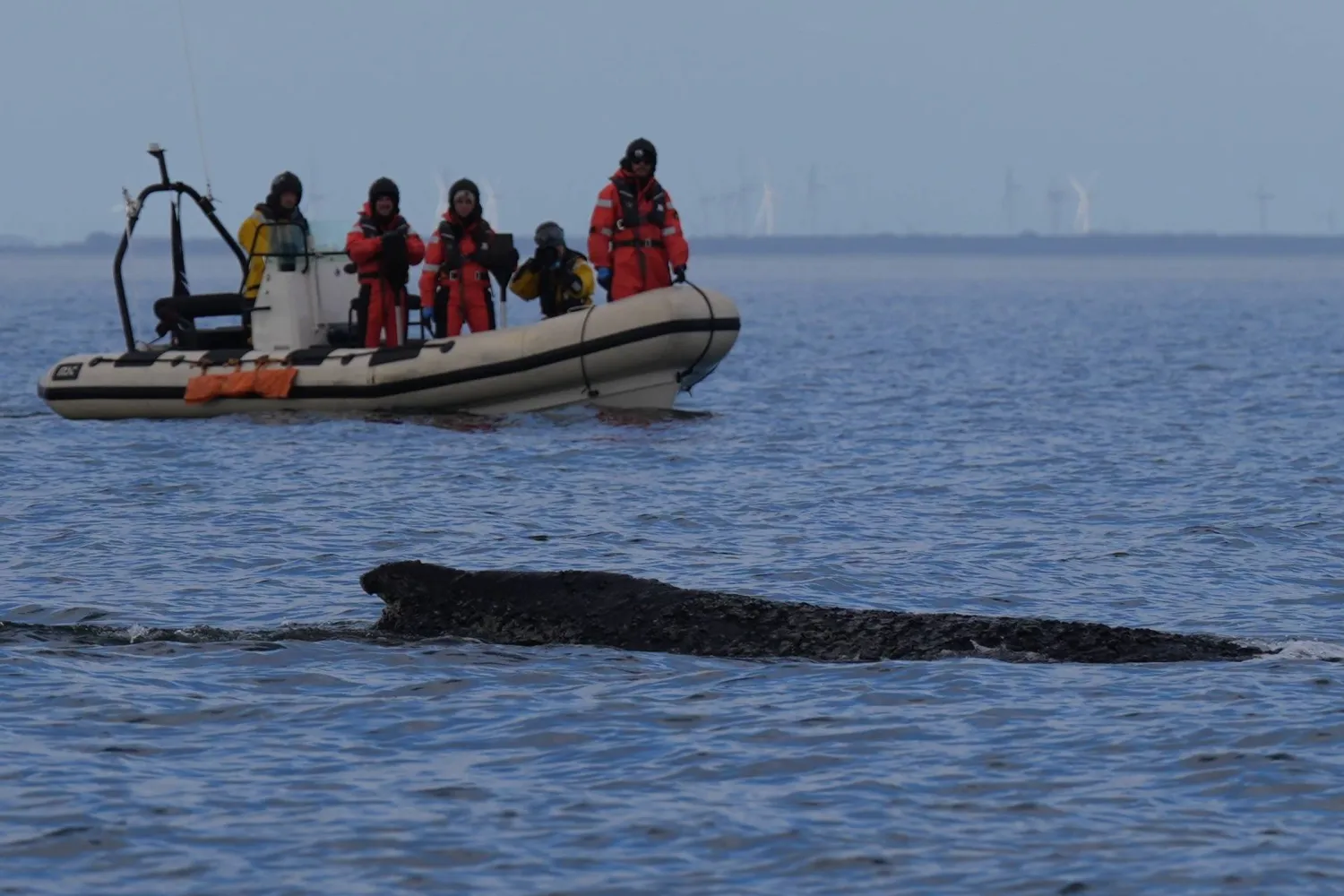
A humpback whale swims in the Baltic Sea, accompanied by an inflatable boat, after freeing itself the night before from being stranded off Niendorf in Timmendorfer Strand, Germany, Friday March 27, 2026. (Marcus Brandt/dpa via AP)
TT

Whale Stranded at Baltic Sea Resort Has Swum Off Sandbank. But it Isn't Safe Yet

A humpback whale swims in the Baltic Sea, accompanied by an inflatable boat, after freeing itself the night before from being stranded off Niendorf in Timmendorfer Strand, Germany, Friday March 27, 2026. (Marcus Brandt/dpa via AP)

A whale that was stranded for days in shallow water at a Baltic Sea resort in Germany has swum free from a sandbank overnight after a last-ditch rescue effort. But it isn't out of danger yet.

An excavator spent Thursday digging an escape channel. The whale then swam through it overnight, marine biologist Robert Marc Lehmann said Friday, German news agency dpa reported.

But he cautioned that it was only a small step in the right direction for the marine mammal, which is 12-15 meters (39-49 feet) long, and that it will only really be at home again if it reaches the Atlantic Ocean.

The whale was spotted stuck on an underwater sandbank in Timmendorfer Strand, a popular resort town, on Monday morning. Initial efforts to free it and coax it back toward deeper water, including using coast guard and fire department boats to create large waves, were unsuccessful. The Baltic Sea lacks strong tides that could have freed the whale.

On Thursday morning, rescuers brought in excavators to dig a trench in front of the whale's head, while Lehmann approached the animal and guided the digging. They worked until well after sunset, but hadn't quite been able to get the whale out by the time they had to stop work for the night.

Early on Friday morning, the whale was on its way out of Lübeck Bay, where Timmendorfer Strand is located, said Stephanie Gross of the Institute of Terrestrial and Aquatic Wildlife Research. She said the massive mammal, which was about 300 meters (nearly 1,000 feet) off the coast, was being accompanied by a coast guard ship and several boats.

Experts assume that the whale is a young male, as males, unlike females, tend to migrate. It also appeared to be the same whale that was spotted several times in the port of Wismar, east of Timmendorfer Strand, in recent weeks.

It was not immediately clear why the whale was in the area and got stranded.

Humpback whales aren't native to the Baltic. This one faces a journey of several hundred kilometers (miles) through German and Danish waters if it is to reach the North Sea.



413,793 KitKat Candy Bars Stolen en Route from Italy to Poland

FILE - A KitKat chocolate bar in Rugby, England, on July 25, 2018. (AP Photo/Martin Cleaver, File)
TT

413,793 KitKat Candy Bars Stolen en Route from Italy to Poland

FILE - A KitKat chocolate bar in Rugby, England, on July 25, 2018. (AP Photo/Martin Cleaver, File)

Swiss food giant Nestlé says about 12 tons, or 413,793 candy bars, of its KitKat chocolate brand were stolen after leaving its production site in Italy earlier this week for Poland.

The company, based in Vevey, Switzerland, said in a statement Friday that “the vehicle and its load are still nowhere to be found.”

The shipment of the crunchy bars, made of waffles covered with chocolate, disappeared last week while en route between production and distribution locations. The chocolate bars were to be distributed throughout Europe.

The missing candy bars could enter unofficial sales channels across European markets, the company said, but if this does happen, all products can be traced using the unique batch code assigned to individual bars.

A spokesperson for KitKat said that as a result, consumers, retailers and wholesalers would be able to identify if a product is part of the stolen shipment by scanning the on-pack batch numbers. If a match is found, the scanner will be given clear instructions on how to alert the company, which will then share the evidence appropriately.

“Whilst we appreciate the criminals’ exceptional taste, the fact remains that cargo theft is an escalating issue for businesses of all sizes," The Associated Press quoted KitKat as saying in a statement.

“With more sophisticated schemes being deployed on a regular basis, we have chosen to go public with our own experience in the hope that it raises awareness of an increasingly common criminal trend,” the statement added.


Virus Kills Tiger Cubs in Indonesian Zoo

Jelita, a Bengal tiger, is seen in its enclosure at Bandung Zoo in Bandung, West Java, on March 26, 2026. (Photo by Timur Matahari / AFP)
TT

Virus Kills Tiger Cubs in Indonesian Zoo

Jelita, a Bengal tiger, is seen in its enclosure at Bandung Zoo in Bandung, West Java, on March 26, 2026. (Photo by Timur Matahari / AFP)

Two Bengal tiger cubs born in Indonesia's Bandung Zoo last year have died from a viral infection, a conservation official told AFP on Friday.

The cubs, two males named Huru and Hara, were born last July to tigress Jelita, who remains in good health.

According to the conservation agency of West Java province, the cubs were infected at birth with the Feline Panleukopenia virus (FPV), which can sicken wild and domestic cats and is particularly dangerous for young animals.

Hara died on the 24th, two days after falling ill, and despite veterinary efforts to save him, Huru followed two days later, agency spokesman Eri Mildrayana told AFP.

The cubs had suffered from diarrhea, vomiting and lethargy in the days before they died.

Bandung mayor Muhammad Farhan, in a social media post Thursday, said the news had left him "very sad."

"This is an important lesson for us. The step that we can take right now is to improve biosecurity," he wrote on Instagram.

The US National Institutes of Health says FPV is also referred to as "cat plague" or "feline distemper" and usually occurs in unvaccinated or improperly vaccinated captive felines.

The Bandung Zoo in West Java has been closed for months due to what officials have described as internal management problems.

In 2017, activists demanded the zoo's closure after skeletal sun bears were pictured begging for food from visitors and eating their own dung.

AFP was unable to reach Bandung city authorities in charge of running the zoo.

According to the International Union for Conservation of Nature, the Bengal tiger is an endangered species, with fewer than 4,000 still in the wild -- mostly in India, Nepal, Bangladesh and Bhutan.


Meet the Artemis Crew in NASA's First Astronaut Mission to the Moon in More than a Half-century

Artemis 2 crew members, from left, Mission Spc. Jeremy Hansen, of Canada, Mission Spc. Christina Koch, Commander Reid Wiseman, and Pilot Victor Glover pose for a photo after the crew’s arrival at the Kennedy Space Center Friday, March 27, 2026, in Cape Canaveral, Fla. (AP Photo/Chris O’Meara)
TT

Meet the Artemis Crew in NASA's First Astronaut Mission to the Moon in More than a Half-century

Artemis 2 crew members, from left, Mission Spc. Jeremy Hansen, of Canada, Mission Spc. Christina Koch, Commander Reid Wiseman, and Pilot Victor Glover pose for a photo after the crew’s arrival at the Kennedy Space Center Friday, March 27, 2026, in Cape Canaveral, Fla. (AP Photo/Chris O’Meara)

The four astronauts making NASA’s next lunar leap bear little resemblance to the Apollo era.

The Americans who blazed the trail to the moon more than half a century ago were white men chosen for their military test pilot experience. This first Artemis crew includes a woman, a person of color and a Canadian, products of a more diversified astronaut corps.

None of them were alive during NASA’s storied Apollo program that sent 24 astronauts to the moon including 12 moonwalkers. They won’t land on the moon this time or even orbit it, but the out-and-back journey will take them thousands of miles deeper into space than even the Apollo astronauts ventured, promising unprecedented views of the lunar far side, The AP news reported.

Here’s a look at the Artemis astronauts whose mission aims to pave the path for future moon landings:

Commander Reid Wiseman Leading the nearly 10-day mission is a widower who considers solo parenting — not rocketing to the moon — his biggest and most rewarding challenge.

Wiseman, 50, a retired Navy captain from Baltimore, was serving as NASA’s chief astronaut when asked three years ago to lead humanity’s first lunar trip since 1972. His wife Carroll’s death from cancer in 2020 gave him pause.

He’d spent more than five months at the International Space Station in 2014, and his two teenage daughters, especially the older one, had “zero interest” in him launching again.

“We talked about it and I said, ‘Look, of all the people on planet Earth right now, there are four people that are in a position to go fly around the moon,” he said. “I cannot say no to that opportunity.”

The next day, homemade moon cupcakes awaited him, along with his daughters' support. The toughest part isn’t leaving them — “it's the stress that I’m putting on them,” he said.

Open with his daughters about everything, he recently told them where he keeps his will.

Pilot Victor Glover As one of NASA’s few Black astronauts, Glover sees his presence on the mission as “a force for good.”

The 49-year-old Navy captain and former combat pilot from Pomona, California, makes it a habit to listen to Gil Scott-Heron’s “Whitey on the Moon” and Marvin Gaye’s “Make Me Wanna Holler” from the white-dominated Apollo era.

“I listen to those for perspective,” he said. “It captures what we did well, what we did poorly.”

The ability for him now to offer hope to others is “an amazing blessing and a privilege.” Despite having one spaceflight behind him — an early SpaceX crew run to the International Space Station — he finds himself in new personal territory. His four daughters are in their late teens and early 20s, “and I spend as an much time and thought preparing them as NASA does preparing me.”

He’s hyper-focused on running “our best race so that we can hand the baton off to the next leg” — a 2027 practice docking mission in orbit around Earth between an Orion crew capsule and one or two lunar landers. The all-important moon landing would follow in 2028 with yet another set of astronauts.

Mission specialist Christina Koch The last time Koch blasted into space, she was gone almost a year, so she’s not sweating a quick trip to the moon and back.

The 47-year-old electrical engineer from Jacksonville, North Carolina, holds the record for the longest single spaceflight by a woman — 328 days. She took part in the first all-female spacewalk during her lengthy stay at the space station in 2019.

More than any one individual, “it’s about celebrating the fact that we’ve arrived to this place in history” where women can fly to the moon, she said.

Before she got called up by NASA, Koch spent a year at a South Pole research station. Between that and her space stint, she feels she's “inoculated” most of her family and friends.

“So far, I haven't gotten too many nerves from folks. Maybe my dog, but I've reassured her that it's only 10 days. It's not going to be as long as last time.”

Her and her husband's rescue pooch is named Sadie Lou.

Canadian Space Agency's Jeremy Hansen The Canadian fighter pilot and physicist is making his space debut, stressful enough, but also serving as his country's first emissary to the moon.

“Maybe I'm naive, but I don't feel a lot of personal pressure.”

Hansen, 50, grew up on a farm near London, Ontario, before moving to Ingersoll and pursuing a flying career. The Canadian Space Agency selected him as an astronaut in 2009, and he was named to the Artemis crew in 2023.

He realizes only now how much effort it took to send men to the moon during Apollo.

“When I walk out and I look at the moon now, it looks and feels a little bit farther than it used to be,” he said. “I just understand in the details how much harder it is than I thought it was watching videos of it.”

Dangers still loom — something he’s shared with his college-aged son and twin daughters. “The most likely outcome is that we will come back safe. There’s a chance we won’t, and you will be able to move through life even if that happens,” he assured them.