
Lebanon Kids Struggle to Keep Up Studies as War Slams School Doors Shut

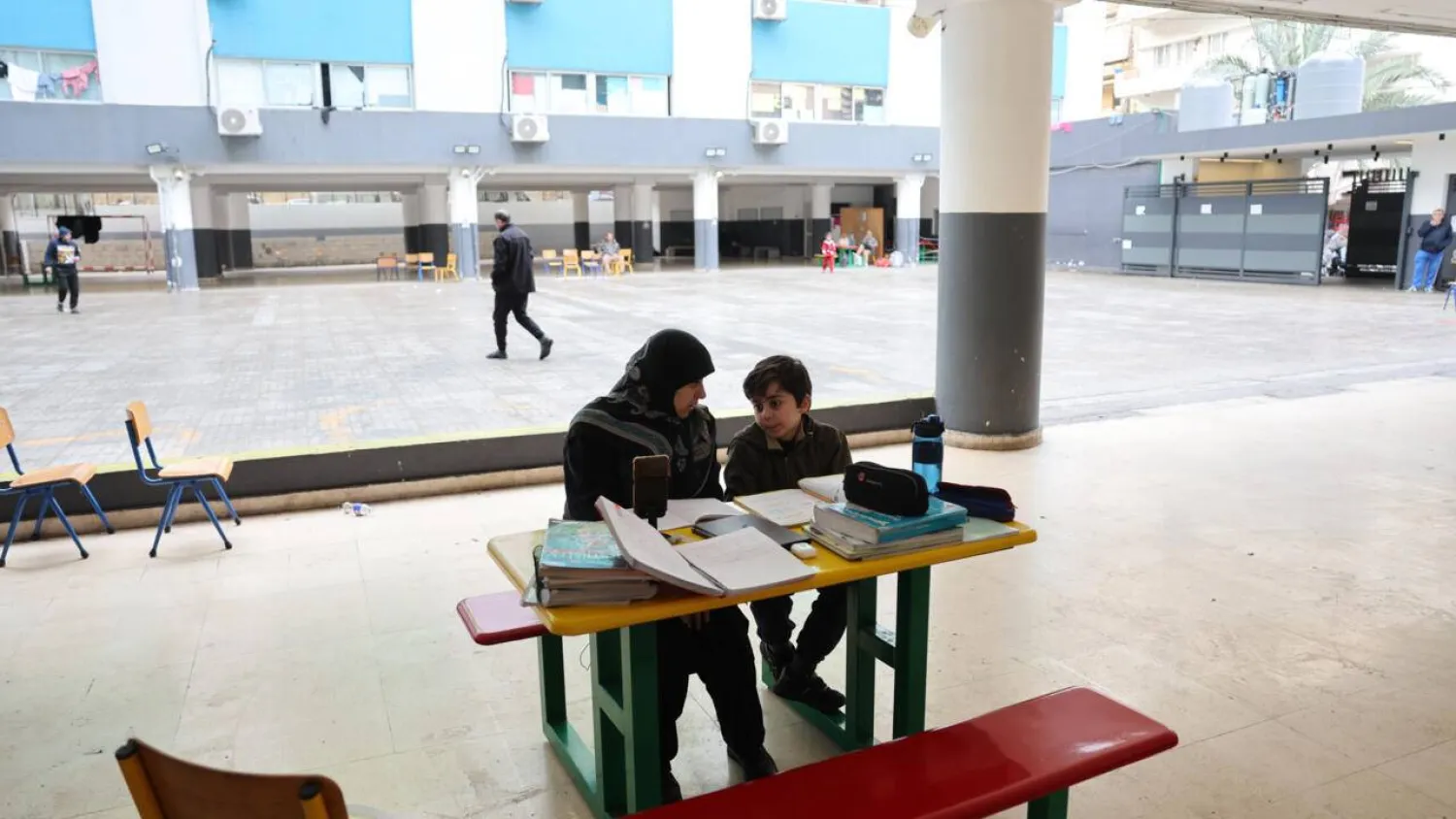
UNICEF says the war has left almost half a million students out of school in Lebanon. Anwar AMRO / AFP
TT

Lebanon Kids Struggle to Keep Up Studies as War Slams School Doors Shut

UNICEF says the war has left almost half a million students out of school in Lebanon. Anwar AMRO / AFP

In a classroom turned shelter for displaced families, teenager Ahmad Melhem follows a recorded lesson on a tablet as the war between Hezbollah and Israel interrupts education for hundreds of thousands of students in Lebanon.

"I don't want to regret not finishing my studies despite the difficult circumstances," said Melhem, whose family was displaced from Beirut's southern suburbs, the site of repeated Israeli bombardment.

"We took a risk and went back to get schoolbooks," he told AFP.

"We're trying with everything we have to continue our education so we can achieve our goals," said the 17-year-old, who hopes to study engineering after finishing high school.

Crisis-hit Lebanon was pulled into the Middle East war on March 2 when militant group Hezbollah fired rockets towards Israel to avenge the US-Israeli killing of Iran's supreme leader Ali Khamenei.

Israel has responded with large-scale strikes on Lebanon and a ground offensive in the country's south, killing more than 1,100 people -- including 122 children -- and displacing more than one million people, according to authorities.

The United Nations children's agency UNICEF says the war has left almost half a million students out of school in Lebanon, after more than 350 public schools were turned into shelters and many in areas under Israeli bombardment were closed.

Melhem's family and others are sharing a classroom divided up by plastic curtains at a school in a central Beirut district, the room scattered with thin mattresses and blankets, a table and small stove serving as a shared kitchen.

- 'Digital divide' -

In the corner, Melhem has set up his books and a computer screen, but there is no internet in the room.

An NGO has provided internet access in the schoolyard, crowded with children playing and families socializing, but Melhem says he cannot concentrate because of the noise, so he watches the recorded classes later.

His private school resumed distance learning two weeks after the war began, after cancelling subjects and shortening lessons.

"In-person (class) is better and more engaging," he said. "I miss group work and the science projects we used to do."

According to a 2023 World Bank report, each day of public school closures costs the Lebanese economy three million dollars.

In the courtyard, Melhem's mother helps her other son, aged eight, to follow his online classes.

"If I leave him alone, his mind wanders and he can't keep up with the lesson," says Salameh, 41.

"The war has destroyed everything," she added.

"Education is the only thing left for my children."

UNICEF's head of education in Lebanon, Atif Rafique, expressed particular concern about the future of students who are preparing to enter university while the war continues.

He warned of the dangers of children dropping out of school, especially "girls and adolescent young women" who face additional risks, including early marriage.

'Not even pens'

In Dekwaneh, north of Beirut, at a vocational institute that is now a shelter, Aya Zahran said she spends her day "preparing food and working to make the place livable".

"We have only one phone that my siblings and I share," said Zahran, 17, who is also displaced from Beirut's southern suburbs.

But "the link the school sent us (for online classes) doesn't work", she said.

Rafique said hundreds of public schools lack the resources for distance learning, and noted a "big digital divide" when it comes to internet access, with teachers also affected.

UNICEF has helped launch an online platform with recorded lessons, and a hotline allowing students to access materials through a phone call, without needing internet access.

He said children in south Lebanon have been disproportionately affected by education interruptions since the last round of hostilities between Israel and Hezbollah broke out in October 2023.

Just a week before the latest war began, UNICEF reopened 30 schools in the south that had been damaged in the previous conflict, he said.

At the vocational institute's entrance, an education ministry employee was registering children to assess what educational services they need.

"The situation here is very difficult... there's no internet here, and not even pens," said Nasima Ismail, who has been displaced from the northeast Bekaa region, as she signed up her children.

"My children are top students. I don't want them to miss out on their education, as happened to us when we were kids," said Ismail, recalling Lebanon's devastating 1975-1990 civil war.

"I want them to complete their education, even if we are left with nothing," she said.

"I wish them days better than ours."


RSF Launches Drone Attacks Across Sudan

RSF Launches Drone Attacks Across Sudan
TT

RSF Launches Drone Attacks Across Sudan

RSF Launches Drone Attacks Across Sudan

Sudan's paramilitary Rapid Support Forces (RSF) launched drone strikes on capital Khartoum and other army-controlled cities on Wednesday, an AFP correspondent, witnesses and an army source said, in what appeared to be their largest coordinated attack in months.

Since April 2023, Sudan has been ravaged by war between its regular military, led by army chief Abdel Fattah al-Burhan, and the RSF, commanded by Burhan's former deputy Mohamed Hamdan Daglo.

The capital Khartoum, which was recaptured by the army last year, has been targeted by drone strikes before but enjoyed relative calm for months.

A source in the army said the RSF attacked the capital, the Kordofan city of El-Obeid, and the northern cities of Atbara and El-Damer "with a large number of drones, which our anti-aircraft defenses engaged with".

El-Obeid is located nearly 400 kilometers (248 miles) from Khartoum and around 650 kilometers from Atbara.

An AFP correspondent in the capital reported a drone attack at 5 am (0300 GMT) along with the sound of anti-aircraft missiles from the direction of the army's Wadi Seidna base, just north of the twin city of Omdurman.

In Khartoum North (Bahri), just across the Nile River, two drones hit a mosque and an electricity transformer in the El-Droshab area, according to an eyewitness.

It was not immediately clear if air defenses had shot them down.

Witnesses in the northern cities of Atbara and El-Damer -- both also under army control -- gave similar reports of hearing explosions and seeing drones in the sky.

Some 120 kilometers southeast, in the town of Tamboul, civilians were in a "state of fear" after drones appeared above them, a witness told AFP.

There were no immediate reports of casualties in the attacks, including in the Khartoum North mosque which worshippers had recently emptied after dawn prayers.

Across the country, aid workers estimate more than 200,000 people have been killed in what the UN calls a "war of atrocities". The conflict has also caused the world's largest hunger and displacement crises.

- Retaliatory strike -

The RSF has seemed to be on the back foot since the army last month pushed them off a key highway connecting Khartoum to El-Obeid, the southern Kordofan region's largest city, which they had tried to seize for months.

Daglo in the aftermath said he would "unleash" his fighters -- already accused of war crimes including genocide -- and his fighters have since repeatedly threatened a large-scale retaliatory attack.

Burhan and Daglo, allies until they fell out in a bitter power struggle, have spent most of the war in a relative stalemate, unwilling to hold negotiations while vying for a decisive battlefield advantage.

The RSF last year consolidated its hold on the vast western region of Darfur, and has since pushed to seize territory in Kordofan and along the southeastern Ethiopian border.

The army holds the country's center, north and east, and has tried to project an image of a return to normalcy in areas it controls.

But in Khartoum, 2.3 million people have returned from displacement, only to find vast amounts of uncleared war remnants, dilapidated infrastructure and limited electricity and water.

According to an eyewitness, Wednesday's drone attack "caused an explosion in an electricity transformer" in Khartoum North, where over half a million people already live without power.

Even parts of the city that have had more reliable services than Khartoum North have been without power for weeks.


US Says New Round of Lebanon-Israel Talks in Rome in September

A photograph taken from the southern Lebanese village of Chaqra shows destruction in the border village of Houla, and behind it is what is known as the “Abbad Israeli outpost” on August 11, 2026. (AFP)
TT

US Says New Round of Lebanon-Israel Talks in Rome in September

A photograph taken from the southern Lebanese village of Chaqra shows destruction in the border village of Houla, and behind it is what is known as the “Abbad Israeli outpost” on August 11, 2026. (AFP)

The United States will sponsor a new round of talks between Lebanon and Israel in early September in Rome, a State Department official announced Tuesday.

"The political track will reconvene in Rome in early September, and conversations will continue in Beirut, Jerusalem, and Washington in the interim," the official said on condition of anonymity. "We feel good about the trajectory."

The United States has been sponsoring talks between Lebanon and Israel aimed at putting an end to hostilities between them, with Beirut seeking Israel's phased withdrawal from the south.

In June, Lebanon and Israel agreed to a framework deal that involves the disarmament of Hezbollah, a gradual withdrawal of Israeli forces from Lebanon's south and the deployment of the Lebanese army to the region, starting in test areas known as "pilot zones."

Talks last week in Rome were the seventh round since Hezbollah drew Lebanon into the Middle East war in March with rocket fire at Israel in support of its backer Iran.

Israel responded with heavy airstrikes and a ground invasion that Lebanon says have killed more than 4,300 people.

The US official speaking Tuesday gave an update on the last round of talks in Rome.

"The framework is being implemented, the first zones are live, and the working groups have aligned their language, maps, and procedures," the official said.

Hezbollah has repeatedly rejected the direct talks between Lebanon and Israel and refuses to surrender its weapons.

Violence in Lebanon has decreased since the Lebanon-Israel deal and the signing in June of a preliminary US-Iran agreement on the Middle East war.

But Lebanon has continued to report intermittent Israeli strikes and shelling, as well as detonations and demolitions in southern villages.

At the next round of technical talks, the US official said: "Lebanon will present detailed roadmaps for securing new areas as implementation proceeds in the current zones."


Pakistan Condemns Houthi Strike That Killed 3 of Its Citizens

Pakistani Foreign Minister Mohammad Ishaq Dar speaks with Russian Foreign Minister Sergei Lavrov during their meeting at the Russian Foreign Ministry headquarters in Moscow, Russia, Nov. 18, 2025. (Shamil Zhumatov/Pool Photo via AP, File)
TT

Pakistan Condemns Houthi Strike That Killed 3 of Its Citizens

Pakistani Foreign Minister Mohammad Ishaq Dar speaks with Russian Foreign Minister Sergei Lavrov during their meeting at the Russian Foreign Ministry headquarters in Moscow, Russia, Nov. 18, 2025. (Shamil Zhumatov/Pool Photo via AP, File)

Pakistan denounced on Wednesday an attack by Houthi militants in Yemen on a vessel in the Red Sea in which three of its citizens were killed.

Yemen's coastguard said Tuesday a strike by the Iran-backed militants on a vessel left six dead, including Pakistanis and an Indonesian citizen.

There has been no official comment from the Houthis about the incident.

"I have learnt with deep concern about the unfortunate incident," Pakistan Foreign Minister Ishaq Dar posted on X, confirming three Pakistanis had been killed and one wounded in the attack.

"Pakistan strongly condemns the Houthi attack on a non-combatant commercial vessel," Dar added.

"We are in contact with the relevant Saudi authorities, as well as the internationally recognized Government of Yemen, to ascertain further details of the incident and the circumstances surrounding it," Dar said.

Pakistan's interior minister, Mohsin Naqvi, is currently in Iran to discuss regional security, Pakistan's foreign office said on Wednesday.