


The Sea Beneath Arctic and Antarctic Ice Holds Many Secrets. These Scientists Dive Deep to Find Out

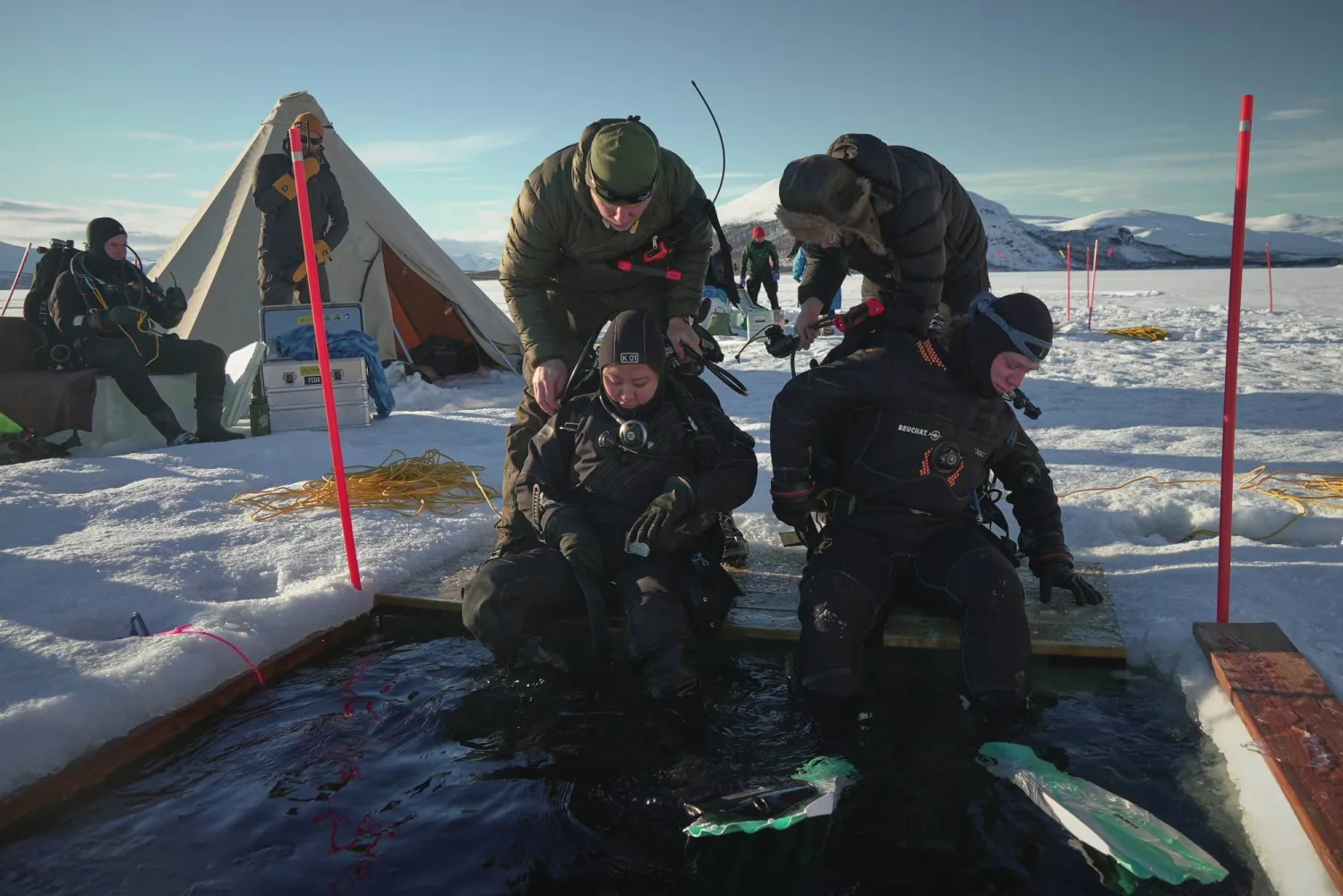
Ruari Buijs, a marine biology and oceanography student, right, and Caroline Chen, a scientific diver and research assistant, prepare to dive during a Polar Scientific Diving class in Kilpisjärvi, March 15, 2026. (AP Photo/Kostya Manenkov)
TT

The Sea Beneath Arctic and Antarctic Ice Holds Many Secrets. These Scientists Dive Deep to Find Out

Ruari Buijs, a marine biology and oceanography student, right, and Caroline Chen, a scientific diver and research assistant, prepare to dive during a Polar Scientific Diving class in Kilpisjärvi, March 15, 2026. (AP Photo/Kostya Manenkov)

As bubbles rippled across the frigid Finnish lake, diver Daan Jacobs emerged from a hole carved out of the thick, crackling ice.

The journey had taken him 8 meters (26 feet) beneath the surface, where sunlight filtered through the Arctic ice and fish swam around a rock formation. It's a remote place few will ever see, especially in winter, when snow blankets the ice and temperatures on land approach minus 40 degrees in both Celsius and Fahrenheit.

But Jacobs, a biodiversity adviser in the Netherlands, is one of a growing number of fortunate underwater explorers, The Associated Press said.

He was part of the Polar Scientific Diving class in the far north of Finland earlier this month, a program designed by the Finnish Scientific Diving Academy to train the next generation of scientists and researchers to dive beneath the Arctic and Antarctic ice to study the flora and fauna below.

“The view is beautiful,” Jacobs said, gulping for air following his 45-minute dive.

The Arctic is warming four times faster than the rest of the planet. From impacting worldwide weather patterns to making the polar bear population smaller, weaker and hungrier, because they rely on the sea ice to hunt from, higher temperatures at the North Pole spell disaster for the entire globe.

In Antarctica, meanwhile, global warming is leading to melting of ice sheets, prompting sea level rise and disrupting ocean ecosystems.

Human divers still needed

So scientists need to study what's underneath the remaining Arctic — and Antarctic — ice, and determine how climate change is affecting the plants and animals that have traditionally survived along the seafloor with little to no sunlight. But carrying out such research requires specialized scuba diving skills plus the proper scientific background — qualifications that experts say only a few hundred people in the world currently have.

The Finnish Scientific Diving Academy’s class aims to not only train more divers, but also to convince the world that the polar ice crisis requires additional research.

“Because it is melting so fast, we need to have more people deployed there — more science to be done — to understand better what happens,” said Erik Wurz, a marine biologist and one of the class's scientific diving instructors. “We have to do more and we need to be fast to save this unique ecosystem in the Arctic, but also the Antarctic.”

And in a world that’s increasingly outsourcing work to artificial intelligence and robots, British Antarctic Survey marine biologist Simon Morley said that human hands are still necessary for this. Dragging nets across the seafloor would destroy the habitat, and a remotely operated submersible or robot can usually only pick up one specimen at a time.

“A diver can go down and pick up 12 urchins, put them in a bag and not affect the rest of the system,” said Morley, who isn't part of the course.

Challenging conditions

During each 10-day session, the academy's instructors drill a dozen experienced divers on a frozen lake at the University of Helsinki's Kilpisjärvi Biological Station. The program began in 2024 and the demand has allowed them to add a second session per year.

The participants range from marine and freshwater biologists and other scientists to highly skilled recreational divers and documentary filmmakers.

Ruari Buijs, a marine biology and oceanography student at the University of Plymouth in England, ultimately wants to work in Antarctica and research marine megafauna. He enrolled in this month's polar diving class in an effort to be more employable upon graduation.

“I thought this would be a very good stepping stone toward that goal,” he said.

Meanwhile, Caroline Chen, a scientific diver and research assistant in Germany, said it’s her dream to dive in the polar regions. She believes that her experience in this course will help her design future experiments in such challenging conditions.

The students must learn more than just diving under ice that's nearly a meter (around three feet) thick and into water temperatures that hover just above freezing. For starters, there's the frigid air temperatures and whipping winds over Lake Kilpisjärvi.

That challenges the topside support team, which must operate equipment to keep the diver safe while fending off their own risk of frostbite. They also have to learn how to become safety divers in case of an emergency, like if the primary diver can't find the hole in the ice to surface after 45 minutes below.

But once they're underwater, the divers say it's an incredible experience. During this month's session, the group dived beneath ice roughly 80 centimeters (around 2½ feet) thick. Chen spotted some fish along the sea floor and then took a moment to look to the surface as sunlight streamed through the ice, seemingly mimicking another Arctic phenomenon.

“It looks insane from the bottom up,” Chen said. “It changes all the time, like the Northern Lights.”

Buijs said that the cold doesn't affect the covered parts of a diver's body. But the area around their mouth remains exposed underwater.

“I think the worst thing is like your lips feel very numb afterward and they like stick out a lot,” he said, laughing. “You kind of get Botox lips a little bit.”



Japan’s Cherry Blossom Season Dazzles Locals and Tourists

 People walk under cherry blossoms in bloom at Ueno Park in Tokyo, Japan, Saturday, March 28, 2026. (Yohei Fukai/Kyodo News via AP)
People walk under cherry blossoms in bloom at Ueno Park in Tokyo, Japan, Saturday, March 28, 2026. (Yohei Fukai/Kyodo News via AP)
TT

Japan’s Cherry Blossom Season Dazzles Locals and Tourists

 People walk under cherry blossoms in bloom at Ueno Park in Tokyo, Japan, Saturday, March 28, 2026. (Yohei Fukai/Kyodo News via AP)
People walk under cherry blossoms in bloom at Ueno Park in Tokyo, Japan, Saturday, March 28, 2026. (Yohei Fukai/Kyodo News via AP)

Japanese locals and tourists packed the country's most stunning cherry blossom spots on Monday to enjoy the dazzling flowers at full bloom.

The tiny white and pink petals of cherry flowers, known as sakura, herald the start of spring in Japan, and full bloom ushers in a brief period of boisterous outdoor parties held by residents.

Across the nation families and friends rolled out blankets and tarpaulins at parks, temples and even cemeteries over the weekend to eat and drink under cherry trees for traditional "hanami" or flower viewing gatherings.

Japanese people hold "very special feelings for sakura", said Tokyo resident Akiko Nyman, 48, as she admired flowers in crowded Ueno park in the center of the capital.

"We love it, because it is so short... it doesn't last long, it comes every year, something very special," she said.

At this time of the year, weather forecasters are laser focused on when the blossom will peak in each city, and they advise excited residents on the best weather days for picnics and how long the flowers might last.

In the ancient capital of Kyoto, officials on Monday declared full bloom after examining a sample tree within the grounds of Nijo-jo Castle, a world heritage site.

- 'Good photo opportunity' -

"We observed the cherry blossoms in full bloom on March 30," Kyoto Local Meteorological Office said.

Cherry flowers at ancient temples and shrines in Kyoto are particularly popular among visitors and locals.

Australian tourist Olivia Martell-Groves went all in for the seasonal experience, and donned a flower-printed kimono while marveling at the flowers.

"We wanted to see them because they're really pretty, good photo opportunities and something you can only see in certain times of the year... and also it just feels so peaceful and nice," she said.

In Tokyo, the flowers reached full bloom during the weekend, entering a brief period of stunning beauty, before the petals will fall like flurries of snow.

The flowers symbolize both the youthful energy and the fragility of life in Japanese culture as full blooms only last about a week.

The season marks the start of the new business year when university graduates join the work force.

It is also a time of farewells, when school graduates leave their hometown while many corporate professionals receive assignments in new cities.


Indonesia to Loan Endangered Komodo Dragons to Japan for Breeding Program

A Komodo Dragon is seen in Komodo National Park, Indonesia April 6, 2018. REUTERS/Henning Gloystein/File Photo
TT

Indonesia to Loan Endangered Komodo Dragons to Japan for Breeding Program

A Komodo Dragon is seen in Komodo National Park, Indonesia April 6, 2018. REUTERS/Henning Gloystein/File Photo

Indonesia will loan two Komodo dragons to Japan's Shizuoka prefecture, where it is hoped the endangered reptiles will be able to breed, and will receive some red pandas and giraffes in return, an official said on Monday.

The Forestry Ministry said the animal swaps would increase "contributions from both parties toward wildlife protection and conservation, as well as raising public awareness of biodiversity," adding that the program ⁠was intended to breed ⁠the Komodo dragons, which the IUCN Red List classifies as endangered.

Ahmad Munawir, a conservation official at the ministry, told Reuters a male and a female will be sent to a zoo in ⁠Shizuoka. In return, the prefecture will send several animals to Indonesia, including red pandas and giraffes, Ahmad said.

The agreement was signed last week, ahead of a visit to Japan by President Prabowo Subianto, who will meet with Japanese Prime Minister Sanae Takaichi later this week.

Indonesia is home to over 3,000 Komodo dragons, according to government data. ⁠The ⁠reptiles are the largest lizards in the world, growing up to around 3 meters (10 feet) long. They have a yellow forked tongue and a venomous bite.

Japan's TV Shizuoka has reported the two dragons would arrive as early as June for the breeding program. Ahmad said the dragons would be sent after a business-to-business agreement was signed by the zoos in Indonesia and Japan.


Chesney the Kangaroo Scales Tall Fence and Flees Petting Zoo for 3 Days on the Lam

This photo provided by Cara Johnson shows her husband and drone operator, Colton Johnson, left, sitting next to Stacy Brereton as she holds a kangaroo named Chesney at Sunshine Farm, in Necedah, Wis., Saturday, March 28, 2026. (Cara Johnson via AP)
TT

Chesney the Kangaroo Scales Tall Fence and Flees Petting Zoo for 3 Days on the Lam

This photo provided by Cara Johnson shows her husband and drone operator, Colton Johnson, left, sitting next to Stacy Brereton as she holds a kangaroo named Chesney at Sunshine Farm, in Necedah, Wis., Saturday, March 28, 2026. (Cara Johnson via AP)

How does a kangaroo escape a petting zoo?

It's not the opening line to a dad joke. If you're Chesney the kangaroo, you scale an eight-foot (2 1/2 meter) fence and go on the lam for three days, giving your keeper sleepless nights and sending residents of a small Wisconsin town on a search that would end happily on Saturday.

The unprecedented leap at Sunshine Farm in Necedah, Wisconsin, last week was precipitated by some stray dogs that rushed the enclosure and spooked the 16-month-old Chesney, said his keeper, Debbie Marland. She and friends then trekked hither and yon in this town about 160 miles (255 kilometers) northwest of Milwaukee.

They chased reports of sightings and even rented heat-seeking drones, which proved effective in narrowing down the wanderings of the high-jumping adventurer.

“I was putting on about 37,000 steps per day looking for him,” Marland said Sunday. "I haven't done so much exercise in a very long time."

Chesney and his roommate Kenny are named for country-music starKenny Chesney. They're among 25 animals at Sunshine Farm, with horses, sheep, alpacas, Kunekune pigs, Highland cows and a Bactrian camel. The farm is generally open Fridays through Sundays from mid-May through mid-November and tours are offered to visitors who can interact with the animals.

Chesney escaped about 11:15 a.m. last Wednesday. Though he stayed within a three-mile (5-kilometer) radius of the farm, he kept his pursuers guessing.

Colton Johnson, owner of Midwest Aerial Drone Services, has used heat-sensing drones to help hunters recover deer and reunite missing dogs with their owners. Add a kangaroo to the list.

Johnson spent three days trailing Chesney alongside Marland and a team of volunteers. His strategy was similar to the ones he uses to find lost pets, but Johnson said the appearance of Chesney's heat signature on the drone footage was unique.

“It almost looked like a dinosaur running through the woods,” Johnson said. “It's got a long tail, and the way it was moving and hopping, that's the only way that I can describe it.”

The team caught up with Chesney on Wednesday and again Thursday night, but Johnson said the frightened kangaroo slipped away — once by jumping into a cold river — and Johnson lost track on the drone.

According to Marland's friend, Stacy Brereton, who helps out at the farm routinely, Friday was a tough day. No one had spotted Chesney all day and searchers feared he had wandered farther afield into even more unfamiliar territory, Brereton said.

Then, Friday night, Chesney was discovered nestled under a tree in a wooded area. A group of searchers surrounded him, but ever fleet of foot — 20 mph (32 kph) is no stretch for him — Chesney eluded them.

Marland returned to the area Saturday morning with Chesney's favorite treats and pieces of material that had his and Kenny's scent. Other searchers later joined her. But with no sign of the kangaroo, they started packing up. Just then, they spotted the long-eared kangaroo with outsize back legs approaching.

Brereton stepped up with a delicate touch.

“He had a very calm attitude when he walked up, obviously you could tell he wasn’t in fight-or-flight mode, so I just went with that,” Brereton said. “I just stayed calm with him and I just kind of went and sat and let him come to me.”

Chesney heard the voices and wanted attention, said Brereton, who eventually scooped up the 40-pound (18-kilogram) animal.

“I do believe he heard our comforting voices, he smelled the familiar smells of home and it just made him feel safe," said Brereton, adding, “I'm just glad he loves me as much as I love him.”

Marland said the “the community really did come together" for the kangaroo, who is now something of a celebrity. A Sunshine Farm fan has written a children's book about Chesney's adventures, which Marland hopes to publish and sell to recoup some of the search costs.

Kenny, who with his marsupial mate has the run of Marland's house, was happy to be reunited with Chesney. Though hungry and tired, Chesney was otherwise healthy but will get a checkup with the veterinarian shortly.

To be safe, Marland added, a new mesh top will be placed over the kangaroo enclosure to prevent any more high-jumping hijinks.