


Iran Accuses US of Ground Assault Plans as Pakistan Hosts Regional Talks

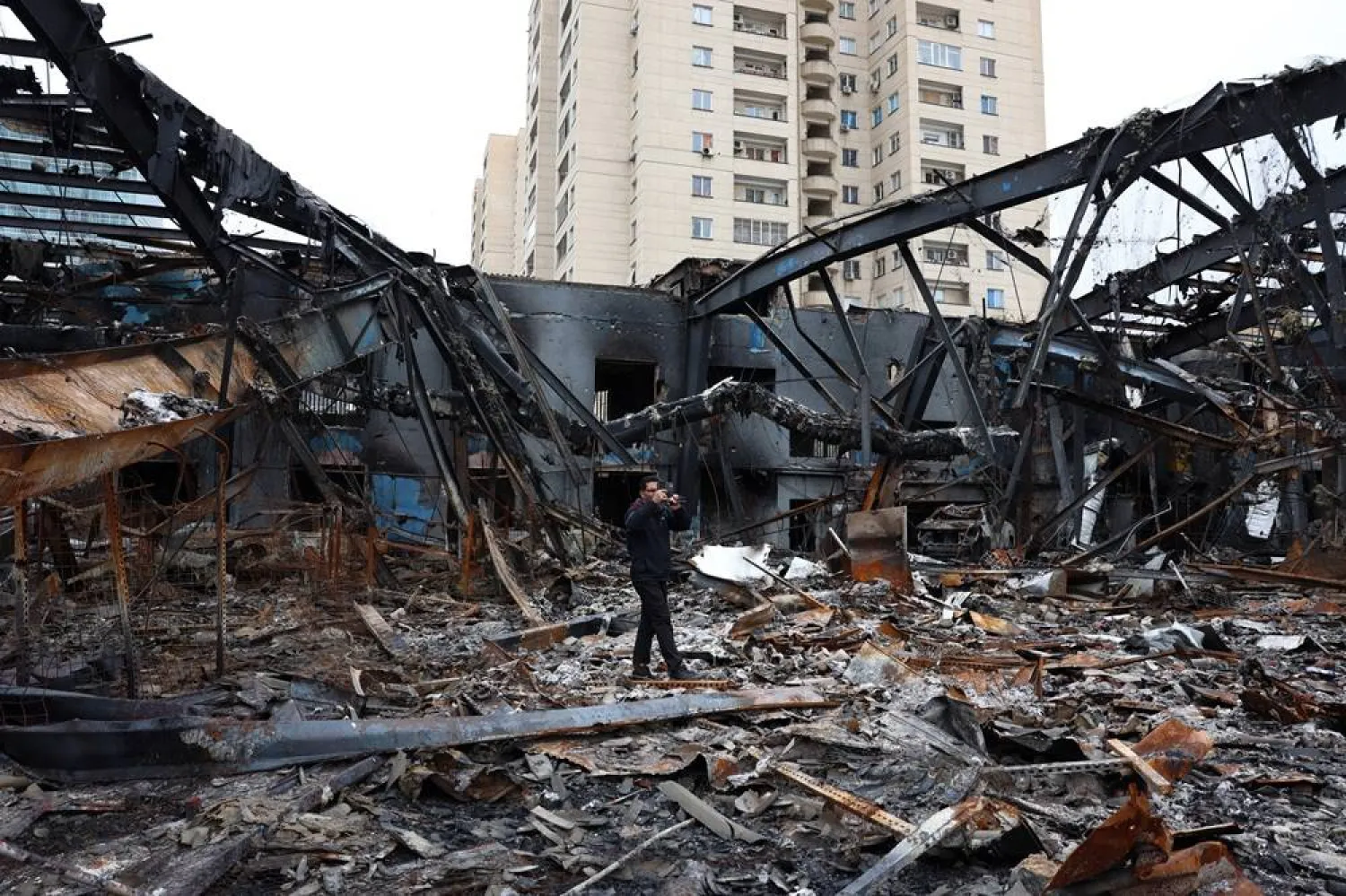
Members of the media work amid wreckage of vehicles at an auto service center in Tehran, Iran, 28 March 2026. (EPA)
TT

Iran Accuses US of Ground Assault Plans as Pakistan Hosts Regional Talks

Members of the media work amid wreckage of vehicles at an auto service center in Tehran, Iran, 28 March 2026. (EPA)

Iran said it was ready to respond to a US ground attack, accusing Washington on Sunday of preparing a land assault even as the Trump administration sought talks and as regional powers met in Pakistan to try to end the conflict.

The foreign ministers of Pakistan, Saudi Arabia, Türkiye and Egypt met in Islamabad to discuss ways to halt the Iran war, which has killed thousands of people and caused the biggest-ever disruption to global energy supplies.

The ministers exchanged views on the severe economic repercussions of the military escalation in the region, its impact on international navigation, supply chains and food security, as well as its implications for energy security in light of rising oil prices, Egypt's foreign ministry said.

As the conflict entered its second month, Israel's military said it carried overnight strikes on Tehran, targeting what it described as a facility producing critical components for ballistic missiles and a weapons production and storage site.

Iran launched multiple missile salvos at Israel on Sunday, sending millions of people across the country into shelters. Israel's fire and rescue service said a blaze had broken out in an industrial area in the country's south after an "impact".

Chemical manufacturing and industrial plants, as well as a hazardous waste treatment facility, are located in the industrial area. It was not immediately clear ‌if a missile had hit ‌the area, or if the fire was caused by debris from an interception.

Iran's parliament speaker Mohammad Baqer Qalibaf accused the US ‌of sending ⁠messages about possible ⁠negotiations while at the same time secretly planning to send in troops, adding that Tehran was ready to respond if US soldiers were deployed.

"As long as the Americans seek Iran's surrender, our response is that we will never accept humiliation," he said in a message to the nation.

The war, which began on February 28 with US and Israeli strikes on Iran, has spread across the Middle East, with Yemen's Iran-aligned Houthis launching on Saturday their first attacks on Israel since the start of the conflict.

The assault points to a potential new threat to global shipping, already hit by the effective closure of the Strait of Hormuz, previously a conduit for about a fifth of global oil and liquefied natural gas supplies.

US MARINES START ARRIVING IN MIDDLE EAST

Washington has dispatched thousands of Marines to the Middle East, with the first of two contingents arriving on Friday aboard an amphibious assault ship, the US military has said.

The Washington Post quoted US officials as saying the Pentagon was ⁠preparing for weeks of ground operations in Iran, adding that it was not yet clear if President Donald Trump would approve ‌such plans.

Reuters has reported that the Pentagon has considered military options that could include ground forces.

Trump faces a stark choice ‌between seeking a negotiated exit or escalating militarily that risks a protracted crisis, and would likely weigh further on his already low approval ratings.

"President Trump has poor options all around to end ‌the war," said Jonathan Panikoff, former US deputy national intelligence officer for the Middle East.

"Part of the challenge is the lack of clarity related to what a satisfactory outcome would ‌be," Panikoff added.

Pakistan, which along with Türkiye and Egypt has been relaying messages between Washington and Tehran, was hosting four-nation talks and looking for proposals that could bring the two sides together, a Pakistani foreign ministry official said.

The countries meeting in Pakistan have floated proposals to Washington tied to maritime traffic and reopening the Strait of Hormuz, five sources familiar with the matter told Reuters, as part of wider efforts to stabilize shipping flows.

Washington said last week it had offered a 15-point ceasefire plan, with a proposal to reopen the waterway and restrict Iran's nuclear program, but Tehran has rejected the list and put ‌forward proposals of its own.

ISRAEL HITS DOZENS OF TARGETS ACROSS IRAN

An Israeli official said Israel would continue carrying out strikes against Iran on what were described as military targets, adding there was no intention to scale back the campaign ahead of ⁠any possible talks between Washington and Tehran.

Israel said ⁠on Sunday it had targeted Tehran's weapons manufacturing infrastructure, including dozens of storage and production sites the day before.

A building housing Qatar's Al-Araby TV in Tehran was hit on Sunday, the semi-official Mehr news agency reported, with video showing walls and windows blown out of the multi-storey block.

"The missile hit. The ceiling and everything fell on our heads. Unfortunately, we couldn't continue to work. It was a real miracle we survived," said Al Araby camera operator Mohammadreza Shademan. "There was no military target here."

Iran continued attacks on several Gulf states, and air defenses shot down a drone near the residence of the leader of the Iraqi Kurdish ruling party in Erbil early on Sunday, security sources said.

Another drone strike targeted the home of the president of Iraq's Kurdistan region a day earlier, the sources added.

Meanwhile, there is concern over shipping lanes around the Arabian Peninsula and the Red Sea after Yemen's Houthis entered the fray by targeting Israel.

During the Gaza war the Houthis also hit ships in the Bab el-Mandeb Strait, a critical maritime choke point leading to the Suez Canal. Analysts say renewed attacks there would pile further pressure on the world economy.

With US midterm elections due in November, the increasingly unpopular war has weighed on Trump's Republican Party. Demonstrators took to city streets across the US on Saturday in protests against the conflict.

Trump has threatened to hit power stations and other energy infrastructure if Iran does not open the Strait of Hormuz, though he has extended a deadline by 10 days.

A European diplomat warned that any further military escalation could make it harder to bring the two sides together, potentially delaying the possibility by weeks, if not longer.

Iranian threats against ships have kept most oil tankers from attempting the waterway. Iran has agreed to let an additional 20 Pakistani-flagged vessels pass through the strait, with two ships permitted to transit daily, Pakistan's Foreign Minister Ishaq Dar has said.



Trump Threatens to Destroy Iran’s Civilian Infrastructure if a Deal Is Not Reached ‘Shortly’

First responders work on the rubble of a building targeted by an Israeli airstrike in the southern Lebanese village of Hanouiyeh, east of Tyre, on March 30, 2026. (AFP)
TT

Trump Threatens to Destroy Iran’s Civilian Infrastructure if a Deal Is Not Reached ‘Shortly’

First responders work on the rubble of a building targeted by an Israeli airstrike in the southern Lebanese village of Hanouiyeh, east of Tyre, on March 30, 2026. (AFP)

US President Donald Trump on Monday threatened widespread destruction of Iran’s energy resources and other vital infrastructure, including desalination plants that supply drinking water, if a deal to end the war is not reached “shortly.”

Iran meanwhile struck a key water and electrical plant in Kuwait, and an oil refinery in Israel came under attack. Israel and the US launched a new wave of strikes on Iran, as the war raged with no end in sight.

Trump’s new threat came in a social media post. Earlier comments to the Financial Times suggested American troops could seize Iran’s Kharg Island oil export hub. Trump has repeatedly claimed to be making diplomatic progress— though Tehran denies negotiating directly — while ramping up his threats and sending thousands more US troops to the Middle East.

It remains unclear where the diplomatic effort facilitated by Pakistan stands. Iran’s continuing attacks on its Gulf neighbors could further complicate any talks.

Trump says diplomacy is going well but threatens major escalation

In a social media post, Trump said “great progress is being made” in talks with Iran to end military operations. But he said if a deal is not reached “shortly,” and if the Strait of Hormuz is not immediately reopened, the US would broaden its offensive by “completely obliterating” power plants, oil wells, Kharg Island and possibly even desalination plants.

The strait is a crucial waterway through which a fifth of the world’s oil is shipped in peacetime.

The laws of armed conflict allow attacks on civilian infrastructure such as energy plants only if the military advantage outweighs the civilian harm, legal scholars say. It’s considered a high bar to clear, and causing excessive suffering to civilians can constitute a war crime.

A 22-year-old resident of Karaj, near Tehran, said his area lost power for several hours overnight following nearby strikes.

“I was really scared. I thought that they’d hit the power plants and that we are not going to have power anymore,” he said, speaking on condition of anonymity out of security fears.

In the FT interview, Trump said his preference would be to “take the oil in Iran.”

“Maybe we take Kharg Island, maybe we don’t,” he said, referring to a terminal through which nearly all of Iran's oil exports pass.

Iran says US demands are ‘excessive, unrealistic and irrational’

The US already has targeted military positions on Kharg.

Iranian Foreign Ministry spokesman Esmail Baghaei said Tehran had received a 15-point proposal from the Trump administration containing “excessive, unrealistic and irrational” demands, while denying there had been any direct talks.

Earlier, Iran’s parliament speaker, Mohammad Bagher Qalibaf, dismissed the talks in Pakistan as a cover while more US troops are brought to the region. He said Iranian forces were “waiting for the arrival of American troops on the ground to set them on fire and punish their regional partners forever,” according to state media.

Twice during Trump’s second term, the US has attacked Iran during high-level diplomatic talks, including with the Feb. 28 strikes that started the current war.

Iran attacks Israel

Sirens sounded at dawn near Israel’s main nuclear research center, a part of the country that has been targeted repeatedly in recent days. Israel’s military also said it had taken out two drones launched from Yemen, where the Iran-backed Houthis entered the war on Saturday with their first missile attack.

Iran kept up the pressure on its Gulf Arab neighbors: Saudi Arabia intercepted five missiles targeting its Eastern province; a fireball erupted over Dubai, United Arab Emirates, as a missile was intercepted; and in Kuwait, an Iranian attack hit a power and desalination plant, killing one worker and wounding 10 soldiers, the state-run KUNA news agency reported.

An Emirati official signaled that the UAE wants more than just a ceasefire.

“An Iranian regime that launches ballistic missiles at homes, weaponizes global trade and supports proxies is no longer an acceptable feature of the regional landscape,” Noura Al Kaabi, a minister of state at the UAE’s Foreign Ministry, wrote in a column published by the state-linked, English-language newspaper The National.

She added: “We want a guarantee that this will never happen again.”

NATO air defenses intercepted a ballistic missile over Türkiye that was fired from Iran, Türkiye’s Defense Ministry said, in the fourth such incident since the start of the war. Iran has denied firing the previous missiles. Türkiye has tried to maintain a neutral position and is taking part in mediation efforts.

Israel launched a new wave of attacks on Iran, saying it was striking “military infrastructure” across Tehran. Explosions were heard in the Iranian capital and Iranian state media reported a petrochemicals plant in Tabriz, in the north, sustained damage in an airstrike.

Peacekeeper killed in Lebanon

In southern Lebanon, which Israel has invaded as it battles the Iran-backed Hezbollah, an Indonesian United Nations peacekeeper was killed and three others were wounded by an exploding projectile.

An Israeli airstrike on a Beirut suburb killed one person and wounded 17, including four children, according to Lebanon's Health Ministry.

Over the weekend, Israeli Prime Minister Benjamin Netanyahu said the military would widen its invasion, expanding the “existing security strip” in southern Lebanon.

In Iran, authorities say more than 1,900 people have been killed, while 19 have been reported dead in Israel.

Two dozen people have been killed In Gulf states and the occupied West Bank. In Lebanon, officials said more than 1,200 people have been killed, and more than 1 million have been displaced. Six Israeli soldiers have died in Lebanon, while 13 US service members have been killed in the war.

Oil prices rise again

Iran’s attacks on the energy infrastructure of the region and its stranglehold on the Strait of Hormuz have threatened global supplies of oil, natural gas and fertilizer. They have sent fuel prices skyrocketing and given rise to growing concerns about an energy crisis.

Trump has said that Iran had agreed to allow 20 oil tankers through the Strait of Hormuz starting Monday as “a sign of respect.” There wasn’t any information on whether those ships were actually moving.

Brent crude oil, the international standard, was trading around $115 Monday, up nearly 60% from when the war started.


Türkiye Says NATO Defenses Downed Fourth inbound Iranian Missile

Turkish army personnel search a field after a piece of ammunition fell following the interception of a missile launched from Iran by a NATO air defense system, in Diyarbakir, Türkiye, March 9, 2026. REUTERS/Sertac Kayar/File Photo
TT

Türkiye Says NATO Defenses Downed Fourth inbound Iranian Missile

Turkish army personnel search a field after a piece of ammunition fell following the interception of a missile launched from Iran by a NATO air defense system, in Diyarbakir, Türkiye, March 9, 2026. REUTERS/Sertac Kayar/File Photo

A ballistic missile launched from Iran entered Turkish airspace before being shot down by NATO air and missile defenses deployed in the eastern Mediterranean, Türkiye's defense ministry said on Monday, Reuters reported.

The incident marked the fourth such incident since the start of the US-Israeli war with Iran, following three earlier interceptions by NATO systems earlier this month that prompted Ankara to protest and warn Tehran.

Tehran has denied in the previous three incidents that it authorized such launches and has asked Ankara to form a joint investigation into the matter.

The ministry said all necessary measures were being taken "decisively and without hesitation" against any threat directed at Türkiye's territory and airspace.


Spain Closes the Country's Airspace to US Planes Involved in the Iran War

Spain's Defense Minister Margarita Robles arrives at the informal EU Defense Ministers' meeting in Copenhagen, Denmark, August 29, 2025. Ritzau Scanpix/Thomas Traasdahl via REUTERS
TT

Spain Closes the Country's Airspace to US Planes Involved in the Iran War

Spain's Defense Minister Margarita Robles arrives at the informal EU Defense Ministers' meeting in Copenhagen, Denmark, August 29, 2025. Ritzau Scanpix/Thomas Traasdahl via REUTERS

Spain has closed its airspace to US planes involved in the Iran war, the defense minister said Monday, marking another step in the government's opposition to US and Israeli involvement in the conflict in the Middle East.

The country had already said that the US couldn't use jointly operated military bases in the Iran conflict, which Spanish Prime Minister Pedro Sánchez has described as illegal, reckless and unjust, The AP news reported.

Defense Minister Margarita Robles said Monday that the same logic applied to the use of Spanish airspace in the conflict.

“This was made perfectly clear to the American military and forces from the very beginning. Therefore, neither the bases are authorized, nor, of course, is the use of Spanish airspace authorized for any actions related to the war in Iran,” Robles told reporters.

Spain’s government under Sánchez, one of Europe's most prominent left-wing leaders, has been Europe’s loudest opposing voice against US and Israeli military actions in the Middle East.

He has called on the US, Israel and Iran to end the war, saying earlier this month: “You cannot respond to one illegality with another, because that’s how humanity’s great disasters begin.”

After Sánchez's government denied the US use of the Rota and Morón military bases in southern Spain, US President Donald Trump threatened to cut trade with Madrid.

It was the latest flare-up between Spain and the US, which made trade threats against the European nation last year, too, when Sánchez said that his government wouldn't increase its defense spending in accordance with a ramp-up agreed to by other NATO members following pressure from Trump.

At the time, Sánchez's government said that Spain could meet its military commitments by spending 2.1% of gross domestic product on defense, instead of the 5% the rest of the 32-nation military alliance agreed upon.

Sánchez was also among the most vocal critics of Israel's actions in the war in Gaza, which invited criticism from Israel's government on several occasions.

“I think everyone knows Spain’s position; it’s very clear,” Robles said, calling the war in Iran “profoundly illegal and profoundly unjust.”

Associated Press