


Syrian President to Talk War, Migrants on Germany Visit

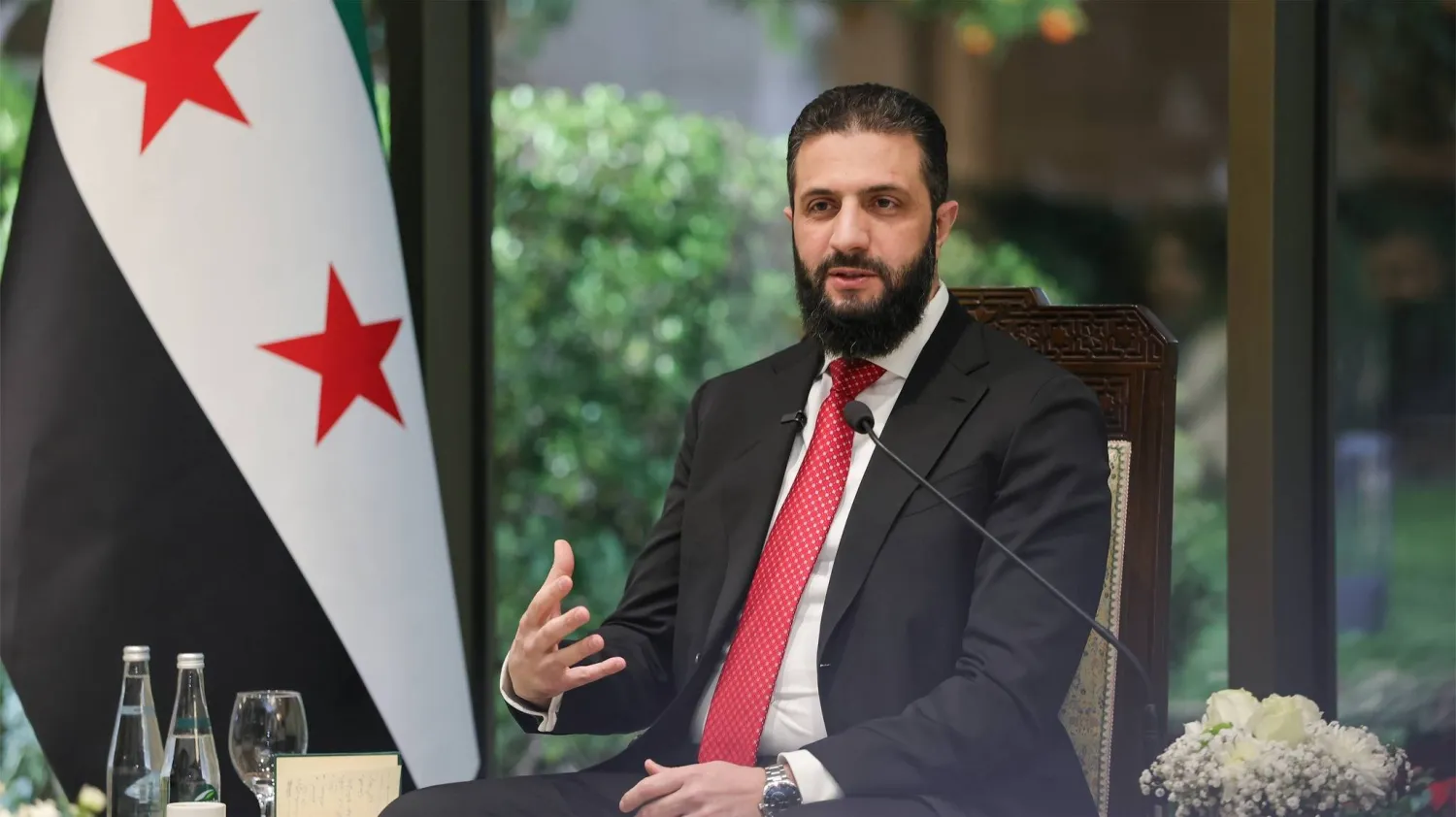
10 March 2026, Syria, Damascus: Syrian President Ahmed al-Sharaa meets with representatives of youth from various initiatives and sectors at the People's Palace in Damascus. Photo: APA Images via ZUMA Press Wire/dpa
TT

Syrian President to Talk War, Migrants on Germany Visit

10 March 2026, Syria, Damascus: Syrian President Ahmed al-Sharaa meets with representatives of youth from various initiatives and sectors at the People's Palace in Damascus. Photo: APA Images via ZUMA Press Wire/dpa

Syria's President Ahmed al-Sharaa is visiting Germany on Monday for talks on the Middle East war, rebuilding his country and Berlin's efforts to send back Syrian refugees.

Sharaa, on his first trip to Germany since ousting Syria's longtime leader Bashar al-Assad in late 2024, is expected to meet Chancellor Friedrich Merz and President Frank-Walter Steinmeier, reported AFP.

The Syrian leader has managed to build relations with Western governments and made several overseas trips, including to the United States, France and Russia.

As a result, many international sanctions on Syria have been lifted to help the country rebuild after its bloody 14-year civil war.

German government spokesman Stefan Kornelius said Merz and Sharaa would discuss the Middle East war, Syria's political situation and reconstruction efforts, and the return of Syrians to their homeland.

While in Berlin, Sharaa will also join a political and business forum exploring "prospects for economic recovery and the reconstruction of Syria", a German foreign ministry spokesman said.

"With the lifting of numerous EU, UN and other sanctions following the end of the Assad regime, the foundations for (economic recovery) have been laid," he said.

Ahead of the visit, the German interior ministry announced a new initiative to provide support to Syria's disaster management ministry and help train emergency services.

Asked whether the talks would also address the case of German journalist Eva Maria Michelmann, who is missing in Syria, the foreign ministry spokesman said Berlin was "looking into" the matter.

- 'No grounds for asylum' -

Roughly one million Syrians fled their war-torn country for Germany in recent years, many of them arriving at the peak of the migrant influx in 2015-16 to escape the civil war.

The conservative Merz, who took power last May, has stepped up a drive to limit irregular immigration as he seeks to counter the rise of the far-right Alternative for Germany (AfD) party.

Merz said last year that, with Syria's civil war over, people from that country now have "no grounds for asylum in Germany".

The government in December resumed deporting criminals to Syria, though only a handful of cases have gone ahead so far.

Merz also said he assumed many Syrians would return home voluntarily, drawing criticism from campaign groups who cite continued instability and rights abuses in Syria.

Since Sharaa has been in power, sectarian tensions have continued to cause repeated bloodshed, while the ISIS group remains active.

After Assad's overthrow, Israel moved its forces into the UN-patrolled demilitarized zone on the Israeli-annexed Golan Heights, and has carried out hundreds of strikes in Syria as well as regular incursions.



Lebanon’s Shiite Alliance United Against Israel Framework Deal, Divided Over Protests

Hezbollah supporters block the old airport road in Beirut’s southern suburbs with burning tires on Saturday to protest the 2026 trilateral agreement signed by the United States, Israel, and Lebanon (AFP)
TT

Lebanon’s Shiite Alliance United Against Israel Framework Deal, Divided Over Protests

Hezbollah supporters block the old airport road in Beirut’s southern suburbs with burning tires on Saturday to protest the 2026 trilateral agreement signed by the United States, Israel, and Lebanon (AFP)

Calls by Hezbollah supporters to take to the streets in protest against the US-sponsored framework agreement between Lebanon and Israel has drawn only a few dozen demonstrators in downtown Beirut.

Also, dozens of motorcyclists blocked the airport road before the Lebanese army reopened it, underscoring the limited scale of the protests.

Observers attributed this to the absence of supporters from the Amal Movement, led by Parliament Speaker Nabih Berri, highlighting one of the main obstacles to any attempt to mobilize the street.

The Israel-Lebanon deal calls for Hezbollah to be disarmed before Israel will withdraw its troops from southern Lebanon. Israel agreed to withdraw initially from a couple of “pilot zones” where the Lebanese army would then deploy, but no details have been shared about how that will work in practice.

While Hezbollah and Amal - the two pillars of Lebanon’s Shiite alliance - remain united in rejecting the agreement, sources familiar with Amal’s position told Asharq Al-Awsat that the priority is to challenge it through constitutional institutions while keeping all options open as events unfold.

Opponents of the alliance, however, argue that there’s a growing discord between the two parties on how to navigate the next phase.

Unified rejection

Mohammad Khawaja, a member of the parliamentary Development and Liberation bloc, told Asharq Al-Awsat that the bloc categorically rejects the agreement, describing it as “a bad and completely unacceptable deal.”

Khawaja dismissed reports of differences between Amal and Hezbollah, insisting that “all talk of divisions within the Shiite duo is unfounded."

He added that the agreement was unacceptable in its current form and expressed hope that those behind it would reconsider it.

No decision on street protests

Sources within the Shiite duo told Asharq Al-Awsat that it is “premature” to offer assurances about whether street protests will or will not be held.

The sources said the current stage requires patience and that the alliance’s response will depend on political and constitutional developments surrounding the agreement. All options, they added, remain on the table.

That position broadly aligns with recent statements by Hezbollah officials, who have argued that the agreement “will not survive.”

At the same time, the party has sought to distance itself from recent street protests, saying they reflect public distrust of the authorities. While Hezbollah rejects both the agreement and the direct negotiations that produced it, it denies organizing or mobilizing the demonstrations.

Opponents of the Shiite alliance argue that differences are becoming increasingly apparent, particularly on how the agreement could reshape Lebanon’s domestic political landscape.

While both Hezbollah and Amal continue to emphasize their united rejection of the deal and favor constitutional and political channels for now, critics believe the coming months will reveal whether that cohesion endures or evolves into a more visible political divide.

Independent MP Ibrahim Mneimneh told Asharq Al-Awsat that Berri appears fully aware of the responsibility he bears and may seek to give state-building a genuine opportunity, while Hezbollah continues to rely on a highly polarizing political discourse.


Iraq Opens Special Account for Recovered Illicit Funds as Anti-Corruption Drive Expands

Iraqi police personnel patrol in their vehicle along a street in Baghdad on June 28, 2026. (AFP)
TT

Iraq Opens Special Account for Recovered Illicit Funds as Anti-Corruption Drive Expands

Iraqi police personnel patrol in their vehicle along a street in Baghdad on June 28, 2026. (AFP)

Iraqi Prime Minister Ali al-Zaidi ordered on Monday the Finance Ministry to open a dedicated account for money recovered from illicit enrichment cases, as the government pressed ahead with its anti-corruption campaign. Meanwhile, the Federal Commission of Integrity said a draft law on asset recovery will soon be submitted to parliament.

Government spokesman Haider al-Aboudi revealed that the new account would hold funds recovered from people convicted of illicit enrichment, stressing that the government remains committed to protecting public money and strengthening state institutions.

In remarks to the state-run Iraqi News Agency (INA), al-Aboudi said the government had adopted a comprehensive approach to institutional reform and combating corruption.

He added that Operation Dawn had resulted in the arrest of 21 suspects, while others remain at large.

Investigators are using suspects’ confessions to uncover broader corruption networks involving additional individuals and assets, he revealed.

Separately, Abbas Mutib, director general of the Integrity Commission’s asset recovery department and deputy chairman of the Iraq Asset Recovery Fund, said the commission had made significant progress in digital transformation, enabling it to freeze substantial assets abroad and prevent those accused of corruption from disposing of them.

Mutib noted that the commission is coordinating with the Justice Ministry to pursue civil lawsuits aimed at recovering frozen assets overseas, adding that authorities have already succeeded in recovering sizable sums.

Former tax chief sentenced

The Federal Commission of Integrity also announced prison sentences against former General Commission for Taxes Director General Osama Hossam Jawdat and his wife after their conviction on money laundering charges.

According to the commission, the Central Criminal Court for Combating Corruption sentenced Jawdat to 10 years in prison and his wife to five years and one month under Iraq’s 2015 Anti-Money Laundering and Counter-Terrorism Financing Law.

The court ordered the couple to pay a fine of IQD 32.496 billion (about $25 million), confiscated 10 properties in Baghdad and 12 properties in Türkiye registered in the wife’s name, as well as seized cash, rental income, gold jewelry, and funds deposited in Kuwaiti and Turkish banks. It also ordered the freezing of their movable and immovable assets.

Broad public backing

An Iraqi security personnel stands guard along a street in Baghdad on June 28, 2026. (AFP)

The government’s sweeping arrests on Sunday have drawn strong political and public support after targeting senior officials, lawmakers, and government directors, raising hopes that Iraq may finally curb corruption, which unofficial estimates say has cost the country more than $500 billion.

More than 50 suspects have been arrested so far, while some estimates suggest the number of wanted individuals could eventually exceed 1,000.

Dozens of activists gathered Sunday evening in Baghdad’s Tahrir Square to express support for the campaign.

Influential Shiite cleric Moqtada al-Sadr praised the “heroic reform measures,” saying the arrests had restored hope among Iraqis after years of entrenched corruption.

He commended the judiciary and security forces, particularly the Counter Terrorism Service, for carrying out the arrests.

More arrests expected

Ghalib al-Daami, a lecturer at the Iraqi Academy for Combating Corruption, told Asharq Al-Awsat that more than 50 prominent figures had already been detained and predicted the campaign could ultimately target more than 1,000 individuals.

While many observers doubt the crackdown will reach Iraq’s most powerful political leaders, al-Daami said he expects the “downfall” of three senior political figures in the coming days.

He also claimed the campaign has received direct US backing, particularly following the arrest of former Deputy Oil Minister Adnan al-Jumaili and another deputy minister, Ali Maarij al-Bahadli, who has been sanctioned by the US for allegedly facilitating Iranian oil sales.

Political scientist Firas Elias of the University of Mosul said the campaign represents “a real test of the state’s authority.”

Its success should be measured not by the number of arrests but by its ability to secure fair convictions and recover stolen assets, he added.

If the law is applied equally to everyone, the campaign could mark a turning point in relations between the state and Iraq’s political class, he remarked. But if it stops with selected figures or becomes a tool for settling political scores, it will quickly lose credibility and allow corruption to reemerge in new forms.


Gazans Turn to Clay, Rubble to Build New Homes

A Palestinian boy makes his way across rubble near a displacement camp in Nuseirat, in the central Gaza Strip, on Sunday. Credit: AFP/EYAD BABA
TT

Gazans Turn to Clay, Rubble to Build New Homes

A Palestinian boy makes his way across rubble near a displacement camp in Nuseirat, in the central Gaza Strip, on Sunday. Credit: AFP/EYAD BABA

While Gaza’s housing crisis remains catastrophic with cement and steel blocked by Israel from entering the Strip, some Palestinians are turning to improvised methods and other workarounds in a bid to make their shelters safer or more habitable.

Among those Palestinians is Jaafar Atallah, a potter in Gaza, who decided to build a home from the earth. It was to be like the bread ovens his family had been making for generations, but big enough for his parents to live in, according to the Financial Times.

Atallah gathered clay from an area of Gaza a few kilometers from his tent and — with the help of about 15 people, including his father, also a potter — he set about making mud bricks.

For months, they learned as they built. Finally, they completed a domed hut, “so solid you could stand on top of it”, said Atallah, whose project was backed by pottery groups around the world after he shared videos online.

The clay structure was a relief after the flimsy protection of the tent: “You can keep your food in this room. In a tent, tomatoes and cucumbers won’t last a day and will rot. Life in the tents is so hard. There is such heat in the summer, it is torture,” Atallah said.

Atallah’s experience reflects the reality of thousands of families looking for alternatives after almost all buildings in Gaza have been destroyed by two years of bombardment amid Israel’s ban on concrete and steel imports.

Several Gazans are reusing steel reinforcing bars and concrete from the debris of buildings, scavenging for cement lying underwater in the port and resorting to mud to make bricks and mortar.

“We already have clay in our land, we don’t have to manufacture it, we don’t need things that we have to get from the crossing [with Israel], which is at the whim of the occupation,” said Atallah, who even designed a waterproof glaze for the bricks. “The occupation does not control this. It’s from our land, our soil.”

According to the UN, 1.9 million Gazans are displaced or live in tents, which lack sanitation or other utilities.

Reconstruction of Gaza remains a distant dream for its people. Israel bans building materials from entering Gaza on the grounds that the materials may be used for military purposes such as tunnel construction.

In May, teenage sisters Tala, 17, and Farah Moussa, 15, won a youth-focused award from the Swiss-based Earth Foundation for recycling cement debris into bricks.

Displaced with their family five times since the start of the war, they now live in a tent in Nuseirat in the center of the Gaza Strip. “We got the idea when our house was bombed,” said Tala. “We thought we had to do something and find a solution that comes from the problem itself, so we are using the rubble.”

Tala said, “We made five or six prototypes before we got it right. We researched on the internet and in books. Now we want to use the [$12,500] prize money to set up workshops to teach others how to make bricks.”

Using mud and stones, Gaza residents rebuild homes destroyed in months of conflict, as lack of access to construction material leaves families with few options.

Their efforts reflect the ability to adapt to the most extreme conditions to restore a normal life, even within walls built from the earth and the debris of buildings.