


Russian Tanker Set to Deliver Oil to Crisis-hit Cuba

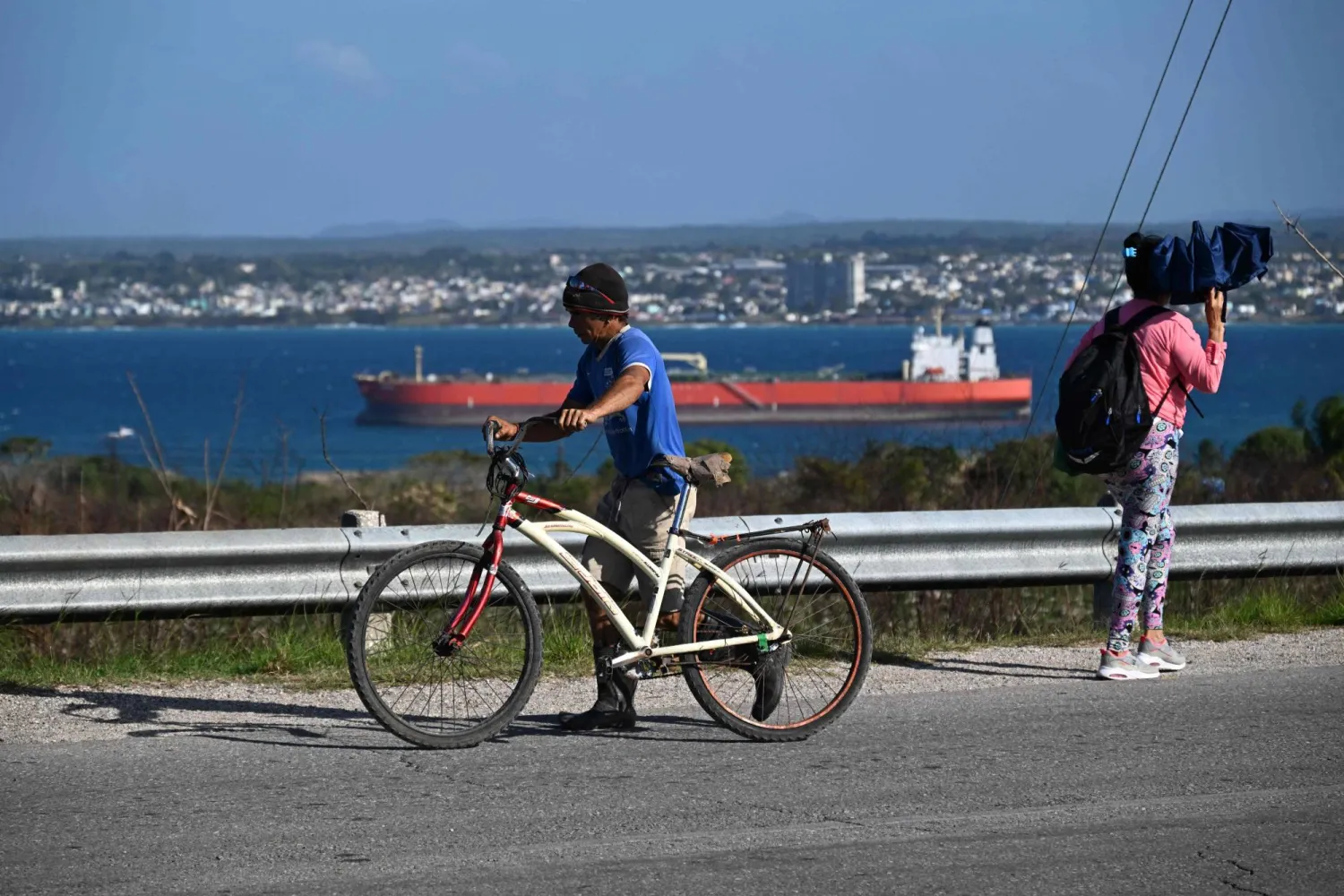
A man walks with a bike as an oil tanker ship sails on Matanzas Bay, Cuba on March 30, 2026. (Photo by Yamil LAGE / AFP)
TT

Russian Tanker Set to Deliver Oil to Crisis-hit Cuba

A man walks with a bike as an oil tanker ship sails on Matanzas Bay, Cuba on March 30, 2026. (Photo by Yamil LAGE / AFP)

A Russian oil tanker was set to deliver the first crude shipment to Cuba since January on Tuesday after Washington gave the crisis-hit island a reprieve from an effective fuel blockade.

The Anatoly Kolodkin, a tanker under US sanctions, was on its way to the port of Matanzas, east of Havana, with 730,000 barrels of crude.

US President Donald Trump's decision to let Russia deliver the oil avoids a confrontation with Moscow and provides temporary relief to a country that has endured blackouts, fuel rationing and dwindling public transportation.

"We'll welcome it with open arms. You have no idea how badly we need that oil," said Rosa Perez, a 74-year-old retiree whose home in Matanzas had lost power again.

"Let's see if things improve for us, even just a little... I can't take it anymore," she told AFP, voicing hope that more shipments will follow.

Trump said Sunday that he did not object to Russia or others sending oil to the island because Cubans "have to survive."

The White House denied however that there was any change to US sanctions policy.

"We allowed this ship to reach Cuba in order to provide humanitarian needs to the Cuban people. These decisions are being made on a case-by-case basis," White House Press Secretary Karoline Leavitt said.

Cuba was cut off from oil supplies in January after US forces ousted its main regional ally, Venezuela's socialist leader Nicolas Maduro, and Trump threatened tariffs on countries that send crude to the country.

The US president has mused about "taking" the communist-ruled island, though Cuban President Miguel Diaz-Canel confirmed in March that Cuban and US officials had held talks.

Ricardo Herrero, executive director of the Cuba Study Group, a nonpartisan policy group in Washington, said the aim of restricting oil was to force Havana "to make real concessions at the negotiating table."

"The strategy here is to drive the system to the brink," Herrero told AFP. "But it's not to precipitate a full-blown societal or humanitarian collapse."

"It's all consistent with idea that the US holds all the cards and they'll decide when to hold, when to fold and when they go all in," he said.

Cubans have endured seven nationwide blackouts since 2024, including two in March, and fuel prices have soared.

The blackouts as well as persistent shortages of food and medicine have fueled public frustration and some rare protests.

Analysts said the Russian oil would buy the Cuban economy only a few weeks.

Jorge Pinon, an expert on Cuba's energy sector at the University of Texas at Austin, said the more urgent need is diesel, which could be used for backup power generators or for transportation systems to keep the economy running.

It would take a month to refine the oil and deliver the diesel, which would be enough to cover demand for about two weeks, he said.

Herrero said the shipment was just "another donation" by Cuba's Russian ally, but he doubted that Moscow wanted to subsidize the Cuban economy in the long term.

"This is not going to help the economy recover," he said. "This is just humanitarian aid."


Japan Deploys Long-Range Missiles Near China

 The Type-12 land-to-ship missile launcher is shown at the Camp Kengun in the Kumamoto prefecture, western Japan, on March 17, 2026. (Kyodo News via AP)
The Type-12 land-to-ship missile launcher is shown at the Camp Kengun in the Kumamoto prefecture, western Japan, on March 17, 2026. (Kyodo News via AP)
TT

Japan Deploys Long-Range Missiles Near China

 The Type-12 land-to-ship missile launcher is shown at the Camp Kengun in the Kumamoto prefecture, western Japan, on March 17, 2026. (Kyodo News via AP)
The Type-12 land-to-ship missile launcher is shown at the Camp Kengun in the Kumamoto prefecture, western Japan, on March 17, 2026. (Kyodo News via AP)

Japan has deployed long-range missiles in a southwest region near China, its defense minister said Tuesday, at a time when ties with Beijing are at their lowest in recent years.

The missiles were installed in Kumamoto in the southern region of Kyushu, as Japan is attempting to shore up its military capacity as China steps up naval activity in the East China Sea.

"Standoff defense capabilities enable us to counter the threat of enemy forces attempting to invade our country... while ensuring the safety of our personnel," said Defense Minister Shinjiro Koizumi.

"This is an extremely important initiative for strengthening Japan's deterrence and response capabilities," he added.

The surface-to-ship guided missile system has a range of around 1,000 kilometers (620 miles), putting parts of the Chinese mainland within reach -- Shanghai lies about 900 kilometers from Kumamoto.

Koizumi also said a "hyper velocity gliding projectile", designed to defend remote islands from enemy forces, had been deployed in Shizuoka, another coastal area closer to Tokyo which faces the Pacific.

Japan has long had a policy to use its military only for self-defense in its most strict meaning.

But in recent years Tokyo has steadily built its defense capacity as regional neighbors including China, Russia and North Korea increase their military activities in the region.

In 2022 it approved a plan to deploy missiles with counter-attack capability.

"If we continue to rely solely on ballistic missile defense... it will become increasingly difficult to fully address the threat" of missiles with advanced technologies, a defense white paper issued last year said.

China is beefing up its military and is engaged in a number of territorial disputes with other countries in the region, including Japan over the Senkaku Islands, known as the Diaoyu in China.

Japan's ties with Beijing have soured in recent months after Prime Minister Sanae Takaichi hinted in November that Tokyo could intervene militarily in any attack on self-ruled Taiwan.

China views Taiwan as its territory and has not ruled out taking it by force.

Critics of Tokyo's move to deploy missiles could make the area a target of possible enemy attacks.

Earlier this month, local media reported that Japan's ground force delivered a launcher for the missiles to Kumamoto without warning local communities, prompting dozens of opponents to stage a protest in front of a local military base.


Eight Injured in Israel After Iran Missile Fire

A photograph shows the damage at the site of an Iranian strike in a residential neighborhood of Bnei Brak on March 31, 2026. (AFP)
TT

Eight Injured in Israel After Iran Missile Fire

A photograph shows the damage at the site of an Iranian strike in a residential neighborhood of Bnei Brak on March 31, 2026. (AFP)

Israel's emergency services said Tuesday that eight people with minor injuries were evacuated to hospitals in the Tel Aviv area, where police reported falling munitions fragments after an alert for incoming Iranian missiles.

Six of the injured were treated in the city of Bnei Brak, which is largely populated by ultra-Orthodox Jews, according to Magen David Adom, Israel's equivalent of the Red Cross.

It specified that they were in mild condition with blast injuries.

The military's Home Front Command said it had received "reports of damage" in the central parts of the country.

Earlier on Tuesday, at least 10 blasts were heard in the Jerusalem area after missile launches from Iran were detected though no injuries were subsequently reported.


Jailed PKK Founder Ocalan Asks to Address Turks Directly

FILE - Youngsters hold a photograph of Abdullah Ocalan, the jailed PKK leader in Diyarbakir, Türkiye, Feb. 27, 2025. (AP Photo/Metin Yoksu, File)
TT

Jailed PKK Founder Ocalan Asks to Address Turks Directly

FILE - Youngsters hold a photograph of Abdullah Ocalan, the jailed PKK leader in Diyarbakir, Türkiye, Feb. 27, 2025. (AP Photo/Metin Yoksu, File)

Jailed PKK founder Abdullah Ocalan, who is being held in solitary confinement, said on Tuesday he wanted to be able to speak freely to the Turkish public.

Last year, the Kurdistan Workers' Party (PKK) formally renounced its armed struggle against the Turkish state after four decades of violence that has killed at least 50,000 people on both sides.

In a message published by a delegation of lawmakers from the pro-Kurdish DEM party, who were authorized to visit him on Friday, Ocalan reaffirmed his commitment to the peace process.

"The period of armed struggle is over. There is no going back," he said.

"I think it is important for me to be able to reach a wider public so my views on this process are properly understood."

"The government must acknowledge that no destructive activity is being carried out and there is no threat to the country's security," said the 76-year-old Ocalan, who has spent the last 27 years in detention.

He urged the parliamentary commission set up to define the future status of the PKK and its former fighters to establish "without delay, a comprehensive and inclusive legal framework".
