

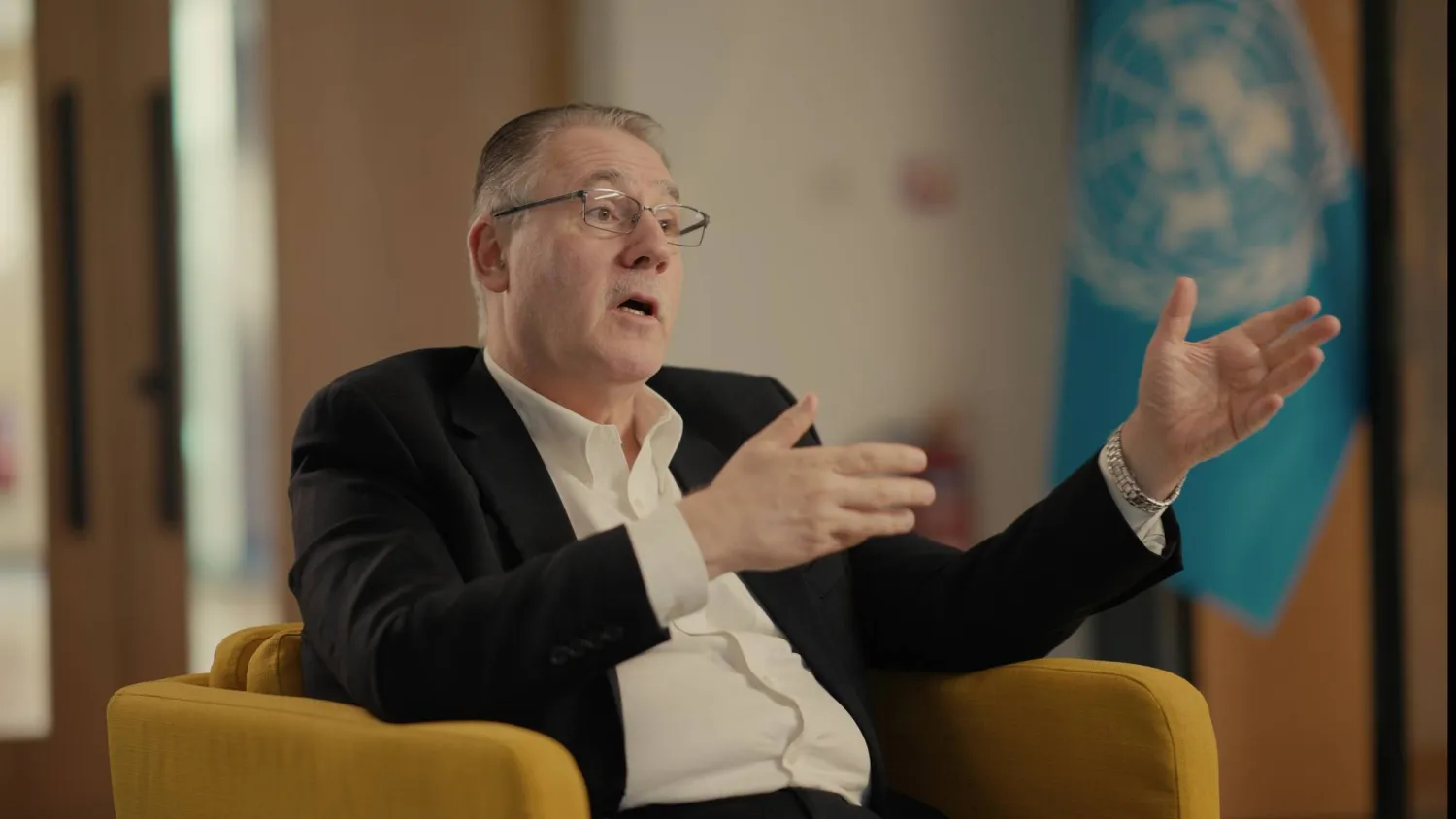

Al Dardari to Asharq Al-Awsat: War Escalation Drives Huge Surge in Losses

Abdallah Al Dardari, Assistant Secretary-General of the UN and Director of UNDP’s Regional Bureau for Arab States (Turky Alagili)
TT

Al Dardari to Asharq Al-Awsat: War Escalation Drives Huge Surge in Losses

Abdallah Al Dardari, Assistant Secretary-General of the UN and Director of UNDP’s Regional Bureau for Arab States (Turky Alagili)

With the release of a special report by the Development Programme on the economic fallout of escalating tensions in the region, Abdallah Al Dardari, Assistant Secretary-General of the UN and Director of UNDP’s Regional Bureau for Arab States said the region is facing an “accelerating economic shock” hitting energy markets, growth, and livelihoods.

Speaking to Asharq Al-Awsat, he warned nearly 4 million people could fall into poverty within a month, calling it an unprecedented indicator of the economic toll of war.

Losses, he said, could rise rapidly if fighting continues, alongside shifts in energy routes, supply chains, and development models.

Estimates based on simulations

Al Dardari said the shock has been sharp and sudden, with losses expanding rapidly over a short period. Current estimates remain based on simulation models, as there has not been enough time to measure real impacts precisely.

The methodology draws on models used in past crises, including Gaza and Lebanon, which later proved highly accurate. The report focuses on broad trends rather than precise figures, particularly in GDP, to track the direction of economic impact.

Losses mounting

The report outlines wide-ranging effects, including declining trade, disruptions in petroleum flows, a worsening investment climate, and growing pressure on public finances.

“After four weeks of war, the impact is very large,” Al Dardari said.

“The Strait of Hormuz is closed, oil exports have been severely affected, and we are moving toward the worst-case scenario.”

He said production inputs have been severely disrupted and infrastructure has been damaged, pushing expected losses closer to $194 billion than $120 billion.

The scenarios are based on one month of fighting. If the conflict continues even one more week, losses would not rise incrementally but multiply, he warned.

GDP losses are highest in Gulf economies due to the hit to oil and energy, while poverty is expected to surge most in the Levant, where rising energy costs quickly drive up food prices.

“The number of poor could increase by around 4 million in a single month,” he said, noting such a jump would normally take years.

Energy routes shifting

Countries are scrambling to contain the shock, repair damage, and secure alternative supply lines.

Saudi Arabia is relying more on pipelines to Yanbu on the Red Sea, while Iraq and Syria are holding serious talks to move crude and petroleum products overland.

“This is a shift toward building alternatives and more diversified, resilient supply chains,” Al Dardari said, adding that the UNDP is supporting efforts to strengthen regional connectivity and trade routes.

Syria’s corridor role

On proposals to bypass the Strait of Hormuz through Syria, Al Dardari said the country has historically served as a regional transit hub linking trade routes.

He pointed to Syria’s “Five Seas” strategy in 2007–2008, which aimed to connect the Caspian, Black, Red, and Mediterranean seas, and the Arabian Gulf through pipelines, rail, roads, and energy grids.

At the time, the plan was backed by a comprehensive development strategy and relatively mature institutions. Today, however, regulatory and legal frameworks for cross-border investment remain underdeveloped, despite ongoing efforts to improve them.

He said the UNDP is ready to support countries in building the technical and institutional capacity needed to pursue such projects.

Opportunity amid crisis

Despite the downturn, Al Dardari said Syria, Jordan, and Lebanon have an opportunity to form a quasi-regional bloc and revive their role as a bridge linking Gulf economies with Türkiye and Europe through alternative supply chains.

But he cautioned this would require more than infrastructure, including stronger institutions, financial systems, and coordination across sectors and borders, as well as “regulatory convergence.”

Rethinking development

The crisis is also forcing a reassessment of development models.

“If 90% of oil and gas exports depend on the Strait of Hormuz, why were alternatives not developed?” he said, noting tensions in the region are not new.

He called for diversification of economies and labor markets, and deeper regional and global integration. While existing models delivered low poverty and strong growth, they have shown vulnerability to shocks.

“We face a more complex reality, with more shocks likely. We need more flexible and effective tools,” he said, adding that current strategies remain valid but may need more efficient pathways.

Rewriting reconstruction

Al Dardari said recovery in Gaza, Syria, and Lebanon can no longer rely on large external funding flows, shifting the burden to governments already facing rising poverty.

He questioned continued reliance on Gulf funding and called for innovative, sustainable recovery models.

The UNDP’s approach focuses on agriculture, local value chains, and affordable housing, drawing on global experience.

He said small and medium-sized enterprises offer a “sustainable alternative” due to their resilience, while strengthening education and healthcare is key to building a new social contract and stabilizing institutions.



Türkiye Raises End-2026 Inflation Target to 24%

FILE PHOTO: A view of the city's business and financial districts, from the July 15 Martyrs' Bridge, known as the Bosphorus Bridge, which links the city's Asian and European sides, in Istanbul, Türkiye, November 2, 2025. REUTERS/Murad Sezer/File Photo
TT

Türkiye Raises End-2026 Inflation Target to 24%

FILE PHOTO: A view of the city's business and financial districts, from the July 15 Martyrs' Bridge, known as the Bosphorus Bridge, which links the city's Asian and European sides, in Istanbul, Türkiye, November 2, 2025. REUTERS/Murad Sezer/File Photo

Türkiye's central bank raised its end-2026 interim inflation target to 24% from 16% Governor Fatih Karahan said on Thursday, forecasting that the inflationary effects related to the Iran war would remain pronounced in the short term.

Presenting the central bank's quarterly inflation report in Istanbul, Karahan said the bank also lifted its end-2027 interim inflation target ⁠to 15% from ⁠9%, setting its end-2028 interim target at 9%.

"While the central question before us is how long the regional tensions and pressures on energy supply will persist, we assess that the related inflationary effects ⁠will remain pronounced in the short term," Reuters quoted Karahan as saying.

He said that how long the tension lasts is a critical risk factor in terms of the inflation outlook, adding that there would be no compromise on the bank's determination to bring down inflation and it will continue to use all available tools for disinflation.

In the previous quarterly inflation report ⁠in ⁠February, the bank raised its year-end inflation forecast range by two percentage points to 15-21% and maintained its interim 16% target, despite market doubts about whether the downward trend seen throughout 2025 is on track.

The war-related surge in energy prices has rattled import-heavy economies like Türkiye. Monthly inflation surged to 4.18% in April and 32.37% on the year.


UK Economy Shows Unexpected Growth of 0.3% in March

Union flags flutter in the breeze close to the Victoria Tower and Palace of Westminster, home to the two houses of Parliament, after the State Opening of Parliament in London on May 13, 2026. (Photo by Adrian DENNIS / AFP)
TT

UK Economy Shows Unexpected Growth of 0.3% in March

Union flags flutter in the breeze close to the Victoria Tower and Palace of Westminster, home to the two houses of Parliament, after the State Opening of Parliament in London on May 13, 2026. (Photo by Adrian DENNIS / AFP)

Britain's economy expanded unexpectedly in March to cap another strong first quarter, suggesting the economy was in slightly better shape as the Iran war escalated than many feared, official data showed on Thursday.

Gross domestic product increased by 0.3% month-on-month in March, the Office for National Statistics (ONS) said, against expectations in a Reuters poll of economists for a 0.2% contraction.

The ⁠services sector, construction ⁠output and manufacturing all grew strongly.

"Many will be unconvinced that this momentum can be sustained throughout this year," said Scott Gardner, investment strategist at J.P. Morgan Personal Investing.

"The risk is that ⁠the energy price spike following the start of the Iran conflict will persist and lead to a rebound in inflation."

Recent business surveys point to a rapid increase in cost pressures that is likely to weigh on corporate activity.

For the first quarter as a whole, the economy expanded by 0.6% - marking the third year ⁠running ⁠of conspicuously strong growth in the first quarter.

The ONS on Thursday published a blog that acknowledged there may be post-pandemic shifts in the timing of spending in the economy, and nudged down its readings for the first quarters of 2024 and 2025.

Finance minister Rachel Reeves said the data showed she had the right economic plan.


SoftBank Profit More Than Triples on OpenAI Stake Gains

A man walks past a Softbank branch in Tokyo on May 13, 2026. (Photo by Andrew CABALLERO-REYNOLDS / AFP)
TT

SoftBank Profit More Than Triples on OpenAI Stake Gains

A man walks past a Softbank branch in Tokyo on May 13, 2026. (Photo by Andrew CABALLERO-REYNOLDS / AFP)

Technology investor SoftBank Group reported on Wednesday that its net profit more than tripled to 1.83 trillion yen ($11.60 billion) in the January-March quarter, as it booked gains on the value of its investment in ChatGPT-maker OpenAI.

It was SoftBank's fifth consecutive quarterly profit, with the Vision Fund investing arm booking an OpenAI-driven gain of 3.1 trillion yen in the quarter, according to Reuters.

Founder and CEO Masayoshi Son is one of OpenAI's most enthusiastic backers, with the group saying its cumulative gains on the investment total $45 billion.

SoftBank has sold off stakes in holdings such as T-Mobile and Nvidia, issued bonds and taken out loans, backed by its holdings in chip designer Arm and its domestic telecommunications arm SoftBank Corp.

SoftBank arranged ⁠a bridge loan agreement totaling $40 billion in March.

On Wednesday, it said $20 billion was drawn down in April, primarily for the OpenAI investment, and $2.5 billion had already been repaid.

SoftBank had previously said it had agreed to invest a further $30 billion in OpenAI over the course of 2026, which would bring its cumulative investment to $64.6 billion for a 13% stake.

Beyond OpenAI, the group booked a 278.6 billion yen gain on its investment in chipmaker Intel, which is led by former SoftBank board member Lip-Bu Tan.

SoftBank has ⁠also sought to build a portfolio of robotics firms, looking to gain a foothold in an industry that is in its infancy but is seen by analysts and investors as having potential to drive profits into the future.

It agreed to acquire the robotics business of Swiss engineering group ABB in a $5.4 ⁠billion deal last year, and created a new subsidiary within the group to hold its robotics-related stakes.