


India has Begun its Long-delayed Population Census

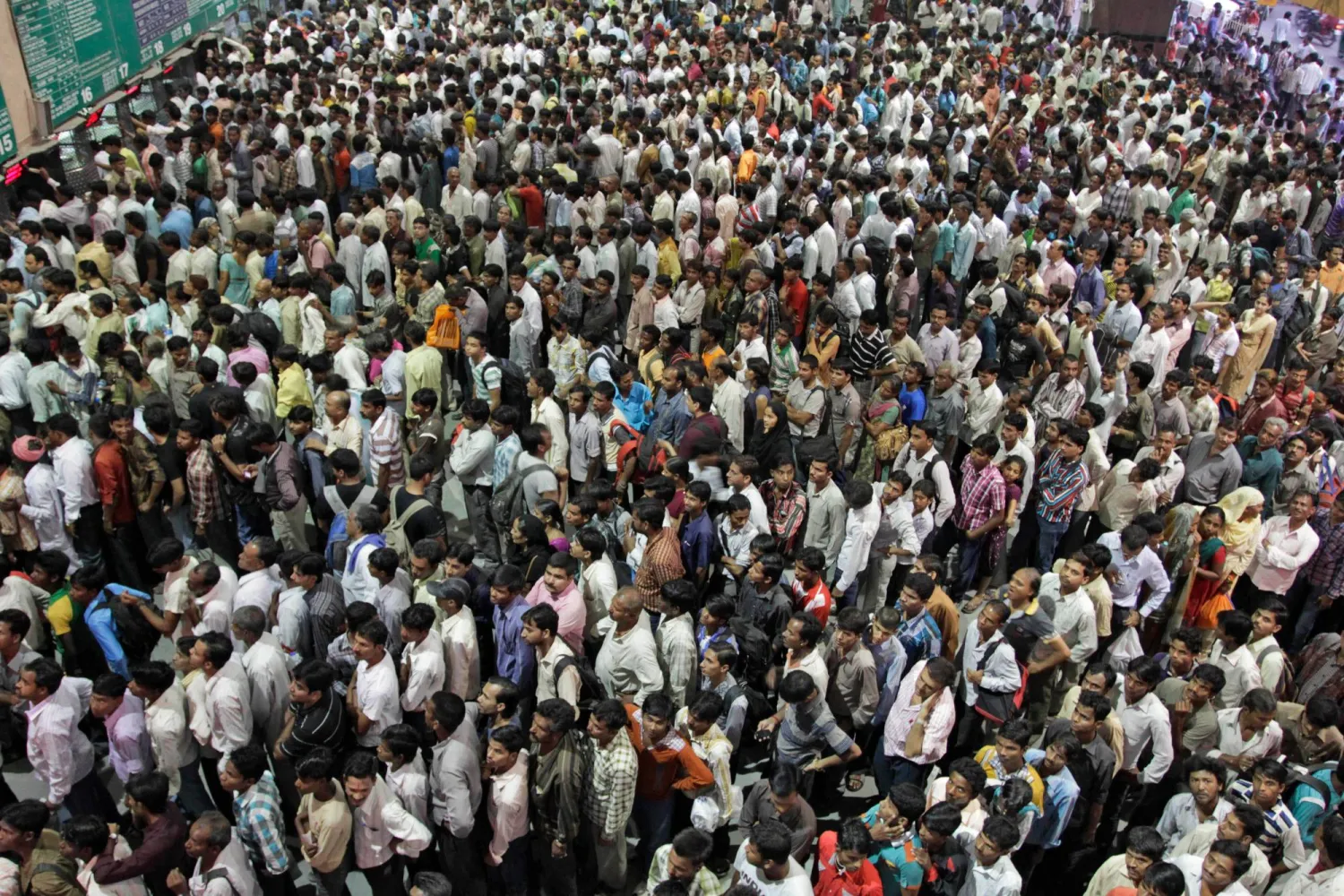
FILE - Indians crowd ticket counters at a railway station in Ahmadabad, India, Oct. 23, 2011. (AP Photo/Ajit Solanki, File)
TT

India has Begun its Long-delayed Population Census

FILE - Indians crowd ticket counters at a railway station in Ahmadabad, India, Oct. 23, 2011. (AP Photo/Ajit Solanki, File)

India has begun the world’s largest national population count, which could reshape welfare programs and political representation across the country.

The previous census in 2011 recorded a population of 1.21 billion. It's now estimated to be more than 1.4 billion, making India the most populous nation, The Associated Press reported.

The new census had been planned for 2021 but was postponed due to the COVID-19 pandemic and logistical challenges.

Here’s how India’s census works and why it is significant:

The first phase of the count started Wednesday and will roll out around the country through September. The workers will spend about a month in each area collecting information on homes and available facilities and will document housing stock and living conditions.

The exercise will blend in-person surveys with a digital option where residents can submit information through a multilingual smartphone application that integrates satellite-based mapping.

The second phase to be conducted from September to next April 1 will record more detailed information, like people's social and economic characteristics, including religion and caste.

More than 3 million government workers are expected to be deployed over the course of the year. In 2011, nearly 2.7 million enumerators surveyed more than 240 million households nationwide.

The second phase of the census will attempt a broader accounting of caste beyond historically marginalized groups.

Caste is an ancient system of social hierarchy in India and is influential in defining social standing and deciding who gets access to resources, education and economic opportunity.

There are hundreds of caste groups based on occupation and economic status across India, particularly among Hindus, but the country has limited or outdated data on how many people belong to them.

The last attempt to gather detailed caste information through a census dates to 1931, during British colonial rule. Since independent India’s first census in 1951, it counted only Dalits and Adivasis, members of marginalized groups known as Scheduled Castes and Scheduled Tribes who qualify for certain government benefits.

Successive governments have resisted conducting a full caste count, arguing it could heighten social tensions and trigger unrest.

Population data collected through the census underpins the distribution of government welfare programs and a wide range of public policies.

It could also prompt a redrawing of India’s political map, as seats in the lower house of Parliament and state legislatures may be increased to reflect population growth. A 2023 law reserves one-third of legislative seats for women, so any expansion would raise the number of seats set aside for female representatives.



France, Germany Send Firefighters to Help Battle Dutch Blazes

A French firefighter douses burning vegetation during a bushfire in Budel, Netherlands May 1, 2026. (Reuters)
TT

France, Germany Send Firefighters to Help Battle Dutch Blazes

A French firefighter douses burning vegetation during a bushfire in Budel, Netherlands May 1, 2026. (Reuters)

France and Germany sent firefighting units to the Netherlands on Friday to help battle woodland blazes flaring in several areas.

Many of the fires, which sparked on Wednesday and Thursday, were raging in land used for military training, including an artillery range, in the south.

Stretched Dutch authorities requested help facing the emergency through the EU Civil Protection Mechanism, with France and Germany responding.

French Interior Minister Laurent Nunez said on X that Paris had dispatched 41 civil security personnel and 10 vehicles.

A total of 67 firefighters, 21 vehicles and three trailers were sent by the Bonn fire service in Germany.

A Dutch military spokesman, Major Mike Hofman, on Friday confirmed to AFP that army "training grounds were in use at the time the fires broke out".

He said an investigation was under way "examining whether there is a connection between the military operations and the origin of the fires".

The head of the Dutch armed forces said on Thursday that extra precautions were being taken on terrain used for drills because of a drought currently parching the country.

He added, however, that the military exercises being conducted would not be suspended.


Oscar Statuette for 'Mr. Nobody Against Putin' Goes Missing on Flight

FILE PHOTO: File Photo: Pavel Talankin arrives at the Vanity Fair Oscars party after the 98th Academy Awards, in Beverly Hills, California, US, March 16, 2026. REUTERS/Danny Moloshok/File Photo/File Photo
TT

Oscar Statuette for 'Mr. Nobody Against Putin' Goes Missing on Flight

FILE PHOTO: File Photo: Pavel Talankin arrives at the Vanity Fair Oscars party after the 98th Academy Awards, in Beverly Hills, California, US, March 16, 2026. REUTERS/Danny Moloshok/File Photo/File Photo

The Oscar statuette belonging to Pavel Talankin, the Russian director who won best documentary this year for "Mr. Nobody Against Putin," has gone missing after he was forced to check the award into hold luggage on a flight from New York to Germany, his co-director said.

Talankin was due to fly from John F. Kennedy International Airport to Frankfurt on German carrier Lufthansa. But Transportation Security Administration (TSA) agents told him that the 8.5 lb (3.8 kg) statuette posed a potential security threat, his co-director David Borenstein said on Thursday.

"At the airport, a ⁠TSA agent stopped ⁠him and said the Oscar could be used as a weapon," Borenstein said on Instagram.

"Pavel didn’t have a bag to check it in, so the TSA put the Oscar in a box and sent it to the bottom of the plane," he said, posting a series of pictures, ⁠including of the box.

"It never arrived in Frankfurt."

Responding to Borenstein's Instagram post, Lufthansa said it was taking the matter seriously.

"We deeply regret this situation," a company spokesperson later said in response to a Reuters request for comment.

"Our team is handling this matter with the utmost care and urgency and we are conducting a comprehensive internal search to ensure that the Oscar is found and returned as soon as possible.”

Speaking to the online magazine Deadline.com after arriving in Germany on Thursday, ⁠Talankin ⁠said it was "completely baffling how they consider an Oscar a weapon."

On previous flights on various airlines, he had flown with it "in the cabin, and there never was any kind of problem," he told the outlet.

Talankin and Borenstein's documentary used two years of footage that Talankin recorded at a school where he worked in Russia's Chelyabinsk region, to show how students were exposed to pro-war messaging.

The 35-year-old Talankin, who fled Russia in 2024, has defended the film as a record for posterity to show how "an entire generation became angry and aggressive."


Russia Successfully Test Launches New Soyuz-5 Rocket from Kazakhstan, Space Agency Says

The ⁠new rocket is ‌capable of ‌carrying payloads of up to ‌17 metric tons. (AP file)
TT

Russia Successfully Test Launches New Soyuz-5 Rocket from Kazakhstan, Space Agency Says

The ⁠new rocket is ‌capable of ‌carrying payloads of up to ‌17 metric tons. (AP file)

Russia has test launched its new Soyuz-5 rocket for the first time, the country's space agency said late on Thursday, saying it had lifted off from the Baikonur cosmodrome in Kazakhstan without any issues.

The Soyuz-5, which Roscosmos, ‌Russia's space ‌agency, describes as a ‌launch ⁠vehicle equipped with ⁠the world's most powerful liquid-fueled engine, lifted off successfully at 2100 Moscow time (1800 GMT) on April 30, it said in a statement.

The ⁠new rocket is ‌capable of ‌carrying payloads of up to ‌17 metric tons, will significantly ‌reduce launch costs, and is more effective than its predecessors at placing objects like satellites in near ‌earth orbit, the agency said.

Dmitry Bakanov, the head ⁠of ⁠Roskosmos, said the rocket - which he hailed as a "new step in space exploration" - would create new jobs in Russia and Kazakhstan.

Bakanov has previously told President Vladimir Putin that the Soyuz-5 is the first new launch vehicle that Russia has developed since 2014.