


Houthi Schools in Yemen Turned into Early Recruitment Camps

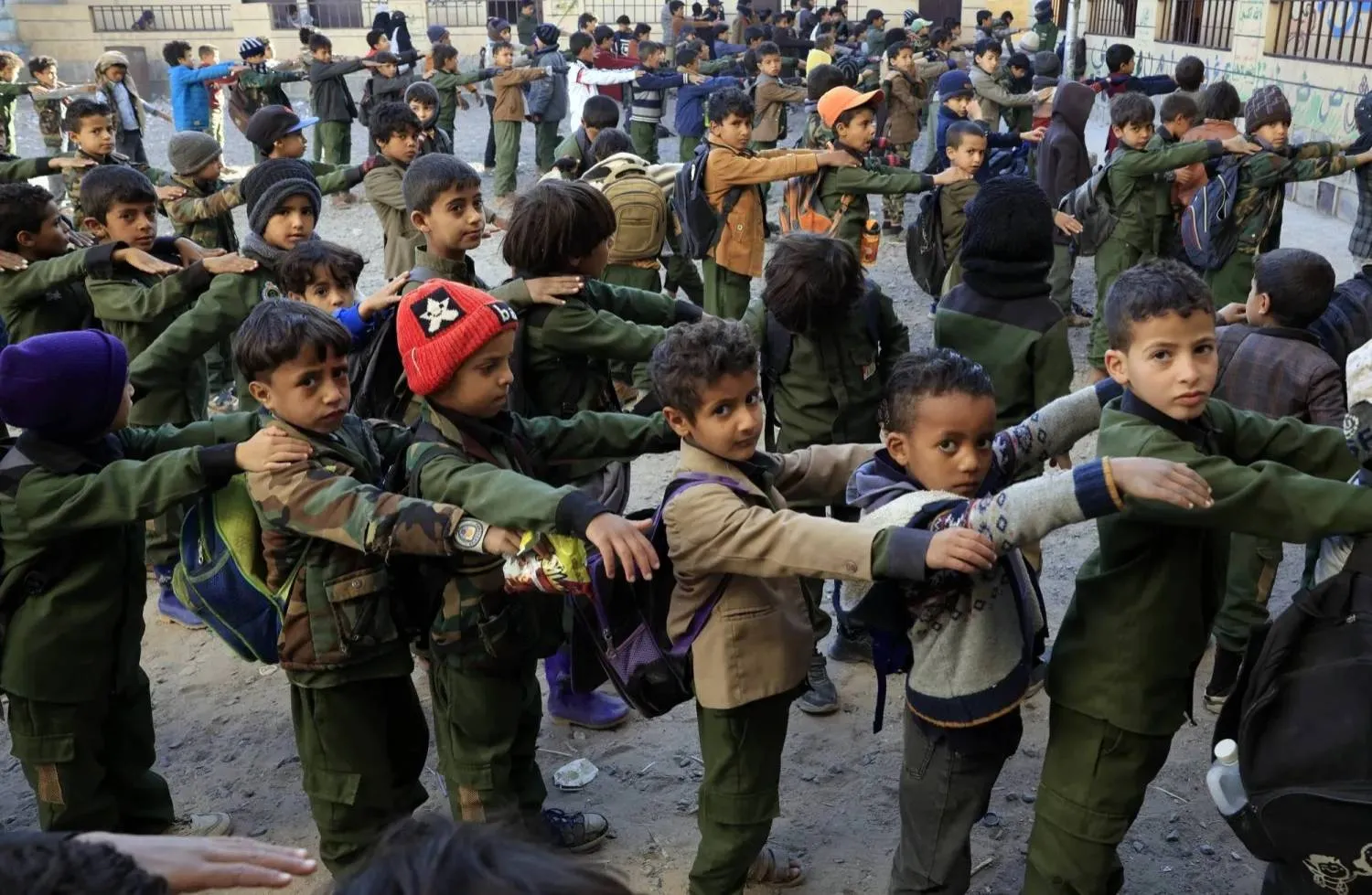
Yemeni students attend morning assembly at a school in Sanaa (EPA)
TT

Houthi Schools in Yemen Turned into Early Recruitment Camps

Yemeni students attend morning assembly at a school in Sanaa (EPA)

Since rising to power in 2014, Yemen’s Houthi movement, Ansar Allah, has systematically entrenched itself within the education system, rewriting curricula, renaming schools, and embedding ideological programs.

Classrooms have become a frontline in a broader struggle over identity and influence, and a pipeline for recruiting young people.

As public schools were sidelined and weakened, the group built a parallel model, recasting education as a controlled, camp-like environment. At its core is a network branded “Martyr of the Quran Schools,” positioned as an alternative system.

Seizure and spread

The shift has been enforced on the ground. Public school buildings have been taken over and rebranded. Kamran School in Ibb, for example, was renamed under the new label. Other schools have been given the names of Houthi figures, a move educators say aims to replace the state’s education identity.

The expansion has also reached mosques, including the Grand Mosque in Dhamar, Al-Shamsiya School, and Al-Firdous Mosque in Sanaa’s Sawaan district, which have been repurposed into centers under the same banner.

Within three years, the model has spread across Houthi-held areas, moving beyond major cities into districts.

The schools operate as closed boarding schools, providing housing, food, and supplies while imposing a tightly controlled ideological framework. The name itself invokes the group’s founder, Hussein Badr al-Din al-Houthi.

From headline to pattern

On March 3, 2024, Houthi authorities said 3,000 students had graduated from the network.

The figure appears routine. But it reflects just two years of intensive, closed education, from a project that only began to take shape in 2022, underscoring the speed of expansion.

Houthi media say the model started with one school in Sanaa, then one per province, before spreading rapidly, especially in the capital.

Accounts suggest similarities with the system used by Hezbollah in Lebanon. Houthi officials frame the schools as part of the founder’s vision to produce generations “aware of the Quran” and able to confront cultural challenges.

Blurred structures

The schools carry the formal name “Martyr of the Quran Secondary Schools for Sharia Sciences,” but key details, including their legal basis and oversight, remain unclear.

References to a “republican decree” establishing them have surfaced, but no confirmed evidence exists. Reports also refer to boards of directors and links to education officials, yet the structure remains opaque.

An entity described as the General Administration of Secondary Schools for Sharia Sciences, reportedly led by Houthi figure Mohammed al-Tawqi within the education ministry, appears to be connected, though its exact role is unclear.

The group’s “General Mobilization” apparatus, tasked with recruitment and ideological training, is a constant presence. It operates directly under Houthi leadership and coordinates with religious bodies, mirroring models used by Hezbollah and Iran-aligned groups elsewhere.

No oversight

A teacher in Sanaa province, speaking anonymously, said the schools operate outside formal educational supervision. Curricula and programs are not published, leaving their content difficult to assess.

Management, he said, is tied to Ansar Allah’s cultural and educational offices, not standard education authorities.

Funding is similarly opaque. The schools are backed by the group’s resources, including levies and compulsory contributions, with Houthi media pointing to the Zakat Authority and the General Mobilization body as sources.

Recruitment and incentives

Each academic year, aligned with the Islamic calendar adopted by the group, enrollment opens to students aged 15 to 17 who have completed basic education.

Admission requires interviews and tests that assess ideological commitment and readiness for a full two-year residential program.

The incentives are clear: full accommodation, meals, clothing, and free tuition, alongside intensive daily programs described as faith-based.

The schools currently focus on secondary education, but expansion is underway. Graduates receive certification from an affiliated religious academy and can pursue further study or join institutions, including the group's military colleges.

A controlled day

Details of the curriculum remain scarce, but officials describe a rigid schedule. According to a school supervisor in Sanaa, the day starts at 4 a.m. with prayers and Quran study, followed by classes, then extended ideological sessions in the afternoon and evening.

Students study the writings of Hussein al-Houthi, attend lectures, and watch group-produced content as part of sustained indoctrination.

The program runs for two years in a closed setting, largely cut off from families.

Teachers are also drawn in. With public sector salaries disrupted, many join these schools, where pay is available, but they must first undergo ideological training.

Beyond the classroom

Activities extend beyond formal lessons. Students visit sites linked to Houthi leaders, including the grave of Hussein al-Houthi and that of Saleh al-Sammad, framed as “faith-building” experiences.

Annual events, including “Martyr’s Day,” feature speeches, marches, and staged combat scenes, reinforcing themes of jihad and allegiance.

A former teacher said the activities follow a structured program designed to build loyalty before academic learning. Students are trained in public speaking, media presence, and simulated combat, and take part in security-style exercises.

Militarization of school life

Military elements are integrated into daily life, with exposure to weapons and organized student parades, such as one held in Raymah province in February 2025.

School environments reinforce the messaging, with classrooms filled with images, slogans, and ideological language tied to the group.

“It is not an educational institution,” one teacher said. “It is a place to shape students.”

Pressure and withdrawal

A student in Sanaa province, identified as Sadiq, said he left after his father learned of the school’s ideological focus.

He described a reduced academic schedule, with only three classes a day, while the rest of the time is devoted to lectures.

“After the lecture, if a student cannot answer questions, he is beaten,” he said, adding that many stopped attending under the pressure.

Parallel system, uncertain future

The rise of these schools has created a parallel education track alongside the recognized system, leaving students exposed if conditions shift.

Houthi media promote student statements dismissing other schools as lacking real knowledge, reflecting a broader effort to discredit formal education.

Graduates emerge shaped by a strong ideological framework, raising questions about their academic and professional prospects and the long-term impact on Yemen.

Education, once a space for critical thinking and opportunity, is being recast as a tool of mobilization, reshaping a generation in line with a narrow ideological project.


Israeli Strikes Damage Hospital in Lebanon

File photo: Destroyed houses that were hit in an Israeli airstrike in Saksakiyeh village, south Lebanon, Friday, April 3, 2026. (AP Photo/Hussein Malla)
TT

Israeli Strikes Damage Hospital in Lebanon

File photo: Destroyed houses that were hit in an Israeli airstrike in Saksakiyeh village, south Lebanon, Friday, April 3, 2026. (AP Photo/Hussein Malla)

A hospital in the coastal Lebanese city of Tyre was damaged by Israeli airstrikes on nearby buildings that wounded 11 people, the health ministry said on Saturday.

The director of the Lebanese Italian Hospital told the state-run National News Agency (NNA) that it would "remain open to provide the necessary medical care" despite the damage.

Strikes destroyed two buildings nearby, an AFP correspondent saw, shattering windows and causing suspended ceilings to collapse in the hospital, the facility's management said.

A series of attacks hit the Tyre region on Saturday, including one on its port that struck a small boat and damaged others moored nearby, the AFP correspondent said.

Israel has been carrying out strikes across Lebanon and launched a ground invasion in the south after Hezbollah entered the war in the Middle East on the side of its backer Iran on March 2.

Tens of thousands of people have left Tyre, but around 20,000 remain, including 15,000 displaced from surrounding villages, despite Israeli evacuation warnings covering most of the city and a broad swathe of southern Lebanon.

The NNA also reported that Israeli forces abducted a man in Shebaa, near the Israeli border in the east, at around 3:00 am on Saturday.


Indonesia Slams 'Unacceptable' Peacekeeper Casualties in Lebanon

FILE PHOTO: UNIFIL vehicles drive on a main road in Qlayaa, amid escalating hostilities between Israel and Hezbollah, as the US-Israel conflict with Iran continues, in Qlayaa, southern Lebanon, March 27, 2026. REUTERS/Karamallah Daher/File Photo
TT

Indonesia Slams 'Unacceptable' Peacekeeper Casualties in Lebanon

FILE PHOTO: UNIFIL vehicles drive on a main road in Qlayaa, amid escalating hostilities between Israel and Hezbollah, as the US-Israel conflict with Iran continues, in Qlayaa, southern Lebanon, March 27, 2026. REUTERS/Karamallah Daher/File Photo

The Indonesian government on Saturday slammed as "unacceptable" an explosion that injured three of its peacekeepers in Lebanon within days of three other blue helmets from the Southeast Asian nation being killed.

The United Nations Interim Force in Lebanon (UNIFIL) said three peacekeepers were wounded in a blast that occurred inside a UN facility near Adaisseh on Friday afternoon, and rushed to hospital.

Two were seriously wounded.

The UN Information Center in Jakarta said the "origin of the explosion" was unknown but identified the injured soldiers as Indonesian.

"Repeated attacks or incidents of this kind are unacceptable," the Indonesian foreign ministry said in a statement.

"Regardless of their cause, these events underscore the urgent need to strengthen protection for UN peacekeeping forces amid an increasingly dangerous conflict situation."

The government urged the UN Security Council to investigate the events and "to immediately convene a meeting of troop-contributing countries to UNIFIL to conduct a review and take measures to enhance the protection of personnel serving with UNIFIL".

Friday's incident came just days after an Indonesian peacekeeper died when a projectile exploded on March 29 in southern Lebanon, where Israel and Hezbollah have been fighting since Lebanon was drawn into the Middle East war.

A UN security source told AFP on condition of anonymity Tuesday that fire from an Israeli tank was responsible for that attack.

A day later, two more Indonesian peacekeepers died after an explosion struck a UNIFIL logistics convoy, also in southern Lebanon.

The father of one of the two fallen soldiers, 33-year-old Zulmi Aditya Iskandar, said this week he was shocked that peacekeepers were losing their lives in the conflict.

"We were really sad and regretful, because this is a UN troop, a peacekeeping troop, not deployed for war," 60-year-old Iskandarudin told reporters at his house in West Java province.

The bodies of the three peacekeepers are scheduled to arrive in Jakarta on Saturday evening, according to the military.

The Indonesian National Armed Forces has said it will deploy more than 750 personnel to Lebanon next month as part of the scheduled UNIFIL peacekeeping troop rotation.


Strike Kills One Iraqi Fighter near Syria Border

Mourners attend the funeral of members of Iraq's Hashed al-Shaabi, who were killed in an airstrike in the town of al‑Qaim near the Syrian border, amid heightened regional tensions due to the US-Israel conflict with Iran, in Baghdad, Iraq, March 12, 2026. REUTERS/Stringer
TT

Strike Kills One Iraqi Fighter near Syria Border

Mourners attend the funeral of members of Iraq's Hashed al-Shaabi, who were killed in an airstrike in the town of al‑Qaim near the Syrian border, amid heightened regional tensions due to the US-Israel conflict with Iran, in Baghdad, Iraq, March 12, 2026. REUTERS/Stringer

An attack killed one fighter from the former paramilitary coalition Hashed al-Shaabi on Saturday, the alliance said, blaming the US and Israel.

Iraq has been dragged into the war between the United States, Israel and Iran, with strikes targeting both US interests and pro-Iran groups in the country, reported AFP.

"This treacherous attack resulted in the martyrdom of one PMF fighter and the wounding of four others, as well as a member of the ministry of defense," said a short statement from the group, which is also known as the Popular Mobilization Forces (PMF), adding it was a "Zionist-American attack".

The PMF is a coalition of armed groups -- formed in 2014 to fight extremists-- that is now part of Iraq's regular army, but also contains pro-Iran factions who have a reputation for acting independently.

PMF positions have been repeatedly targeted since the outbreak of war, with the group consistently blaming the attacks on the US and Israel.

According to the group's statement, the latest attack targeted a position in western Anbar province of the 45th Brigade, which belongs to the US-blacklisted, pro-Iran Kataeb Hezbollah group.

Kataeb Hezbollah is part of the umbrella movement known as the Islamic Resistance in Iraq, which has been claiming daily attacks since the start of the war on US interests in Iraq and the region.

The Pentagon has said helicopters have carried out strikes against pro-Iran armed groups in Iraq during the war.

Washington has strongly denied claims it has targeted Iraqi security forces.
