


Israel Wary of Sudden Trump Shift Despite War Pledge

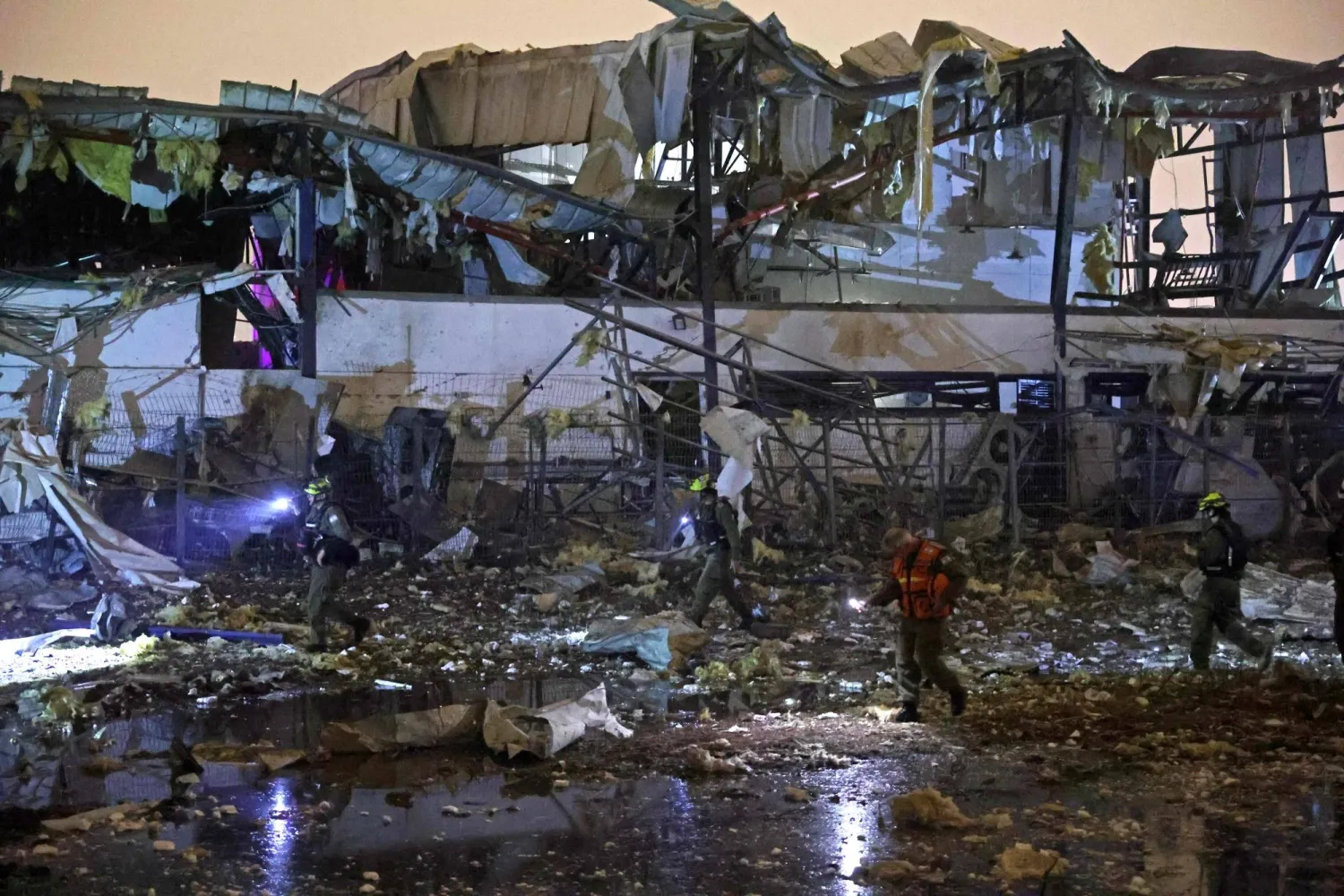
Israeli security forces and first responders inspect the site of an Iranian strike that hit a residential neighborhood in Petah Tikva on April 2, 2026. (AFP)
TT

Israel Wary of Sudden Trump Shift Despite War Pledge

Israeli security forces and first responders inspect the site of an Iranian strike that hit a residential neighborhood in Petah Tikva on April 2, 2026. (AFP)

Despite reassurances in Israel after US President Donald Trump said the war on Iran would continue for another two to three weeks, Israeli assessments still warn of a possible abrupt policy shift that could halt the conflict “before its objectives are complete.”

Security sources say Iran’s Revolutionary Guard Corps (IRGC) remains intent on prolonging the war despite heavy losses, seeking to turn it into a drawn-out war of attrition. Trump, however, is viewed as aiming to deny Tehran that leverage.

Sources quoted by Israeli outlet Walla said ending the war sooner could allow Israel and the United States to better assess the impact of their strikes, amid growing opposition to the conflict in the United States and Western countries, as well as waning support within Israel.

According to Channel 12, Iran has sustained extensive damage. The United States and Israel have struck 19,650 targets — including 11,000 by US forces — killing 55 senior figures, among them 22 top-level leaders. Around 4,700 sites linked to ballistic missile production and storage were destroyed, eliminating about 90 percent of that capability, along with 150 naval vessels.

Still, Iran has continued to launch missiles. Only 14 percent of its strikes targeted Israel — 411 barrages involving 585 missiles and 765 drones — while the rest were directed at roughly 14 countries, most of them Arab or Muslim states, the report underlined.

Better prepared than expected

Danny Citrinowicz, a researcher at Tel Aviv University’s Institute for National Security Studies and former head of the Iran desk in Israeli military intelligence, told Ynet that Iran retains significant capabilities and appears better prepared than Israel and the United States had expected.

He said statements by Iranian parliament speaker Mohammad Bagher Ghalibaf about an “eye-for-an-eye” policy indicate that Iran’s command structure remains intact and that its missile launches follow a coordinated strategy.

“This is not random fire,” Citrinowicz said. “There is a strategic and operational plan.”

He cited a pattern of reciprocal strikes, including attacks in southern Iran followed by the first strike on the Haifa oil refinery, then an attack on the Natanz nuclear facility and a retaliatory strike on Israel’s Dimona reactor.

Further exchanges included strikes on Iranian steel plants and on an Israeli facility in Neot Hovav in the Negev desert. Iran later targeted the Haifa refinery again after Israeli attacks on its electricity infrastructure.

Citrinowicz said Tehran is seeking to establish a deterrence equation that goes beyond Israel alone. He pointed to an attack on Ras Laffan that disrupted 17 percent of Qatar’s gas production following strikes on the South Pars field in southern Iran.

He also highlighted a new risk: threats by Yemen’s Iran-backed Houthis to close the Bab el-Mandeb Strait in response to any major escalation or ground incursion.

Such a move would mark a significant escalation, he warned. Iran’s strategy is not parity, but escalation to impose new rules of engagement and deter future attacks.

Citrinowicz said the next phase could include strikes on academic institutions, noting recent threats by the Revolutionary Guard against Israeli universities.

These assessments reflect a broader shift in Israel, where officials increasingly believe the war will not destroy Iran, but could delay its strategic programs for several years, requiring future confrontation.

Israeli Foreign Minister Gideon Saar said Israel had removed an existential threat, but cautioned the conflict would not be its last.

He stated: “Our enemies still exist. They have suffered a severe blow, but we must remain prepared.”

Israeli and US forces, meanwhile, are continuing their intensive strikes, aiming to further weaken Iran. According to Maariv, both sides agree Iran will not return to its pre-war status after the conflict.


Explosion Hits Pro-Israel Center in the Netherlands

Rotterdam Police officers. (Getty Images/AFP)
TT

Explosion Hits Pro-Israel Center in the Netherlands

Rotterdam Police officers. (Getty Images/AFP)

A blast hit a pro-Israeli center in the Netherlands, police said Saturday, adding it caused minimal damage and no injuries.

A police spokeswoman told AFP no one was inside the site run by Christians for Israel, a non-profit, in the central city of Nijkerk when the explosion went off outside its gate late on Friday.

An investigation was ongoing.

The incident comes after a string of similar night-time attacks on Jewish sites in the Netherlands and neighboring Belgium in recent weeks that has heightened concerns in the wake of the war in the Middle East.


Iran Says Strike Hit Close to Its Bushehr Nuclear Facility, Killing a Guard and Damaging a Building

Iran's Bushehr nuclear reactor (Reuters)
TT

Iran Says Strike Hit Close to Its Bushehr Nuclear Facility, Killing a Guard and Damaging a Building

Iran's Bushehr nuclear reactor (Reuters)

Iran’s atomic agency says an airstrike has hit near its Bushehr nuclear facility, killing a security guard and damaging a support building. It is the fourth time the facility has been targeted during the war.

The agency announced Saturday’s attack on social media.

The US AP’s military pressed ahead Saturday in a frantic search for a missing pilot after Iran shot down an American warplane, as Iran called on people to turn the pilot in, promising a reward.

The plane, identified by Iran as a US F-15E Strike Eagle, was one of two attacked on Friday, with one service member rescued and at least one missing. It was the first time the United States lost aircraft in Iranian territory during the war, now in its sixth week, and could mark a new turning point in the campaign.

The conflict, launched by the US and Israel on Feb. 28, has rippled across the region. It has so far killed thousands, upended global markets, cut off key shipping routes, spiked fuel prices and shows no signs of slowing as Iran responds to US and Israeli airstrikes with attacks across the region.


Trump Seeks $152 Mn to Revive Alcatraz as Federal Prison

FILE PHOTO: A view of Alcatraz prison complex located on Alcatraz Island in San Francisco Bay near San Francisco, California, US July 17, 2025. REUTERS/Carlos Barria/File Photo
TT

Trump Seeks $152 Mn to Revive Alcatraz as Federal Prison

FILE PHOTO: A view of Alcatraz prison complex located on Alcatraz Island in San Francisco Bay near San Francisco, California, US July 17, 2025. REUTERS/Carlos Barria/File Photo

US President Donald Trump asked Congress on Friday for $152 million to begin rebuilding the notorious Alcatraz prison, pressing ahead with his vision to return the former island lockup to active use.

The funding request, included in the White House's proposed 2027 budget, would cover the first year of converting the San Francisco Bay site into what officials describe as a "state-of-the-art secure prison facility."

Trump has pushed for reopening Alcatraz since last year, portraying it as a symbol of a tougher approach to crime, said AFP.

In a social media post at the time, he called for a "substantially enlarged and rebuilt" facility to house the country's most dangerous offenders.

The proposal comes as part of a broader Justice Department budget that emphasizes prison investment and law enforcement, though such requests are ultimately subject to approval by Congress.

Political news outlet Axios, citing administration officials, reported that any "supermax" prison complex at the site would have to be built from scratch -- putting the total cost at somewhere around $2 billion.

Alcatraz, which opened as a federal penitentiary in 1934, was once considered among the most secure prisons in the United States due to its isolated island location and the strong currents surrounding it.

It held a relatively small number of prisoners, including high-profile inmates such as Al Capone.

The island fortress entered American cultural lore after a 1962 escape by three inmates, which became an inspiration for the film "Escape from Alcatraz" starring Clint Eastwood.

It was closed in 1963 after officials determined it was too costly to maintain.

According to the Federal Bureau of Prisons, operating expenses were nearly three times higher than at other federal facilities, largely because all supplies -- including fresh water -- had to be transported to the island.

Since the early 1970s, Alcatraz has been managed by the National Park Service as part of the Golden Gate National Recreation Area and has become one of San Francisco's most popular tourist attractions, drawing more than a million visitors annually.

The White House argues that rebuilding the site would help modernize the federal prison system and expand capacity for high-risk inmates.

But critics have questioned both the practicality and cost of the plan, noting that the island's infrastructure would likely require extensive reconstruction.

Feasibility studies have already been conducted by federal agencies to assess whether a modern correctional facility could be established on the site, though no final decision has been made.

Any move to proceed could face political resistance given competing budget priorities and the site's current status as a major tourism and historical landmark.
