


US Fighter Shot Down Over Iran as Trump Threatens to Hit More Infrastructure

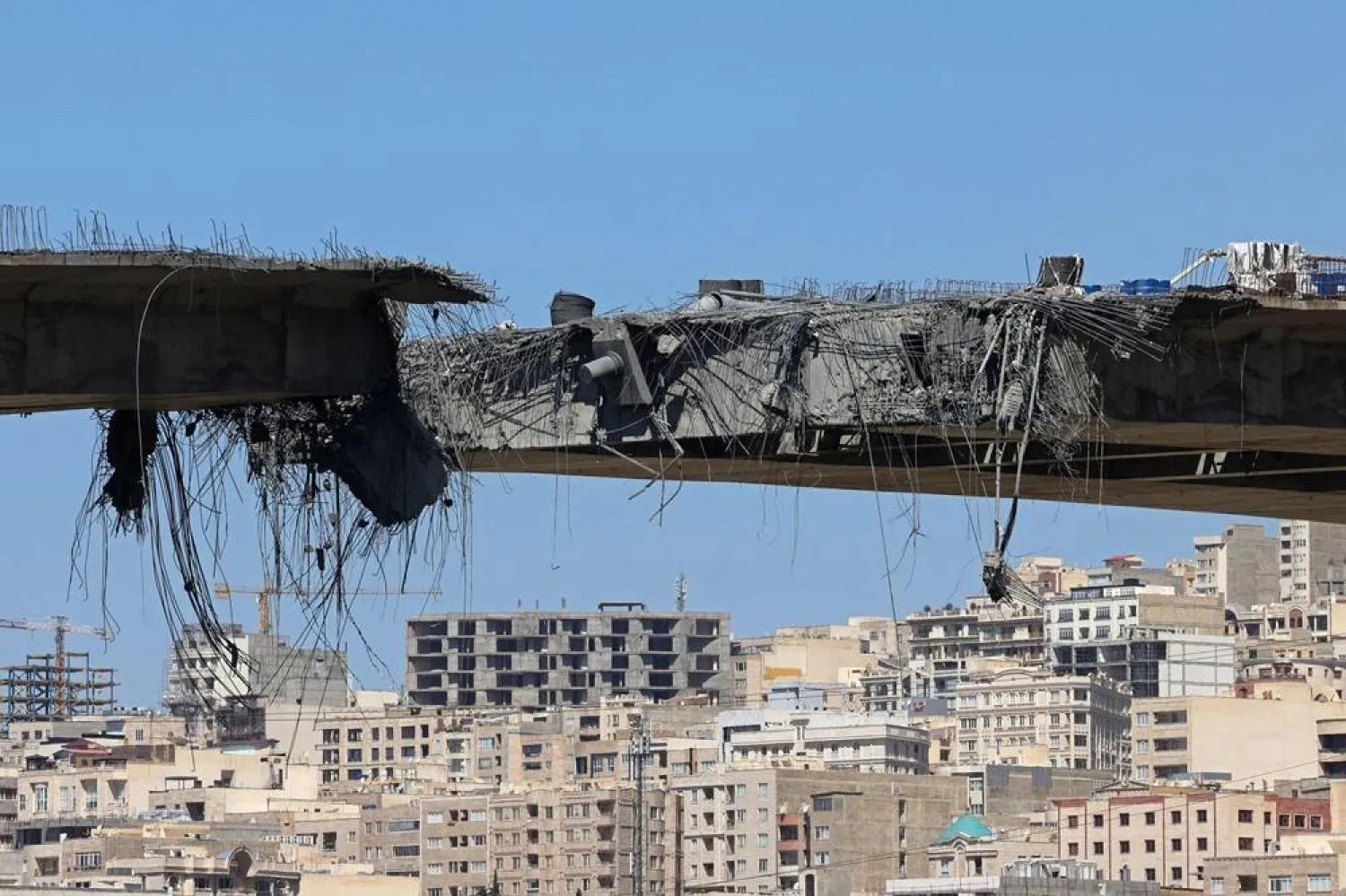
A view of the B1 bridge is pictured, a day after it was destroyed by a strike in Karaj, around 20miles (35kms) southwest of Tehran, April 3, 2026. (AFP)
TT

US Fighter Shot Down Over Iran as Trump Threatens to Hit More Infrastructure

A view of the B1 bridge is pictured, a day after it was destroyed by a strike in Karaj, around 20miles (35kms) southwest of Tehran, April 3, 2026. (AFP)

Iran shot down a US warplane on Friday, setting off a search by both sides for surviving crew as the war looked set to intensify with President Donald Trump threatening more attacks on civilian infrastructure.

Iran's Revolutionary Guard Corps said it was combing an area near where the plane came down in southwestern Iran. The regional governor promised a commendation for anyone who captured or killed the pilot.

A US military official confirmed that a fighter jet had been shot down and a search was under way.

Iranian news agencies said US helicopters were flying low on apparent search missions and carried videos of residents shooting at them.

DETAILS UNCLEAR OF US FIGHTER JET DOWNED BY IRAN

There were no confirmed details of the searches or the type of aircraft shot down, which the Iranian military said was an F-35, a single-seater. The Pentagon and US Central Command did not immediately respond to requests for comment.

The loss underlined the risk still faced by US and Israeli aircraft over Iran, despite assertions by Trump and Defense Secretary Pete Hegseth that their forces had total control of the skies.

Nearly five weeks after the US and Israel opened the campaign with a wave of strikes that killed Supreme Leader ‌Ali Khamenei, there is ‌no sign of an end to the war, which has already killed thousands and threatened lasting damage ‌to the global ⁠economy.

On Thursday, Trump ⁠posted footage on social media showing dust and smoke billowing up as US strikes hit the newly constructed B1 bridge between Tehran and nearby Karaj, which was due to open this year, and said more attacks would follow.

"Our Military, the greatest and most powerful (by far!) anywhere in the World, hasn't even started destroying what’s left in Iran. Bridges next, then Electric Power Plants!" he wrote in a subsequent post.

Despite the pressure, Iran has been able to hit back at Israel and strike Gulf countries.

On Friday, as Trump threatened to hit its bridges and power plants, Iran struck a power and water plant in Kuwait.

Trump urged Iran's leaders ⁠to seek peace, saying on social media that Iran "knows what has to be done, and has to be done, FAST!".

But ‌Tehran has shown no sign of acquiescence and Trump faces growing pressure to find a quick ‌resolution, with anger building at home and his Republican Party in danger of losing control of Congress at elections in November.

Negotiations conducted via intermediaries with new leaders in Iran have ‌shown little sign of progress, and polls indicate most Americans oppose the war.

'TAKE THE OIL AND MAKE A FORTUNE'

At the same time, the economic ‌impact has been global, with Iran's grip on the strategic shipping lane in the Strait of Hormuz giving it a choke hold on oil and gas.

Trump has expressed anger at US allies that have refused his calls to help re-open the strait, through which a fifth of global oil and liquefied gas passes in normal times. On Friday, he said reopening it would not be difficult.

"With a little more time, we can easily OPEN THE HORMUZ STRAIT, TAKE THE OIL,& MAKE A FORTUNE," he said on Truth Social.

The ‌US and Israel say they have degraded Iran's military capacity. But Iranian media have issued daily reports of attacks on civilian sites too, including schools, pharmaceutical suppliers and health facilities.

On Thursday, the century-old Pasteur Institute in the ⁠heart of Tehran was severely damaged, the ⁠Health Ministry said. On Friday, a drone hit a Red Crescent relief warehouse in the Choghadak area of the southern Bushehr province.

Over 100 American international law experts said the conduct of US forces and statements by senior US officials "raise serious concerns about violations of international human rights law and international humanitarian law, including potential war crimes".

For its part, Iran has continued to strike targets around the Gulf.

Kuwait Petroleum Corporation said its Mina al-Ahmadi refinery had been hit by drones. Other attacks were also reported to have been intercepted in Saudi Arabia and Abu Dhabi. Missile debris landed near the Israeli port of Haifa, site of a major oil refinery.

IRAN WAR CAUSES GLOBAL ECONOMIC UPHEAVAL

Global financial markets have whipsawed in response to expectations of a possible end to the war and the re-opening of the Strait, which only isolated vessels have been able to transit.

The closure has also squeezed shipments of fertilizer, threatening a humanitarian crisis in developing countries in Asia and Africa, underlined by data showing a sharp rise in global food prices in March.

On Friday, a container ship belonging to the French shipping group CMA CGM passed through, MarineTraffic vessel tracking data showed, a sign that Iran may not consider France hostile. A liquefied natural gas ship belonging to Japan's Mitsui OSK Lines also transited.

Oil markets were closed after benchmark US crude prices gained 11% on Thursday following a speech by Trump that offered no clear sign of an imminent end to the war.

The UN Security Council is set to vote on Saturday on a Bahraini resolution to protect commercial shipping in and around the strait, diplomats said, but veto-wielding China made clear its opposition to authorizing armed intervention.



Iran President Calls on People to Save Energy

Iranians shop in the Tajrish bazaar in Tehran, Iran, 25 April 2026. (EPA)
TT

Iran President Calls on People to Save Energy

Iranians shop in the Tajrish bazaar in Tehran, Iran, 25 April 2026. (EPA)

Iranian President Masoud Pezeshkian called on his people Saturday to conserve electricity, warning that while there were no shortages at present, the US and Israel aimed to sow "dissatisfaction" among the Iranian people.

"We have asked our dear people, who are now ready and present on the ground, a simple request. And that is to reduce their own electricity and energy consumption," the president said on state TV.

"We do not need people to sacrifice for the time being, but we do need to control consumption. Instead of 10 lights, two lights should be turned on in the house -- what is wrong with that?" he added.

Despite the US-Israeli bombing campaign against Iran, there have been no reported power cuts in Tehran in recent days.

Pezeshkian accused Iran's enemies of hitting infrastructure and imposing a blockade "so that the current satisfaction turns into dissatisfaction".

US President Donald Trump has repeatedly threatened to wipe out Iran's power infrastructure, but has so far not followed through.

Even before the current war with the United States and Israel, however, Iran suffered frequent power outages during the winter and summer peaks in demand.

According to the International Energy Agency, Iran generates nearly four-fifths of its electricity from burning natural gas, a resource in which it is self-sufficient thanks to vast gas fields.

It supplements this with low-quality heavy fuel oil, known as mazout, used at older power stations.

Nevertheless, ageing infrastructure, a lack of investment and the impact of fierce international sanctions that cut off access to technology and investment have left the electricity grid unable to cope with demand.

Pezeshkian has previously launched several public awareness campaigns to reduce energy use.


Türkiye Dismisses Deputy Education Minister After School Shootings

Flowers are hung on the fence of a school where a shooting took place, in the southeastern province of Kahramanmaras, Türkiye, April 16, 2026. (Reuters)
TT

Türkiye Dismisses Deputy Education Minister After School Shootings

Flowers are hung on the fence of a school where a shooting took place, in the southeastern province of Kahramanmaras, Türkiye, April 16, 2026. (Reuters)

President Recep Tayyip Erdogan has dismissed Türkiye’s deputy education minister after two school shootings that left nine people dead, according to the official gazette published late Friday.

Eight students aged 10 and 11 and a teacher were killed this month when a 14-year-old opened fire at a school in the southern province of Kahramanmaras.

Authorities said the attacker, who died at the scene, brought five firearms and was the son of a former police inspector, who has since been arrested.

A separate attack in southeastern Sanliurfa province involved a former student who opened fire at his old high school before taking his own life when confronted by police.

Under a decree signed by Erdogan, deputy education minister Nazif Yilmaz was dismissed and replaced by Cihad Demirli.

The measures also targeted the leadership of state institutions responsible for education, according to the decree.

The incidents have sparked public outcry and Erdogan has said the government will introduce measures, including restrictions on gun ownership.


Macron Reaffirms Efforts to Reopen Strait of Hormuz, as TotalEnergies Warns of Energy Shortages

 French President Emmanuel Macron attends a Greece–France Economic Forum at the Stavros Niarchos Foundation Cultural Center in Athens, Greece, April 25, 2026. (Reuters)
French President Emmanuel Macron attends a Greece–France Economic Forum at the Stavros Niarchos Foundation Cultural Center in Athens, Greece, April 25, 2026. (Reuters)
TT

Macron Reaffirms Efforts to Reopen Strait of Hormuz, as TotalEnergies Warns of Energy Shortages

 French President Emmanuel Macron attends a Greece–France Economic Forum at the Stavros Niarchos Foundation Cultural Center in Athens, Greece, April 25, 2026. (Reuters)
French President Emmanuel Macron attends a Greece–France Economic Forum at the Stavros Niarchos Foundation Cultural Center in Athens, Greece, April 25, 2026. (Reuters)

French President Emmanuel Macron reiterated ‌on Saturday that he was focused on efforts to reopen the Strait of Hormuz, a day after the head of TotalEnergies warned of global energy shortages if the Iran war continues for months.

Macron, speaking at a news conference in Athens alongside Greek Prime Minister Kyriakos Mitsotakis, said panic caused by geopolitical uncertainty can in itself lead to shortages.

"Our goal is to achieve a full reopening in the coming days and weeks, in accordance with ‌international law, ‌guaranteeing freedom of navigation without tolls on ‌the ⁠Strait of Hormuz. Then ⁠things can gradually return to normal," Macron said.

TotalEnergies CEO Patrick Pouyanne pressed on Friday for the reopening of the strait, through which about a fifth of the globe's oil and gas supply normally flows.

Movement through the strait, which is also a key transport route for ⁠goods including fertilizers and pharmaceuticals, has been choked ‌due to the US-Israeli ‌war with Iran, as Iran has seized container ships and ‌the United States has mounted a blockade on Iranian ‌ports.

"If it lasts two, three months more, we are entering in a world of scarcity of energy, which Asian countries have already suffered," Pouyanne told the World Policy Conference in Chantilly, ‌outside Paris. "You cannot have 20% of the oil and gas of the planet being ⁠stranded and ⁠not accessible without major consequences."

More than a dozen countries have said they are willing to join an international mission led by France and Britain to protect shipping in the strait when conditions permit, even as US President Donald Trump has said he does not need allies' help.

"We're all in the same boat, and it's not a boat we chose, if I may say. We're victims of geopolitics and we're victims of this war that started several months ago," Macron said on Saturday.