


Air Strike Cuts Southern Iraq Off from Iran

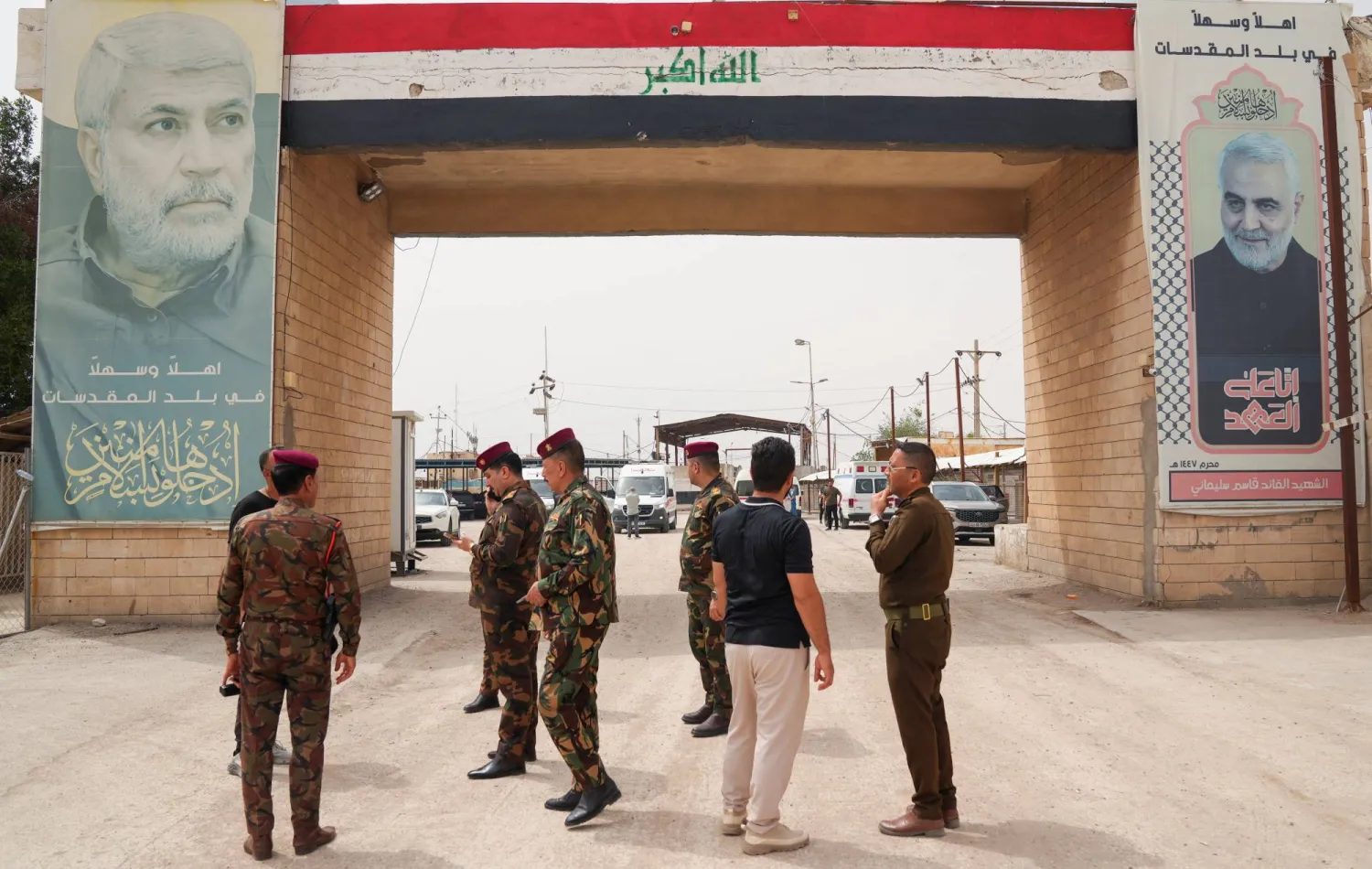
 Iraqi security forces stand at the Shalamcheh border crossing with Iran after Iraq closed the crossing following airstrikes on the Iranian side that security sources said killed an Iraqi citizen, Iraq, April 4, 2026. (Reuters)
Iraqi security forces stand at the Shalamcheh border crossing with Iran after Iraq closed the crossing following airstrikes on the Iranian side that security sources said killed an Iraqi citizen, Iraq, April 4, 2026. (Reuters)
TT

Air Strike Cuts Southern Iraq Off from Iran

 Iraqi security forces stand at the Shalamcheh border crossing with Iran after Iraq closed the crossing following airstrikes on the Iranian side that security sources said killed an Iraqi citizen, Iraq, April 4, 2026. (Reuters)
Iraqi security forces stand at the Shalamcheh border crossing with Iran after Iraq closed the crossing following airstrikes on the Iranian side that security sources said killed an Iraqi citizen, Iraq, April 4, 2026. (Reuters)

A US air strike hit the Shalamcheh border crossing with Iran on Saturday, killing and wounding several people and halting trade and travel, in a sharp escalation that could signal a push by Washington to sever links between the two countries.

The crossing, east of Iraq’s Basra and about 30 km (19 miles) from the city center, is a key trade artery, with more than 300 trucks passing through daily.

The Iraqi Border Ports Authority chief, Lieutenant General Omar al-Waeli, said the strike “directly hit the passenger hall,” killing one Iraqi and wounding five others, who were taken to a hospital in Iran. He said the attack forced a halt to passenger and trade movement.

Al-Waeli said alternative crossings, including Safwan, remain available to ensure the flow of goods.

Some media reports said the strike coincided with the passage of logistical support convoys heading into Iran.

Reports of a similar strike on the Mehran crossing on the border with Wasit province were denied by a medical worker there, who told Asharq Al-Awsat the strike occurred in the nearby Iranian city of Mehran.

A source said support convoys organized by factions and other groups continue to cross into Iran, but increasingly use small vehicles to avoid US strikes.

The Popular Mobilization Forces had previously sent aid through Shalamcheh, amid reports Iraqi fighters had crossed into Iran to assist authorities in their war with the United States and Israel, raising the risk of escalation inside Iran.

Reza Pahlavi criticized on Friday the presence of Iraqi armed factions on Iranian territory.

Political analyst Falah al-Mashaal said targeting crossings appears aimed at “isolating Iraq from Iran,” adding the escalation likely seeks to block aid and disrupt trade, effectively imposing isolation “by bombs” after political efforts failed.

Later on Saturday, Iraq said passenger movement at the crossing had resumed, reportedthe country’s state official news agency INA.

Drone strikes hit oil facilities

In Iraq’s Basra, drones believed to have been launched by Iran-aligned factions struck oil facilities, in what appeared to be an effort to pressure foreign companies, particularly US firms, to leave the country.

Two drones hit sites operated by al-Majal company, sparking fires in Burjesia and the North Rumaila oilfield, with no casualties reported.

A source said the attack set fire to a food storage warehouse in Rumaila and damaged company offices in Burjesia. Civil defense teams extinguished one fire and brought the other under control.

US strikes also hit positions linked to the Popular Mobilization Forces in Anbar, where the group said one fighter was killed and five others wounded in al-Qaim.

The PMF said four of its fighters were wounded, along with a Defense Ministry member.

Sources close to the group told Asharq Al-Awsat it had ordered members to keep their distance from headquarters and granted leave to about half its personnel over fears of further strikes.

Separately, the Interior Ministry said its forces had taken over security duties in al-Qaim and al-Rummanah, part of a shift from the Defense Ministry within city centers.

The ministry said the move aims to strengthen security, allow army units to focus on border duties and improve coordination among forces, calling on citizens to report suspicious activity.



Hezbollah Signals Possible Return to 1980s 'Tactics' Against Israeli Army

Israeli military vehicles maneuver on the Lebanese side of the border, as seen from the Upper Galilee in northern Israel, 29 April 2026, amid a ceasefire between Israel and Lebanon.  EPA/ATEF SAFADI
Israeli military vehicles maneuver on the Lebanese side of the border, as seen from the Upper Galilee in northern Israel, 29 April 2026, amid a ceasefire between Israel and Lebanon. EPA/ATEF SAFADI
TT

Hezbollah Signals Possible Return to 1980s 'Tactics' Against Israeli Army

Israeli military vehicles maneuver on the Lebanese side of the border, as seen from the Upper Galilee in northern Israel, 29 April 2026, amid a ceasefire between Israel and Lebanon.  EPA/ATEF SAFADI
Israeli military vehicles maneuver on the Lebanese side of the border, as seen from the Upper Galilee in northern Israel, 29 April 2026, amid a ceasefire between Israel and Lebanon. EPA/ATEF SAFADI

Overlapping media leaks from within Hezbollah on activating “martyrdom fighters” (suicide operatives) have raised questions about the next phase on the southern front, amid talk of non-traditional combat options that echo the warfare of the 1980s.

Media leaks citing military sources within Hezbollah said the group is studying a return to “1980s tactics,” including activating what it described as “martyrdom units.”

The issue gains additional weight in light of prior rhetoric within the group. Former Hezbollah Secretary-General Hassan Nasrallah described fighters in the south during the 2024 “support war” as “martyrdom fighters,” reflecting the nature of the fighting and battlefield conditions.

The renewed use of the term raises questions over whether it is mobilizing rhetoric or an indication of potential operational choices.

Environmental Constraints and Technological Shift

Retired Brigadier General Yarub Sakhr told Asharq Al-Awsat that “the field reality in southern Lebanon makes talk of a return to suicide operations closer to a theoretical proposition than a practical option.”

He added: “The south today is largely depopulated due to displacement and destruction, which strips this type of operation of one of its key elements, namely the ability to conceal within a civilian environment.”

“Technological advances in surveillance and reconnaissance, along with Israel’s extensive target bank, make carrying out such operations extremely difficult, if not impossible, under constant monitoring and precise tracking, in addition to the difficulty of movement and field access.”

He noted that “signaling the existence of such operations along the border with Israel is used in a propaganda context,” adding that “the real message goes beyond the military dimension to the Lebanese domestic arena, where this rhetoric is employed as a pressure tool on officials and political forces to push them toward certain foreign policy choices.”

According to Sakhr invoking the 1980s approach does not stop at suicide operations but also recalls a broader pattern that included kidnappings and assassinations.

He affirmed that the comparison between the current situation in the south and that of the 1980s is not accurate, stressing that “talk of a return to this mode of warfare remains within the realm of slogans and political pressure rather than a viable military option under current conditions.”

Between Theory and Application

By contrast, retired Brigadier General Fadi Daoud told Asharq Al-Awsat: “Talk of reviving 1980s methods is not merely media rhetoric, but reflects that this option exists within the party’s available capabilities.”

He said references to suicide operatives ready to act “fall within the human capabilities that have long been one of the party’s strengths.”

“These operations, despite major technological advances in surveillance and monitoring, can still have battlefield impact, because technology remains limited in effectiveness against a human element determined to reach its target.”

Daoud said the effectiveness of such operations “depends on the nature of the target, the level of surrounding security protection, and field measures around sites and facilities,” noting that “the chances of success vary from case to case based on these factors.”

He said any potential use of such capabilities would remain directed at Israeli targets, adding that carrying out such operations inside Israel would require infiltration and direct access to the target, which faces major field challenges and makes success rates uneven.

“Merely signaling this option carries psychological and strategic weight, recalling past experiences in the Israeli memory and sending a message that any settlement that does not take balances into account could lead to escalation outside conventional frameworks.”

Operational Meaning of the Term

A source following Hezbollah’s operations told Asharq Al-Awsat that “the use of the term ‘martyrdom fighters’ does not necessarily mean a return to traditional suicide operations, but reflects the nature of the current battlefield phase under the siege imposed on areas in southern Lebanon.”

He added: “Fighters are fully aware of the scale of risks surrounding them and deal with them on the basis of fighting to the utmost limits.”

The source noted: “What is meant by the term is readiness for engagement under the most difficult battlefield conditions, and continuing the confrontation until death if imposed, not as a separate tactical option but as part of the nature of the battle itself.”


Lebanese Defense Minister: Talks With Israel Aimed at Peace, Not Surrender or Trade-Offs

Lebanese Defense Minister Michel Menassa (National News Agency)
TT

Lebanese Defense Minister: Talks With Israel Aimed at Peace, Not Surrender or Trade-Offs

Lebanese Defense Minister Michel Menassa (National News Agency)

Lebanon’s Defense Minister, Major General Michel Menassa, said on Thursday that his country had entered negotiations for peace, not for surrender or trade-offs.

The state-run National News Agency quoted Menassa as saying, during a meeting with Druze spiritual leader Sheikh Sami Abi al-Muna in Verdun: “We discussed the Israeli aggression against our country and the ongoing efforts to stop it. Preserving national unity, rallying around Lebanese legitimacy, and ensuring that arms remain exclusively in the hands of the Lebanese army and official security agencies were our shared priorities. Helping our people overcome this ordeal has been our concern, and rising above narrow calculations in favor of major national objectives will remain our goal.”

He added: “If we are heading to negotiations, they are for peace, not for surrender. We are going to negotiate, not to trade off. We want to stop the rivers of blood in honor of the martyrs, and we, as Lebanese, Muslims and Christians, insist on remaining united.”

He expressed hope that “this ordeal will end, that this cloud will pass, and that the light of deliverance will rise over Lebanon and its people.”

For his part, the Druze spiritual leader stressed “the duty to rally around the state and its legitimate institutions, foremost among them the military establishment, especially under the current circumstances, in support of carrying out its assigned tasks in protecting Lebanon and its sovereignty,” warning against any “attempts to undermine civil peace,” and saying that “a strong Lebanon is a united Lebanon.”


Media Organizations Call on Israel to Allow Foreign Reporters Independent Access to Gaza

FILE - Palestinians walk along a street surrounded by buildings destroyed during Israeli air and ground operations in Khan Younis, southern Gaza Strip, on April 9, 2026. (AP Photo/Abdel Kareem Hana, File)
TT

Media Organizations Call on Israel to Allow Foreign Reporters Independent Access to Gaza

FILE - Palestinians walk along a street surrounded by buildings destroyed during Israeli air and ground operations in Khan Younis, southern Gaza Strip, on April 9, 2026. (AP Photo/Abdel Kareem Hana, File)

The leaders of major media companies around the world, including The Associated Press, are calling on Israel's government to lift a ban keeping foreign journalists from being able to independently enter and report from Gaza, a barrier that's been in place since the war's start in 2023 and continues even as a ceasefire has been in place for more than six months.

“Being on the ground is essential. It allows journalists to question official accounts on all sides, to speak directly with civilians and report back what they witness firsthand,” said the statement from the executives, released Thursday. “That is why news organizations send their reporters into the field, often at great personal risk.”

From the AP and the BBC to CNN to MS NOW, from Reuters to German news agency dpa to The Washington Post, the top editors of more than two dozen organizations said the Israeli government has so far not responded to their efforts to discuss the situation. They questioned the country's rationales for why the restrictions are still in place.

The letter was released at 5 a.m. ET by the local foreign press association.

Israel had said ban was necessary Initially, Israel said the ban was necessary because foreign journalists allowed into Gaza could give away the positions of Israeli soldiers and endanger them. Other rationales have included that as an active battle zone, it was too dangerous. The army has occasionally brought foreign reporters in on highly controlled trips, but media outlets want independent access.

Currently, “the heaviest fighting is over and there is a ceasefire in place," the editors' statement said. "The hostages have come home. Journalists do not pose a threat to Israeli troops. There is a mechanism in place—however restrictive—that allows aid workers to enter and exit the territory. Why not journalists?”

There have been attempts at legal action to force the issue. The Foreign Press Association, which represents international media in Israel, Gaza and the West Bank, has been waiting on a decision from the Israeli Supreme Court on a petition for independent access to Gaza. That action was filed in 2024, but a ruling has been repeatedly delayed, most recently in January.

With foreign journalists kept out of Gaza, coverage of the conditions on the ground there has been possible only for local Palestinian journalists. While covering war would be fraught for any reporter, the Palestinian correspondents have also had to experience it on a personal level — their homes destroyed, their loved ones killed.

When access to food became severely restricted last year they also had to deal with hunger, to the point that the Agence France-Presse news agency in July raised an alarm about their Palestinian colleagues' continued survival. That concern was echoed by the AP and Reuters for the reporters in Gaza they work with.

The editors raised that point in the statement Thursday, saying “this has pushed the responsibility for covering this devastating war and its aftermath almost entirely on our Palestinian colleagues ... They should not have to shoulder this burden alone, and they should be protected.”

Their lives have also been put at risk from military actions. Well over 200 journalists and media workers have been killed according to a tally from the Committee to Protect Journalists organization, far more than in conflicts elsewhere like the Russia-Ukraine war.

Among them was Mariam Dagga, a 33-year-old visual journalist who worked as a freelancer for the AP and other news organizations. She and four other journalists, including Reuters cameraman Hussam al-Masri and Moaz Abu Taha, a freelance journalist who worked with Reuters, were among those killed last August in an Israeli strike on a medical facility.

The AP's reporting on the strike raised questions about the rationale used by the Israeli government to carry out the action against the hospital, which was known as a place where journalists gathered. AP and Reuters later issued a statement calling on Israel to explain what took place and what steps would be taken to protect reporters. The Israeli military says it is still investigating.

The statement from the editors on Thursday came during Press Freedom Week, which they noted. “Freedom of the press is a basic value in any open society. It is time for the delays to end. Let us into Gaza.”