Iran Deputy FM Says Trump Threats to Hit Civilian Sites Could Be War Crimes

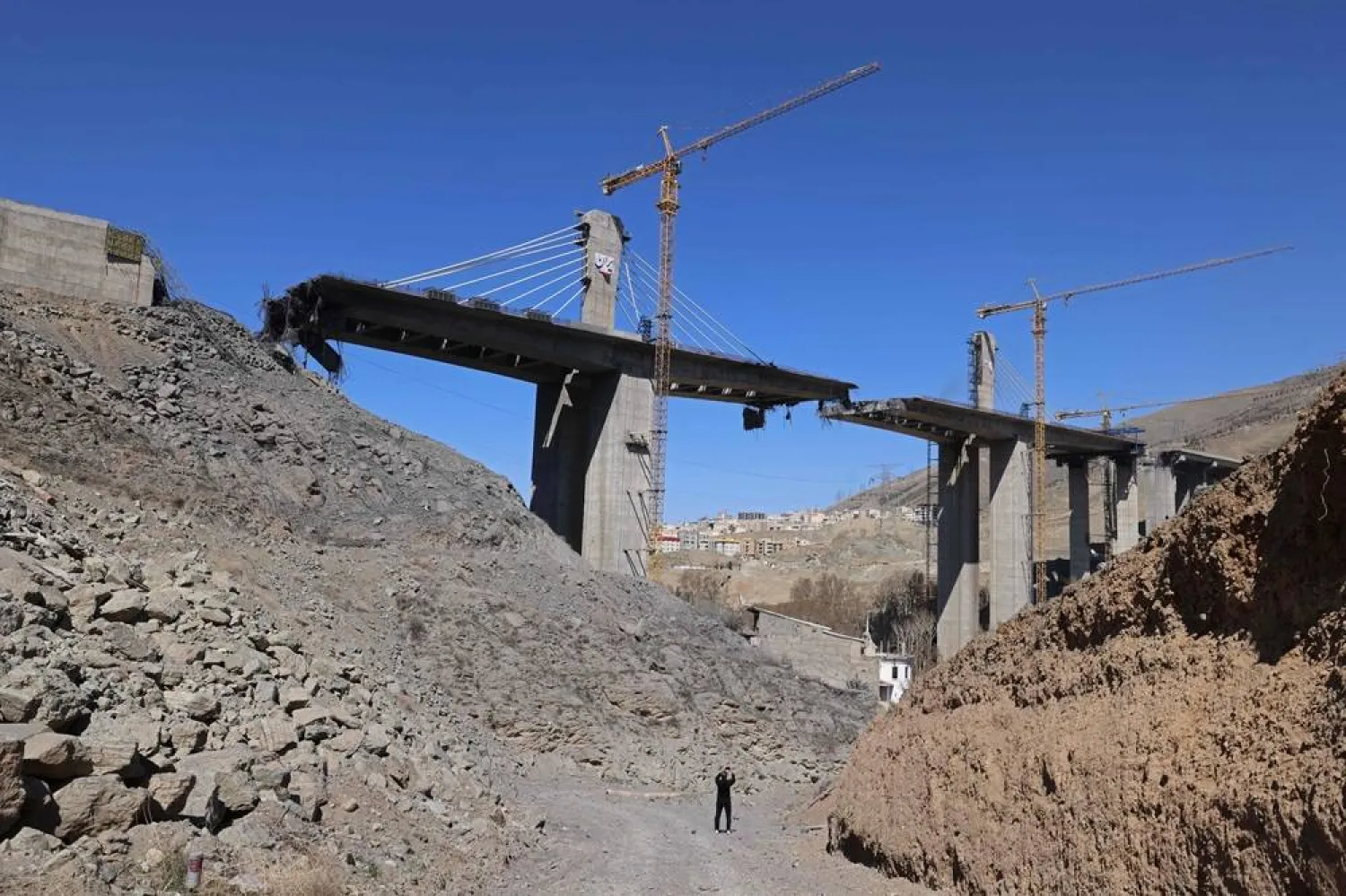
A man takes pictures with his mobile phone of the B1 bridge, a day after it was destroyed by a strike in Karaj, around 20miles (35kms) southwest of Tehran, April 3, 2026. (AFP)
TT

Iran Deputy FM Says Trump Threats to Hit Civilian Sites Could Be War Crimes

A man takes pictures with his mobile phone of the B1 bridge, a day after it was destroyed by a strike in Karaj, around 20miles (35kms) southwest of Tehran, April 3, 2026. (AFP)

Iran's Deputy Foreign Minister Kazem Gharibabadi said Monday that US President Donald Trump's threats to strike power plants and bridges in Iran could amount to war crimes.

"The American president, as the highest official of his country, has publicly threatened to commit war crimes," Gharibabadi said in a post on X, citing provisions of international law that could be breached.

"The threat to attack power plants and bridges (civilian infrastructure) is a war crime under Article 8(2)(b) of the Rome Statute of the International Criminal Court," he added.


UN Nuclear Watchdog Urges Iran to Take ‘Steps’ Towards Inspections

An Iranian woman walks next to a billboard depicting Iran’s national flag in a street in Tehran, Iran, 09 November 2026. (EPA)
TT

UN Nuclear Watchdog Urges Iran to Take ‘Steps’ Towards Inspections

An Iranian woman walks next to a billboard depicting Iran’s national flag in a street in Tehran, Iran, 09 November 2026. (EPA)

The UN's nuclear watchdog urged Iran to take "incremental steps" to allow inspectors to return to key nuclear facilities in the Islamic republic, adding such access was "critical" in a report seen by AFP Friday.

The International Atomic Energy Agency (IAEA) has not had access to key nuclear facilities in Iran since Israel, joined by the United States, launched a 12-day conflict in June 2025 that included strikes on nuclear sites.

Nuclear facilities have also been hit in the latest war, which erupted on February 28, and the IAEA has repeatedly called for access.

In its report, to be discussed at an IAEA board of governors meeting next week, the agency noted that it was "critical" for it to conduct "verification activities in Iran without further delay".

"The director general encourages Iran to consider technical and gradual measures by which conditions are achieved that allow for the return of agency inspectors to Iran," the report said.

"Such incremental steps could pave the way to normal safeguards implementation in Iran while contributing to a confidence-building atmosphere conducive to a wider agreement," it added.

The report detailed correspondence in recent weeks between the IAEA and Iran.

IAEA inspectors were able to visit Iran's Bushehr nuclear plant in September, but have had no access to other facilities.

The IAEA "acknowledged that the military attacks on Iran's nuclear facilities and sites created an unprecedented situation".

But because of a lack of cooperation "the agency is not able to conclude that there has been no diversion of declared nuclear material from peaceful nuclear activities in Iran", the report said.

"The agency's lack of information about ... nuclear material and access to facilities to verify it is a matter of serious proliferation concern," the IAEA said, adding it "needs to be rectified with the utmost urgency".

The IAEA board in September referred Iran to the UN Security Council over its nuclear "non-compliance", marking the first time Iran has been referred to the UN top body in 20 years for failing to comply with its nuclear reporting obligations.

Before the June 2025 strikes, the IAEA calculated that Iran possessed approximately 440 kilograms of uranium enriched to 60 percent, nearing the 90 percent needed to make a bomb and well above the 3.67-percent limit set by a 2015 now-defunct agreement with Iran.

Since June 2025, the fate of the stockpile has remained uncertain.

Iran has long denied striving to develop a nuclear bomb.


US Navy Quietly Fired Some Commanders And Officials, Drawing Congressional Pushback

 US Marine Corps aviation assets and personnel embarked aboard USS Boxer (LHD 4) support ongoing enforcement of the US blockade against Iran. (CENTCOM)
US Marine Corps aviation assets and personnel embarked aboard USS Boxer (LHD 4) support ongoing enforcement of the US blockade against Iran. (CENTCOM)
TT

US Navy Quietly Fired Some Commanders And Officials, Drawing Congressional Pushback

 US Marine Corps aviation assets and personnel embarked aboard USS Boxer (LHD 4) support ongoing enforcement of the US blockade against Iran. (CENTCOM)
US Marine Corps aviation assets and personnel embarked aboard USS Boxer (LHD 4) support ongoing enforcement of the US blockade against Iran. (CENTCOM)

The Navy has quietly fired or removed several top officers in recent months but broke with its usual practice of announcing those changes, drawing pushback from Congress, according to The Associated Press.

Two Democratic lawmakers said Thursday that the Navy failed to inform Congress that it fired the entire leadership team of a nuclear-powered attack submarine last month after an underwater collision.

Separately, the sea service in September fired the commander of a destroyer deployed to the Middle East, according to a defense official, who spoke on condition of anonymity to describe sensitive personnel matters.

Dr. Brian Monahan, a Navy rear admiral and attending physician for Congress and the Supreme Court, also departed his post during a Navy investigation — with no public announcement or confirmation.

All three are a break from the Navy’s longstanding policy to announce major removals of commanders and other highly visible officials. They also follow an increasing level of secrecy over military operations, especially in the Middle East.

“As a result of the Navy’s failure to communicate, what should have been a standard exercise in information sharing has instead raised questions about the Navy’s commitment to transparency and its commitment to a productive working relationship with Congress,” Representatives Joe Courtney of Connecticut and Adam Smith of Washington wrote in a letter to Navy leaders.

The developments could set up a contentious confirmation hearing next week for acting Navy Secretary Hung Cao as he seeks to permanently take over as the top civilian official.

Restrictions on the military sharing information go beyond the Navy.

US Central Command, which oversees operations in the Middle East, has released few details on recent limited strikes on Iran and refused to comment on or specify damage to bases or equipment, usually citing the need for operational security.

Major satellite imagery providers with US contracts have blocked or delayed public release of images in the region at the request of American officials.

As a result, it took months to determine that Iranian drone and missile strikes damaged or destroyed structures on 26 military bases and other sites with US equipment in the region, according to an AP analysis.


Israeli Defense Minister Says No Need for Opposition Approval to Launch Strikes

25 June 2024, Jerusalem: Israeli Defense Minister Israel Katz is pictured in Jerusalem. (dpa)
TT

Israeli Defense Minister Says No Need for Opposition Approval to Launch Strikes

25 June 2024, Jerusalem: Israeli Defense Minister Israel Katz is pictured in Jerusalem. (dpa)

Israel's defense minister said Thursday that caretaker Prime Minister Benjamin Netanyahu did not need opposition permission to order fresh military operations despite election setbacks, after threats to strike Iran.

"We do not need approval from the opposition or any legal authority" for the army to carry out strikes in any of the arenas where it operates, caretaker Defense Minister Israel Katz wrote on X.

Gadi Eisenkot, who has been tasked with forming a new government, met for two hours on Thursday with Netanyahu after saying earlier he had not been properly consulted.

In a brief joint statement, the two men said that Netanyahu and his military aide had briefed Eisenkot "on the security and diplomatic challenges currently facing the State of Israel" and that the two agreed to stay in touch.

Eisenkot had earlier called on Netanyahu to show restraint, warning that the use of force without a "direct and immediate threat" could have "disastrous consequences for Israeli democracy and for citizens' trust".

Netanyahu repeatedly threatened to resume the Iran war on the campaign trail for elections last month, warning of threats and even posting an image of a nuclear bomb destroying Tel Aviv.

Katz said on Thursday that the outgoing coalition had "demonstrated resolve and sound judgement in dealing with Iran, in full coordination with the Israeli army -- and that will remain the case now, as circumstances require".

- Warning on lack of authority -

Avigdor Liberman, a key member of Eisenkot's political bloc who has been named head of a parliamentary committee on foreign and defense affairs, also criticized Netanyahu on Thursday.

"I warn you: a caretaker government is not allowed to make decisions that could drag Israel into war without parliamentary oversight and without the full consent of all security agencies," said Liberman, a hawkish former aide to Netanyahu who has become a strident critic.

Neither Liberman nor Eisenkot mentioned Iran directly.

Netanyahu's office has hit back, saying on Wednesday that Eisenkot, a former military chief, was politicizing national security.

Since last year Netanyahu has twice ordered major bombing campaigns against Iran in partnership with US President Donald Trump.

Both leaders said afterwards that they had severely set back Iran's efforts to build nuclear weapons, which the clerical state denies pursuing.

Trump has allied himself with Netanyahu but in recent days has said the focus is on diplomacy, after he also suffered a setback in elections, partly due to the war.

Eisenkot has until December 6 to form a government, although President Isaac Herzog can give him an extension until December 20.

Both Eisenkot's broad left-to-right coalition and Netanyahu's bloc of hard-right and religious parties fell short of a majority in Israel's October polls.

Eisenkot is exploring options to form a government, with Liberman demanding he not work with Israeli-Arab lawmakers, whose numbers soared in the elections on the back of anger over Netanyahu.