


‘Unconscious’, ‘Incapacitated’, ...Report Reveals Mojtaba Khamenei’s Status and Whereabouts

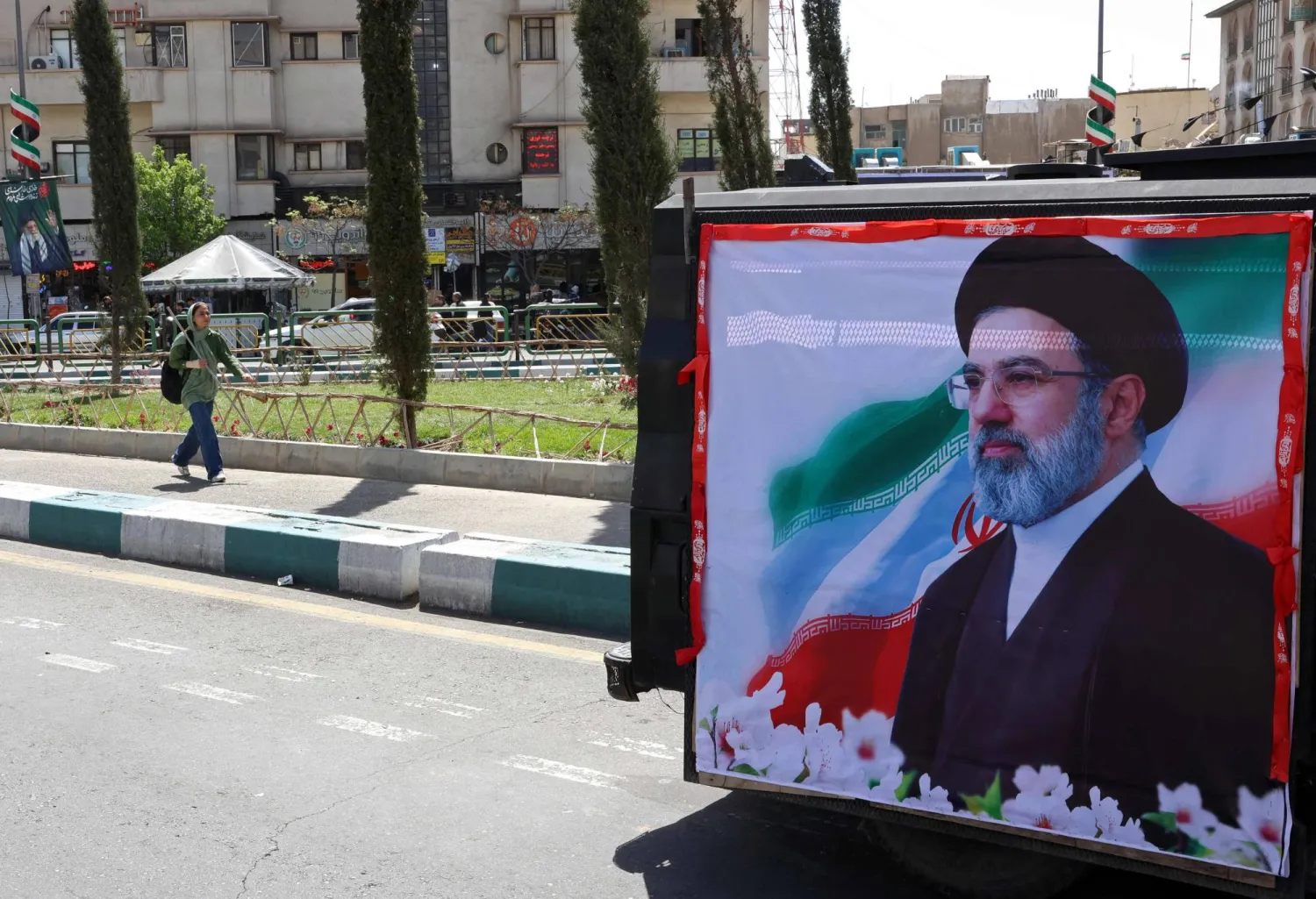
A woman walks past a banner depicting Iran's new supreme leader Mojtaba Khamenei, along a street in Tehran on April 5, 2026.  (Photo by AFP)
A woman walks past a banner depicting Iran's new supreme leader Mojtaba Khamenei, along a street in Tehran on April 5, 2026. (Photo by AFP)
TT

‘Unconscious’, ‘Incapacitated’, ...Report Reveals Mojtaba Khamenei’s Status and Whereabouts

A woman walks past a banner depicting Iran's new supreme leader Mojtaba Khamenei, along a street in Tehran on April 5, 2026.  (Photo by AFP)
A woman walks past a banner depicting Iran's new supreme leader Mojtaba Khamenei, along a street in Tehran on April 5, 2026. (Photo by AFP)

Amid growing ambiguity regarding the health condition of Iranian Supreme Leader Mojtaba Khamenei, questions are mounting over his ability to effectively manage the country's affairs.

Since reportedly sustaining injuries during US-Israeli strikes in late February, he has limited his communications to written statements, with no direct public appearances.

This comes as purported video footage circulating online appears to show him inside a military control room, fueling speculation about the reality of his condition and his actual role in leading Iran during this critical period.

The Times of London has published new details about the health condition of Mojtaba Khamenei, who was reportedly injured in the same US-Israeli airstrike that killed his father.

The newspaper, citing information drawn from a diplomatic memo, reported that Mojtaba Khamenei is incapacitated and receiving medical treatment in the holy city of Qom. He "is being treated in Qom in a severe condition, unable to be involved in any decision making by the regime".

This marks the first time his location has been disclosed. The central city of Qom lies about 87 miles (approximately 140 kilometers) south of Tehran and serves as the hub of Iran’s Shiite religious establishment and a stronghold for its clerical leadership.

The newspaper reported that US and Israeli intelligence agencies had been aware of his location for some time, though this information had remained undisclosed until now.

It also noted that efforts were made to obtain official comment on the contents of the memo, including outreach to the US National Security Agency, as well as Iran’s mission in Washington, which operates out of the Pakistani embassy.

Arrangements for the Burial of Ali Khamenei

According to the memo, preparations are underway for the burial of the late Supreme Leader, Ali Khamenei, in the city of Qom.

The Times also reported that intelligence agencies have monitored efforts to “laying the groundworks needed to build a large mausoleum in Qom” capable of accommodating “more than one grave,” suggesting the possibility that additional family members—potentially including Mojtaba himself—could be buried alongside the late leader.

Iran has confirmed that Khamenei’s son was injured in the same airstrike that killed his father, as well as his mother, his wife Zahra Haddad-Adel, and one of his sons, on the first day of a war that has engulfed the Middle East for more than five weeks.

Since then, only two statements attributed to him have been broadcast on Iranian state television. On Monday, the channel also aired a video produced using artificial intelligence, showing the leader entering a war room and analyzing a map of Israel’s Dimona nuclear facility.

The absence of any audio recording has further reinforced unconfirmed reports that he remains in critical condition.

Who is in Control in Iran?

Despite continued insistence from Iranian officials that Mojtaba Khamenei remains in charge, a stream of leaks and conflicting reports have painted a very different picture. Opposition groups have claimed he has fallen into a coma, while other accounts suggest he sustained severe injuries, including a broken leg and facial trauma.

According to The Times, these divergent narratives have intensified questions about the true state of power within Tehran’s leadership structure—particularly in a system where the Supreme Leader is regarded as the ultimate political and religious authority.

Speculation therefore is mounting that Iran’s Revolutionary Guard Corps (IRGC) may be the party effectively holding the reins of power, while Khamenei appears increasingly as a silent figurehead rather than an active decision-maker, the newspaper reported.



EU Moves to Sanction Iran over Hormuz Blockade

Traffic through Hormuz, a vital global shipping conduit, has come under Iranian control since the outbreak of war with Israel and the United States on February 28. (Photo by AFP) /
TT

EU Moves to Sanction Iran over Hormuz Blockade

Traffic through Hormuz, a vital global shipping conduit, has come under Iranian control since the outbreak of war with Israel and the United States on February 28. (Photo by AFP) /

European Union nations moved Friday towards imposing sanctions on Iranian officials and others responsible for blocking the Strait of Hormuz, the EU said.

Tehran effectively closed the key shipping lane for global gas and oil in retaliation to US-Israeli strikes launched in February.

Deeming the blockade "contrary to international law", EU governments took a technical step to extend the scope of its existing Iran sanctions regime allowing for more individuals to be targeted under it.

"The EU will now be able to introduce further restrictive measures in response to Iran's actions undermining the freedom of navigation in the Strait of Hormuz," the European Council representing EU nations said.

Brussels' punitive measures on Iran previously targeted the country's military support for Russia in its war against Ukraine and for armed groups across the Middle East.

The European Union has also imposed sanctions over human rights violations in the country.

The EU did not immediately name any individual or entities that would be targeted by the new sanctions, consisting of travel bans and asset freezes.

EU citizens and companies will also be banned from making funds, financial assets or other economic resources available to those listed.

The Iran war and the closure of Hormuz, which normally carries a fifth of global oil production, have sent ripples across the global economy, sending energy prices soaring.


Rubio Cites Some Progress on Iran Talks but "We're Not There Yet"

United States Secretary of State Marco Rubio during a signing ceremony on the sidelines of a meeting of NATO foreign ministers in Helsingborg, Sweden, Friday, May 22, 2026. Julia Demaree Nikhinson/Pool via REUTERS
TT

Rubio Cites Some Progress on Iran Talks but "We're Not There Yet"

United States Secretary of State Marco Rubio during a signing ceremony on the sidelines of a meeting of NATO foreign ministers in Helsingborg, Sweden, Friday, May 22, 2026. Julia Demaree Nikhinson/Pool via REUTERS

The United States has seen some progress in talks with Iran and is in constant communication with the Pakistani mediators, but there is more work to be done, Secretary of State Marco Rubio said on Friday.

"There's been some progress. I wouldn't exaggerate it. I wouldn't diminish it," Rubio told reporters after a NATO ministers meeting in Sweden.

"There's more work to be done," he added. "We're not there yet. I hope we get there."

President Donald Trump would prefer to do a good deal, Rubio said. The core concern remains that Iran cannot have a nuclear weapon and the issue of future uranium enrichment needs to be discussed as well as reopening the Strait of Hormuz, he said.

"We're dealing with a very difficult group of people, and if it doesn't change, then the president's been clear he has other options," Rubio said.

"He prefers the negotiated option and having a good deal, but he himself has expressed concern that maybe that's not possible. But we're going to keep trying."

Rubio said the United States was in constant communication with the Pakistanis who are facilitating the talks with Iran.

There was no specific ask from the US on Friday for help from NATO on the Strait of Hormuz but there needs to be a Plan B if Iran refuses to reopen the supply route, Rubio said after the close of the NATO meeting.


Netherlands to Ban Imports from Israel's Jewish Settlements

The Neve Yaakov settlement north of East Jerusalem, with the Israeli wall visible separating the Palestinian neighborhood of al-Ram in the West Bank (AFP). 
TT

Netherlands to Ban Imports from Israel's Jewish Settlements

The Neve Yaakov settlement north of East Jerusalem, with the Israeli wall visible separating the Palestinian neighborhood of al-Ram in the West Bank (AFP). 

The Dutch government has agreed to impose a ban on imports of goods produced in Jewish settlements in Israeli-occupied Palestinian territories, Dutch Prime Minister Rob Jetten said on Friday.

The ban is meant to prevent "any contribution through economic activities by the Netherlands to the unlawful occupation", Jetten said.

The previous Dutch government last year said it was planning the ban, which is now expected to take effect in the second half of the year.

The Netherlands is a leading global buyer of Israeli goods, but the government has never disclosed what volume of goods are currently imported from Jewish settlements.

Most world powers deem Israel's settlements, on land it captured in a 1967 war, illegal. Numerous UN Security Council resolutions have called on Israel to halt all settlement activity.

Israel disputes this, saying it has historical and biblical ties to the land.