


Israel Military Says ‘Battle’ in Lebanon Continues, Ceasefire Does Not Apply

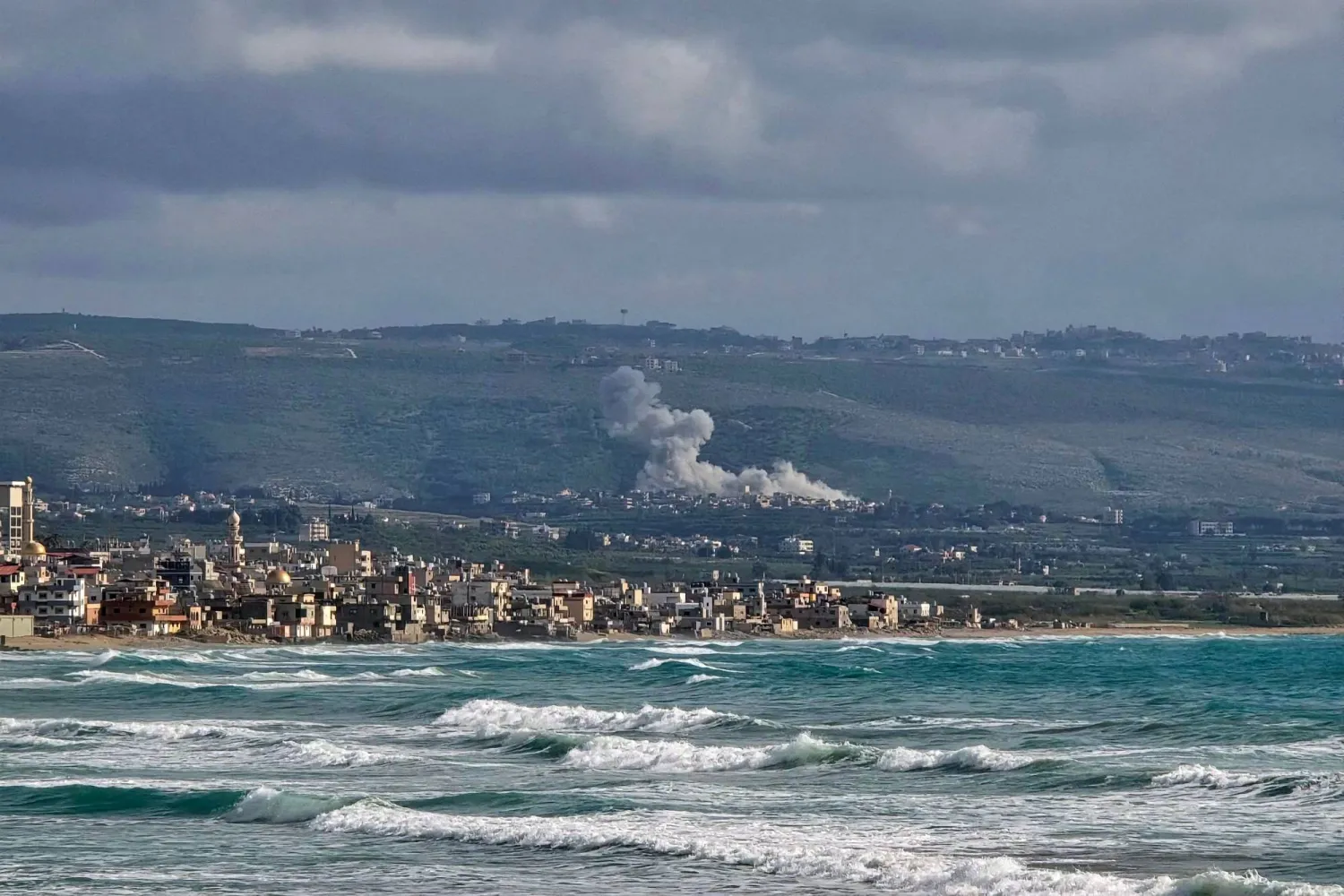
This photograph taken from the southern Lebanese area of Tyre shows smoke rising from the site of an Israeli strike in Hanniyeh village of Lebanon, on April 5, 2026. (AFP)
TT

Israel Military Says ‘Battle’ in Lebanon Continues, Ceasefire Does Not Apply

This photograph taken from the southern Lebanese area of Tyre shows smoke rising from the site of an Israeli strike in Hanniyeh village of Lebanon, on April 5, 2026. (AFP)

Israel's military said Wednesday its forces would continue their campaign against Hezbollah fighters, claiming the ceasefire with Iran does not apply to Lebanon. 

"The battle in Lebanon continues, and the ceasefire does not include Lebanon," the military's Arabic-language spokesman, Colonel Avichay Adraee, said on X, warning residents to evacuate areas south of the Zahrani River. 

Israeli Prime Minister Benjamin Netanyahu earlier said the Iran war truce does not include Lebanon. 

The strikes came despite Iran-backed armed group Hezbollah, which drew Lebanon into the Middle East war by attacking Israel on March 2, not claiming any operations since 1am (Tuesday 2200 GMT). 

Israel renewed an evacuation order for an area more than 40 kilometers inside Lebanon. It followed another warning to evacuate a building in the southern Tyre region, which Israel then struck, according to Lebanon's state-run National News Agency. 

NNA reported several strikes across the south. 

Pakistani Prime Minister Shehbaz Sharif, who has acted as a mediator in the conflict, said the two-week ceasefire between Iran and the United States applied "everywhere including Lebanon", but Netanyahu later said the country was excluded. 

Lebanese President Joseph Aoun welcomed the ceasefire, saying he hoped his country would be included in the regional truce. 

Aoun said Beirut "continued efforts to ensure that the regional peace includes Lebanon in a stable and lasting manner", according to a statement from the presidency. 

A Lebanese official told AFP that authorities "have not been informed" of Lebanon being included. 

Hezbollah told people displaced by the war to refrain from returning to their homes before a ceasefire is announced in Lebanon, while claiming to be nearing a "historic victory". 

"Today, we stand on the threshold of a great and historic victory," the Iran-backed group said in a statement, calling on people to "not head to the targeted villages, towns, and areas in the south, the Bekaa, and the southern suburbs of Beirut before the official and final ceasefire declaration in Lebanon is issued". 

Hezbollah did not share an official stance on the truce. 

French President Emmanuel Macron, welcoming the ceasefire, said "our wish is to ensure that the ceasefire fully includes Lebanon". 

Spain's foreign minister said it was "unacceptable" that Israel continued its invasion of Lebanon after the ceasefire. 

"All fronts must cease, and all fronts also means Lebanon. It is unacceptable that Israel's war, Israel's invasion of a sovereign country like Lebanon... continues," Jose Manuel Albares told public radio RNE. 

Prime Minister Pedro Sanchez welcomed the US-Iran ceasefire as "good news" on X but said Spain would not "applaud those who set fire to the world because they show up with a bucket". 

Israel's attacks in recent weeks have killed more than 1,500 people and displaced over a million, according to Lebanese authorities, especially in the country's south, east and Beirut's southern suburbs, areas where Hezbollah holds sway. 

On Wednesday an AFP correspondent in southern Lebanon saw small numbers of people heading south, some in cars and others carrying their children on motorcycles. 

But Lebanon's military warned displaced people against returning south "since they may be exposing themselves to the ongoing Israeli attacks". 

Another correspondent in Beirut's southern suburbs, which have been heavily struck by Israel, said the area remained deserted. 

Shortly before the ceasefire announcement, an Israeli strike on the southern city of Sidon killed eight people. 


UN Expert Condemns ‘Torture’ of Palestinian Prisoners in Israel

 Israeli soldiers stand guard during a weekly settlers' tour in Hebron, in the Israeli-occupied West Bank, May 16, 2026. (Reuters)
Israeli soldiers stand guard during a weekly settlers' tour in Hebron, in the Israeli-occupied West Bank, May 16, 2026. (Reuters)
TT

UN Expert Condemns ‘Torture’ of Palestinian Prisoners in Israel

 Israeli soldiers stand guard during a weekly settlers' tour in Hebron, in the Israeli-occupied West Bank, May 16, 2026. (Reuters)
Israeli soldiers stand guard during a weekly settlers' tour in Hebron, in the Israeli-occupied West Bank, May 16, 2026. (Reuters)

A United Nations expert on Tuesday raised alarm over the alleged "torture" of Palestinian prisoners and "potentially unlawful deaths" in Israeli prisons since October 2023.

The comments come as Israel faces growing scrutiny over detention conditions following the October 7, 2023 attack by Hamas inside Israel that sparked the Gaza war.

"Emergency measures introduced after 7 October 2023 exposed Palestinian detainees to torture, potentially unlawful deaths, incommunicado detention, and degrading conditions," said Alice Jill Edwards, the UN special rapporteur on torture.

Quoted in a UN statement seen by AFP, she argued the "number and cruelty of allegations" point to a "gross disregard by Israel of its duty to treat all detainees humanely".

Edwards said she had gathered information on 52 cases involving various forms of torture or ill-treatment, as well as 33 cases of sexual torture and other forms of sexual abuse.

Reported abuses include "severe beatings, stress positions, excessive restraints, electrocution, sleep deprivation, malnutrition and starvation" among many others.

She also expressed concern over reports of at least 94 deaths in custody since October 2023 that had not been investigated.

Autopsies in several cases revealed multiple rib fractures, skin hemorrhages and injuries to internal organs, including abdominal tears, she said.

"Behind every allegation is a human being who was wholly dependent on those exercising power over them," Edwards said, calling for "full, independent and transparent" investigations and accountability.

In a communication to Israeli authorities, she noted that none of the 1,680 complainants filed against Israeli intelligence services had led to indictments.

She urged Israel to review and revise its detention laws, policies and practices.

More than 9,000 Palestinians are currently held in Israeli jails, including 2,200 serving sentences.


Board of Peace Will Ask the UN Security Council to Press Hamas to Disarm

A Palestinian boy stands next to plastic containers on a trolley, as he and others collect portable drinking water for their displaced family living in shelters after homes were destroyed in Israeli bombardment, in the Bureij refugee camp, in the central Gaza Strip on May 18, 2026. (AFP)
TT

Board of Peace Will Ask the UN Security Council to Press Hamas to Disarm

A Palestinian boy stands next to plastic containers on a trolley, as he and others collect portable drinking water for their displaced family living in shelters after homes were destroyed in Israeli bombardment, in the Bureij refugee camp, in the central Gaza Strip on May 18, 2026. (AFP)

The body overseeing the US-brokered ceasefire in Gaza will ask the United Nations Security Council to press the Hamas group to disarm, according to a report seen by The Associated Press on Tuesday.

The report by the Board of Peace, an international body set up by US President Donald Trump and tasked with overseeing the fragile ceasefire between Hamas and Israel, is expected to be discussed by the Security Council on Thursday when it meets on the situation in the Middle East.

“At this stage, the principal obstacle to full implementation (of the ceasefire) remains Hamas’ refusal to accept verified decommissioning, relinquish coercive control, and permit a genuine civilian transition in Gaza,” the report said.

Hamas in a statement rejected the report and said it contains “fallacies.”

A diplomat familiar with the report confirmed its authenticity, speaking on condition of anonymity because it has not been made public.

Trump’s 20-point ceasefire plan calls on Hamas to surrender its weapons and destroy its vast network of tunnels. It also envisions Israeli forces withdrawing from Gaza, the arrival of a new technocratic Palestinian government, deployment of an international security force and the rebuilding of the battered Palestinian enclave after more than two years of war.

Board of Peace head has said the ceasefire has stalled

Last week, the head of the Board of Peace, former UN Mideast envoy Nickolay Mladenov, acknowledged that the truce had stalled since taking effect in October, saying the deadlock over disarming Hamas had paralyzed progress.

“Reconstruction cannot commence where weapons have not been laid down,” the board’s report to the Security Council says. “The critical variable — the single factor that unlocks every other element of the plan — is the conclusion of an agreement on the Roadmap for the full implementation of the plan that includes full decommissioning by Hamas and all armed groups in Gaza.”

The Palestinian group, which led the Oct. 7, 2023, attack on Israel that sparked the war in Gaza, has accused Israel of failing to meet its obligations under the first phase of the ceasefire and has sought to link any demilitarization to Israeli troop pullbacks. Israel’s military has expanded its control of Gaza since the truce took effect and now controls some 60% of the territory.

The new report calls on the Security Council to “reiterate publicly, clearly and consistently that the decommissioning of weapons in Gaza is not merely a requirement (of the UN’s resolution to end the war) but critical for reconstruction to begin, for a timebound Israeli forces withdrawal, and for a credible pathway to Palestinian self-determination and statehood to be pursued.”

The Security Council endorsed the Board of Peace in a resolution in November.

Hamas says the report tries to derail the ceasefire

Hamas said the report “contains a number of fallacies that absolve the occupying government of its responsibilities for the daily violations of the ceasefire agreement in Gaza.”

The group said the report ignored Israel’s “failure to uphold the majority of its commitments” in the ceasefire deal, including the continued restrictions on crossings into the Palestinian territory and preventing the entry of material and equipment needed to repair basic infrastructure and shelter for the largely displaced population.

“The report’s adoption of the occupation’s conditions regarding disarmament is a dubious attempt to muddy the waters and derail the ceasefire agreement,” Hamas said in a statement.

It called on the Security Council and Mladenov to compel Israel to fulfill its commitments under the ceasefire' deal's first phase, "foremost among them the cessation of the daily aggression against our Palestinian people in Gaza.”

The ceasefire has seen numerous violations The report noted near-daily ceasefire violations, “some of which are serious, and their human consequences — civilians killed, families living in fear, and continued impediments to humanitarian access — cannot be minimized.”

Israel’s military still carries out airstrikes in Gaza despite the ceasefire and has pushed deeper into the territory, where it now controls more than it was granted under the ceasefire agreement. Living conditions are dire, with most of the territory’s 2 million people living in tent camps lacking basic services.

Mladenov last week said his office is addressing violations by both sides on a daily basis. But he repeatedly cited the disarmament issue as a central sticking point, saying Hamas’ obligation to give up its arsenal is “not negotiable" and that progress on all other issues was being held up.


Israel Military Issues Fresh Evacuation Warnings for South Lebanon

Smoke rises from the site of an Israeli airstrike that targeted the southern Lebanese village of Burj el-Shmali on on May 19, 2026. (AFP)
TT

Israel Military Issues Fresh Evacuation Warnings for South Lebanon

Smoke rises from the site of an Israeli airstrike that targeted the southern Lebanese village of Burj el-Shmali on on May 19, 2026. (AFP)

The Israeli military on Tuesday warned residents of 12 towns and villages in southern Lebanon to immediately evacuate ahead of expected attacks against Hezbollah, the latest despite a ceasefire.

"Hezbollah's continued violations of the ceasefire compel the army to operate against it. The army does not intend to harm you. For your safety, we urge you to distance yourself from the area and immediately move at least 1,000 meters away," the military's Arabic-language spokesman Avichay Adraee posted on X.

Lebanon's state-run National News Agency reported a new series of Israeli strikes targeting several locations in southern Lebanon on Tuesday.

Meanwhile, Hezbollah said in a statement that it had targeted a gathering of soldiers and vehicles in northern Israel with "a swarm of attack drones."

The Iran-backed group also claimed responsibility for new attacks against Israeli forces operating inside Lebanese territory.

The Israeli military said that following sirens in several areas of northern Israel, a drone "that crossed from Lebanon to Israeli territory was intercepted".

Since the start of the ceasefire on April 17, Israel has continued to launch strikes, carry out demolitions and issue evacuation orders in south Lebanon, saying it is targeting the group.

Hezbollah has also continued operations against Israeli forces in southern Lebanon and northern Israel.

On Monday, the Lebanese health ministry said the death toll from Israeli strikes since the start of the war on March 2 had reached 3,020.

The Israeli military says it has lost 20 soldiers and one civilian contractor in southern Lebanon since the war began.
