Lebanon PM Calls on Country's Friends to Help End Israeli Attacks

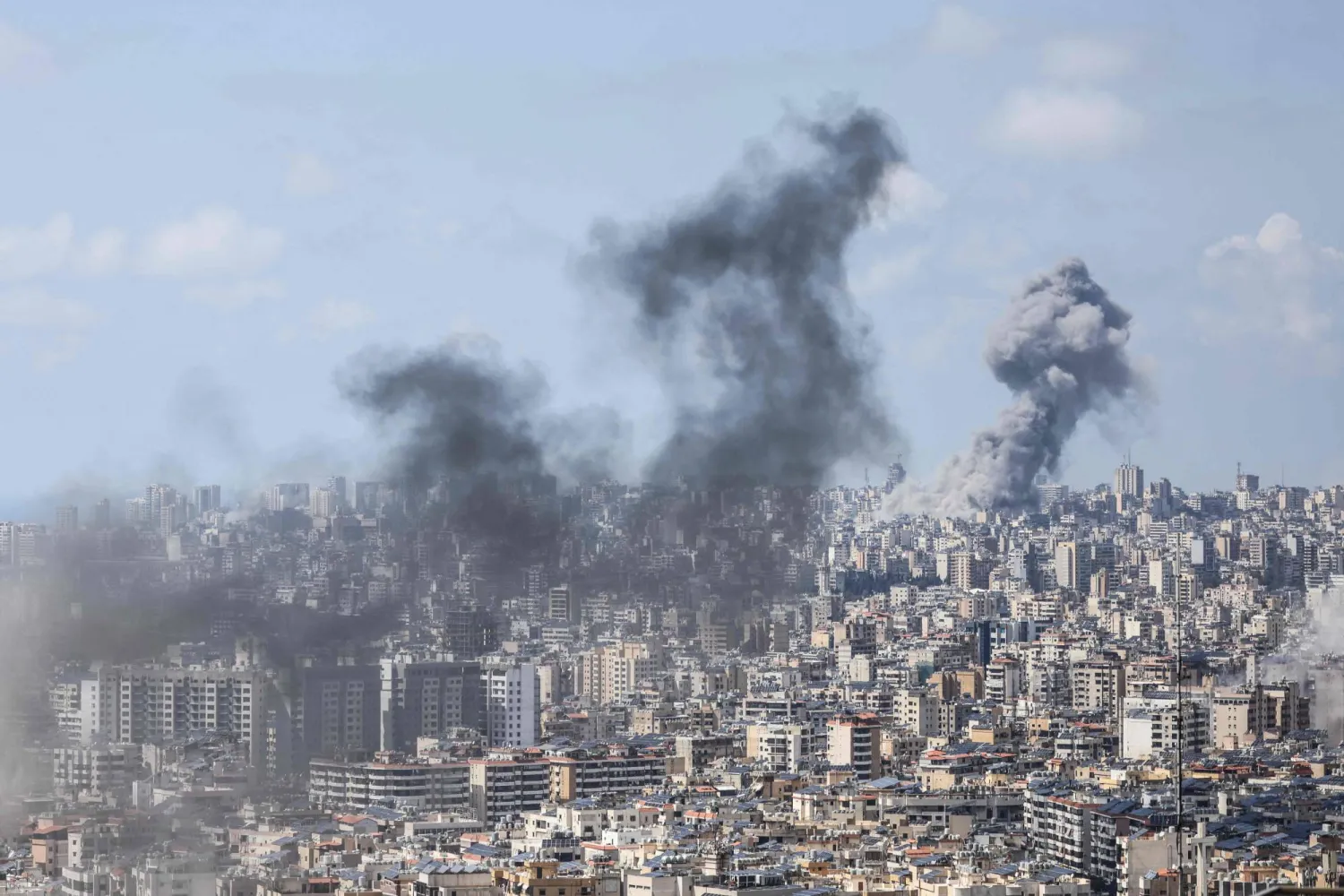
Smoke rises from the site of Israeli airstrikes in Beirut and its southern suburbs on April 8, 2026. Israel launched a series of strikes on Beirut on April 8, hitting several parts of the capital as well as its southern suburbs, Lebanese state media reported. (Photo by anwar amro / AFP)
TT

Lebanon PM Calls on Country's Friends to Help End Israeli Attacks

Smoke rises from the site of Israeli airstrikes in Beirut and its southern suburbs on April 8, 2026. Israel launched a series of strikes on Beirut on April 8, hitting several parts of the capital as well as its southern suburbs, Lebanese state media reported. (Photo by anwar amro / AFP)

Lebanese Prime Minister Nawaf Salam on Wednesday called on his country's friends to help put an end to Israeli attacks following a series of deadly strikes across the country.

In a statement, Salam said that while Beirut "welcomed the agreement between Iran and the United States and intensified our efforts to reach a ceasefire agreement in Lebanon, Israel continues to escalate its attacks".

"All of Lebanon's friends are called upon to help us stop these attacks by all available means," he added, after Israeli strikes that Lebanon's health ministry said killed dozens of people and wounded hundreds more.


Zamir Says Army Completed Iran, Lebanon Missions, Eyes Gaza

Two Israeli soldiers walk through rubble in southern Lebanon (AP)
TT

Zamir Says Army Completed Iran, Lebanon Missions, Eyes Gaza

Two Israeli soldiers walk through rubble in southern Lebanon (AP)

As Israel faces intensifying domestic criticism over the war, with opponents saying the government has failed to achieve its goals in Lebanon, Iran, and Gaza, scrutiny has also turned to the military, accused of not telling the truth.

In that context, Chief of Staff Eyal Zamir said in closed-door meetings on Wednesday in southern Lebanon, remarks later leaked by the army, that “everything defined for us by the political echelon regarding the current campaign in Iran and Lebanon has been achieved and even beyond that.”

“In doing so, we have created the operational conditions for the processes now being led by the political echelon,” said Zamir.

But a newly launched drone by Hezbollah targeting Israeli artillery in the town of Shomera, wounding 12 soldiers, including two seriously, shifted Zamir’s calculations.

Shomera, a Jewish town built on the ruins of Tarbikha, captured at the end of 1948, is considered Lebanese by Beirut, which granted citizenship to its displaced residents.

Israel destroyed most of its homes and two mosques and turned it into a Jewish locality. In the current war, it has been evacuated, with Israeli forces establishing positions there.

Retaliatory strikes

Following Hezbollah’s attack, the Israeli Air Force launched retaliatory strikes, calling it a serious attack that cannot be ignored.

It hit several sites and ordered residents of 16 villages in southern Lebanon to evacuate ahead of their destruction, including Bchit, Habboush, Harouf, Kfar Jouz, Nabatieh al-Fawqa, Aba, Aadchit, Shaqif, Arab Salim, Toul, Houmine al-Fawqa, Majadel, Arzoun, Dounine, Hmeiri, and Maaroub.

This came as sources close to the government said it is seeking to impose a two- to three-week deadline for negotiations with Lebanon, ending by mid-May, warning it could revert to what it described as the “original plan” for the war if no progress is made.

According to Channel 12, the approach was raised in a Wednesday evening call between Prime Minister Benjamin Netanyahu and US President Donald Trump, following what was described as an urgent Israeli request to set a time frame for US-mediated direct talks between Tel Aviv and Beirut.

The sources said the current “limited response” policy is eroding deterrence and harming civilians and operational readiness.

Gaza not over

The Channel 12 report said the Israeli army is operating under political directives to restrain operations in Lebanon, avoiding deep strikes, with any action north of the Litani River requiring special approval.

It said the current posture, limiting the army to response rather than initiative, benefits Hezbollah and gives it room to regroup, exposing Israeli forces to added risks.

Amid the criticism, Zamir toured areas held by Israeli forces in Lebanon on Wednesday, saying the army is carrying out political directives and awaiting further decisions.

“In Lebanon, the mission assigned to us by the political echelon is to position ourselves along the line to prevent direct fire on the communities. We have achieved this; this is the line we are on. We may be required to remain on it,” said Zamir.

The report questioned the cost Israel is paying at this stage, citing what it described as consideration for US interests in the confrontation with Iran.

Zamir also said the next battle could be in Gaza, stressing the war there is not over. If Hamas obstructs disarmament efforts, he said, the army would resume the war with full force.


France to Host International Meet on Palestinian-Israeli Conflict in June

15 April 2026, Berlin: French Foreign Minister Jean-Noel Barrot, gives a statement at the International Sudan Conference at the Federal Foreign Office in Berlin. (dpa)
TT

France to Host International Meet on Palestinian-Israeli Conflict in June

15 April 2026, Berlin: French Foreign Minister Jean-Noel Barrot, gives a statement at the International Sudan Conference at the Federal Foreign Office in Berlin. (dpa)

France will host an international meeting in June dedicated to the long-touted two-state solution to the Palestinian-Israeli conflict, the French foreign minister announced on Thursday.

"On September 22 last year, France took the momentous decision to recognize the State of Palestine and will host an international conference in Paris on June 12 so that Israeli and Palestinian civil societies can make their voices heard," Jean-Noel Barrot said in a video message played to a gathering of peace activists in the Israeli city of Tel Aviv.

The "People's Peace Summit" in Tel Aviv was organized by the "It's Time" coalition, a grouping of more than 80 peacebuilding organizations working to end the Palestinian-Israeli conflict through a political agreement guaranteeing both peoples' right to self-determination and secure lives.

Several hundred people attended the meeting in Tel Aviv, AFP journalists reported.

"While the Middle East remains deeply scarred by the terrorist attacks of October 7 (2023) in Israel, by more than two and a half years of devastating war in Gaza and by a humanitarian crisis that, sadly, shows no sign of abating, your presence here is an act of resistance against fatalism and resignation," Barrot said.

Palestinian movement Hamas's October 7, 2023 attack on Israel sparked the war in Gaza, where a ceasefire in effect since October has largely halted fighting.

Barrot's remarks come as the government of Prime Minister Benjamin Netanyahu, one of the most right-wing in Israel's history, vehemently opposes the emergence of a sovereign and fully independent Palestinian state in the occupied West Bank and Gaza, and is working on the ground to undermine the possibility of a two-state solution.

Meanwhile, the Palestinian Authority led by President Mahmoud Abbas appears extremely weakened and deeply unpopular.


‘Positive’ Mood in Cairo Talks on New Proposal by Mediators

 A Palestinian man carries jerrycans filled with water through a tent camp in Khan Younis, in the southern Gaza Strip, Thursday, April 30, 2026. (AP)
A Palestinian man carries jerrycans filled with water through a tent camp in Khan Younis, in the southern Gaza Strip, Thursday, April 30, 2026. (AP)
TT

‘Positive’ Mood in Cairo Talks on New Proposal by Mediators

 A Palestinian man carries jerrycans filled with water through a tent camp in Khan Younis, in the southern Gaza Strip, Thursday, April 30, 2026. (AP)
A Palestinian man carries jerrycans filled with water through a tent camp in Khan Younis, in the southern Gaza Strip, Thursday, April 30, 2026. (AP)

Hamas described as “positive” an initial meeting held by its delegation on Wednesday evening with mediators in Egypt to discuss a new Gaza ceasefire proposal.

Asharq Al-Awsat reviewed a message sent by Hamas to Palestinian factions describing the talks as “a preliminary, frank, clear and brief meeting, held in a positive atmosphere.”

The message said Hamas told the UN’s senior representative for Gaza on the Board of Peace, Nickolay Mladenov, and his team that “there must be clear implementation of the first phase before moving to the second,” noting this stance had already been adopted by the movement and other Palestinian factions.

It added that mediators are awaiting Israel’s response to determine next steps.

A senior Hamas source confirmed the message, saying the atmosphere in Wednesday’s meetings with mediators was positive. Another meeting was held later the same evening with Mladenov and other figures, the source said.

Mladenov, who arrived in Cairo from Israel on Tuesday, carried Israel’s position on the recently updated proposal covering the first and second phases, the source added. Further meetings are expected on Thursday.

The source said Israel is still trying to obstruct the agreement by pushing conditions linking progress to disarmament, including seeking signed approval from Hamas and other factions, a demand all factions in the Cairo talks reject.

Mediators, including Mladenov, are attempting to find workable approaches, the source said, with talks set to continue through Friday.

Leftist factions raise concerns

Despite Hamas describing the talks as positive and calling for a clear implementation timeline and firm guarantees, some factions, particularly leftist groups within the Palestine Liberation Organization, raised concerns over the latest mediators’ proposal.

A senior source from leftist factions said their observations focused on the absence of a binding timeline for Israeli withdrawal and the lack of a clear monitoring mechanism.

The source also cited the need for a defined schedule for the second phase and warned of a reduced Palestinian national role in favor of an international administration.

Other concerns included ambiguity in implementing the first phase, linking reconstruction to disarmament, and the exclusion of areas beyond the “Yellow Line” from reconstruction plans.

The factions proposed affirming the right to self-determination and a Palestinian state in line with international legitimacy, and that Gaza’s administrative committee begin work from the first phase.

They also suggested weapons be neutralized through a national agreement within security arrangements overseen by guarantor states, particularly Egypt, and held in custody there.

They further proposed that weapons neutralization coincide with a full Israeli withdrawal, the disarmament of armed groups linked to Israel, and the deployment of international forces starting from the “Yellow Line,” to be completed after withdrawal.

They called for international guarantees for both withdrawal and reconstruction, ensuring reconstruction begins in all areas vacated by Israeli forces, including those beyond the “Yellow Line,” alongside the launch of an early recovery plan at the start of the remaining first phase.

The proposal stressed the need to ensure freedom of political and civil activity under national laws. It said any arrangements in Gaza must not contradict Palestinian Authority laws and called for strengthening national consensus.

It also called for addressing armed groups through a separate track, with the possibility of integrating them into official institutions.

The proposal urged a comprehensive solution to the detainees’ issue, particularly those from Gaza, and said any arrangements for weapons neutralization should be linked to resolving this issue.

The Hamas source said the factions’ observations were conveyed to the mediators and Mladenov.