


Vance Warns Iran Not to ‘Play’ the US as He Departs for Negotiations Aimed at Ending Their War

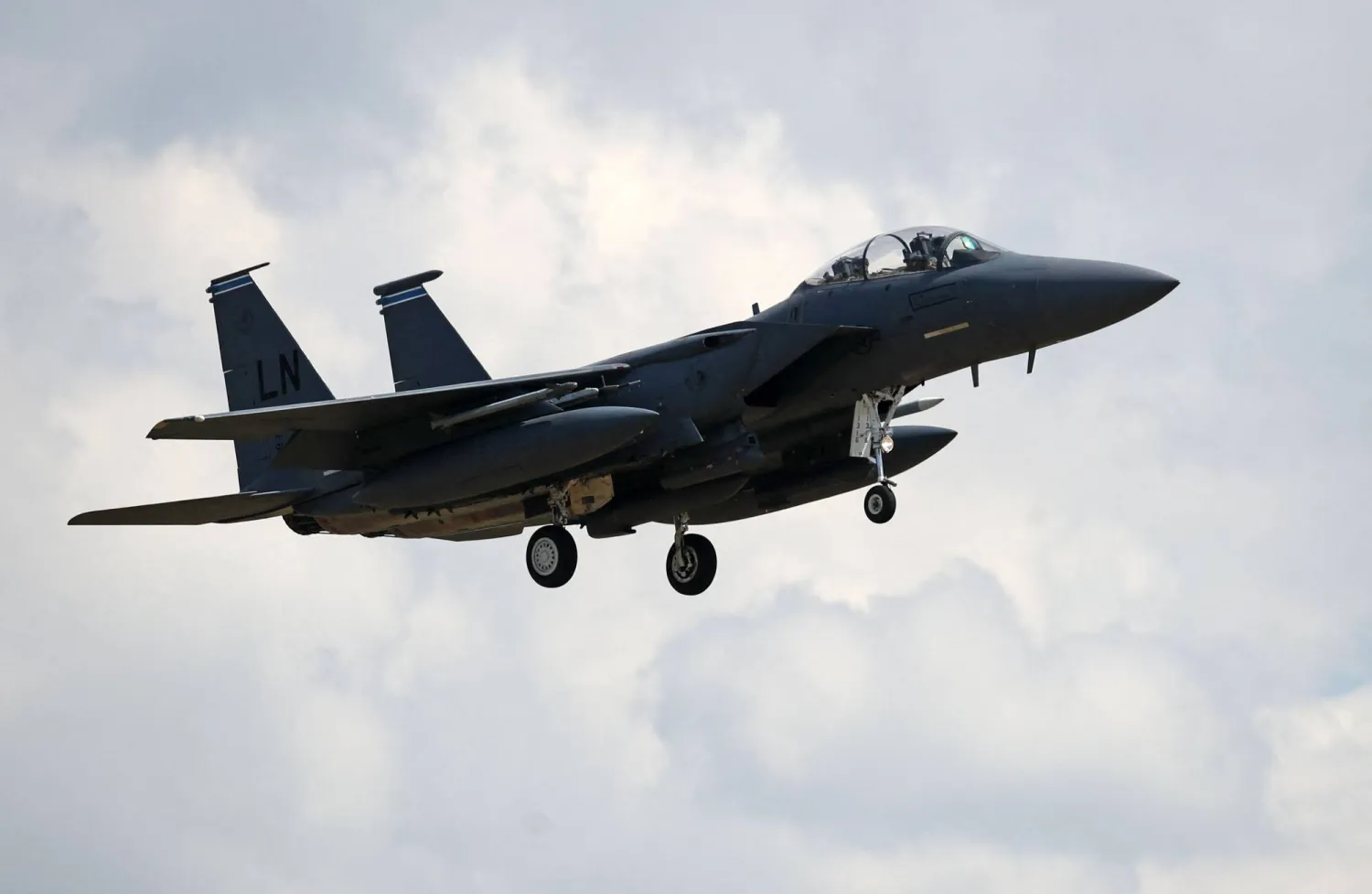
(FILES) A US Air Force (USAF) F-15E Eagle fighter jet, is pictured as it prepares to land at RAF (Royal Air Force) Lakenheath, east of England, on June 15, 2020. (Photo by CHRIS RADBURN / AFP)
TT

Vance Warns Iran Not to ‘Play’ the US as He Departs for Negotiations Aimed at Ending Their War

(FILES) A US Air Force (USAF) F-15E Eagle fighter jet, is pictured as it prepares to land at RAF (Royal Air Force) Lakenheath, east of England, on June 15, 2020. (Photo by CHRIS RADBURN / AFP)

Vice President JD Vance on Friday warned Iran not to “play” the US as he headed overseas for negotiations aimed at ending their war. 

President Donald Trump has tasked the member of his inner circle who has seemed to be the most reluctant defender of the six-week-old conflict with Iran to now find a resolution and stave off the US president's astonishing threat to wipe out its “whole civilization.” 

Vance, who has long been skeptical of foreign military interventions and outspoken about the prospect of sending troops into open-ended conflicts, set off Friday to lead mediated talks with Iran in the Pakistani capital of Islamabad. Boarding Air Force Two on his way to Pakistan, the vice president said, “We’re looking forward to the negotiation. I think it’s gonna be positive. We’ll of course see.” 

He cited Trump in saying, “If the Iranians are willing to negotiate in good faith, we’re certainly willing to extend the open hand.” But he added, “If they’re gonna try and play us, then they’re gonna find that the negotiating team is not that receptive.” 

Vance also said that Trump “gave us some pretty clear guidelines” on how talks should go, but he didn’t elaborate. He did not take questions from reporters traveling with him. 

Vance's trip comes as a tenuous, temporary ceasefire appears to be on the precipice of collapsing. The chasm between Iran’s public demands and those from the US and its partner Israel seem irreconcilable. And in the US, where Vance might ask voters in two years’ time to make him the next president, there is growing political and economic pressure to wrap it up. 

Vance is joined by Trump's special envoy Steve Witkoff and Trump's son-in-law Jared Kushner, who took part in three rounds of indirect talks with Iranian negotiators aimed at settling US concerns about Tehran’s nuclear and ballistic weapons programs and its support for armed proxy groups in the Middle East before Trump and Israel launched the Feb. 28 war against Iran. 

The White House has provided scant detail about the format of the talks — whether they will be direct or indirect — and has not provided specific expectations for the meeting. 

But the arrival of Vance for negotiations marks a rare moment of high-level US government engagement with the Iranian government. Since the revolution in 1979, the most direct contact had been when President Barack Obama in September 2013 called newly elected Iranian President Hassan Rouhani to discuss Iran’s nuclear program. 

Steep climb in making headway  

Almost immediately after the White House and Iran announced a temporary ceasefire Tuesday evening, the sides found themselves at odds over terms of the truce. 

Iran insisted that an end to the Israeli war in Lebanon was part of the ceasefire. But Israeli Prime Minister Benjamin Netanyahu and Trump said the truce did not cover Lebanon, and the Israeli operations there continued. 

The US, meanwhile, demanded that Iran make good on reopening the Strait of Hormuz. Tehran had closed the critical shipping waterway in response to Israel’s intensifying attacks against the Hezbollah armed group in Lebanon. 

Trump on Thursday said Iran was “doing a very poor job” of allowing oil tankers to pass through, writing on social media, “That is not the agreement we have!” 

White House spokeswoman Anna Kelly said Vance, Witkoff, Kushner and Secretary of State Marco Rubio “have always been collaborating on these discussions” and said Trump was optimistic that a lasting deal can be reached during the two-week ceasefire.  

“President Trump has a proven track record of achieving good deals on behalf of the United States and the American people, and he will only accept one that puts America first,” Kelly said. 

High stakes for peace — and for politics  

It’s the highest-stakes moment thus far for Vance, who spent much of last year as more of a background player in the Trump White House, especially as others like Elon Musk and Rubio took turns as ever-present advisers for the president. 

But Vance’s portfolio is fattening fast, first with a mission to root out fraud in government programs at home and now to help solve a US war in the Middle East, where complicated doesn’t even begin to describe things. 

Vance, who served in the Iraq War while in the Marines and spent two years as a US senator for Ohio and a little more than one as vice president, has little diplomatic experience. 

On Wednesday, he dismissed speculation that the Iranians requested that he join the talks, telling reporters: “I don’t know that. I would be surprised if that was true. But, you know, I wanted to be involved because I thought I could make a difference.” 

Jonathan Schanzer, a former Treasury Department official who is now executive director of the Foundation for Defense of Democracies, a hawkish Washington think tank, said Vance, with little experience on Iran policy, is an interesting choice to lead the delegation. 

Trump has noted his vice president was “less enthusiastic” than other top senior officials in the Republican administration, making Vance an intriguing interlocutor for the Iranian side, Schanzer said. 

“I think they probably prefer him knowing that his perspective on foreign intervention is one of skepticism,” Schanzer said of the Iranians. “I do think that he’s going to need some help. I don’t think he’s ever been engaged in negotiations with this kind of weight, this kind of seriousness. This is as serious as it gets.” 

The White House has pushed back against the characterization that Iran wanted Vance in the talks, casting it as an effort to hurt negotiations. 

The White House has not detailed who will be in the talks besides Vance, Witkoff and Kushner, but Kelly said officials from the National Security Council, State Department and Pentagon “will also play a supportive role.” 

During early rounds of indirect nuclear talks with the Iranians before the war, Democrats and some nuclear experts questioned whether Kushner and Witkoff had enough technical knowledge. The White House has not said whether the pair, whom Trump has entrusted with some of his most difficult negotiations since returning to office, had a nuclear expert with them for those talks. 

Tall order 

It’s not unusual for vice presidents to take on important negotiating roles for the president, said Joel Goldstein, a professor of law at Saint Louis University who is an expert on the history of the vice presidency. 

But, he said, “I don’t recall a situation where a vice president has been sent to negotiate a ceasefire or peace in connection with a war the United States was involved with.” 

Vance and Rubio are seen as the Republican Party’s strongest potential 2028 presidential contenders, though neither has given a clear answer about whether he intends to run. 

The vice president's team is not thinking about the negotiations with an eye to future political considerations, according to a person familiar with discussions who was not authorized to speak publicly and spoke on the condition of anonymity. 

As vice president, Vance inherently would carry any baggage of the administration if he eventually does run for president, Goldstein said. But stepping in to lead negotiations even further identifies him with the conflict. 

“The fact that he’s involved in the negotiations in a very visible way, that means that, if things go south, that people will be pointing fingers at him,” Goldstein said. 

At the same time, Goldstein said, “If things go well, then it will be something that he could point to.” 



Rubio Says US Will Not Accept Iranian Tolls on Hormuz

 Vessels at the Strait of Hormuz, as seen from Musandam, Oman, June 22, 2026. (Reuters)
Vessels at the Strait of Hormuz, as seen from Musandam, Oman, June 22, 2026. (Reuters)
TT

Rubio Says US Will Not Accept Iranian Tolls on Hormuz

 Vessels at the Strait of Hormuz, as seen from Musandam, Oman, June 22, 2026. (Reuters)
Vessels at the Strait of Hormuz, as seen from Musandam, Oman, June 22, 2026. (Reuters)

Washington's top diplomat insisted Tuesday that the US would not accept any attempt to impose tolls or fees on Strait of Hormuz, the key waterway where the UN said it would begin evacuating thousands of sailors stranded by the Middle East war 

The US and Iran have signed a preliminary deal to halt the war, and concluded a first round of talks in Switzerland as part of a 60-day negotiation period to settle outstanding issues like sanctions relief and the fate of Tehran's nuclear program. 

An Iranian blockade that began early in the conflict choked off maritime traffic through the Hormuz strait -- sending global oil prices surging -- but crossings have begun to rise again since the US-Iran deal was inked. 

Iran has repeatedly maintained it will retain control over the waterway, including on Tuesday, when it and Oman said in a joint statement that they would study the administration of the trade route and the costs to be charged for services provided, insisting on their sovereignty over the strait. 

But US Secretary of State Marco Rubio, kicking off a regional tour, reiterated Washington's position that such an arrangement would be unacceptable. 

"It's an international waterway. No country is allowed to charge tolls or fees on an international waterway," he said from Abu Dhabi, adding that he believed "all the countries in this region would agree". 

Tehran's top negotiator, Mohammad Bagher Ghalibaf, had earlier insisted the Strait of Hormuz "will never return" to the pre-war status quo, despite the foes agreeing to set up communication lines to keep it open. 

- Muscat meeting - 

Oman and Iran agreed on Tuesday to press on with discussions about the future administration of navigation in the Strait of Hormuz. 

In a joint statement issued after talks in Muscat, they said a joint working group involving their foreign ministries ‌would be ‌formed to continue the discussions and ‌that they ⁠would consult other ⁠littoral states and relevant parties.  

The move appears to implement a provision of the memorandum of understanding signed last week that calls for Iran to hold talks with Oman and other states on the future management of ⁠navigation and maritime services in the strait, ‌a vital waterway ‌for global oil supplies.  

The agreement was announced following a ‌visit by Speaker Ghalibaf and Foreign Minister Abbas Araqchi, who met Oman's Sultan Haitham bin Tariq and held talks with Omani Foreign Minister Badr Albusaidi.  

In the statement, Oman and ‌Iran, the two states bordering the strait, reaffirmed their commitment to ensuring ⁠safe ⁠passage through the waterway in accordance with international law while underlining sovereignty over their territorial waters.  

Since the start of the US-Israeli war against Iran in February, the strait has been largely closed to commercial shipping. The United States blockaded Iranian ports after Iran started effectively blocking the strait.  

Oman and Iran reaffirmed their commitment to the strait being a secure and open route for international navigation and to promoting maritime safety, freedom of navigation and regional stability. 

The head of the UN's International Maritime Organization, meanwhile, said it would begin evacuating more than 11,000 sailors stranded by the Hormuz blockade in cooperation with Iran, Oman and the United States, adding it had "secured the necessary safety guarantees". 

Traffic through the strait on Monday reached the highest level since the start of the war, according to two maritime tracking platforms, representing just over 40 percent of the normal peacetime level of about 120 vessels per day. 


Tehran Gets Three-Day Holiday for Ali Khamenei Funeral

An Iranian man walks past a banner depicting slain supreme leader Ali Khamenei at Valiasr Square in Tehran on June 15, 2026. (AFP)
TT

Tehran Gets Three-Day Holiday for Ali Khamenei Funeral

An Iranian man walks past a banner depicting slain supreme leader Ali Khamenei at Valiasr Square in Tehran on June 15, 2026. (AFP)

Iran announced Tuesday three days of public holidays in the capital Tehran for late supreme leader Ali Khamenei's funeral ceremonies, state television reported.

"The farewell ceremony and prayers for the martyred leader's body will be held on Saturday and Sunday, July 4th and 5th, in Tehran's Grand Mosalla, and the funeral will be held on Monday, July 6th, and Tehran province will be off for these three days," Iranian Revolutionary Guards Corps (IRGC) commander Hassan Hassanzadeh, in charge of the ceremonies, was quoted as saying.

Earlier, state media said Tehran would be on holiday on July 4 and 5, while the rest of the country will join it on July 6.

Tehran authorities expect an attendance of around 20 million.

The northern city of Qom will also host a tribute on July 7.

Ali Khamenei will be laid to rest on July 9 in the northeastern city of Mashhad, his birthplace.

These two cities will also observe public holidays.

Neighboring Iraq has scheduled ceremonies for July 8.

The funeral was originally planned for March but was postponed due to the war in the Middle East, which was triggered by the US-Israeli attacks in February that killed Khamenei.

Ali Khamenei's son Mojtaba succeeded his father as supreme leader in early March, becoming the third person to hold the position since the regime was established in 1979.

Mojtaba Khamenei was wounded in the bombing that killed his father and other officials. He has not been seen in public since his appointment and communicates solely through official statements.


China’s Newest Aircraft Carrier Sails Through the Taiwan Strait

In this photo released by Xinhua News Agency, China's third conventionally powered aircraft carrier, the Fujian, conducts a maiden sea trial on May 7, 2024. (Ding Ziyu/Xinhua via AP, File)
TT

China’s Newest Aircraft Carrier Sails Through the Taiwan Strait

In this photo released by Xinhua News Agency, China's third conventionally powered aircraft carrier, the Fujian, conducts a maiden sea trial on May 7, 2024. (Ding Ziyu/Xinhua via AP, File)

China’s newest and most powerful of its three aircraft carriers sailed through the Taiwan Strait on Tuesday, the Taiwanese defense ministry said, a day after Taiwan began a five-day military exercise on responding to a Chinese attack.

The Fujian carrier first sailed through the narrow body of water separating China and Taiwan in a trial run last September. It later transited the strait for the first time as a fully commissioned military vessel in December.

China claims the self-governed island as part of its territory and has not ruled out the use of force to bring it under Beijing's control. China regularly sends navy vessels and war planes towards Taiwan in military exercises that have become more frequent in recent years to where they now occur almost daily.

Taiwan on Monday kicked off its own five-day exercise to support its response in case of a possible Chinese military invasion.

The US Navy sends warships through the strait periodically, as do some of its allies, in a warning to Beijing against any attempt to use force to establish its claim to the island.

The Fujian was commissioned in November 2025. It is world’s largest nonnuclear-powered warship, according to the US Naval Institute, and is considered more advanced than China's other two carriers, the Shandong and the Liaoning.