


Macron Meets Pope Leo to Talk Lebanon, Middle East War

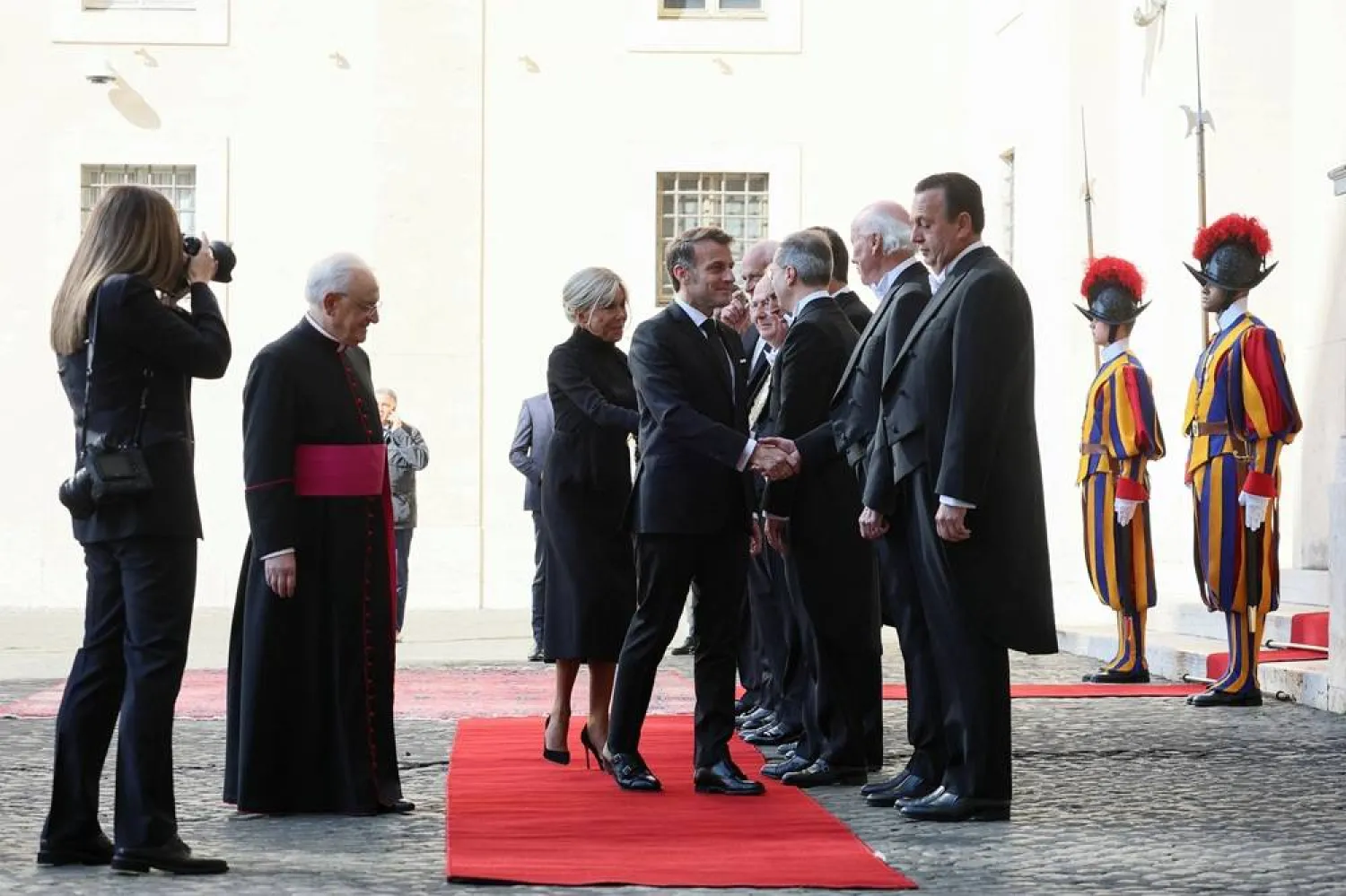
 French President Emmanuel Macron and his wife Brigitte Macron are welcomed as they arrive at the San Damaso courtyard to meet Pope Leo XIV at the Vatican, April 10, 2026. (Reuters)
French President Emmanuel Macron and his wife Brigitte Macron are welcomed as they arrive at the San Damaso courtyard to meet Pope Leo XIV at the Vatican, April 10, 2026. (Reuters)
TT

Macron Meets Pope Leo to Talk Lebanon, Middle East War

 French President Emmanuel Macron and his wife Brigitte Macron are welcomed as they arrive at the San Damaso courtyard to meet Pope Leo XIV at the Vatican, April 10, 2026. (Reuters)
French President Emmanuel Macron and his wife Brigitte Macron are welcomed as they arrive at the San Damaso courtyard to meet Pope Leo XIV at the Vatican, April 10, 2026. (Reuters)

French President Emmanuel Macron arrived Friday at the Vatican for his first meeting with Pope Leo XIV, a private audience expected to be dominated by the Iran war.

The French leader, who arrived with his wife Brigitte after flying to Rome on Thursday, will meet the US pontiff and the Vatican's secretary of state, Pietro Parolin.

Macron and the leader of the world's 1.4 billion Catholics were due above all to discuss "the resolution of the crisis in the Middle East", a spokesman for Macron's office told reporters.

They are particularly focused on Lebanon, where deadly Israeli strikes threatened this week's temporary truce between the US and Iran.

Leo XIV visited Lebanon late last year as part of his first trip abroad, which also included Türkiye, and has repeatedly prayed for the victims of conflict there.

Macron has also made numerous appeals for Lebanon to be included in the ceasefire.

He discussed the conflict on Thursday evening with representatives of the Catholic community of Sant'Egidio, an informal diplomatic channel of the Holy See that is very active on Middle Eastern and humanitarian issues.

"Macron is a man of peace," and "can do a lot" to "support" the Lebanese authorities, the community's founder, Andrea Riccardi, told reporters, adding that Lebanon "must not be left alone".

In recent days, both Macron and the Chicago-born pontiff have spoken out against US President Donald Trump over the war, which began with Israel-US attacks on Iran.

Leo condemned as "unacceptable" threats to civilian targets -- while not citing Trump by name -- while Macron said there was "too much talk, and it's all over the place".

Both welcomed the truce and have urged a diplomatic solution to the war, which has expanded across the Middle East and roiled the global economy.

The US government on Thursday denied a report that the Vatican's US envoy was summoned in January for a "bitter" dressing down over a speech by the pope condemning "diplomacy based on force", in remarks widely viewed as aimed at the Trump administration.

Macron is expected to invite Leo, a more reserved character than his predecessor, to visit France soon.

Friday's meeting at the Vatican comes three days before the pope's visit to the former French colony of Algeria, the first ever by a pontiff.



Seasonal Rainfall Deepens Yemenis’ Humanitarian Plight

Relief agencies said 200,000 people have been affected by the rainfall. (Local media)
TT

Seasonal Rainfall Deepens Yemenis’ Humanitarian Plight

Relief agencies said 200,000 people have been affected by the rainfall. (Local media)

Yemen is reeling from floods caused by seasonal rainfall that have swept vast swathes of the country in recent weeks, claiming dozens of lives and causing major damage in infrastructure.

Relief agencies said 200,000 people have been affected by the rainfall in April, with the number expected to rise as more rain is predicted.

Local and international assessments have said that southwestern regions of Yemen have since March witnessed heavy rain and flooding that have caused death, displacement and widespread damage in public and private property. The Mokha, Mawza, and al-Waziyah districts in Taiz and the al-Khokha and Hays districts in the Hodeidah province have been the most affected.

Several humanitarian sources said the floods have so far killed at least 24 people and affected 55,000 along the western coast regions held by the legitimate government.

Field assessments continue to determine the extent of the damage to homes, roads, water infrastructure and agricultural fields.

The number of affected people is expected to rise to some 220,000 if the rain continues, especially given the poor infrastructure and weak water drainage systems. The seasonal rainfall and ensuing floods are a recurring problem in Yemen given the weak infrastructure.

Authorities have dedicated around USD205,000 through an emergency response fund to tackle the crisis, support emergency relief operations and provide shelter to those affected.


China Says UN Should Revisit Lebanon Peacekeeping Mission Decision

United Nations Interim Force in Lebanon (UNIFIL) armored vehicle drives at the entrance of the southern Lebanese coastal city of Tyre on April 30, 2026. (AFP)
TT

China Says UN Should Revisit Lebanon Peacekeeping Mission Decision

United Nations Interim Force in Lebanon (UNIFIL) armored vehicle drives at the entrance of the southern Lebanese coastal city of Tyre on April 30, 2026. (AFP)

China's ambassador to the United Nations said on Friday that there was a need to revisit the UN Security Council's decision to end the mandate of a long-running peacekeeping mission in Lebanon at the end of this year.

The UN Interim Force in Lebanon (UNIFIL), established in 1978, patrols Lebanon's southern border with Israel. Last year, the Security Council unanimously agreed to begin a withdrawal of the mission at the end of 2026.

Envoy Fu Cong said China, which has ‌taken over the presidency ‌of the Security Council for May, ‌was ⁠concerned about the situation ⁠in Lebanon. He said there was no real ceasefire in place, only a "lesser fire."

"It is incumbent on Israel to stop this bombardment of Lebanon," he told reporters.

More than 2,500 people have been killed in Israeli strikes across Lebanon since March 2, when armed group Hezbollah fired on Israel in ⁠support of its ally Iran and triggered ‌an Israeli ground and air ‌campaign that has left swathes of southern Lebanon in ruins.

Israel's mission to ‌the United Nations did not immediately respond to a ‌request for comment, but Israel says its military activities in Lebanon are aimed at stopping attacks by Hezbollah.

Responding to a question about the UNIFIL mandate, Fu said: "We do believe we should ‌revisit the decision actually to withdraw the UNIFIL."

Fu said he had spoken recently about the ⁠issue ⁠to UN Secretary-General Antonio Guterres. He said the UN secretariat was thinking about a review and would come up with options in June for the implementation of UN resolution 1701 that ended a round of deadly conflict between Hezbollah and Israel in 2006.

"I think at least the view of the overwhelming majority of the Security Council is that this is not the time to redraw UNIFIL," Fu said.

UN peacekeeping chief Jean-Pierre Lacroix said last month that some form of ongoing UN presence might continue after the UNIFIL mandate ends.


Lebanon Says 13 Killed in Israeli Strikes in South

A man sits watching as Lebanese first responders search for human remains amongst the rubble the day after a house was targeted in an Israeli airstrike in the southern Lebanese city of Nabatieh, on May 1, 2026. (AFP)
TT

Lebanon Says 13 Killed in Israeli Strikes in South

A man sits watching as Lebanese first responders search for human remains amongst the rubble the day after a house was targeted in an Israeli airstrike in the southern Lebanese city of Nabatieh, on May 1, 2026. (AFP)

Lebanon's health ministry said 13 people were killed on Friday in Israeli strikes in the south, including in a town where Israel's army had issued an evacuation order despite a ceasefire.

The strikes in Habboush killed eight people, including a child and two women, and wounded 21 others, the ministry said, raising an earlier toll.

Other strikes in Zrariyeh killed four people, two of them women, and wounded four more, it said.

The ministry also reported a strike in Ain Baal near the coastal city of Tyre killed one person and wounded seven others.

In Habboush, where the Israeli evacuation warning was issued, an AFP photographer saw clouds of smoke rising after the raids.

The state-run National News Agency (NNA) reported that Israeli warplanes "launched a series of heavy strikes... less than an hour after" the warning.

Israel's military had said it would act "forcefully" against Hezbollah after the Iran-backed group's "violations of the ceasefire agreement", and told residents to flee to open areas at least one kilometer (0.6 miles) from the town.

The NNA also reported Israeli strikes and artillery fire on other south Lebanon locations, including Tyre.

Israel has kept up deadly strikes on Lebanon despite the April 17 ceasefire that sought to halt more than six weeks of war between Israel and Hezbollah.

The ceasefire text grants Israel the right to act against "planned, imminent or ongoing attacks".

Israeli soldiers are operating inside a "Yellow Line" running some 10 kilometers deep inside Lebanon's border, where they are carrying out wide-scale detonations and demolitions of buildings.

The NNA said Israeli troops carried out detonations in the southern town of Shamaa, and "demolished a monastery and a school" run by a religious order in the town of Yaroun after other detonations of "homes, shops and roads" there.

- 'Fear for their lives' -

Hezbollah claimed a series of attacks on Israeli troops and sites in southern Lebanon on Friday, saying they were in response to Israeli ceasefire violations.

The group drew Lebanon into the Middle East war in March with rocket fire at Israel to avenge the US-Israeli killing of Iranian supreme leader Ali Khamenei.

Lebanon's health ministry on Friday raised the toll from Israeli strikes since March 2 to more than 2,600 dead, including 103 emergency workers and paramedics.

The International Federation of Red Cross and Red Crescent Societies' under-secretary general for national society development and coordination, Xavier Castellanos, said that when Lebanese Red Cross volunteers go on a mission, "they fear for their lives".

Two Lebanese Red Cross paramedics are among those killed in Israeli strikes.

"That a person that is trying to save lives, is trying to alleviate human suffering, might be targeted, might be killed... this is something that I found absolutely unacceptable," Castellanos told reporters near Beirut.