


Lebanon Between 2026 War and Negotiation Talks Next Week

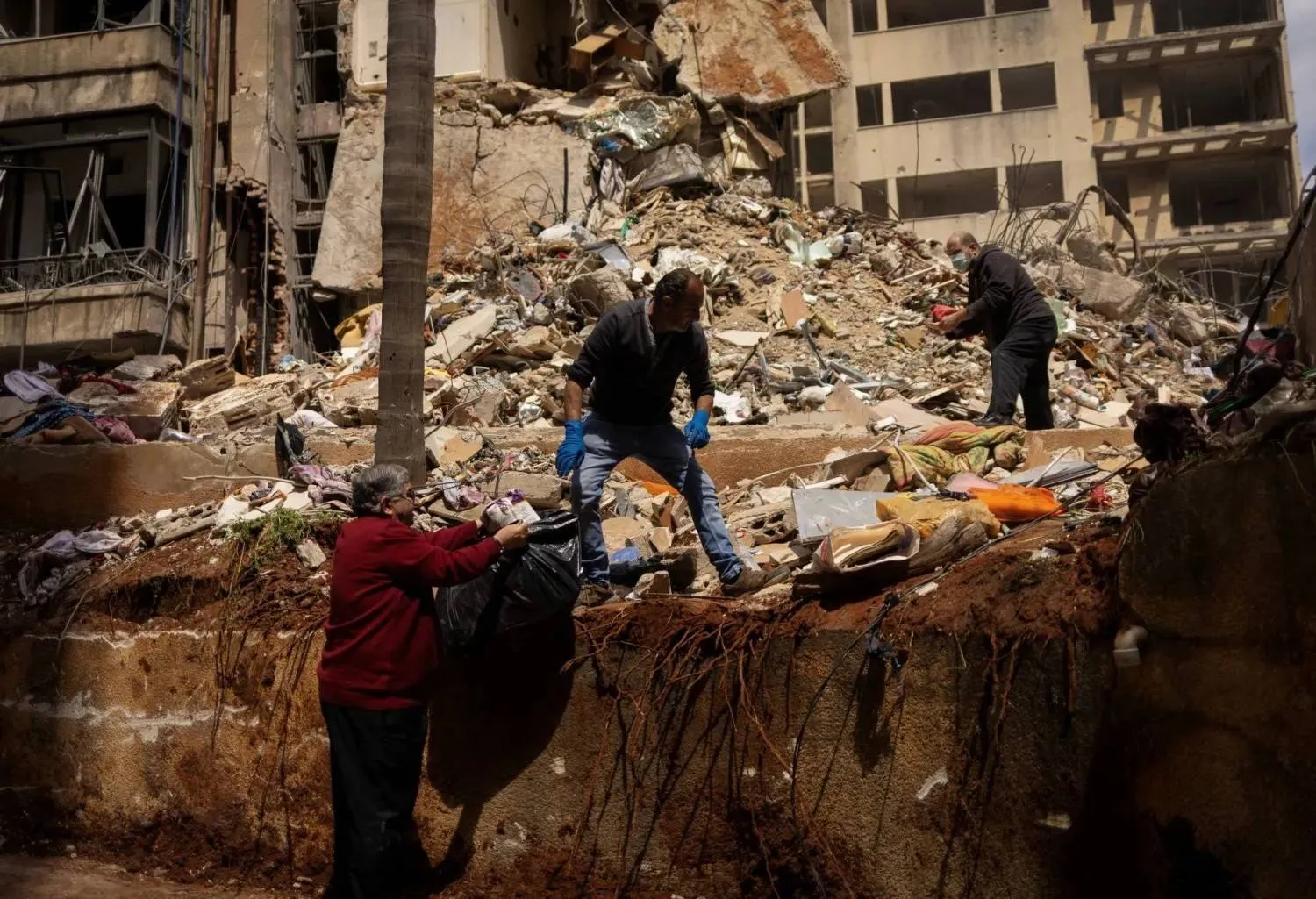
Residents search for belongings in the rubble of a building hit by an Israeli strike in the Ain el-Mreisseh area of Beirut (Reuters)
TT

Lebanon Between 2026 War and Negotiation Talks Next Week

Residents search for belongings in the rubble of a building hit by an Israeli strike in the Ain el-Mreisseh area of Beirut (Reuters)

Lebanon, under sustained Israeli air strikes and an open war, is entering a pivotal week as it prepares for preliminary meetings expected next week that could open a new negotiating track to secure a ceasefire, stabilize the border, and regulate the south.

The move brings Lebanese-Israeli negotiations back into focus, not as a precedent, but as a continuation of a path shaped by wars and facts on the ground.

The key shift lies in the form. Most past negotiations were indirect, conducted through the United Nations, international mediators, or technical committees. Lebanon has seen only one formal round of direct negotiations at this level, the May 17, 1983, agreement. That makes the 2026 track, in form, the closest parallel, though it differs sharply in context, conditions, and aims.

From armistice to border demarcation: indirect track

Negotiations between Lebanon and Israel began with the 1949 Armistice Agreement, signed in Naqoura after the 1948 war and the Lebanese army’s participation in the al-Malikiyyah battle.

It established a ceasefire, adopted the armistice line based on international borders, and set up a joint committee under UN supervision.

Since then, all frameworks, except the 1983 deal, have stayed within indirect or technical formats.

In April 1996, Israel’s “Grapes of Wrath” operation and the Qana massacre led to the April Understanding, which barred targeting civilians. It set up a monitoring committee including Lebanon, Israel, the US, France, and Syria, helping curb escalation until Israel’s withdrawal from the south in 2000.

After the 2006 war, United Nations Security Council Resolution 1701 set the international framework for the southern border, including a halt to hostilities, deployment of the Lebanese army south of the Litani River, expansion of UNIFIL, and restricting weapons in the area to the state.

In 2022, US-mediated indirect talks on maritime borders ended with the adoption of Line 23 and recognition of Lebanon’s right to develop the Qana field, seen as a model for technical, non-political negotiation.

In November 2024, border escalation produced a fragile ceasefire that included partial Israeli withdrawal from some points, expanded Lebanese army deployment south of the Litani, and a halt to hostilities. Repeated violations and weak implementation exposed its limits, prompting calls for a stricter mechanism.

“Mechanism”: toward direct engagement

In 2025, the term “mechanism” emerged as a practical framework to anchor a ceasefire. The proposal centers on a five-party committee including Lebanon, Israel, the US, France, and the United Nations, backed by technical and field monitoring.

Lebanon insists the Lebanese army alone must implement any arrangements on its territory, rejecting any Israeli operational role on the ground.

This marks the core shift. Unlike previous talks, which were indirect or technical, the 2026 meetings are set to be direct or semi-direct, making them the second such test after May 17.

Second time since 1983

Former MP Fares Soaid said Lebanon is entering “the second instance of formal direct negotiations with Israel,” after the first, which followed the 1982 invasion, when President Amine Gemayel pursued talks to secure Israeli withdrawal and reach an understanding.

He said 1983 unfolded under vastly different conditions. “The obstacles were enormous. The Cold War shaped the scene, and the Soviet Union, led by Yuri Andropov, opposed any track that could pull Lebanon fully into the US camp,” he said.

Arab capitals, led by Damascus under Hafez al-Assad, were not supportive, and Lebanese public opinion, especially among Muslims, was not ready, he added.

Although the May 17 agreement won majority backing in parliament, Damascus, aligned with the Soviet camp, mobilized local forces, leading to the February 6 uprising and the collapse of the deal, effectively besieging Gemayel in Baabda, Soaid said.

He said 2026 presents a different landscape. “There is no Soviet veto, the international climate is more positive, and Arab and Islamic positions are more open to negotiations,” he said.

“There is no objection from Damascus and no real internal opposition. The negotiating delegation is expected to be formed in line with the constitution and presidential powers,” he added, saying the chances of success are far higher than in 1983.

Negotiation is not normalization

A Lebanese parliamentary source said conflating negotiation with normalization has no legal or political basis, stressing that talks do not amount to diplomatic recognition or normal relations.

Lebanon has repeatedly negotiated, from the armistice to the April Understanding and the maritime demarcation, without changing its legal or political stance toward Israel, the source said.

“Negotiation is a political decision governed by international law and the Vienna and Geneva conventions,” the source said, adding that legal doctrine does not treat negotiation as recognition.

Lebanon has used multiple formats, from separate rooms to technical committees, all confined to specific files tied to security, borders, and sovereignty.

“The issue is not the form, but the substance,” the source said. “If the goal is to stabilize borders, stop violations, and restore sovereignty, that falls within the core duties of the Lebanese state.”

Iraqi PM to Visit Tehran This Week

Iraqi Prime Minister Ali al-Zaidi attends a meeting with US President Donald Trump (not pictured) in the Oval Office of the White House in Washington, DC, USA, 14 July 2026. (EPA)
TT

Iraqi PM to Visit Tehran This Week

Iraqi Prime Minister Ali al-Zaidi attends a meeting with US President Donald Trump (not pictured) in the Oval Office of the White House in Washington, DC, USA, 14 July 2026. (EPA)

Iraqi Prime Minister Ali al-Zaidi will visit Tehran ‌within ‌the coming ‌week, ⁠the Iraqi state ⁠news agency reported on ⁠Sunday.

During ‌the visit, ‌the prime minister will ‌sign memoranda of ⁠understanding in ⁠Tehran in areas of cooperation.

Al-Zaidi had visited the United States earlier this week where he met with President Donald Trump.

Trump praised the new PM, saying the US is “going to have a long-term relationship with Iraq. We're going to have a long-term relationship with a man that will be a great leader.”

“It's a great honor to have the Prime Minister of Iraq with us. He's been a great fighter, and he's been a great fan of America,” he went on to say.

Iraq signed 48 agreements and partnerships with American companies, many in the oil sector, during al-Zaidi's visit.

Al-Zaidi, a businessman, came to power this year with US blessing after Trump vetoed another candidate.

He has vowed to boost Iraq's fragile economy and disarm pro-Iran armed groups in Iraq that have targeted US facilities.

Iraq has long walked a tightrope between the competing influences of allies the United States and neighboring Iran.


Rubio Hails Lebanon for Peace Efforts After Meeting Aoun

Lebanese President Joseph Aoun attends a press conference, at the presidential palace, in Baabda, Lebanon January 17, 2025. (Reuters)
TT

Rubio Hails Lebanon for Peace Efforts After Meeting Aoun

Lebanese President Joseph Aoun attends a press conference, at the presidential palace, in Baabda, Lebanon January 17, 2025. (Reuters)

US Secretary of State Marco Rubio met with Lebanese President Joseph Aoun in Washington on Sunday, praising the country for its "move towards peace" after the latest round of Lebanon-Israel talks. 

It was the first trip to the US capital by a Lebanese head of state since Michel Suleiman was received by Barack Obama in 2009. 

Aoun and Rubio held talks at the State Department, and Lebanese officials said Aoun is due to meet with President Donald Trump on Tuesday. 

Rubio commended the Lebanese government for its "determined effort to reclaim Lebanon's sovereignty, disarm Hezbollah and dismantle its terrorist infrastructure, and move towards peace," the State Department said following the talks. 

Lebanon and Israel, which do not have formal diplomatic relations, began US-sponsored negotiations in April aimed at reaching a peace deal and permanently ending the Israel-Hezbollah war. 

On June 26, they reached a framework agreement in Washington under which the Israeli military is to withdraw from southern Lebanon and the Lebanese army is to deploy, starting with two "pilot zones." 

But the agreement is contingent on the disarmament of Iran-backed group Hezbollah, which has flatly rejected both the deal and the Israel-Lebanon negotiations that underpin it. 

Following the latest round of talks last week in Rome, Israel and Lebanon agreed on the structure and guidelines for implementing the pilot zones, according to the United States. 

Rubio said Washington was committed "to supporting the successful implementation of the Trilateral Framework and to backing the Government of Lebanon's efforts to deliver peace, economic recovery, and a better future for the Lebanese people." 

Hezbollah pulled Lebanon into the Middle East war on March 2, when it began striking Israel in support of its backer Iran. 

Israel responded with airstrikes and a ground invasion, and despite a ceasefire it continues sporadic attacks and holds territory in the south in what it describes as a "security zone." 

While in Washington, Aoun planned talks "on the situation in Lebanon and ways to strengthen the ceasefire" as well as on "the withdrawal of Israel from the Lebanese regions it occupies," his office said earlier. 

The United States carried out airstrikes on Sunday to "punish" Iran after the first US military deaths since open hostilities rekindled the Middle East war. 


Jordan Summons Iranian Diplomat Over ‘Unjustified’ Attacks

The Jordanian capital, Amman. Petra file photo
TT

Jordan Summons Iranian Diplomat Over ‘Unjustified’ Attacks

The Jordanian capital, Amman. Petra file photo

Jordan has summoned Iran's charge d'affaires in Amman over what it ‌called "unjustified ‌and blatant Iranian ‌attacks" ⁠and "provocative and inflammatory ⁠statements targeting the Kingdom's territory," Jordan's ministry of foreign affairs ⁠said in ‌a ‌statement on ‌Sunday. 

Over the ‌last week, Jordan has repeatedly said that ‌it has intercepted Iranian missiles flying ⁠over ⁠its territory, including three that it shot down on Sunday, according to the country's military.
