


Report: Iran’s New Supreme Leader Has Severe and Disfiguring Wounds

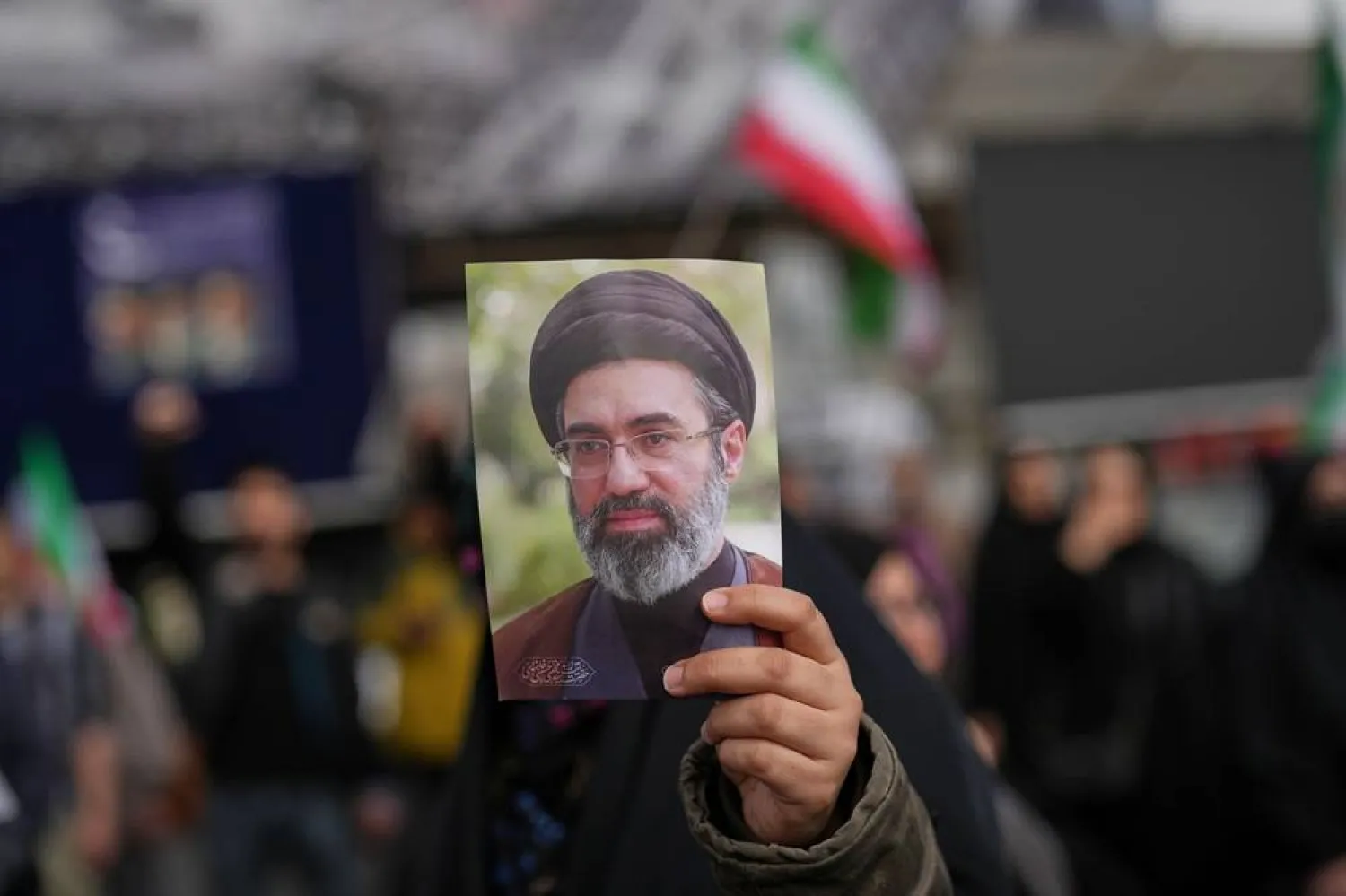
 A demonstrator holds a picture of Iran's Supreme Leader Mojtaba Khamenei during a gathering after announcement of a two-week ceasefire with the United States and Israel, in Tehran, Iran, Wednesday, April 8, 2026. (AP)
A demonstrator holds a picture of Iran's Supreme Leader Mojtaba Khamenei during a gathering after announcement of a two-week ceasefire with the United States and Israel, in Tehran, Iran, Wednesday, April 8, 2026. (AP)
TT

Report: Iran’s New Supreme Leader Has Severe and Disfiguring Wounds

 A demonstrator holds a picture of Iran's Supreme Leader Mojtaba Khamenei during a gathering after announcement of a two-week ceasefire with the United States and Israel, in Tehran, Iran, Wednesday, April 8, 2026. (AP)
A demonstrator holds a picture of Iran's Supreme Leader Mojtaba Khamenei during a gathering after announcement of a two-week ceasefire with the United States and Israel, in Tehran, Iran, Wednesday, April 8, 2026. (AP)

Iran's new Supreme Leader Mojtaba Khamenei is still recovering from severe facial and leg injuries ‌suffered in the airstrike that killed his father at the beginning of the war, three people close to his inner circle told Reuters.

Khamenei's face was disfigured in the attack on the supreme leader's compound in central Tehran and he suffered a significant injury to one or both legs, all three sources said.

The 56-year-old is nonetheless recovering from his wounds and remains mentally sharp, according to the people, who requested anonymity to discuss sensitive matters. He is taking part in meetings with senior officials via audio conferencing and is engaged in decision-making on major issues including the war and negotiations with Washington, two of them said.

The question of whether Khamenei's health allows him to run state affairs comes during Iran's moment of gravest peril for decades, with high-stakes peace talks with the United States opening in the Pakistani capital Islamabad on Saturday.

The accounts of the people close to Khamenei's inner circle provide the most detailed description of the leader's condition for weeks. Reuters couldn't independently verify their descriptions.

Khamenei's whereabouts, condition and ability to rule still largely remain a mystery to the public, with no photo, video or audio recording of him published since the air attack and his subsequent appointment as his father's replacement on March 8.

Iran's United Nations mission did not respond to Reuters questions about the extent of Khamenei's injuries or the reason he has not yet appeared in any images or recordings.

Khamenei was wounded on February 28, the first day of the war launched by the US and Israel, in the attack that ‌killed his father and predecessor ‌Ali Khamenei, who had ruled since 1989. Mojtaba Khamenei's wife, brother-in-law and sister-in-law were among other members of his family ‌killed in the ⁠strike.

There has been ⁠no official Iranian statement on the extent of Khamenei's injuries. However, a newsreader on state television described him as a "janbaz", a term used for those badly wounded in war, after he was named supreme leader.

The accounts of Khamenei's injuries tally with a statement made by US Secretary of Defense Pete Hegseth on March 13 when he said that Khamenei was "wounded and likely disfigured".

A source familiar with US intelligence assessments told Reuters that Khamenei was believed to have lost a leg.

The CIA declined to comment on Khamenei's condition. The Israeli prime minister's office didn't respond to questions.

Alex Vatanka, senior fellow at the Middle East Institute, said that, regardless of the severity of his injuries, it was unlikely the new and inexperienced leader would be able to command the overarching power wielded by his father. While he is seen to represent continuity, it could take years for him to build up the same level of automatic authority, Vatanka added.

"Mojtaba will be one voice but ⁠it will not be the decisive one," he said. "He needs to prove himself as the credible, powerful, overriding voice. The regime ‌as a whole has to make a decision in terms of where they are going to go."

One of the ‌people close to Khamenei's circle said images of the supreme leader could be expected to be released within one or two months and that he might even appear in public then, although all ‌three sources stressed he would only emerge when his health and the security situation allowed.

'WE DON'T KNOW MUCH ABOUT HIS WORLD VIEW'

In Iran's theocratic system of rule, ultimate ‌power is meant to be wielded by the supreme leader, a venerable Shiite cleric appointed by an assembly of 88 clerics. The leader oversees the elected president while directly commanding parallel institutions including the Revolutionary Guards, a powerful political and military force.

Iran's first supreme leader, Khomeini, enjoyed unquestioned authority as the charismatic leader of the revolution and the most learned cleric of his day.

His successor, Ali Khamenei, was a less revered cleric but had served as Iran's president. He spent decades cementing his authority after his appointment in 1989, partly through promoting the power of the Revolutionary Guards.

His son Mojtaba does ‌not command absolute power in the same way, senior Iranian sources have previously told Reuters.

The Revolutionary Guards, who helped steer him into the top job after his father's assassination, have emerged as the dominant voice on strategic decisions during the war. ⁠Iran's UN mission didn't respond to questions about ⁠the power wielded by the Guards and the new supreme leader.

As an influential figure in his father's office, Khamenei had previously spent years involved in exercising power at the top levels of the regime, officials and insiders have said, building ties with senior Guards figures.

While he is widely seen as likely to continue his father's hardline approach due to his links to the Guards, we don't know much about his world view, said Vatanka at the Middle East Institute.

Khamenei's first communication with Iranians as supreme leader came on March 12, saying in a written statement read out by a television news presenter that the Strait of Hormuz should stay closed and warning regional countries to shut US bases.

His office has since issued a few other brief written statements from him, including on March 20 when he welcomed in the Persian new year, which he named the "year of resistance".

Public statements of policy on Iran's war stance, its approach towards diplomacy, neighbors, ceasefire negotiations and domestic unrest, have been made by other senior officials.

'WHERE IS MOJTABA?' MEMES CIRCULATE ONLINE

Khamenei's absence is widely discussed on Iranian social media and in messaging app groups, when the country's patchy internet allows, with conspiracy theories widespread about his condition and who is running the country.

One popular meme circulating online is a picture of an empty chair under a spotlight with the slogan "Where is Mojtaba?"

However, some government supporters, including a senior member of the Basij militia, a volunteer paramilitary group run by the Revolutionary Guards, said that it was important for Khamenei to keep a low profile, given the threat posed by waves of US and Israeli airstrikes that have already wiped out much of the country's leadership.

A lower-ranking Basij member agreed.

"Why should he appear in public? To become a target for these criminals?" Mohammad Hosseini, from the city of Qom, said in a text message.



UN Demands Accountability for Violations of Rules of War in Middle East

Smoke rises from the sites of Israeli airstrikes in Beirut and its southern suburbs on April 8, 2026. (AFP)
TT

UN Demands Accountability for Violations of Rules of War in Middle East

Smoke rises from the sites of Israeli airstrikes in Beirut and its southern suburbs on April 8, 2026. (AFP)

UN agency chiefs on Saturday demanded an end to impunity for widespread international law violations in the Middle East, as casualties pile up six weeks into the war unleashed by US-Israeli strikes on Iran.

In a joint statement, the heads of multiple United Nations agencies said they were "alarmed by the sustained violations of the rules of war and international humanitarian law" in the region.

"Even wars have rules, and these rules must be respected," the statement from the UN Inter-Agency Standing Committee said.

The joint statement -- penned by UN humanitarian chief Tom Fletcher along with the heads of the UN agencies for human rights, health, food, refugees and children among others -- decried the soaring toll since the Middle East war erupted on February 28.

"In just the last month across the Middle East, thousands of civilians have been killed and injured. Hundreds of thousands have been displaced, many multiple times," it said.

"The numbers continue to rise and essential services are increasingly difficult to access.

"Health workers, hospitals and ambulances have been targeted. Schools have been struck. Civilian infrastructure - including bridges, residential buildings, houses, water facilities and power plants - has been destroyed," it said.

The agency chiefs voiced particular concern about the impact on "women and children and others with specific needs", as well as on global supply chains, "with food and fuel prices on the rise."

At the same time, they highlighted that "our humanitarian colleagues have been caught up in hostilities."

Just since the beginning of this year, they said, "14 aid workers have been killed or injured in the Occupied Palestinian Territory, eight in Iran and five in Lebanon."

"This is an alarming toll."

The agency chiefs said they "strongly condemn all attacks on civilians, including humanitarian and health workers, as well as civilian objects."

"We demand that all parties - whether Member States of the United Nations or armed groups - respect their legal obligation to protect civilians, including humanitarian personnel, and civilian infrastructure," they said.

"All violations must be met with accountability."


Ukraine Can Play Useful Role in Strait of Hormuz, Britain Says

FILE PHOTO: A map showing the Strait of Hormuz is seen in this illustration taken June 22, 2025. REUTERS/Dado Ruvic/Illustration/File Photo
TT

Ukraine Can Play Useful Role in Strait of Hormuz, Britain Says

FILE PHOTO: A map showing the Strait of Hormuz is seen in this illustration taken June 22, 2025. REUTERS/Dado Ruvic/Illustration/File Photo

Ukraine can play a useful role in international efforts to secure the Strait of Hormuz, Britain's armed services minister said, praising its drone technology as among the best in the world.

Britain has organized discussions this month among more than 30 nations on how to reopen the strait, amid an Iranian blockade that has choked oil supplies to the global economy following US and Israeli strikes on Iran, Reuters reported.

President Volodymyr Zelenskiy said this week Kyiv had participated in consultations on safeguarding navigation, drawing on expertise from four years of war with ‌Russia. Ukraine has already ‌deployed more than 200 experts to the Middle East, where ‌they ⁠have downed Iran's ⁠long-range Shahed drones.

"Ukraine has some of the best technology in the world that it's developed here in the war. I think that could provide utility in the Middle East, as we're seeing already against Shahed drones, all the way through to the Strait of Hormuz," Al Carns said during a visit to Kyiv on Friday.

Carns, who served as a colonel in Britain's armed forces before being elected to parliament two years ⁠ago, said his visit was intended to reassure Kyiv that the ‌war in Ukraine remained Britain's top defense and ‌security priority.

He played down tensions within the NATO military alliance following US President Donald Trump's ‌criticism of European allies for not joining the Iran war, saying NATO was ‌still the "backbone of our security".

'REVOLUTION IN MILITARY AFFAIRS'

While Britain is providing funding, training and military capability to Ukraine, Carns said there was also much the UK could learn from Kyiv's battlefield innovations, particularly in drone technology, the use of data and AI.

"It's a revolution in military ‌affairs, and we need to move faster," Carns said.

Incorporating advances in warfare into Britain's 10-year defense investment plan - due late ⁠last year - is ⁠taking time but the report will be ready this spring, Carns said.

Carns urged Ukraine to accelerate exports of its cutting-edge technology to capture a corner of the global market before other nations catch up, and to facilitate learning and development with NATO allies.

Ukraine issued its first export licenses in February. Kyiv hopes to raise funds to expand its defense industry while using its weapons as diplomatic leverage with allies.

However, some industry executives have complained Kyiv is dragging its heels in approving licenses and risks missing the opportunity presented by the Iran war.

"Ukraine needs to speed up its capacity to export," Carns said. "I still believe the best systems sit in Ukraine, but the rest of the world is catching up."

Britain is home to a plant making Ukrainian interceptor drones that started production in February. Another UK-headquartered Ukrainian military tech company, UForce, produces the Magura sea drone.


North Korean Leader Kim Backs China’s Push for ‘Multi-polar World’ in Talks with FM

This picture taken on April 10, 2026 and released by North Korea's official Korean Central News Agency (KCNA) on April 11, 2026, shows Chinese Foreign Minister Wang Yi (L) shaking hands with North Korean leader Kim Jong Un at the headquarters of the Workers' Party of Korea in Pyongyang.  (KCNA / KCNA via KNS / AFP)
This picture taken on April 10, 2026 and released by North Korea's official Korean Central News Agency (KCNA) on April 11, 2026, shows Chinese Foreign Minister Wang Yi (L) shaking hands with North Korean leader Kim Jong Un at the headquarters of the Workers' Party of Korea in Pyongyang. (KCNA / KCNA via KNS / AFP)
TT

North Korean Leader Kim Backs China’s Push for ‘Multi-polar World’ in Talks with FM

This picture taken on April 10, 2026 and released by North Korea's official Korean Central News Agency (KCNA) on April 11, 2026, shows Chinese Foreign Minister Wang Yi (L) shaking hands with North Korean leader Kim Jong Un at the headquarters of the Workers' Party of Korea in Pyongyang.  (KCNA / KCNA via KNS / AFP)
This picture taken on April 10, 2026 and released by North Korea's official Korean Central News Agency (KCNA) on April 11, 2026, shows Chinese Foreign Minister Wang Yi (L) shaking hands with North Korean leader Kim Jong Un at the headquarters of the Workers' Party of Korea in Pyongyang. (KCNA / KCNA via KNS / AFP)

North Korean leader Kim Jong Un voiced support for China’s push to build a “multi-polar world” and called for deeper ties between the traditional allies during a meeting with Chinese Foreign Minister Wang Yi, state media said Saturday.

During the meeting Friday, Kim said his government will fully support Chinese efforts to achieve territorial integrity based on its “one-China principle,” a reference to Beijing’s official position that Taiwan is an inalienable part of China’s territory, according to North Korea’s official Korean Central News Agency.

Kim also outlined North Korea’s position on unspecified regional and international issues of “mutual concern” and said sustained development of ties between the two countries has become more crucial in the current geopolitical environment, KCNA said.

Wang, on a two-day trip to North Korea, said the countries’ relations were entering a “new phase” following a summit last year between Kim and Chinese President Xi Jinping.

Embracing the ideas of a “new Cold War” and a “multi-polarized world,” Kim has sought to break out of international isolation and push a more assertive foreign policy by expanding ties with governments locked in confrontations with the United States.

While Russia has been Kim’s top foreign policy priority in recent years, sending thousands of troops and large weapons shipments to support its war against Ukraine, he has also been cozying up to China, the North’s traditional main ally and economic lifeline.

Kim joined Russian President Vladimir Putin at a World War II ceremony in Beijing in September and held his first summit with Xi Jinping in six years, moves that supported his efforts to portray North Korea as part of a united front against Washington.

North Korea and China last month resumed direct flight and passenger train services, which had been suspended since the beginning of the COVID-19 pandemic in 2020.

Wang arrived in Pyongyang on Thursday in his first visit to North Korea in seven years. He earlier met with North Korean Foreign Minister Choe Sun Hui and discussed ways to facilitate further cooperation and exchanges and holding “in-depth” talks on international issues, state media from both countries said.

The state media outlets did not mention whether Wang and North Korean officials discussed issues related to the US or the ongoing war in the Middle East.

Wang’s trip to North Korea came before US President Donald Trump travels to Beijing for a rescheduled summit with Xi Jinping in May. Some South Korean officials have expressed hope the Trump-Xi meeting could provide a diplomatic opening with Pyongyang.

Kim has suspended all meaningful dialogue with the US and South Korea since the collapse of his diplomacy with Trump in 2019 during the American president’s first term. Kim has since taken a hard-line stance toward South Korea, which he now defines as his “most hostile” adversary, and rejected US offers to resume talks, calling on Washington to drop its demand for North Korea’s denuclearization as a precondition.