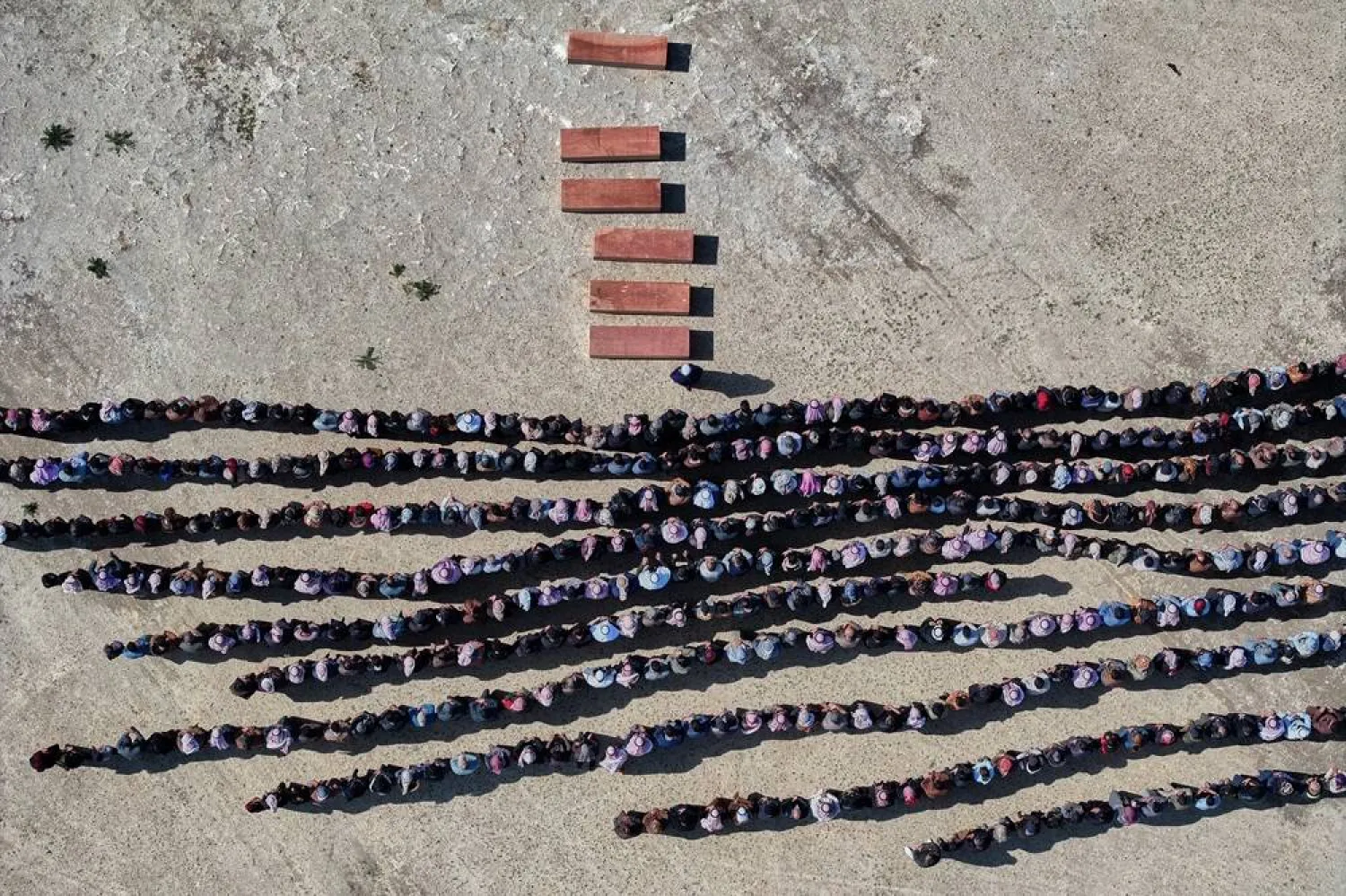
A Syrian Man Buries His Wife and 4 Children Killed in Israeli Strikes on Beirut

 Mourners pray over the six coffins of members of the al-Jalib family, who were killed Wednesday in Israeli strikes in Beirut, during their funeral in the village of al-Sour, Deir Ezzor province, northeastern Syria, Saturday, April 11, 2026. (AP)
Mourners pray over the six coffins of members of the al-Jalib family, who were killed Wednesday in Israeli strikes in Beirut, during their funeral in the village of al-Sour, Deir Ezzor province, northeastern Syria, Saturday, April 11, 2026. (AP)
TT

A Syrian Man Buries His Wife and 4 Children Killed in Israeli Strikes on Beirut

 Mourners pray over the six coffins of members of the al-Jalib family, who were killed Wednesday in Israeli strikes in Beirut, during their funeral in the village of al-Sour, Deir Ezzor province, northeastern Syria, Saturday, April 11, 2026. (AP)
Mourners pray over the six coffins of members of the al-Jalib family, who were killed Wednesday in Israeli strikes in Beirut, during their funeral in the village of al-Sour, Deir Ezzor province, northeastern Syria, Saturday, April 11, 2026. (AP)

A Syrian man on Saturday buried his wife and four of his five children, killed in the massive wave of Israeli strikes that pounded Beirut earlier this week, laying them to rest in Deir Ezzor province in northeastern Syria.

It was not the homecoming they had anticipated when they fled to Lebanon six years ago.

The bodies, along with that of his six-month pregnant daughter-in-law, arrived in wooden coffins on a bus from Lebanon, their names scribbled on the sides. Men stood beside the bus crying before the burial procession in al-Sour town, as mourners gathered to offer condolences.

The remains of one of his two daughters were still missing, believed to be trapped under rubble, as search operations concluded Saturday, three days after the attacks.

The strike was one of roughly 100 carried out by Israel on Wednesday without warning, targeting what the Israeli military said were Hezbollah-linked sites across Beirut and other parts of Lebanon. More than 350 people were killed that day, a third being women and children, making it the deadliest day in nearly six weeks of war.

Many of the strikes hit commercial streets and densely populated neighborhoods in central Beirut, far from conflict zones, where repeated Israeli evacuation warnings have been issued since March 2, when the Iran-backed militant group Hezbollah fired missiles into Israel in retaliation for the US-Israeli attacks on Iran.

The father, Hamad al-Jalib, survived because he was away fetching a gas canister while working as the building’s concierge. When he heard that a strike had hit the Ain Mreisseh neighborhood, where he lives, he rushed back, only to see a plume of smoke rising from a building behind a mosque across from Beirut’s famous seaside promenade — usually crowded with people walking and exercising.

“The Israeli attack killed my girls, they are innocent, just sitting at home,” al-Jalib said. “They were having lunch.”

He said it took rescue teams three days to extract the bodies of his family from under the rubble. “And I still have a daughter missing, her name is Fatima Hamad al-Jalib.” She is 10 years old. His other daughter was 12 while his sons were 17, 14 and 13 years old.

Three other Syrian relatives were also killed in the Ain Mreisseh strike and were buried on Saturday in the town of al-Shuhail in Deir Ezzor, after the family split upon returning to Syria.

Al-Jalib said his family had been displaced from their area and moved to Lebanon in 2020, as local tensions grew involving tribal groups and the Kurdish-led Syrian Democratic Forces.

Syrian refugees among the dead and wounded

The casualties from Wednesday’s strikes and others across the country have pushed the death toll in more than a month of Israel’s war with Hezbollah to over 1,950 killed and more than 6,300 wounded, according to Lebanon’s Health Ministry. The toll includes at least 315 Syrians killed and wounded.

It remains unclear how many of those killed on Wednesday were non-Lebanese, as the Health Ministry did not provide a breakdown by nationality. Officials have reported that at least 39 Syrians were among the dead.

Dalal Harb, a spokesperson for the UN refugee agency, said the family killed in Ain Mreisseh was not registered with the UNHCR. There are about 530,000 Syrians refugees registered with UNHCR in Lebanon, with hundreds of thousands more believed to be unregistered.

While hundreds of thousands of Syrians have returned from Lebanon since the ouster of former Syrian President Bashar al-Assad in December 2024, many others remain reluctant to go back because of the lack of jobs and ongoing violence.

Al-Jalib’s brother, Jomaa, who also lived in Lebanon, said he was about 150 meters (500 feet) away at work when the first blast hit. “We ran and we ran, then the second strike happened.”

He said he was arriving at the building as it began to collapse. “It was too late to get anyone out. We yelled for them, but no one answered.”

He said ambulances later recovered the bodies, which he identified at a hospital.

Following the burial on Saturday, men stood shoulder to shoulder in prayer over the fresh graves.


Where Does Hamas Still Hold Territory in Gaza?

 A concrete block marking the Israeli military’s “Yellow Line” in Bureij, central Gaza (File photo: AFP). 
 A concrete block marking the Israeli military’s “Yellow Line” in Bureij, central Gaza (File photo: AFP). 
TT

Where Does Hamas Still Hold Territory in Gaza?

 A concrete block marking the Israeli military’s “Yellow Line” in Bureij, central Gaza (File photo: AFP). 
 A concrete block marking the Israeli military’s “Yellow Line” in Bureij, central Gaza (File photo: AFP). 

Nearly a week ago, Hussam al-Astal, who leads an Israeli-backed armed group operating in Khan Younis in southern Gaza, appeared in a video announcing the start of an operation he described as a “cleansing of displacement camps in the Mawasi area.”

His remarks came after an attack by another armed group linked to the Israeli military, which resulted in the abduction of dozens of residents from an area theoretically considered to be under Hamas control in Gaza.

Since the ceasefire agreement was announced in October 2025 under US President Donald Trump’s plan, an imaginary boundary known as the “Yellow Line” has separated Israeli-occupied areas east of the line, estimated at more than 60 percent of the Gaza Strip, from areas west of it held by Hamas and other Palestinian factions.

However, intensified operations by Israeli-backed armed groups, including abductions and forced displacement under covering fire from the Israeli military, have raised new questions about the extent of the territory where Hamas still exercises authority.

More than a year after the ceasefire agreement, which Israel has repeatedly violated, Israeli forces have also shifted their positions along the Yellow Line, expanding the area they occupy to more than 65 percent of the Gaza Strip’s approximately 360 square kilometers.

Last week, members of armed groups infiltrated a displacement camp near Abu Hamid roundabout, between central and eastern Khan Younis. Reinforcements subsequently arrived in four-wheel-drive vehicles, while Israeli drones flew overhead to provide support.

The operation resulted in the abduction of 35 Palestinians. Some were released after more than 10 hours of intensive interrogation by Israeli officers, while three remained in captivity.

A similar operation took place at an intersection near the Shujaiya neighborhood. Dozens of those detained were released, while one person remained in custody.

Israeli Occupation Extends Beyond the Yellow Line

According to a map of the areas occupied by Israel, Israeli forces now hold 67 percent of the Gaza Strip as they continue expanding the area covered by the Yellow Line.

In northern Gaza, the Israeli military occupies the entire town of Beit Hanoun, at the northernmost end of the territory, parts of Beit Lahia and a larger section of Jabalia refugee camp.

In Gaza City governorate, which includes the territory’s main urban center, Israeli forces hold all the city’s eastern neighborhoods, including Tuffah, Shujaiya and Zeitoun. Small areas of Zeitoun remain inhabited by displaced Palestinians living under difficult security and humanitarian conditions.

Central Gaza has recently witnessed extensive military activity, with Israeli forces expanding their positions by pushing the Yellow Line farther west, particularly around the Bureij and Maghazi refugee camps, al-Masdar and areas east of Deir al-Balah.

These operations have forced more Palestinians to flee their homes and shelters in recent days.

In southern Gaza, Israel occupies the entire city of Rafah, apart from a small section of Mawasi in the city’s northwestern area, along the southern boundary with Khan Younis.

Israeli forces also occupy large parts of southern Khan Younis, while Mawasi remains under Palestinian authority. The city’s eastern areas, meanwhile, remain entirely under Israeli occupation.

Where Is Hamas?

Four Hamas field sources and two sources from other Palestinian factions told Asharq Al-Awsat in separate accounts that Israeli forces hold most Palestinian areas east of Salah al-Din Road, the main highway connecting northern, central and southern Gaza.

Israeli forces also occupy large parts of the territory’s northern and southern regions.

The sources, who are based in different parts of Gaza, said residents west of Salah al-Din Road, as well as those in areas south of the northern region and north of the southern region, continue to observe a Hamas presence and authority.

However, the movement faces complicated circumstances that prevent it from fully maintaining security and order.

One source estimated that “Hamas’ grip has become fragile and effectively extends to no more than 17 to 20 percent of the Gaza Strip.”

Nevertheless, Hamas has been seeking to assert its presence by proposing humanitarian projects for residents and attempting to confront Israeli-backed armed groups militarily.

Its members have set ambushes for armed men infiltrating areas under its authority, but the Israeli military frequently intervenes to provide covering fire for the groups it supports.

In Gaza City governorate, which once served as the center of Hamas’s political, governmental and security activities, the movement’s position remains unstable because of Israeli attacks targeting the leadership of Hamas, its government and its armed wing, the Qassam Brigades.

Central Gaza currently represents the area where Hamas and its various institutions retain their strongest presence.

According to the sources, this is largely because the central region did not suffer the same level of damage as other parts of the territory during the war, and Israeli ground forces entered only limited sections of it.

In Khan Younis, at the southern end of the Gaza Strip, Hamas faces more complicated conditions. Nevertheless, its hold there can be described as moderate, particularly in the densely populated Mawasi area, which shelters large numbers of displaced Palestinians.

The movement relies on ambush tactics to confront the threat posed by armed groups and Israeli forces in southern and eastern Khan Younis, as well as in the eastern parts of the governorate’s central areas.

These include locations around Abu Hamid roundabout and the Khan Younis municipal headquarters.

Israeli Firepower Extends Beyond Its Positions

Two field sources told Asharq Al-Awsat that the differences between areas where Hamas maintains a strong security presence and those where its grip is fragile can be attributed to several factors.

Among them is Israel’s ability to dominate areas from a distance using elevated platforms and drones, as well as airstrikes targeting anyone approaching areas near Salah al-Din Road from the western side in certain locations.

Another factor is Israel’s use of armed groups as a means of extending its reach by pushing farther into areas close to the road.

This has occurred particularly in southern and eastern Khan Younis, northwestern Mawasi in Rafah, eastern Gaza City, and the areas around Jabalia and Beit Lahia in northern Gaza.

More recently, similar operations have also taken place in central Gaza.

The two sources explained that this complex security situation makes it difficult for government security forces or other personnel to reach areas close to the western side of Salah al-Din Road.

As a result, extensive additional areas have effectively fallen under indirect Israeli security control.

This allows armed groups, people collaborating with Israel and others to operate freely in those locations.

The sources said Hamas’ so-called “resistance security” apparatus has responded by periodically setting ambushes for members of these groups, seeking to kill or capture them and prevent them from carrying out their plans.

According to a third source, the Israeli military uses the armed groups to conduct sweeping operations in new areas beyond the Yellow Line, east of Salah al-Din Road.

Israeli forces then advance into those same areas, either several hours later on the same day or the following day, carrying out engineering operations, including bulldozing land and other activities.

The military subsequently extends the Yellow Line to expand the territory under its direct occupation.

The three sources said Israeli forces kill or wound anyone attempting to cross Salah al-Din Road, particularly in areas opposite Khan Younis in the south and Gaza City in the north.

They added that Israeli operations have recently intensified east of Deir al-Balah and al-Masdar in central Gaza.

Israeli forces have also increasingly targeted people approaching areas on the western side of the road, suggesting that the territory over which Israel exercises dominance through firepower now exceeds 70 percent of the Gaza Strip.

Open Defiance

A fourth Hamas source defended the movement’s loss of security authority during and after the war, describing it as “natural” given the changes that occurred in Gaza during Israeli ground incursions into its cities.

The source said government security agencies and those affiliated with Palestinian factions had repeatedly attempted to maintain order deep inside the western areas of the Gaza Strip.

However, each attempt was met with renewed attacks, most of them Israeli airstrikes targeting security positions in forward areas or even locations far from territory directly occupied by Israel.

The Hamas source acknowledged that the weakening of security had recently prompted some members of local families to engage in what he described as “open defiance” of attempts to arrest them in connection with criminal cases.

Some had opened fire on Hamas police officers, while in one incident individuals seized a weapon. Family elders subsequently intervened, and legal and tribal settlements were reached.

As an example, the source cited an incident in Deir al-Balah a few days earlier in which a member of a local clan killed two police officers during an attempt to arrest him.

The deterioration in security has been compounded by intensive Israeli attacks targeting Hamas’ security apparatus.

According to Gaza’s Interior Ministry, these systematic attacks have killed 76 police officers and security personnel since the ceasefire took effect in October 2025.


Hezbollah Members Questioned Over Suspected Reconnaissance Mission in Northern Lebanon

A Hezbollah member in Syria in 2017 (AFP)
TT

Hezbollah Members Questioned Over Suspected Reconnaissance Mission in Northern Lebanon

A Hezbollah member in Syria in 2017 (AFP)

Investigations are continuing into the arrest of five Hezbollah members in a remote mountainous area between the Bsharri and Batroun districts of northern Lebanon on Tuesday, amid questions about the purpose of their movements and whether they were conducting surveillance.

Judicial sources told Asharq Al-Awsat that investigators were still gathering information and examining why the men had been moving through isolated, uninhabited areas.

“Preliminary information suggests they were on a reconnaissance mission to survey the area,” the sources indicated.

They added that the five were not alone but were accompanied by others monitoring them from a distance. Following the arrests, those individuals reportedly retrieved mobile phones from a room where the detainees had left their belongings. The five had been arrested without their phones.

The suspects claimed they were visiting the area as tourists, an explanation that raised questions, particularly because one lives locally while the others come from South Lebanon and the Bekaa Valley.

Further suspicions arose over documents and maps allegedly found in their possession, some of which they reportedly attempted to tear up as an Internal Security Forces patrol approached.

Asharq Al-Awsat also learned that investigators were leaning toward bringing charges against the detainees in their individual capacities rather than as Hezbollah members, as occurred in a previous explosives-smuggling case.

According to the judicial sources, the suspected surveillance raises questions about whether the survey was linked to security or military preparations, specific targets, or plans to establish a security or military facility.

Salam: No Limits on Investigation

Prime Minister Nawaf Salam followed developments from Antalya, where he arrived to lead Lebanon’s delegation to a climate summit.

“The era of avoiding accountability and covering things up is over,” Salam stressed, adding that the investigation would face “no limits other than those imposed by the law.”

Gemayel: Hezbollah Has Lost Its Way to the South

Lebanese Kataeb Party leader MP Samy Gemayel stepped up his criticism of Hezbollah, linking the arrests to recent security and political developments.

“On the roads to Jerusalem, Damascus and Sanaa, Hezbollah lost its way to the South and ended up in Fanar and the mountains of Bsharri and Tannourine, after Dahr al-Baidar,” he wrote on X.

He argued that dragging Lebanon into wars, defying state decisions, bringing in a truckload of explosives and deploying security groups in the heart of Mount Lebanon were threats to national security and civil peace.

“If all this does not warrant referring Hezbollah’s leadership to the Judicial Council, then the council should be abolished!” he added.

Lebanese Forces MPs Strida Tawk Geagea and Melhem Tawk warned of possible organized security preparations in the area.

They argued that the available information could not be dismissed as an ordinary security incident.

According to published reports they cited, the seized documents contained names of groups, assignments of personnel and references to weapons, including sniper rifles.

The lawmakers questioned why the detainees were in the area, what documents they had attempted to destroy, who had assigned them their mission and what they intended to accomplish.

They warned that the incident raised the possibility of “reconnaissance movements or organized security preparations targeting peaceful Lebanese areas or specific individuals.”

The two urged the interior and defense ministers and judicial authorities to expand the investigation, establish individual and organizational responsibility, and prosecute anyone implicated by the evidence.

The Free Patriotic Movement, meanwhile, called on security and judicial authorities to complete their investigations and disclose the circumstances of the case to the public as quickly as proper legal procedures allow.

It emphasized that security in Batroun, Bsharri and all other Lebanese regions falls exclusively under the responsibility of the state and its institutions.

The party rejected any security activity outside state authority, insisting that proven violations must be punished without political protection for those responsible.

At the same time, it warned against exploiting the incident to stoke sectarian or regional tensions or deepen divisions among Lebanese citizens.


Türkiye's President Calls the War in Gaza an 'Ecocide' at the UN Climate Summit

Erdogan pledged to continue investigations into the investment funds scandal until its eradication and to prevent its recurrence (Turkish Presidency)
TT

Türkiye's President Calls the War in Gaza an 'Ecocide' at the UN Climate Summit

Erdogan pledged to continue investigations into the investment funds scandal until its eradication and to prevent its recurrence (Turkish Presidency)

Turkish President Recep Tayyip Erdogan on Wednesday called for the world to recognize the environmental impacts of the Israel-Hamas war in Gaza and asked the Israeli government to grant more aid access to the Palestinian territory.

Erdogan was speaking at the UN climate summit, known as COP31, in Antalya, Türkiye.

“What has taken place in Gaza is not only a genocide, but it is also an ecocide,” Erdogan said to applause by world leaders and other climate envoys.

A UN-backed panel of independent experts concluded last year that Israel had committed genocide in Gaza. Israel vehemently denies the allegations and has accused the panel of antisemitism, The Associated Press said.

“Centuries old olive trees have been cut down. The soil and water have been polluted in Gaza, and cities in Gaza have been turned into enormous piles of rubble,” Erdogan said. “With Gaza’s destroyed infrastructure, compounded by torrential rain and by flooding, tens of thousands of tents and shelters have been inundated.”

Israel's Foreign Ministry responded in a post on X, accusing Erdogan of “using an international forum to push his anti-Israel campaign of lies” and of supporting Hamas. Israel launched its campaign in Gaza following attacks by Hamas-led militants in southern Israel on Oct. 7, 2023. Militants killed around 1,200 people and took 251 hostages.

“Those who truly care about Gaza should demand that Hamas disarm so reconstruction can begin,” the statement read. Israel wasn't invited to COP31.

Israel’s retaliatory offensive has killed more than 74,000 people, according to local health authorities, and destroyed much of Gaza. The Health Ministry, part of Gaza’s Hamas-run government, doesn’t distinguish between civilians and combatants, but says women and children make up nearly half of the dead.

Erdogan has been an outspoken critic of Israel, while Israeli Prime Minister Benjamin Netanyahu has called Erdogan an antisemitic “tyrant.”

“The latest country to become a superspreader of antisemitic lies is Türkiye," Netanyahu said in September while speaking at the UN General Assembly.

In recent days, heavy rainfall and subsequent flooding destroyed many of the tents and makeshift shelters that Palestinian residents now live in. At least four people were killed earlier this week when a sand embankment collapsed on their shelter. The rain also left many displaced people without food, drinking water or a dry place to sleep.

Humanitarian aid enters the territory, but imports remain far below levels before the start of the Israel-Hamas war — and many items remain blocked by Israel.

A 2025 report by the UN Environment Program also outlined the devastating reality of Gaza’s environment since the war began.

Remote sensing assessments showed that by May 2025, more than 97% of the tree crops, 82% of annual crops, 95% of shrubland and 89% of grass and fallow land had been damaged, according to the UNEP report.

“As of now, our families only have 3% of cropland to use, and that is assuming it’s distributed across 2 million Palestinians" in the Gaza Strip, said Mohammed Usrof, co-founder and executive director of the Palestinian Institute for Climate Strategy.

“Not talking about these losses undermines Palestinians’ food supply, livelihoods and ability to remain on their land,” Usrof said.

The territory’s ability to dispose of garbage, treat sewage and deliver clean water has been virtually decimated by three years of war. This has made grim living conditions worse and raised health risks for hundreds of thousands of people deprived of adequate shelter, food and medicine, aid groups say.

The conflict has “all but eliminated” Gazan fishing livelihoods, the report said, highlighting how marine ecosystems have been contaminated with munitions, sewage and solid waste.

“For people in Gaza, this translates into severely limited access to safe drinking water, greater exposure to waterborne diseases and toxic substances, deepening food insecurity and the loss of livelihoods dependent on agriculture and fishing,” Ghiwa Nakat, executive director at Greenpeace MENA, told The Associated Press.

Nakat also warned that Gaza's environment could take years to recover.

“The environmental damage will not end when the war ends,” Nakat said. “Contaminated soil and groundwater, destroyed ecosystems and the collapse of essential environmental infrastructure could undermine public health, food security and livelihoods for generations, threatening communities’ resilience and their ability to recover.”

World leaders began formal talks at COP31 this week, seeking agreement on concrete steps to curb global warming after a year of deadly floods, heat waves and other climate-related disasters.

More than 70 world leaders and senior government officials are speaking at the summit, though some key leaders are absent, including heads of state from the United States, China and India.