

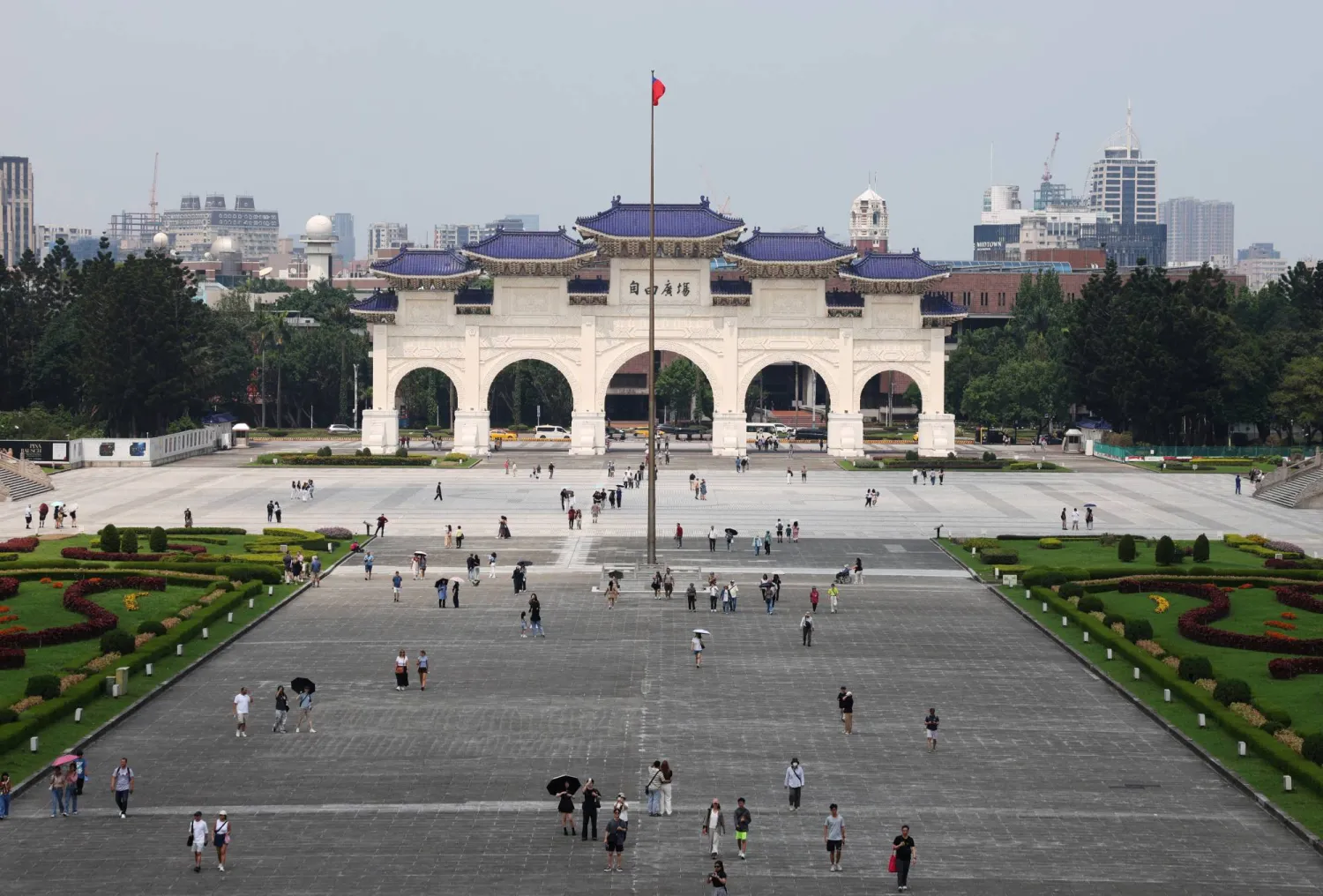

China Says it Will Resume Some Ties with Taiwan Including More Direct Flights

People visit the Chiang Kai-shek Memorial Hall in Taipei, Taiwan April 12, 2026. REUTERS/Edgar Su
TT

China Says it Will Resume Some Ties with Taiwan Including More Direct Flights

People visit the Chiang Kai-shek Memorial Hall in Taipei, Taiwan April 12, 2026. REUTERS/Edgar Su

China said Sunday it would resume some ties it had suspended with Taiwan such as direct flights to cities across China and imports of Taiwanese aquaculture products as the island's opposition party leader concludes her visit.

The Taiwan Work Office under China's Communist Party issued a statement saying it would explore setting up a longstanding communication mechanism between the Communist Party and Taiwan’s Kuomingtang Party, and facilitate the import of Taiwan’s aquaculture products, after it banned them in recent years.

Cheng Li-wun, the head of the Kuomingtang, and China’s President Xi Jinping held a high-profile meeting Friday during which both called for peace without offering specifics. Taiwan is self-ruled but China claims the island as part of its territory.

Relations between China and Taiwan have been tense since 2016 when the Taiwanese public elected Tsai Ing-wen from the Democratic Progressive Party as president. Since then, Beijing cut off most of its official dialogue with Taiwan's government in the capital Taipei and started sending military planes and vessels towards the island on a daily basis.

The list of measures in the statement touches on ties that China had suspended in recent years as tensions increased, The Associated Press reported.

China plans to resume direct flights for other mainland cities like Xi'an or Urumqi to Taiwan, the statement said, although it remained unclear how the measures will be implemented.

China banned individual trips by Chinese people to Taiwan in 2019. Taiwan's rules now require Chinese visitors to hold a valid resident visa from another country, like the US or the European Union, to apply for a visitor visa.

China also said it would work toward construction of a bridge that would connect to Matsu and Kinmen, Taiwanese islands that are closer geographically to China. The project is a longstanding proposal that Beijing has previously announced.

China banned the import of Taiwanese pineapples in 2021 and since then extended the import ban to products as varied as the grouper fish, squid, tuna and other fruits.

After the initial ban on grouper, Taiwan’s Ministry of Agriculture said it approached China about making adjustments to ensure it met import requirements. China replied with a limited list of individual companies that were allowed to sell to China, but without explanation.

Taiwan added it would "continuously assist farmers and businesses in expanding into overseas markets" in order to diversify risk, according to a statement it issued Saturday.



Iran Parliament Speaker Urges Citizens to Cut Petrol Use

Drivers queue at a petrol station to refuel in Tehran, on August 25, 2026. (AFP)
TT

Iran Parliament Speaker Urges Citizens to Cut Petrol Use

Drivers queue at a petrol station to refuel in Tehran, on August 25, 2026. (AFP)

A top Iranian official called on citizens to curb their petrol consumption on Tuesday, as the country faces difficulty importing enough fuel to meet demand due to a US naval blockade.

"Of course, part of the responsibility for this high consumption does not lie with our people; it lies with our industry," parliament speaker and top negotiator Mohammad Bagher Qalibaf said in a televised address. "But in any case, what is clear is that we need to save gasoline in our consumption."


Türkiye’s Erdogan Signals Further Nuclear Projects with Russia

Turkish President Recep Tayyip Erdogan (L) and Russian President Vladimir Putin shake hands during a meeting on the sidelines of the Shanghai Cooperation Organization (SCO) summit in Bishkek, Kyrgyzstan, 01 September 2026. (EPA/Vyacheslav Prokofyev / Sputnik / Kremlin Pool)
TT

Türkiye’s Erdogan Signals Further Nuclear Projects with Russia

Turkish President Recep Tayyip Erdogan (L) and Russian President Vladimir Putin shake hands during a meeting on the sidelines of the Shanghai Cooperation Organization (SCO) summit in Bishkek, Kyrgyzstan, 01 September 2026. (EPA/Vyacheslav Prokofyev / Sputnik / Kremlin Pool)

Türkiye is planning to expand its nuclear cooperation with Russia to build more power plants, President Recep Tayyip Erdogan said Tuesday.

The signal of deepening ties with Russia is likely to raise concerns among Western allies, who have been worried by Ankara’s closeness to Moscow as the war in Ukraine rages.

Rosatom, a Russian state corporation, is close to completing the Akkuyu nuclear power station on Türkiye’s Mediterranean coast. Its four reactors are expected to generate around 10% of Türkiye’s electricity when it comes online.

“The Akkuyu nuclear power plant is of great importance in Russia-Türkiye relations. We are now in the final stages,” Erdogan said as he sat next to Russian President Vladimir Putin following a one-on-one meeting on the sidelines of the Shanghai Cooperation Organization summit in Kyrgyzstan.

He added that, with Russia, Türkiye “will take steps together to open some new power plants, along with the opening of the Akkuyu nuclear power plant.” His remarks were reported by Türkiye’s state-run Anadolu news agency.

Erdogan also described relations between the two countries as being “at a much more advanced level today than in any previous period.”

Putin, meanwhile, referred to Türkiye as “one of our privileged partners.”

Türkiye is dependent on energy imports, with around 70% of its energy needs being met by foreign sources.

Türkiye’s Russian imports were valued at $42.37 billion last year, according to United Nations international trade figures. Energy accounted for $29.8 billion.


Rescuers Comb Through Mud and Debris as Nepal-China Floods Leave More Than 1,000 Dead

A boy uses a mobile phone to take photos of missing and deceased people pasted on wall outside Tribhuvan University Teaching Hospital, following flash floods and a mudslide, in Kathmandu, Nepal, September 1, 2026. (Reuters)
TT

Rescuers Comb Through Mud and Debris as Nepal-China Floods Leave More Than 1,000 Dead

A boy uses a mobile phone to take photos of missing and deceased people pasted on wall outside Tribhuvan University Teaching Hospital, following flash floods and a mudslide, in Kathmandu, Nepal, September 1, 2026. (Reuters)

Rescue teams with search dogs combed through mud, rocks and debris Tuesday in Nepal and China looking for thousands of people still missing after catastrophic flooding tore through communities across the Himalayas, leaving more than 1,000 dead.

Nepal’s disaster agency said Tuesday that 987 deaths had been counted there, with 3,916 people missing, including 583 foreigners. Chinese authorities, in their latest update on Sunday, reported 16 deaths and 546 people still missing, including 261 foreigners.

The scale of last week's disaster was hampering rescue efforts in both regions, with landslides, destroyed roads and widespread damage cutting off remote areas. Crews faced challenging conditions as they searched unstable terrain and piles of debris, raising fears the death toll could rise as rescuers reach isolated communities.

In Nepal, rescuers were racing to reach hundreds of workers believed to be trapped inside tunnels at hydropower projects damaged by the floods. About 900 workers are missing from 12 projects, with roughly 500 believed to be trapped in tunnels, according to Nepalese authorities.

Brig. Gen. Raja Ram Basnet, Nepal’s army spokesperson, said teams assisted by foreign experts were working at several hydropower projects. Visuals released by the army showed rescue teams entering dark, debris-filled tunnels, wading through mud and water and climbing over rocks as they searched for signs of life.

On the Chinese side, rescue crews scoured areas hit by mudslides, particularly around the Gyirong Port border crossing, which was destroyed.

Some rescuers, aided by search dogs, searched gaps among rocks and debris for signs of life. Other teams used heavy machinery to clear a major highway leading to Gyirong Port, hoping to clear the way for equipment, personnel and supplies to reach the disaster zone, according to China's state-run Global Times newspaper.

At least 11,814 people have been rescued so far, according to Nepalese authorities. Emergency crews were using helicopters and other aircraft to reach stranded communities in areas where roads and bridges have been destroyed by the flooding and landslides.

Authorities on Tuesday also stepped up efforts to provide assistance to survivors in areas where roads and other transportation routes had been damaged or cut off.

Chinese Foreign Ministry spokesperson Guo Jiakun said China’s second batch of relief supplies for Nepal was expected to ship Tuesday, including drones, DNA testing and water purification equipment. Chinese DNA testing experts will also help Nepal identity bodies, he said.

Bimal Sharma, a helicopter pilot who has been flying rescue and relief missions since the disaster began, said he was shocked to see the devastation in Timure, a border town close to Tibet that he has known for years.

“It felt like I was flying over an entirely different landscape,” he said.

Sharma said he has had little opportunity to speak with the people he rescued, but their expressions told him how deeply the disaster had affected them.

“I can see the pain in their eyes. It’s heartbreaking,” he said.

The Aug. 26 disaster began with a chain of events high in the Himalayas. A glacial collapse sent large amounts of rock, ice and meltwater into valleys below, triggering powerful floods downstream.

Scientists studying satellite imagery said the collapse appears to have involved the failure of bedrock beneath a glacier in the Himalayan region. The rockfall was powerful enough to register as a magnitude 5.2 seismic event.

The resulting surge of water and debris entered rivers that flow through valleys in Tibet and Nepal, causing them to rise rapidly. Floodwaters swept away homes, buildings, roads and bridges and carried mud and rocks downstream.

Nepal's Prime Minister Balendra Shah said that the disaster highlighted the need for action to combat climate change.

“This incident has indicated that the risks we face in the Himalayan region are increasing with climate change,” Shah said in a social media post Monday night. “Therefore, this region must be alert, and at the same time, it is time for us to strongly raise the issue of disasters caused by climate change before the international community.”