


As US Talks Fail, Iranians Caught Between ‘War and Peace’

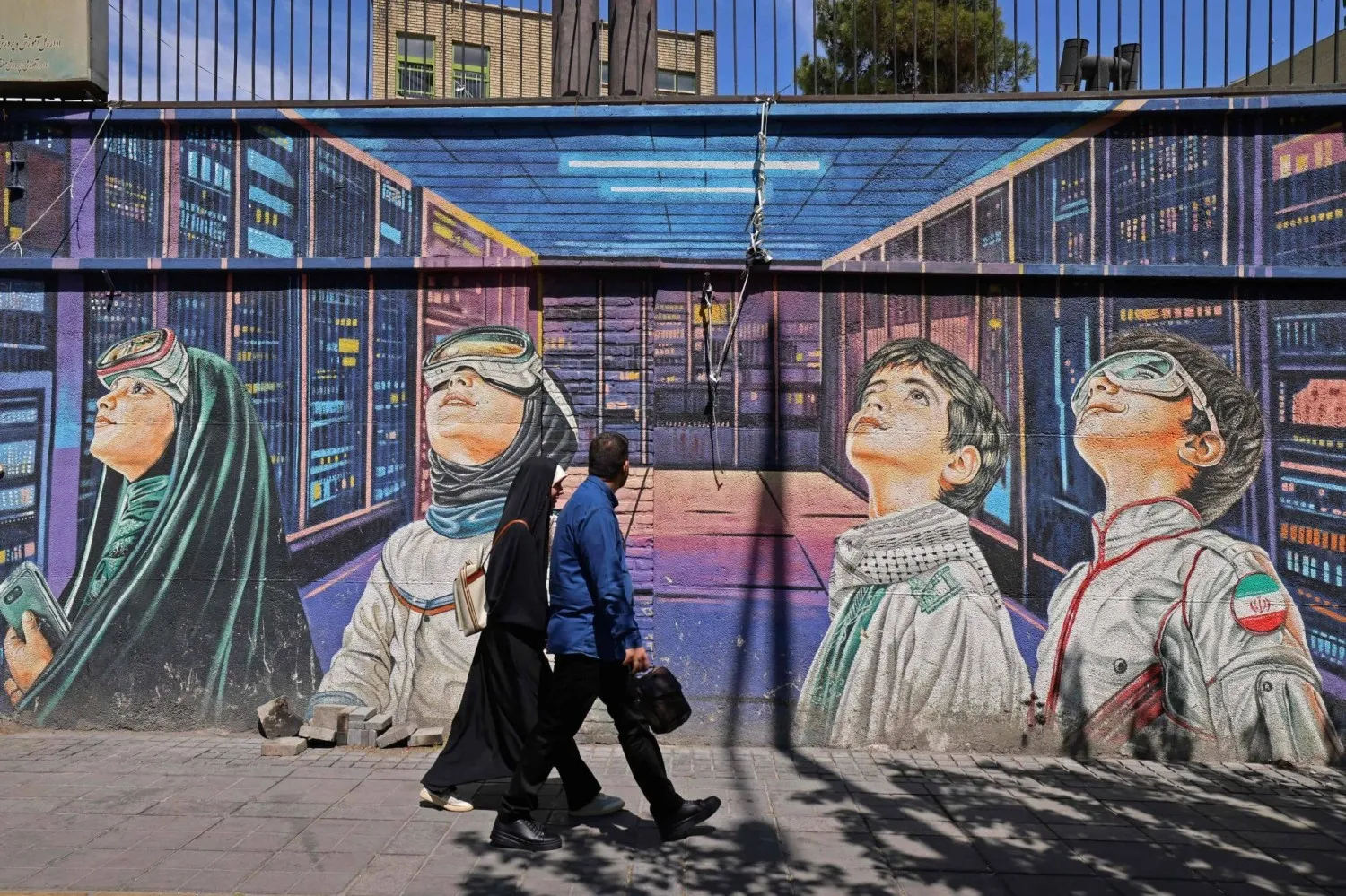
People walk past a wall mural along the roadside in Tehran on Sunday. AFP
TT

As US Talks Fail, Iranians Caught Between ‘War and Peace’

People walk past a wall mural along the roadside in Tehran on Sunday. AFP

Iranians reacted with a mixture of disappointment and defiance on Sunday after 21 hours of talks between the US and Iran ended without an agreement, casting fear over the future of a fragile two-week ceasefire and the possible comeback of military escalation, according to AP and AFP.

US officials said the talks collapsed over what they described as Iran's refusal to commit to abandoning its nuclear program. Iranian officials blamed the US for failing to reach a deal, without specifying the sticking points.

While the fragile ceasefire seems to hold, the war is not over and uncertainty remains on the streets of Tehran where some residents were reluctant to speak to the media.

After weeks of war between Iran and the US, Iranians clung to hopes that negotiations could bring an end to the fighting – only to have them dashed when the talks failed.

“I really wanted them to make peace,” said Mahsa, a 30-year-old employee of an export company in the Iranian capital.

“It’s been almost 45 days now that I’ve seen everyone stressed. It’s a bad situation,” she said.
Iranians have been living in digital blackout for over a month after the internet was blocked shortly after the war started on Feb. 28.

Since then, the population has been relying on state-controlled media, with a limited number of people having access to overseas satellite TV channels for access to information, according to AP.

Standing outside a newsstand in the capital, Tehran, Farhad Simia told AP he had hoped for successful negotiations and an end to the fighting, but stood with Iran despite the failure of the talks.

“I'm against war. I think negotiation is the better path,” Simia, 43, said. He blamed “inappropriate demands” by the US for the failure to reach a deal.

Mehdi Hosseini, also 43, agreed: “Considering the advantage Iran seemed to have on the battlefield, there was a real concern that we might lose all those gains in the negotiations.”
Hosseini added, “Whether the talks succeed or not is one matter, but the fact that the Iranian negotiating team managed to preserve what it achieved in the war, while refusing to back down and surrender, gives reason for hope.”

The streets of Tehran were lined up with large Iranian flags and giant billboards glorifying the country's leaders and military achievements. One large illustration depicted Iranian men in uniform lifting a fishing net out of the sea with a catch of miniature-sized US military aircraft and warships. “The Strait Remains Closed,” the billboard read.

Hamed, 37, said the failure to reach a deal signaled more fighting ahead.

“I would have preferred peace, but I think there is no other way but war and confrontation,” he told AFP. “Based on what I see and hear, unfortunately, we are going to war again, and it seems like we will have a long war,” he added.

Nahid, a 60-year-old housewife in Tehran, said: “We feel despair and hopelessness. We are tired of this uncertainty.”

Iran says 3,375 people were killed during the war with the United States and Israel, according to the head of the country’s Forensic Medicine.

But Iranian organizations operating from outside the country said more than 3,600 people were killed in the fighting, reflecting the high number of human losses.

Hours before the ceasefire was announced, US President Donald Trump warned that “a whole civilization will die... never to be brought back again” as he threatened to bomb infrastructure across Iran.

“I was stressed until 3am... No one slept that night,” Mahsa said.

Although disappointed, 42-year-old shop owner Farhad said he had expected the talks to fail.
“We knew from the beginning that the other side did not want to reach a conclusion,” he said, referring to the US.



Italian PM Condemns ‘Unacceptable’ Trump Criticism of Pope

Italian Prime Minister Giorgia Meloni gestures in the Senate chamber during the briefing to Parliament on the government's activities in Rome, Italy, 09 April 2026. (EPA)
TT

Italian PM Condemns ‘Unacceptable’ Trump Criticism of Pope

Italian Prime Minister Giorgia Meloni gestures in the Senate chamber during the briefing to Parliament on the government's activities in Rome, Italy, 09 April 2026. (EPA)

Italian Prime Minister Giorgia Meloni on Monday condemned US President Donald Trump's criticism of Pope Leo XIV as "unacceptable", after the US pontiff spoke out against the Middle East war.

"The Pope is the head of the Catholic Church, and it is right and normal for him to call for peace and to condemn all forms of war," she said in a statement.

It represents a rare rebuke of Trump by Meloni, a far-right leader who has sought to be a bridge between the conservative US president and European leaders.

Meloni earlier put out a statement supporting Pope Leo's efforts at peace and reconciliation in a trip to Africa, which began Monday, just hours after Trump launched a scathing criticism of the first US pontiff.

"I thought the meaning of my statement this morning was clear, but I will restate it more explicitly. I find President Trump's words about the Holy Father unacceptable," she said.

Speaking to reporters late Sunday, Trump said he was "not a big fan of Pope Leo", accusing the pontiff of "toying with a country (Iran) that wants a nuclear weapon".

The president later doubled down on his comments with a post on Truth Social, saying: "I don't want a Pope who thinks it's OK for Iran to have a Nuclear Weapon."

"Pope Leo is WEAK on Crime, and terrible for Foreign Policy," he said.

His comments drew outrage from many Italian politicians, while Catholic bishops from the United States and Italy were quick to defend the pontiff.

Leo himself told reporters on the plane to Algeria -- the first stop on a four-nation tour that also takes in Cameroon, Angola and Equatorial Guinea -- that he had a "moral duty" to speak out against war.

"I have no fear, neither of the Trump administration, nor speaking out loudly about the message of the Gospel," he said.


Middle East Ceasefire a ‘Priority’, China’s FM Tells Pakistan

Chinese Foreign Minister Wang Yi waves after a press conference on the sidelines of the National People's Congress (NPC), in Beijing, China, March 8, 2026. (Reuters)
TT

Middle East Ceasefire a ‘Priority’, China’s FM Tells Pakistan

Chinese Foreign Minister Wang Yi waves after a press conference on the sidelines of the National People's Congress (NPC), in Beijing, China, March 8, 2026. (Reuters)

Maintaining a ceasefire in the Middle East war is an "immediate priority" for resolving the conflict, China's top diplomat told his Pakistan counterpart in a phone call on Monday.

Pakistan's Prime Minister Shehbaz Sharif also said on Monday that the ceasefire between the United States and Iran was "holding" and that efforts were underway to reach an agreement after talks in Islamabad at the weekend failed to do so.

"The immediate priority is to make every effort toward preventing the resumption of hostilities and to maintain the hard-won ceasefire momentum," Wang Yi told Pakistan's Ishaq Dar, according to a Chinese foreign ministry statement.

Wang said a joint peace plan by China and Pakistan announced last month as the two officials met in Beijing "still can serve as a direction for efforts toward a resolution".


UN Maritime Chief Says No Country Has Right to Close Hormuz

FILE PHOTO: Cargo ships in the Gulf, near the Strait of Hormuz, as seen from northern Ras al-Khaimah, near the border with Oman’s Musandam governance, March 11, 2026. REUTERS/Stringer/File Photo
TT

UN Maritime Chief Says No Country Has Right to Close Hormuz

FILE PHOTO: Cargo ships in the Gulf, near the Strait of Hormuz, as seen from northern Ras al-Khaimah, near the border with Oman’s Musandam governance, March 11, 2026. REUTERS/Stringer/File Photo

The head of the UN maritime agency said Monday no country had a legal right to block shipping in the Strait of Hormuz, a trade passage paralysed by the US-Iran war.

The International Maritime Organization's Secretary General Arsenio Dominguez addressed a news conference as access to the strait remained blocked six weeks after the war erupted with US and Israeli strikes against Iran.

The United States had threatened to begin a blockade on Monday of Iranian ports in and around the strait, which Tehran's forces have been controlling access to since after the war broke out on February 28.

"In accordance to international law, no countries have the right to prohibit the right of innocent passage or the freedom of navigation through international straits that are used for international transit," Dominguez said.

Iranian authorities have been allowing a trickle of vetted vessels to pass the strait through a route close to their coast and in some cases have reportedly levied a payment to let vessels through.

"This principle of introducing a toll on an international strait for international navigation is against the international law of the sea and the customary law," Dominguez said.

"It will create a very dangerous precedent."

The US vow to blockade Iranian ports meanwhile "doesn't make it any easier", he added.

"De-escalation is what is going to start helping us to address the crisis and to bring shipping back to the way that we used to operate."

He predicted that the extra impact of a US blockade on shipping would be negligible, however.

"With the very few number of ships that have managed to transit, an additional blockade is not going to exacerbate the situation in a level that it could be perceived."