


Gulf Observers Outline Views on US Iran Talks, 14-Day Truce

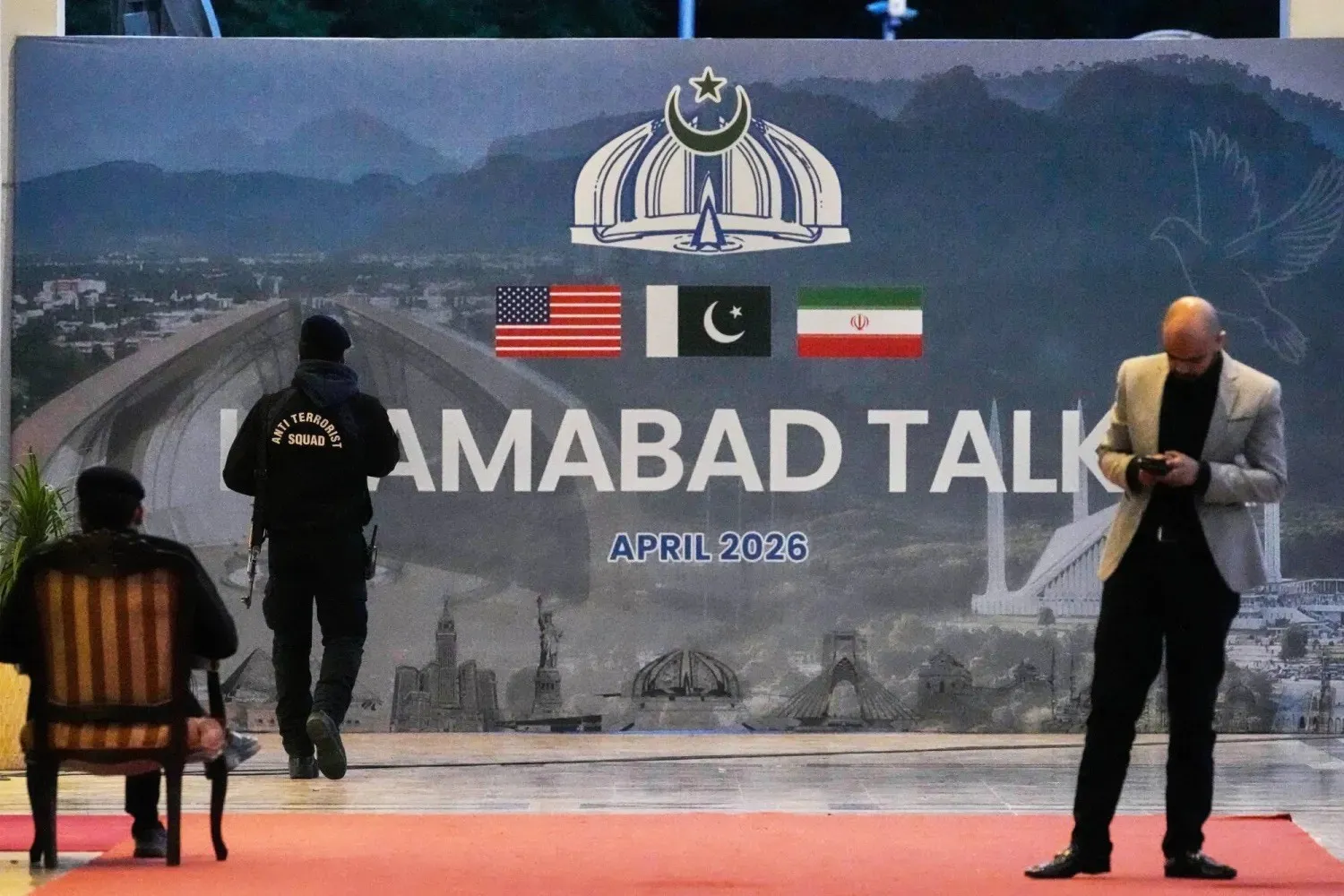
A security officer stands in front of a sign for the Islamabad talks outside a media center set up to cover negotiations between the United States and Iran (AP)
TT

Gulf Observers Outline Views on US Iran Talks, 14-Day Truce

A security officer stands in front of a sign for the Islamabad talks outside a media center set up to cover negotiations between the United States and Iran (AP)

As a 14-day truce announced by the United States and Iran, brokered by Pakistan on April 8, continues to hold, and just hours after the end of the US Iran “Islamabad talks” without an agreement, Gulf states are closely watching how the situation will evolve during the temporary ceasefire period.

Three Gulf observers shared their views in response to a question from Asharq Al-Awsat on how Gulf countries see the US-Iran negotiations and their options depending on whether a deal is reached. They broadly agreed on the importance of taking Gulf concerns into account in any negotiations.

Former Kuwaiti information minister Saad bin Tefla al-Ajmi said Gulf states are primarily concerned with two key issues, peace and stability. He stressed that under no circumstances should any Gulf country become party to negotiations over freedom of navigation in the Strait of Hormuz or support such talks, as this would amount to negotiating an established principle of international law.

Calls to assess all possible scenarios

Al-Ajmi stressed that freedom of navigation in international straits such as Hormuz, Gibraltar and Bab al-Mandab is governed by the 1982 United Nations Convention on the Law of the Sea and should not be turned into a subject of political bargaining, as this would contradict the principle of freedom of the seas.

As for options if no agreement is reached, he said this would depend on the positions of the two sides, Iran and the United States. Gulf countries, he remarked, opposed the war from the outset but are now “required to assess all possible scenarios following the outbreak of war and exposure to Iranian attacks.”

He questioned whether Washington would continue granting Tehran additional deadlines or move toward resuming hostilities. In any case, he noted that Gulf states must be prepared for all scenarios, including the possibility of renewed conflict.

Political analyst Moneef Ammash al-Harbi said Gulf states view the US-Iran negotiations positively, based on their belief that military solutions do not lead to lasting settlements. He added that Gulf countries had sought, before February 28, to steer the region away from a military path and its consequences.

No flawed deal

Al-Harbi underlined that Gulf states do not want a flawed agreement similar to the 2015 deal, which he said does not prevent Iran from acquiring nuclear weapons but merely delays it within a limited timeframe.

He outlined four Gulf requirements for any lasting agreement. These include preventing Iran from obtaining nuclear weapons to avoid a regional arms race, addressing the ballistic missile issue in terms of range and capabilities, curbing Iran’s destabilizing regional role and ending support for militias, and ensuring Iran respects freedom of navigation in the Straits of Hormuz and Bab al-Mandab without using direct or indirect means to disrupt it.

He warned that if no agreement is reached, Gulf states would keep all options open, including military action, particularly if Iranian attacks on Gulf countries continue.

Abdullah al-Junaid said Gulf influence was reflected in the ceasefire decision and in the choice of Pakistan as mediator. However, he noted that Gulf states “have not put forward a unified framework representing a minimum consensus on post crisis Gulf Iran relations and the safety of navigation in the Strait of Hormuz.”

Al-Junaid also noted that the US Navy is currently clearing the Strait of Hormuz to secure navigation, describing this as unrelated to the halted war. He said Gulf naval forces should join the effort, as it would send political as well as security signals.

“That is the diplomacy that should be pursued now, rather than relying solely on traditional approaches,” he remarked.



OIC, MWL Condemn Israeli Attacks on Lebanon

First responders gather at the site of an Israeli strike that hit near a hospital in the southern Lebanese city of Tyre on June 1, 2026. (Photo by KAWNAT HAJU / AFP)
TT

OIC, MWL Condemn Israeli Attacks on Lebanon

First responders gather at the site of an Israeli strike that hit near a hospital in the southern Lebanese city of Tyre on June 1, 2026. (Photo by KAWNAT HAJU / AFP)

The General Secretariat of the Organization of Islamic Cooperation (OIC) and the Muslim World League condemned on Monday the Israeli attacks on Lebanon, including the destruction of villages and archaeological sites in the country's south, the Saudi Press Agency reported.

In a statement, the OIC strongly condemned Israel's aggression as a flagrant violation of Lebanese sovereignty, international law, and international humanitarian law.

The secretariat expressed its strong condemnation of the continued Israeli attacks against Lebanon, warning that they pose a serious threat to security and stability in the region.

It reaffirmed the OIC's solidarity with Lebanon and its sovereignty, unity, and territorial integrity, calling on the international community to take immediate action to halt the aggression.

In its statement, the Muslim World League (MWL) denounced Israel’s attacks as a grave violation of all international and humanitarian norms and laws, as well as Lebanon's national sovereignty.

It affirmed support for all efforts aimed at promoting security and stability for the Lebanese people and strengthening the sovereignty of the state and the authority of its legitimate institutions throughout Lebanon, in accordance with government decisions, the Taif Agreement, and relevant international agreements.


Enayati to Asharq Al-Awsat: 30,000 Hajj Pilgrims Begin to Return Home from Saudi Arabia

Iranian pilgrims during this year’s Hajj. (Iranian Embassy in Saudi Arabia)
TT

Enayati to Asharq Al-Awsat: 30,000 Hajj Pilgrims Begin to Return Home from Saudi Arabia

Iranian pilgrims during this year’s Hajj. (Iranian Embassy in Saudi Arabia)

Iranian Hajj pilgrims began returning home from Saudi Arabia after completing their holy journey.

Iranian Ambassador to Saudi Arabia Alireza Enayati told Asharq Al-Awsat that some 30,000 Iranians performed the Hajj this year.

They were accorded a warm welcome and enjoyed generous hospitality like all over pilgrims, he added.

Saudi authorities announced that 1,707,301 pilgrims performed Hajj this year, including 1,546,655 from 165 countries, while the rest were comprised of Saudi citizens and residents of the Kingdom.

Enayati said the Iranian pilgrims began returning home of Monday and the departures are expected to continue until the end of the month.

He stressed that they enjoyed a smooth Hajj, like all other pilgrims.

Ambassador Enayati welcomes the head of the Iranian Hajj mission in Madinah. (Iranian Embassy in Saudi Arabia)

“They are now returning home safely,” he remarked, saying they had arrived by air to the Kingdom and they will head back to Iran the same way.

There is no need to transport them by land, as flights are operational and their departures will take place according to plans, he explained.

Enayati hailed the major means and developed services provided by Saudi Arabia at the holy sites, Makkah and Madinah, saying they allow the pilgrims to perform the rituals with ease and calm.

He underlined the level of coordination and cooperation between Iran’s Hajj and Pilgrimage Organization and the Saudi Ministry of Hajj and Umrah that ensured that the Iranian pilgrims had a smooth journey.

The ambassador expressed his gratitude to all Iranian and Saudi officials who exerted great efforts in service of the Hajj pilgrims and who made their journey smooth and secure and their welcome warm and hospitable.


Arab Parliament, MWL Strongly Condemn Iranian Aggression against Kuwait

Kuwait blamed Iran for the attack, saying it was a dangerous escalation and violation of its sovereignty. (KUNA)
TT

Arab Parliament, MWL Strongly Condemn Iranian Aggression against Kuwait

Kuwait blamed Iran for the attack, saying it was a dangerous escalation and violation of its sovereignty. (KUNA)

Speaker of the Arab Parliament Mohammed Al Yamahi condemned the Iranian attacks targeting Kuwait, stressing that they constitute a violation of international law and the United Nations Charter and represent an escalation that threatens the security and stability of Kuwait and the region.

He reiterated the Arab Parliament’s full solidarity with Kuwait and support for the measures it is taking to protect its security, sovereignty, and territorial integrity.

Al Yamahi emphasized that Kuwait’s security is an integral part of pan-Arab national security, underscoring the Arab Parliament’s rejection of all attacks targeting the sovereignty, security, and stability of Arab states, SPA reported.

He also called on the international community and the United Nations Security Council to assume their responsibilities in stopping these attacks, ensuring respect for international law and preserving regional and international security and stability.


Also, the Muslim World League (MWL) strongly condemned the heinous Iranian aggression against Kuwait.

In a statement, Secretary-General of the Muslim World League and Chairman of the Organization of Muslim Scholars Sheikh Dr. Mohammed bin Abdulkarim Al-Issa renewed his condemnation of the repeated Iranian attacks against the State of Kuwait. He stressed that such criminal acts violate religious values as well as international law, norms, and humanitarian principles.

He reaffirmed the MWL’s full solidarity with the State of Kuwait, its leadership, government, and people. He also expressed support for all measures taken to safeguard the country’s security, sovereignty, and the safety of its citizens and residents.