


Pakistan Says Looking at Options to Repay $3.5 Billion UAE Loan

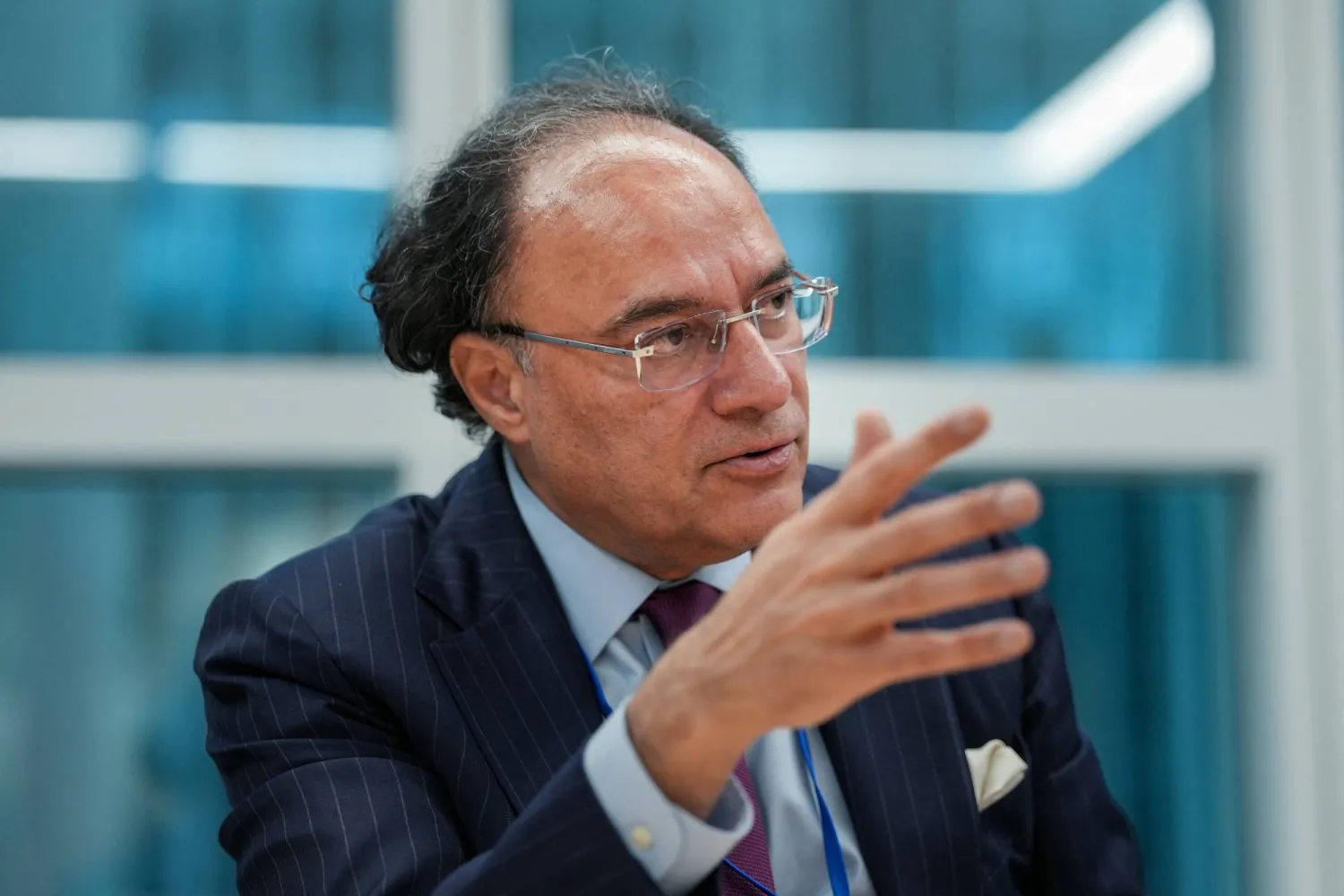
Pakistan Finance Minister Muhammad Aurangzeb speaks during an interview at the International Monetary Fund and World Bank Group’s annual spring meetings in Washington D.C., US, April 13, 2026. REUTERS/Ken Cedeno
TT

Pakistan Says Looking at Options to Repay $3.5 Billion UAE Loan

Pakistan Finance Minister Muhammad Aurangzeb speaks during an interview at the International Monetary Fund and World Bank Group’s annual spring meetings in Washington D.C., US, April 13, 2026. REUTERS/Ken Cedeno

Pakistan is considering Eurobonds, loans from other countries and commercial debt to replace a $3.5 billion facility from the United Arab Emirates (UAE) and manage its foreign reserves, its finance minister said.

Muhammad Aurangzeb also told Reuters the shock from the ongoing war in the Middle East meant that Pakistan must consider a strategic petroleum reserve and a faster switch to renewable energy.

"All options are on the table," Aurangzeb said when asked if the government was in talks with Saudi Arabia for a loan that could replace the UAE facility.

Reuters reported that Pakistan will return a $3.5 billion loan to the UAE this month, putting pressure ⁠on its reserves ⁠and risking breaches of its International Monetary Fund (IMF) program targets.

The South Asian country has been thrust into the international spotlight as it plays the role of a mediator between the US and Iran to end the war in the Middle East.

Aurangzeb, speaking on the sidelines of the IMF/World Bank annual spring meetings, said the country could manage all debt repayments, and that its reserves remained at roughly 2.8 months of import cover. Maintaining at least that ⁠level, he said, would be "an important aspect of our overall macro stability as we go forward."

"We are looking at Eurobond, we are looking at Islamic sukuk, we are looking at dollar-settled rupee-linked bonds," Aurangzeb said, adding that they expected to issue Eurobonds this year and are also exploring commercial loans.

Aurangzeb said while the country had not yet requested any addition or changes to its $7 billion IMF lending program due to the economic shocks of the war in the Middle East, it was a potential option.

"Depending upon how things pan out over the next few weeks, that's something which can be discussed," he said.

The Fund's board is likely to sign off on the latest lending tranche by the end ⁠of this month ⁠or early next month, Aurangzeb said, which would unlock just under $1.3 billion via the Extended Fund Facility and the Resilience and Sustainability Facility.

Pakistan also expects to launch its first-ever Panda bond - debt denominated in Chinese yuan - next month, he said. The $250 million issue, the first of a planned $1 billion program, will be backed by the Asian Development Bank and the Asian Infrastructure Investment Bank.

Aurangzeb said the country's expected GDP growth of close to 4%, remittances of around $41.5 billion and targeted assistance to the poorest citizens could withstand the Iran war shock for this fiscal year, which ends on June 30.

But the price spikes meant the country should focus on establishing strategic reserves of fuels and LPG - rather than simply relying on commercial reserves - and accelerate its move towards renewable energy.

"When you go through a supply shock like this... it sends a very clear view that we need to accelerate these journeys," he said.




IMF Says World Is Drifting Toward More Adverse Growth Scenario as Energy Disruptions Continue

Pierre-Olivier Gourinchas, Director of IMF Research Department, speaks during an economic outlook briefing during the 2026 IMF and World Bank Group Spring Meetings in Washington, DC, on April 14, 2026. (AFP)
TT

IMF Says World Is Drifting Toward More Adverse Growth Scenario as Energy Disruptions Continue

Pierre-Olivier Gourinchas, Director of IMF Research Department, speaks during an economic outlook briefing during the 2026 IMF and World Bank Group Spring Meetings in Washington, DC, on April 14, 2026. (AFP)

The world may be already drifting towards the International Monetary Fund's "adverse scenario" forecast of weaker 2.5% global growth in 2026 even as it released ‌on Tuesday ‌a more benign ‌reference ⁠forecast of 3.1% growth, ⁠IMF chief economist Pierre-Olivier Gourinchas said.

Gourinchas told a news conference that the reference forecast assumes that the conflict is ⁠resolved quickly and that energy ‌prices ‌normalize in the second ‌half of 2026, but acknowledged ‌that the war's developments are fluid and changing daily. He said the reference forecast ‌was "not quite yet" irrelevant.

"I would say that we ⁠are ⁠somewhere in between the reference scenario and the adverse scenario," Gourinchas said.

"And of course, every day that passes and every day that we have more disruption in energy, we are drifting closer towards the adverse scenario."


Iraq Says Has ‘Understandings’ to Bypass Hormuz Blockade

A worker rides a bicycle at the Zubair oil field in Basra, Iraq, April 6, 2026. (Reuters)
TT

Iraq Says Has ‘Understandings’ to Bypass Hormuz Blockade

A worker rides a bicycle at the Zubair oil field in Basra, Iraq, April 6, 2026. (Reuters)

Baghdad's oil ministry said Tuesday it has "understandings" with the United States and Iran to reduce the impact of the blockade of the Strait of Hormuz on Iraqi oil exports.

The ministry did not elaborate or say when these reported understandings were reached.

But Iran announced earlier this month -- before the fragile ceasefire was reached last Wednesday with the United States -- that it would allow Iraqi shipping to transit the key waterway.

Iraqi oil ministry spokesperson Saheb Bazoun told the Iraqi News Agency (INA) "there are understandings with the American and Iranian sides to circumvent the blockade imposed on the Strait of Hormuz, and with all parties to guarantee exports".

A founding member of the OPEC oil cartel, Iraq normally exports the majority of its crude through the strait, but like other exporters in the oil-rich region, it has been left scrambling for alternative routes.

Bazoun told INA that Iraq was continuing to use secondary export routes, including a pipeline to the Turkish port of Ceyhan and via Syria's Baniyas port.

Authorities announced earlier this month Iraq has begun exporting crude using tanker trucks through Syria, after resuming oil exports of 250,000 barrels per day through Ceyhan.

The Middle East war has wrought havoc on energy markets, especially after Iran tightened the screws on the Strait of Hormuz -- through which roughly a fifth of global oil and gas passes -- sharply slowing maritime traffic, and reportedly charging transit fees.

Despite the two-week ceasefire between the United States and Iran, and after a failed attempt to reach an agreement, Washington imposed a blockade on Iranian ports in the Strait of Hormuz, sending tremors through global energy markets.

Oil exports account for some 90 percent of Iraq's budget revenues, which plummeted more than 70 percent in March compared with February.


Saudi Arabia Boosts Water Efficiency with Over $26.7 Billion in Investments Since 2018

Shuaibah Desalination Plant (Saudi Water Authority)
TT

Saudi Arabia Boosts Water Efficiency with Over $26.7 Billion in Investments Since 2018

Shuaibah Desalination Plant (Saudi Water Authority)

Saudi Arabia has invested about SAR100 billion ($26.7 billion) in its water sector since 2018, as part of its National Water Strategy to improve efficiency and sustainability while expanding private sector participation in line with Vision 2030.

Deputy Minister for Water at the Ministry of Environment, Water and Agriculture Abdulaziz Al-Shaibani told Asharq Al-Awsat that increased public-private partnerships are driving a shift toward a more efficient operating model and easing pressure on the state budget.

He said private sector involvement has transferred capital costs for major projects, including desalination plants, transmission networks, storage facilities and wastewater treatment, while boosting value across the supply chain through water reuse and reducing reliance on non-renewable resources.

Lower operating costs have also strengthened the sector’s appeal to investors. Seawater desalination using reverse osmosis now costs about SAR0.74 per cubic meter, while groundwater desalination costs around SAR0.55, offering competitive returns for local and international investors.

Local content in privatization projects has reached about 70 percent, while Saudis account for 90 percent of operational jobs, highlighting the sector’s contribution to economic growth and employment.

Al-Shaibani said investment in research and development has helped reduce production costs and localize key technologies, including reverse osmosis membrane manufacturing, valued at SAR 1.14 billion ($304 million). This supports the development of domestic supply chains and increases economic value added.

According to data from the Saudi Water Partnership Company (SWPC), 51 privatization projects have been launched with total investments of about SAR56 billion ($14.9 billion), including operational projects and others under development or tender.

Private sector production capacity is expected to reach 2.6 million cubic meters per day by 2030 and rise to 8.18 million cubic meters per day by 2032. Water transmission capacity between cities is projected to reach 2.43 million cubic meters per day by 2029, while strategic storage capacity is expected to reach just over 7 million cubic meters.

Major projects include the Juranah Independent Strategic Water Reservoir in Makkah province, with a capacity of 2.5 million cubic meters, the Rayis-Rabigh Independent Water Transmission Project, and the Rabigh 3 Independent Water Plant, all developed under long-term contracts to ensure sustainability.

The Al-Khafji solar-powered desalination plant, one of the world’s leading projects of its kind, has reduced desalination costs by about 40 percent, supporting more efficient and sustainable production.
