


US Hosts Lebanese and Israeli Envoys as Israel Presses War on Hezbollah

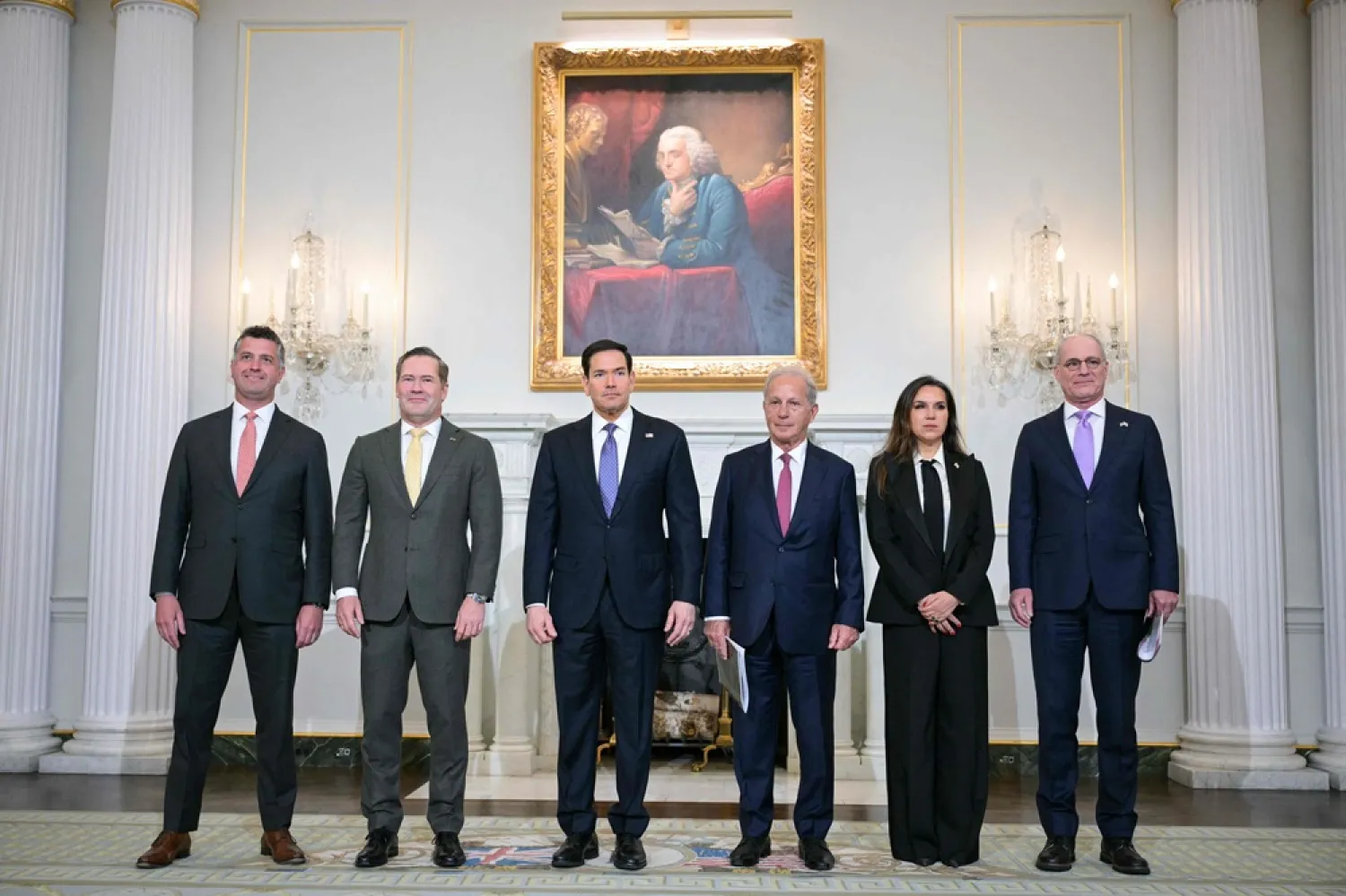
(L/R) US State Department Counselor Michael Needham, US Ambassador to the UN Mike Waltz, US Secretary of State Marco Rubio, US Ambassador to Lebanon Michel Issa, Lebanon's Ambassador to the US Nada Hamadeh Moawad, and Israeli Ambassador to the US Yechiel Leiter stand together before meeting at the State Department in Washington, DC, on April 14, 2026. (AFP)
TT

US Hosts Lebanese and Israeli Envoys as Israel Presses War on Hezbollah

(L/R) US State Department Counselor Michael Needham, US Ambassador to the UN Mike Waltz, US Secretary of State Marco Rubio, US Ambassador to Lebanon Michel Issa, Lebanon's Ambassador to the US Nada Hamadeh Moawad, and Israeli Ambassador to the US Yechiel Leiter stand together before meeting at the State Department in Washington, DC, on April 14, 2026. (AFP)

Lebanese and Israeli envoys met in Washington on Tuesday as Israel pressed its war on Iran-backed Hezbollah, a diplomatic milestone overshadowed by conflicting agendas with Israel ruling out discussion of a ceasefire and demanding Beirut disarm the group. 

The meeting comes at a critical juncture in the crisis in the Middle East, a week into a fragile ceasefire between the United States, Israel and Iran.  

Iran says Israel's campaign against Hezbollah in Lebanon must be included in any agreement to end the wider war, complicating talks mediated by Pakistan aimed at averting further economic fallout.  

The conflict has snared global energy supply and spiked oil prices, piling pressure on US President Donald Trump to find an off-ramp.  

In a sign Washington wants to see progress in the talks, Trump's top diplomat and National Security Advisor Marco Rubio appeared at the start of the meeting alongside the Israeli ambassador to the US, Yechiel Leiter, and his Lebanese counterpart, Nada Hamadeh Moawad. State Department Counselor Michael Needham, US ambassador to the United Nations ‌Mike Waltz, and ‌US ambassador to Lebanon Michel Issa, a personal friend of Trump, were also participating. 

It marks a rare ‌encounter ⁠between representatives of governments ⁠that have remained technically in a state of war since Israel was established in 1948. 

LEBANON SEEKS CEASEFIRE  

Lebanese President Joseph Aoun said in a statement on X as the meeting started that he hoped it would "mark the beginning of ending the suffering of the Lebanese people in general, and the southerners in particular." 

"The only solution lies in the Lebanese army re-deploying up to the internationally recognized border, and so being solely responsible for the security of the area and the safety of its residents, without the partnership of any other party," Aoun added. 

The Lebanese government led by Aoun and Prime Minister Nawaf Salam has called for negotiations with Israel despite objections from Hezbollah, reflecting worsening tensions between the group and its opponents. 

Hezbollah opened fire in support of Tehran on March 2, sparking an Israeli offensive that has killed more than 2,000 people and forced 1.2 million from their homes, according to Lebanese authorities. 

Lebanese officials have said Moawad ⁠only has authority to discuss a ceasefire in Tuesday's meeting. 

But Israeli government spokesperson Shosh Bedrosian said Israel ‌would not discuss a ceasefire.  

Israeli Foreign Minister Gideon Saar told reporters in Jerusalem ahead ‌of the meeting that talks would focus on the disarmament of Hezbollah, which he said must take place before Israel and Lebanon could sign ‌any peace agreement and normalize relations. 

He said Hezbollah was a problem for Israel's security and Lebanon's sovereignty "and this problem needs ‌to be addressed in order to move to a different phase." 

"We want to reach peace and normalization with the state of Lebanon," he said. 

The Lebanese state has been seeking to disarm Hezbollah peacefully since a war between the group and Israel in 2024. Any move by Lebanon to disarm it by force risks igniting conflict in a country shattered by civil war from 1975 to 1990. Moves against Hezbollah by a Western-backed government in 2008 prompted armed ‌clashes. 

The current government banned Hezbollah's military wing after it opened fire on Israel last month. 

'AT WAR WITH HEZBOLLAH, NOT LEBANON' 

Israel and the US have said the campaign ⁠against Hezbollah was not part of ⁠the Iran-US ceasefire, though Pakistan's prime minister had said the truce would include Lebanon, as Iran had demanded. 

While Israel has pressed attacks in Lebanon, it has launched no airstrikes in Beirut since last Wednesday, when it pounded the capital during a 10-minute barrage that killed hundreds of people across Lebanon. 

The following day, US President Donald Trump, in an interview with NBC News, said Israeli Prime Minister Benjamin Netanyahu had told him he would "low-key it" in Lebanon. 

A US State Department official said that Israel was at war with Hezbollah, not Lebanon, and so there was no reason they should not talk, describing the talks as direct, high-level and the first of their kind since 1993. 

The conversation would "scope the ongoing dialogue about how to ensure the long-term security of Israel's northern border and to support the Government of Lebanon's determination to reclaim full sovereignty over its territory and political life". 

Hezbollah leader Naim Qassem on Monday called on the government to cancel the meeting, saying Hezbollah would continue to confront Israeli attacks on Lebanon. 

In Lebanon, the dead include 252 women and 166 children, the health ministry says. Sources familiar with the matter said on March 27 that more than 400 Hezbollah fighters have been killed. Since March 2, 13 Israeli soldiers have been killed in Lebanon, while Hezbollah attacks have killed two Israeli civilians. 

'SEIZE THIS OPPORTUNITY' 

Foreign ministers from 17 countries, including the UK, Tuesday urged Israel and Lebanon to "seize this opportunity" in a statement ahead of the talks in Washington.  

Britain's foreign ministry posted the ministers' joint statement saying "direct negotiations can pave the way to bring lasting security for Lebanon and Israel as well as the region".  

The statement called "upon all parties to urgently deescalate and seize the opportunity offered by the ceasefire between the United States and Iran".  

It was signed by ministers from Britain and Australia and European countries such as France, Belgium, the Netherlands and Spain, but not Germany, Austria, Hungary or Italy.  

The statement said that signatories "condemn in the strongest terms" both attacks by Hezbollah on Israel and "massive Israeli strikes on Lebanon".  

The countries said they welcomed the initiative by President Aoun to open direct talks and were "ready to support" discussions. 


Ambassadors Set to Meet Again Ahead of Launch of Lebanon-Israel Negotiations

 From left, Michael Needham, counselor for the US Dept. of State, US Ambassador to the United Nations Mike Waltz, Secretary of State Marco Rubio, US Ambassador to Lebanon Michel Issa, Lebanese Ambassador to the US Nada Hamadeh Moawad, and Israeli Ambassador to the US Yechiel Leiter pose for a photo before a meeting at the State Department in Washington, Tuesday, April 14, 2026. (AP)
From left, Michael Needham, counselor for the US Dept. of State, US Ambassador to the United Nations Mike Waltz, Secretary of State Marco Rubio, US Ambassador to Lebanon Michel Issa, Lebanese Ambassador to the US Nada Hamadeh Moawad, and Israeli Ambassador to the US Yechiel Leiter pose for a photo before a meeting at the State Department in Washington, Tuesday, April 14, 2026. (AP)
TT

Ambassadors Set to Meet Again Ahead of Launch of Lebanon-Israel Negotiations

 From left, Michael Needham, counselor for the US Dept. of State, US Ambassador to the United Nations Mike Waltz, Secretary of State Marco Rubio, US Ambassador to Lebanon Michel Issa, Lebanese Ambassador to the US Nada Hamadeh Moawad, and Israeli Ambassador to the US Yechiel Leiter pose for a photo before a meeting at the State Department in Washington, Tuesday, April 14, 2026. (AP)
From left, Michael Needham, counselor for the US Dept. of State, US Ambassador to the United Nations Mike Waltz, Secretary of State Marco Rubio, US Ambassador to Lebanon Michel Issa, Lebanese Ambassador to the US Nada Hamadeh Moawad, and Israeli Ambassador to the US Yechiel Leiter pose for a photo before a meeting at the State Department in Washington, Tuesday, April 14, 2026. (AP)

Lebanon’s and Israel’s ambassadors to Washington are preparing for a second meeting after an initial round on Tuesday at the US State Department, hosted by Secretary of State Marco Rubio.

The meeting is aimed at shaping talks and securing a ceasefire pushed by Washington before launching a negotiation track between the two countries.

Lebanon is pressing ahead with direct negotiations with Israel under US sponsorship, describing it as the only viable option to end the war, as the military track has stalled and failed to secure a ceasefire for 45 days, according to ministerial sources following the talks.

The sources said Washington is acting as “mediator, facilitator, and driver of the talks,” while also “pressuring Tel Aviv to implement a ceasefire.”

Rubio launched the talks on Tuesday, attended by Lebanon’s ambassador to Washington, Nada Hamadeh Moawad, and Israel’s ambassador Yechiel Leiter.

He described the meeting as the beginning of a long process aimed at reaching a final solution to Hezbollah’s influence in the region, rather than merely securing a ceasefire.

Second meeting

Lebanese ministerial sources said the first session marked “the start of a process aimed at reaching a ceasefire agreement that would pave the way for negotiations under a mechanism to be agreed upon.”

They stressed the meeting was not a negotiating round, but a launch of the process, to be followed by setting a date for formal talks.

The sources revealed a second meeting would be held between the two ambassadors under US mediation to cement a ceasefire and continue the process afterward.

Rubio cautioned that the complexities of the conflict would not be resolved in a single day, framing the meeting as a “process” to lay the groundwork for future peace.

However, the sources said the atmosphere was “not tense and did not produce negative signals,” adding that Rubio “played a key role in backing the Lebanese position on implementing a ceasefire and strongly pushed for meeting Lebanon’s condition to move the file forward toward negotiations.”

Freedom of action

Lebanon is insisting on implementing the ceasefire agreement reached in November 2024, which it says Israel violated.

According to Asharq Al-Awsat sources, Beirut is demanding an end to Israeli assassinations, warnings, and attacks carried out over the past 15 months, demands Israel rejects as it insists on maintaining “freedom of action.”

The sources said the Israeli side presented its own vision, while Lebanon presented its demands through Moawad, with the US side speaking before the exchange of ideas began.

Rubio then intervened to support the Lebanese push for a ceasefire, they added, describing the US role as “more than a facilitator,” with the secretary of state acting as a driver of the talks.

The ambassadors’ role is expected to conclude once a ceasefire is secured, after which a formal negotiation will begin at a location yet to be determined. Participants have already been agreed upon by both sides, with technical committees to be formed later for follow-up and discussions.

Framework agreement

A framework agreement for negotiations is expected once a ceasefire is reached. Lebanon’s priorities begin with an Israeli withdrawal from occupied territories, followed by the return of residents, reconstruction, and the release of detainees. Israel, however, insists on disarming Hezbollah during these stages.

Lebanese estimates suggest progress would be step-by-step, with each issue addressed before moving to the next.

For Lebanon, the track represents the only available path to end the war, death, and destruction.

Despite opposition from Hezbollah, Beirut points to precedents of direct negotiations, including the 1949 armistice agreement; the May 17, 1983 talks; the Madrid and Washington negotiations in 1993; and UN-sponsored maritime border talks in 2022, where representatives of both sides sat in the same room without addressing each other directly, instead speaking through US or UN mediators.

Political backing

The negotiation track has garnered domestic political support, except from Hezbollah.

Interior Minister Ahmad al-Hajjar said Lebanon’s priority is reaching a ceasefire, stressing the importance of support from friendly and allied countries, as well as the key role of UN agencies, particularly as more than one million Lebanese have been displaced during the conflict.

The Kataeb party welcomed the launch of direct negotiations under US sponsorship, calling it “the only way to secure a ceasefire, end hostilities, ensure Israel’s withdrawal from occupied areas in southern Lebanon, enable displaced residents to return, achieve stability in Lebanon, and establish peace.”

It stressed the need for the Lebanese state to continue implementing its decisions on seizing all illegal weapons and banning Hezbollah’s military and security activities across Lebanese territory.


Sudan War ‘Nightmare Must End’, UN Chief Tells Aid Meeting

United Nations Secretary-General Antonio Guterres speaks during a press conference, following an escalation between Hezbollah and Israel amid the US-Israeli conflict with Iran, in Beirut, Lebanon, March 14, 2026. (Reuters)
TT

Sudan War ‘Nightmare Must End’, UN Chief Tells Aid Meeting

United Nations Secretary-General Antonio Guterres speaks during a press conference, following an escalation between Hezbollah and Israel amid the US-Israeli conflict with Iran, in Beirut, Lebanon, March 14, 2026. (Reuters)

UN Secretary-General Antonio Guterres on Wednesday said the third anniversary of Sudan's war marked a "tragic milestone" and called for an end to the "nightmare".

"Today marks three years since the war in Sudan began," Guterres told a meeting of international donors in Berlin via a video message.

"It is a tragic milestone in a conflict that has shattered a country of immense promise -- and created the world's largest humanitarian crisis."

Guterres noted that "credible allegations of the gravest international crimes" were continually emerging from the conflict.

"Women and girls have been terrorized and systematic sexual violence has prevailed. Families and communities have been devastated," he said.

"The consequences are not confined to Sudan. They are destabilizing the wider region... This nightmare must end."

Guterres called for humanitarian workers to be allowed to carry out their work safely and without obstruction, and for humanitarian operations to be fully funded.

"Partners must step up. But let's be clear: funding alone cannot substitute for peace," he said, calling for "an immediate cessation of hostilities".

"External interference and the flow of arms that fuel this war must finally end."


Israeli Settlers Block Palestinian Kids’ Path to School with Tear Gas and Barbed Wire

 Palestinian students walk to school using an alternative route that is nearly twice as long because a fence separates their village from the nearby Israeli settlement of Carmel, near the West Bank village of Umm al-Khair, Tuesday, April 14, 2026. (AP)
Palestinian students walk to school using an alternative route that is nearly twice as long because a fence separates their village from the nearby Israeli settlement of Carmel, near the West Bank village of Umm al-Khair, Tuesday, April 14, 2026. (AP)
TT

Israeli Settlers Block Palestinian Kids’ Path to School with Tear Gas and Barbed Wire

 Palestinian students walk to school using an alternative route that is nearly twice as long because a fence separates their village from the nearby Israeli settlement of Carmel, near the West Bank village of Umm al-Khair, Tuesday, April 14, 2026. (AP)
Palestinian students walk to school using an alternative route that is nearly twice as long because a fence separates their village from the nearby Israeli settlement of Carmel, near the West Bank village of Umm al-Khair, Tuesday, April 14, 2026. (AP)

Hajar and Rashid Hathaleen have always walked to school from their neighborhood on the outskirts of Umm al-Khair. But when classes resumed this week for the first time since the Iran war began, coiled barbed wire blocked the Palestinian siblings' path to the village center.

Israeli settlers had installed it overnight, according to video that Palestinian residents provided to The Associated Press. Palestinians say the improvised fence is just the latest attempt by settlers to expand control in part of the occupied West Bank where state-backed demolitions, arson and vandalism regularly occur and settler violence, at times lethal, is rarely prosecuted.

The villagers' plight was covered in the 2024 Oscar-winning documentary “No Other Land," but the publicity has done little to stem the bloodshed or curb land grabs. They say Israel has used the cover of the Iran war to tighten its grip over the territory, as settler attacks surge and the military imposes additional wartime restrictions on movement, citing security.

Khalil Hathaleen, head of the village council and a member of the extended family that makes up much of Umm al-Khair’s population, said settlers were exploiting the war to seize land, cut down olive groves and raid nearby villages at night. “It was a good chance for settlers to do what they want, with no rules,” he said.

Like in Israel, Palestinian kids stayed home before last week's ceasefire, with the threat of falling missile debris leading schools to close.

Hajar, her brother Rashid and their classmates sat waiting Monday and Tuesday near Israeli flags, the barbed wire and newly felled trees as their parents and village leaders demanded they be allowed to pass. On Monday, the children were met by plumes of tear gas and sound grenades hurled by armed men in an unmarked white truck, including some uniformed soldiers, according to the video.

Israel’s military said troops used “riot dispersal means” outside Carmel, the settlement next to Umm al-Khair. It acknowledged that children were present but said the measures — which it didn't detail — were directed at adults in the area, not the children. The Har Hevron Regional Council, the settlements' local government in the area, did not respond to questions about the fence.

Bedouins and other villagers have been using the 3-kilometer (1.8-mile) path from the neighborhood of Khirbet Umm al-Khair to the village center for decades. “We are determined to keep it,” Khalil Hathaleen said.

The fence is just another way that Palestinian movement is being restricted as Israeli settlements multiply in the occupied West Bank. Palestinians say it follows a well-worn pattern in which settlers erect fences or claim farmland that Palestinians say is theirs, and then move to enforce this new reality with the backing of Israel’s military.

Hathaleen said Israeli forces sometimes restrain the settlers, but more often than not they defer to them.

“We are refused a solution,” he said.

The international community overwhelmingly considers the settlements illegal. Israel, meanwhile, views the territory as disputed and says its final status is subject to negotiations. The outposts are built without the permission of Israeli authorities, who sometimes dismantle them, but other times turn a blind eye or even legalize them retroactively.

Hathaleen said the military's civil administration unit told Umm Al-Khair to divert students to another path. But parents said the alternate route is roughly twice as long and more dangerous, requiring them to pass near Carmel.

“We have deep concerns as parents and as residents that the (Israeli) occupation and soldiers will attack students,” said Al-Mutasim Hathaleen, another parent.

On Tuesday, some students got to school on buses that took the alternate route. But classrooms sat half-empty and the playground was deserted. There was no school on Wednesday due to Palestinian Authority cuts to teacher salaries in the area. But on Thursday, kids will try again to get to school on their regular route, Khalil Hathaleen said.

Testing the settlers' resolve could be risky.

Israeli officials and military leaders have recently sounded the alarm over intensifying violence and lawlessness by extremist settlers in the occupied West Bank, where arsons and deadly attacks have continued unabated. At least 35 Palestinians have been killed by Israeli soldiers and settlers across the territory in 2026. Settlers have killed eight Palestinians — an equal number to all of 2025.

The Israeli rights group B’Tselem, following the killing of a 23-year-old Palestinian man by a settler, said that what it called “daily unbridled violence” amounted to Israeli government policy, noting that many of those involved are army reservists.

“These militias are fully backed by the state of Israel and enjoy complete impunity for killing, assaulting and looting Palestinian residents,” it said.
