


Pakistani Army Chief Visits Tehran in Bid to Broker Renewed Talks between US and Iran

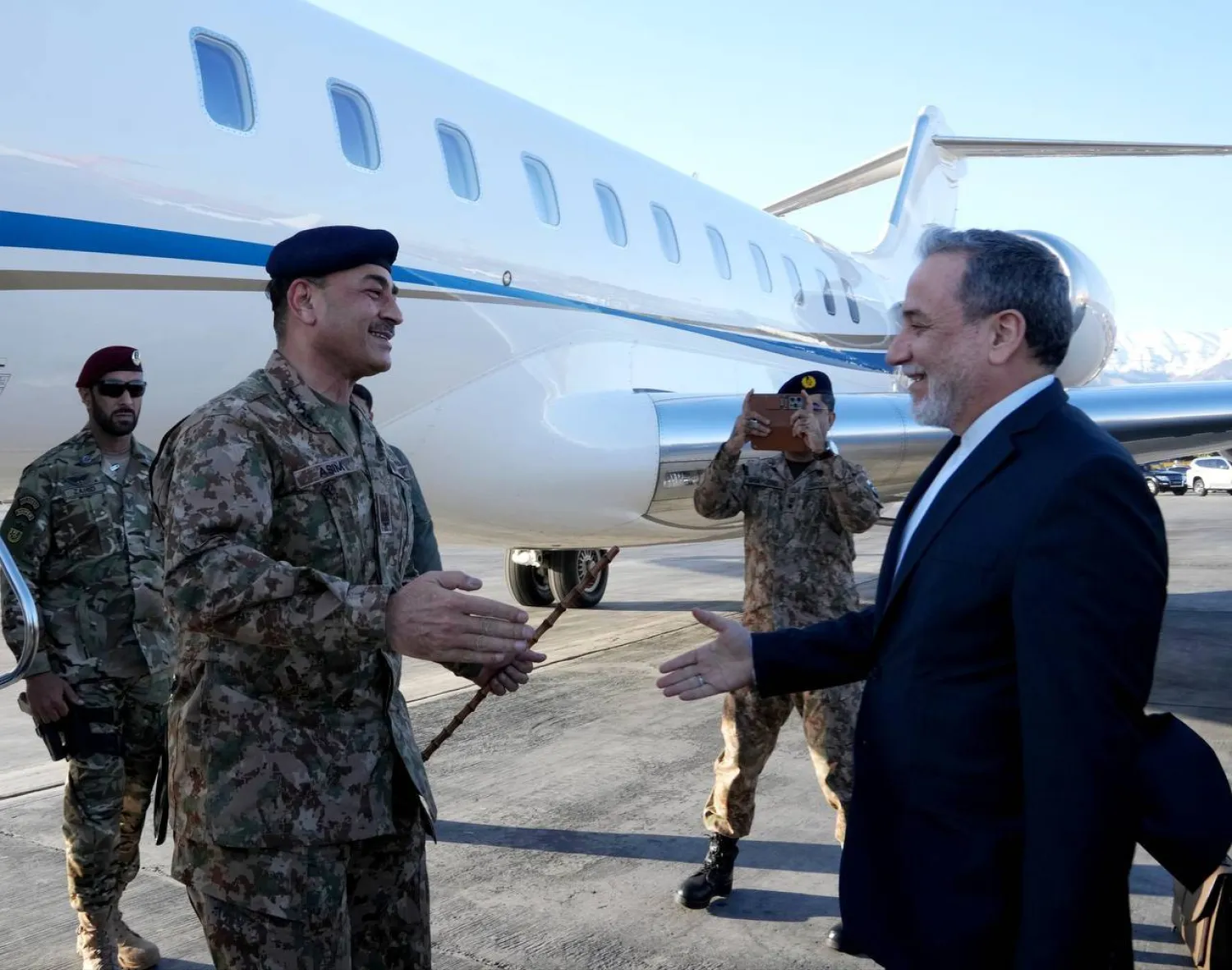
Image published by the Iranian Foreign Ministry of Araghchi receiving Pakistani Army Chief Asim Munir in Tehran on Wednesday.
TT

Pakistani Army Chief Visits Tehran in Bid to Broker Renewed Talks between US and Iran

Image published by the Iranian Foreign Ministry of Araghchi receiving Pakistani Army Chief Asim Munir in Tehran on Wednesday.

Pakistan’s army chief is set to meet with Iranian officials in Tehran on Thursday in a bid to ease tensions in the Middle East and arrange a second round of negotiations between the United States and Iran after almost seven weeks of war.

The White House said any further talks would likely take place in the Pakistani capital of Islamabad, though no decision had been made on whether to resume negotiations.

The US naval blockade of Iranian ports continued as US Treasury Secretary Scott Bessent said the Trump administration would ramp up economic pain on Iran with new economic sanctions on countries doing business with it, calling the move the “financial equivalent” of a bombing campaign.

Pakistan has emerged as a key mediator after it hosted direct talks between the US and Iran in Islamabad that authorities said helped narrow differences between the two sides. Mediators are seeking a new round before the ceasefire expires next week.

Meanwhile, Trump wrote late Wednesday on Truth Social that leaders from Israel and Lebanon would speak the next day in a renewed effort to broker a ceasefire after the countries' first direct talks in decades ended the previous day in Washington without a deal. It was not clear what leaders Trump was referring to. The Israeli prime minister’s office did not immediately respond for comment, which was posted before dawn in Israel and Lebanon.

The war has jolted markets and rattled the global economy as shipping has been cut off and airstrikes have torn through military and civilian infrastructure across the region. Oil prices have fallen amid hopes for an end to fighting, and US stocks on Wednesday surpassed records set in January.

Officials say US and Iran are making progress

Even as the US blockade on Iranian ports and renewed Iranian threats strained the ceasefire agreement, regional officials reported progress, telling The Associated Press the United States and Iran had an “in principle agreement” to extend it to allow for more diplomacy. They spoke on condition of anonymity to discuss sensitive negotiations.

Iran's foreign minister, Abbas Araghchi, took part in a preliminary meeting Wednesday with Asim Munir, Pakistan's army chief of staff, Iranian state media reported.

But even as mediators worked for peace, tensions simmered.

The commander of Iran’s joint military command, Ali Abdollahi, threatened to halt trade in the region if the US does not lift its naval blockade, and a newly-appointed military adviser to Iranian Supreme Leader Mojtaba Khamenei said he doesn’t support extending the ceasefire.

Mediators seek compromise on sticking points

Mediators are pushing for a compromise on three main sticking points that derailed direct talks last weekend — Iran’s nuclear program, the Strait of Hormuz and compensation for wartime damages, according to a regional official involved in the mediation efforts.

Iranian Foreign Ministry spokesman Esmail Baghaei said Iran is open to discussing the type and level of its uranium enrichment, but his country “based on its needs, must be able to continue enrichment,” Iranian state media reported.

The fighting has killed at least 3,000 people in Iran, more than 2,100 in Lebanon, 23 in Israel and more than a dozen in Gulf Arab states. Thirteen US service members have also been killed.

China calls for Strait of Hormuz to reopen

Chinese Foreign Minister Wang Yi said the window of peace was opening during a phone call with his Iranian counterpart, who briefed him on the latest developments in Iran-US negotiations and Tehran’s considerations on the next step, according to a statement from China’s foreign ministry late Wednesday.

Wang told Araghchi that the situation has reached a critical juncture between war and peace, and said Iran’s sovereignty, security, and legitimate rights should be respected as a littoral state of the Strait of Hormuz, while freedom of navigation and safety through the strait should be ensured.

Since the war began, Iran has curtailed maritime traffic through the Strait of Hormuz, which a fifth of global oil transited through in peacetime. Tehran’s effective closure of the strait sent oil prices skyrocketing, raising the cost of fuel, food and other basic goods far beyond the Middle East, and the US has responded with a blockade on Iranian shipping.

US Central Command said Wednesday that no ships had made it past the blockade since it was imposed two days earlier, while 10 merchant vessels complied with direction from US forces to turn around and reenter Iranian waters.

The blockade is intended to pressure Iran, which has exported millions of barrels of oil, mostly to Asia, since the war began Feb. 28. Much of it has likely been carried by so-called dark transits that evade sanctions and oversight, providing cash that’s been vital to keeping Iran running.

Strikes continue in Lebanon after Washington talks

Meanwhile, Israel pressed ahead with its aerial and ground war in Lebanon. The country's National News Agency reported airstrikes and artillery shelling throughout southern Lebanon on Wednesday, including near Bint Jbeil, where Israeli forces have encircled Hezbollah fighters.

Israeli Prime Minister Benjamin Netanyahu said Israeli troops were about to “eliminate this great stronghold of Hezbollah” and would continue expanding control of areas in southern Lebanon.

Netanyahu said negotiations are continuing, with disarming Hezbollah a key goal.

The Lebanese Health Ministry said Israel struck three teams of paramedics Wednesday in southern Lebanon, first hitting one team and then two more that rushed to help. The attacks killed three paramedics and wounded six others, the ministry said.

The Israeli military did not immediately respond to a request for comment.

Israel and Lebanon have technically been at war since Israel was established in 1948, and Lebanon remains deeply divided over diplomatic engagement with Israel.



Iran Reviewing US Proposal as Trump Pressures Tehran for Agreement on Deal to End War

US and Iran flags are seen in this illustration taken June 18, 2025. REUTERS/Dado Ruvic/Illustration/File Photo
TT

Iran Reviewing US Proposal as Trump Pressures Tehran for Agreement on Deal to End War

US and Iran flags are seen in this illustration taken June 18, 2025. REUTERS/Dado Ruvic/Illustration/File Photo

Iran said it was reviewing the latest American proposals to end the war after US President Donald Trump threatened the country with a new wave of bombing unless a deal is reached that includes reopening the crucial Strait of Hormuz to international shipping.

Hope that the two-month conflict could soon be over buoyed international markets Thursday, a day after the US military fired on an Iranian oil tanker attempting to breach the American blockade of Iran’s ports. The developments followed days of mixed messages from the Trump administration over its strategy to end the war, according to The AP news.

Meanwhile, US Secretary of State Marco Rubio discussed peace efforts in the Middle East at the Vatican. Rubio met with Pope Leo XIV, whose opposition to the Iran war has led to open sparring with Trump.

Trump posted on social media Wednesday that ending the war and resuming oil and natural gas shipments disrupted by the conflict depends on Iran accepting an agreement, which he did not detail.

“If they don’t agree, the bombing starts,” Trump wrote.

A fragile ceasefire between the US and Iran has largely held since April 8. But in-person talks between the two countries hosted by Pakistan last month failed to reach an agreement. The war began Feb. 28, when the US and Israel launched strikes against Iran.

Pakistan says it expects a deal soon “We expect an agreement sooner rather than later,” Pakistani Foreign Ministry spokesperson Tahir Andrabi said Thursday.

“We hope the parties will reach a peaceful and sustainable solution that will contribute not only to peace in our region but to international peace as well.” But he declined to give a timeline, saying Pakistan would not disclose details of the ongoing diplomatic efforts.

Asked whether Pakistan was expecting any response from Iran later Thursday, Andrabi said: “I will not comment on specifics or the movement of the messages.”

Pakistani Prime Minister Shehbaz Sharif, speaking in televised remarks, said Islamabad remained in “continuous contact with Iran and the United States, day and night, to stop the war and extend the ceasefire.”


Pakistan Warns of Strong Response to Any Attack on Anniversary of Clash with India

The Pakistani flag is seen in Islamabad. AP file photo
TT

Pakistan Warns of Strong Response to Any Attack on Anniversary of Clash with India

The Pakistani flag is seen in Islamabad. AP file photo

Pakistan’s military warned Thursday it would respond strongly against any attack as it marked the anniversary of last year’s four-day conflict with neighboring India that brought the nuclear-armed rivals to the brink of war before a US-brokered ceasefire halted the fighting.

The military said that any “hostile design” against Pakistan would be countered with “greater strength, precision and resolve” than what India witnessed during the May 2025 conflict, which Islamabad named “Marka-e-Haq,” or “Battle of Truth.”

Pakistan and India had exchanged tit-for-tat strikes following an attack by gunmen in the Indian-controlled part of the disputed Himalayan region of Kashmir that killed 26 people, most of them Hindu tourists. India blamed Pakistan-backed militants for the massacre in the town of Pahalgam, an allegation Islamabad denied while calling for an independent investigation, The AP news reported.

India launched strikes inside Pakistan on May 7, triggering retaliatory attacks by Pakistan that included drone incursions, missile strikes and artillery fire. Dozens of people were killed on both sides before a ceasefire was reached on May 10 following US mediation.

Pakistan at the time claimed it shot down at least seven Indian military aircraft, including a French-made Rafale fighter jet. India acknowledged suffering some losses but did not provide details.

US President Donald Trump has repeatedly taken the credit for helping avert a wider war.

Speaking at a televised news conference, army spokesperson Lt. Gen. Ahmad Sharif Chaudhry said India had blamed Pakistan for the attack on tourists in Kashmir within minutes of the shooting without presenting evidence.

“It has been one year since the Pahalgam incident, yet the questions Pakistan raised remain unanswered,” he said. Chaudhry said Pakistan did not underestimate India’s military capability but was fully prepared to respond to any “misadventure.”

“We are prepared; if anyone wishes to test us, they are more than welcome,” he said alongside Deputy Chief of Naval Staff Rear Adm. Shifaat Ali and Deputy Chief of Air Staff (Projects) Air Vice Marshal Tariq Ghazi. However, Chaudhry added: “We are not seeking conflict, we are not seeking war. But we know how to defend ourselves with honor and dignity.”

Ali said the Indian navy had attempted to deploy vessels in the northern Arabian Sea during the fighting in an effort to target Pakistan’s naval assets and disrupt maritime trade routes. “But due to the effective strategy of the Pakistan Navy, maritime traffic in all our waterways remained uninterrupted,” he said.

At Thursday’s briefing, Ghazi said Pakistan had downed eight Indian fighter jets during the conflict. He added that Pakistan had exercised restraint and that its air force had the capability to inflict greater damage on the enemy.

Pakistan and India have long had strained relations and have fought two of their three wars over Kashmir, which is claimed by both in its entirety.


Pezeshkian Says he Recently Met with the Supreme Leader

Women walk past a banner depicting Iran's current supreme leader Mojtaba Khamenei along a street Tehran on May 6, 2026. (Photo by AFP)
TT

Pezeshkian Says he Recently Met with the Supreme Leader

Women walk past a banner depicting Iran's current supreme leader Mojtaba Khamenei along a street Tehran on May 6, 2026. (Photo by AFP)

Iran’s President Masoud Pezeshkian said he met recently with Supreme Leader Mojtaba Khamenei, state media reported ⁠on Thursday, offering ⁠a first public account of him ⁠meeting Khamenei after the latter suffered severe wounds at the start of the US-Israeli war on Iran.

The ⁠meeting ⁠was marked by a "humble and deeply cordial" atmosphere, Pezeshkian was reported as saying.

Khamenei, reportedly wounded in strikes on the first day of the Middle East war that claimed the life of his father and predecessor Ali Khamenei, has released only written statements since his appointment.

"What struck me most during this meeting was the vision and the humble and sincere approach of the supreme leader of the Islamic revolution," Pezeshkian said in a video broadcast by state television.