


Gaza's War Amputees Short of Prostheses under Israeli Restrictions

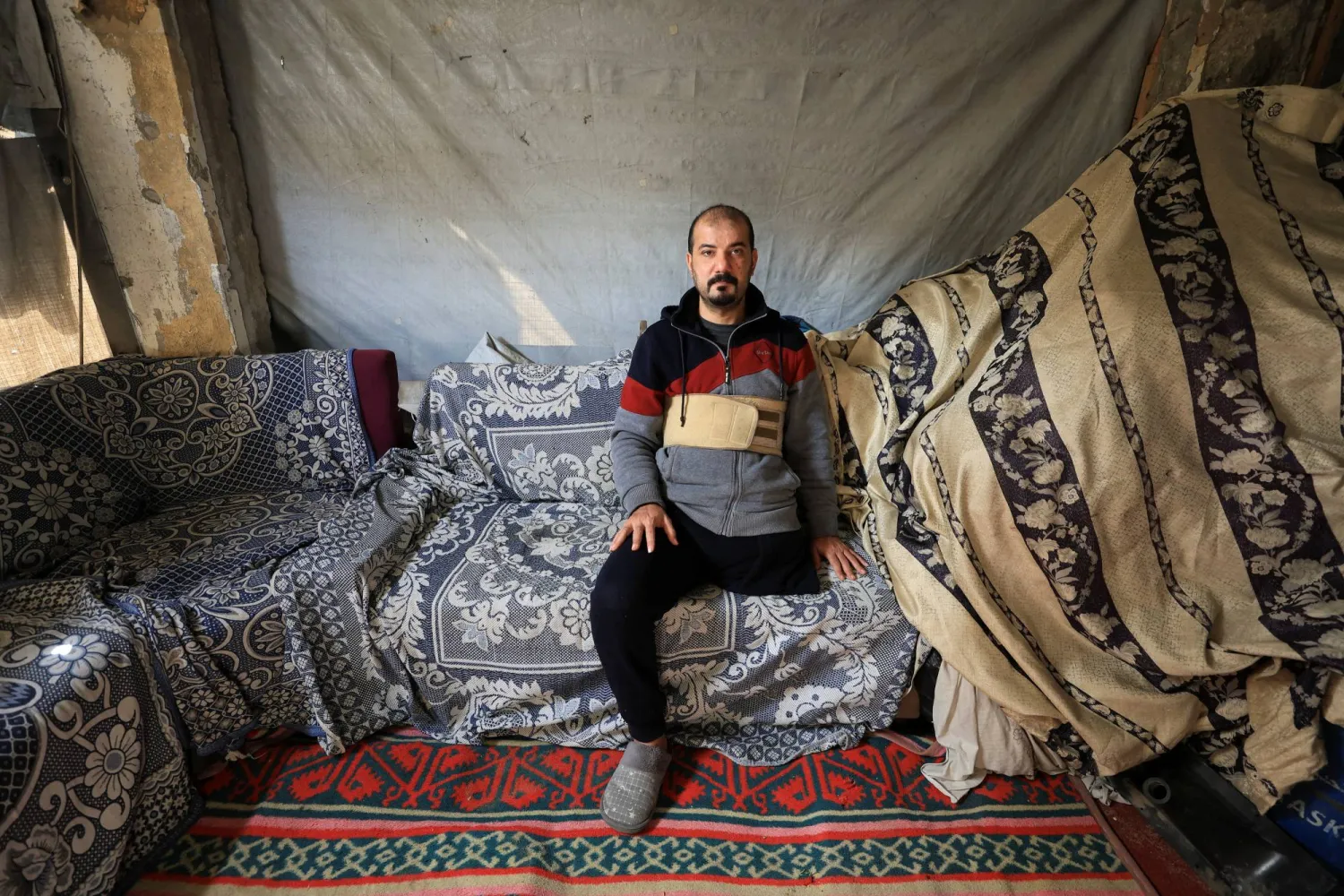
Palestinian amputee Hazem Foura, who lost one leg, sits at his home in Gaza City, April 3, 2026. REUTERS/Dawoud Abu Alkas
TT

Gaza's War Amputees Short of Prostheses under Israeli Restrictions

Palestinian amputee Hazem Foura, who lost one leg, sits at his home in Gaza City, April 3, 2026. REUTERS/Dawoud Abu Alkas

Fourteen-year-old Fadel al-Naji used to be a keen footballer but is now largely confined to his home in Gaza City since both legs were severed in an Israeli drone attack in September. He sits sullenly on a couch with one hollow pant leg dangling and the other tucked into his waist beside his 11-year-old brother who lost an eye in the same strike.

"He has become withdrawn and isolated," said his mother Najwa al-Naji, showing old videos of him doing kick-ups on her phone. "It is as if he is dying slowly, and I wish that they would fit him with prosthetic limbs." But those are in scarce supply for Gaza's nearly 5,000 war amputees - a quarter of whom are children like al-Naji - because of Israeli restrictions on materials like plaster of Paris, seven aid and medical sources told Reuters.

Israel, which fought a two-year war with Hamas militants in the Palestinian enclave, cites security concerns as the reason for restrictions. Taken together with Gaza's pre-war amputee population provided by Palestinian health officials, its per capita amputee rate now exceeds even Cambodia, which had been the worst due to landmines, aid group Humanity & Inclusion said. Such is the need that two medical centers said they were trying to reuse old ‌prosthetic limbs recovered ‌from people killed in the war. Others are creating makeshift artificial limbs with plastic piping or wooden planks, medics ‌said, though ⁠this risks damaging the ⁠stump or causing infection.

UNFULFILLED PROMISE

Gaza's amputees are a symbol of unfulfilled pledges from the October ceasefire and US President Donald Trump's 20-point plan envisaging full aid "without interference". It also foresaw the reopening of the Rafah border crossing - Gaza's sole route out to Egypt - but medical evacuations including for amputees have been irregular.

Israel restricts imports of items it says have potential military as well as civilian use under a policy pre-dating the two-year war. While plaster of Paris and other plastic components for prostheses are not specified on Israeli lists of so-called dual use items, "construction products" are there, an Israeli export control document showed.

Israel's COGAT military agency, which controls access to Gaza, says it facilitates the regular entry of medical equipment but will not permit materials that could be used by Hamas for a "terrorist build-up". Responding to questions about prostheses, COGAT said it is in dialogue with the UN ⁠and other aid groups to identify ways to enable an adequate medical response.

The International Committee of the Red Cross, ‌which supports the Artificial Limbs and Polio Center in Gaza, the main center for prosthetics, said imports of ‌plaster of Paris have been almost completely restricted for over four months with supplies left only to June or July.

"What we are producing now are very small quantities compared ‌to the actual need," said Hosni Mhana, the center's spokesperson, without giving numbers. The Qatari-funded Sheikh Hamad Hospital said no supplies have been received during the war and ‌that it has run out. It can now only offer maintenance on existing prostheses. "There are no local alternatives for prosthetic manufacturing materials," said the hospital's General Director Ahmed Naim.

Humanity & Inclusion, which has fit 118 temporary prostheses in Gaza since early 2025, said supplies from its last shipment in December 2024 are dwindling.

The Trump-led Board of Peace, which has sought to boost aid for Gaza, said it took very seriously the hardships of amputees and other patients in Gaza.

"These are urgent civilian needs," it said in a statement to Reuters, noting that the ‌ceasefire obligations included the sustained flow of humanitarian, commercial and medical supplies.

Restrictions and delays are raised with the relevant authorities, it added. "We have significant guarantees and commitments that these restrictions will be eased and eliminated as armed parties ⁠agree to decommission their weapons and hand over ⁠authority to a Palestinian technocratic government in Gaza."

PROLONGED TRAUMA

Artificial limbs cannot be imported whole into Gaza since they are built for each patient, with plaster used to take an exact cast of the residual limb to shape a custom-made socket.

Reuters interviewed three other Gaza amputees all struggling to resume their pre-war lives without prostheses. Some of the amputees are on a waiting list and may have undergone preparatory work, which can include stump revisions, a form of surgery to hone its shape. One on the list is Hazem Foura, a 40-year-old former office worker unable to work since losing his left leg above the knee in December 2024 when he says Israel bombed his house.

"I am not asking for the luxuries of life, I am asking for a limb so I can regain my humanity," he said. Lack of prostheses severely disrupts recovery and prolongs trauma for amputees, many of whom might have avoided limb loss had more specialist surgeons been available.

It also puts them in greater danger from ongoing Israeli attacks, which have killed 750 Palestinians since the ceasefire, Palestinian health officials say.

Israeli restrictions on items like wheelchairs have eased since the ceasefire, the ICRC and the UN children's agency said, but medics said maneuvering around Gaza’s rubble-strewn roads remains a challenge. As well as materials, expertise is lacking, with only eight prosthetists still in Gaza according to the World Health Organization.

Follow-up care for children is especially tough, medics said, since they need regular refittings as they grow. "The amputation itself is not just a lost limb, it's lost hope, it's lost independence," said Heba Bashir, prosthetic and orthotic technical officer for Humanity & Inclusion. "For the kids, it means losing their future."



Jordan Says Air Defenses Intercepted 18 out of 20 Missiles Launched from Iran

Projectiles streak across the sky in this screengrab taken from footage published by Iranian authorities purporting to show missiles launched at US military targets in Jordan from an unknown location, released on August 31, 2026. Wana News Agency via REUTERS
TT

Jordan Says Air Defenses Intercepted 18 out of 20 Missiles Launched from Iran

Projectiles streak across the sky in this screengrab taken from footage published by Iranian authorities purporting to show missiles launched at US military targets in Jordan from an unknown location, released on August 31, 2026. Wana News Agency via REUTERS

The Jordanian Army said in a statement on Wednesday that its air defenses intercepted 18 out of 20 ballistic missiles originating from Iran while two other missiles fell in a remote area confirming that there were no casualties.

The statement quoted the army’s official spokesman as saying that “Jordanian air defense systems had dealt with 20 ballistic missiles launched toward Jordanian territory from Iran. Eighteen of the missiles were successfully intercepted and destroyed, while two fell in areas away from populated areas”, he said, adding that there were no casualties.

Iran's Revolutionary Guard had earlier said that it fired ballistic missiles at a base in Jordan used by the US military and attacked 10 ships on Wednesday, after the US said it had destroyed five Iranian oil tankers, in a sharp escalation of the six-month-old war.

Iran has also threatened oil tankers in Kuwaiti and ‌Bahraini ports, according to a statement carried by state media.

IRNA quoted a message by Iranian Revolutionary Guard Corps (IRGC) as saying: “In light of the hostile actions being carried out by the terrorist US military, including its targeting of several oil tankers belonging to the Islamic Republic of Iran, we warn all crews of oil tankers in the vicinity of the ports of Kuwait and Bahrain, which host these terrorists and participate in their hostile actions, and urge them to leave their vessels immediately, whether they are in waiting areas or at the docks, as they will be subject to attack.”

US Central Command (CENTCOM) said it destroyed five Iranian crude oil tankers on Sept. 8 after Iran’s Revolutionary Guards twice targeted a US Navy warship with ballistic missiles. The warship evaded the attacks and continued its patrols without any US casualties.


Lebanese Contacts with Washington Curb Israeli Escalation in South

Mourners carry pictures of victims killed in an Israeli airstrike on Kafr Rumman in southern Lebanon during their funeral. (AP)
TT

Lebanese Contacts with Washington Curb Israeli Escalation in South

Mourners carry pictures of victims killed in an Israeli airstrike on Kafr Rumman in southern Lebanon during their funeral. (AP)

Intensive contacts between Lebanese President Joseph Aoun and US officials helped curb Israeli attacks that had escalated since Saturday, as Lebanon awaits Washington’s confirmation of a date for an eighth round of negotiations with Israel, expected to be set this week and held later this month.

Israeli attacks in South Lebanon subsided on Tuesday after three days of airstrikes and artillery shelling that killed at least 28 people, wounded dozens and displaced hundreds from Nabatieh and surrounding villages. Residents began returning on Tuesday morning.

Unlike the heavy strikes on Saturday, Sunday and Monday, no Israeli airstrikes were reported by Tuesday afternoon, although drones flew over Beirut, its southern suburbs and other areas in the south.

Israeli forces carried out a demolition in the town of Mansouri, south of Tyre, while an Israeli unit entered the outskirts of Kfar Shouba overnight and raised an Israeli flag on a hill.

Intensive contacts

Ministerial sources close to the Lebanese presidency told Asharq Al-Awsat that Aoun had “conducted intensive contacts with the US side to press Israel to halt its military campaign,” adding that US officials had, in turn, contacted Israel.

The contacts included US Ambassador to Lebanon Michel Issa, while Lebanon’s ambassador to Washington, Nada Hamadeh Moawad, also held talks with US officials aimed at containing the escalation in the south.

On Monday, Aoun warned that Israel’s attacks “will not bring security to civilians along the border” and were targeting the path of the “framework agreement” and undermining efforts to halt escalation in the south and across the region.

“The question today is: Does Israel want peace or war? If it wants war, let that be made clear,” he added.

Lebanon has little leverage to halt Israeli attacks other than through Washington, which it sees as the only available diplomatic channel capable of pressing Israel to cease fire and halt the growing bulldozing and demolition operations in South Lebanon.

Beirut expects a definitive answer from the US by the end of the week on the eighth negotiating session with Israel. Lebanon’s demands in the talks include a ceasefire, Israeli withdrawal from occupied Lebanese territory and the return of prisoners.

US ambassador visits Shiite council

Issa visited the Higher Islamic Shiite Council on Tuesday and met its vice president, Sheikh Ali al-Khatib.

Sources following the visit described it as part of Issa’s protocol meetings with Lebanon’s religious leaders, including Grand Mufti Sheikh Abdel Latif Derian and Druze spiritual leader Sheikh Sami Abi al-Muna over the past two weeks. Others pointed to its timing following al-Khatib’s meetings in Iran and Iraq.

After the meeting, Issa stressed that the United States wanted what was best for the Shiite community and for southerners to return to their land.

On Israeli attacks, Issa noted that his understanding from the Israeli side was that any fire directed at Israel would be met with a response 10 times greater.

Asked about prisoners, he replied that he will keep up his efforts until they are released, saying it was his responsibility.

Condemnation

Lebanese Minister of State for Administrative Reform Fadi Makki condemned the Israeli attacks after meeting Aoun, calling for intensified efforts to halt them and protect Lebanon.

He also stressed support for the Lebanese army and the need for all sides to rally around the state and its legitimate institutions to safeguard the country’s sovereignty and territorial integrity.

Israeli strikes on Lebanon have killed more than 4,300 people since Hezbollah fired rockets at Israel on March 2, two days after US and Israeli strikes on Iran began, prompting an Israeli air and ground offensive against Lebanon.

Lebanon’s Health Ministry reports that the dead include more than 250 children, around 400 women and more than 130 paramedics.

A ceasefire sharply reduced the violence, but Israeli forces occupying large parts of South Lebanon have continued destroying villages inside a unilaterally declared “security zone.” The Israeli military also continues to carry out strikes within the zone and north of it, often without issuing evacuation warnings.


Tunisian Journalists Protest Over Media Crackdown

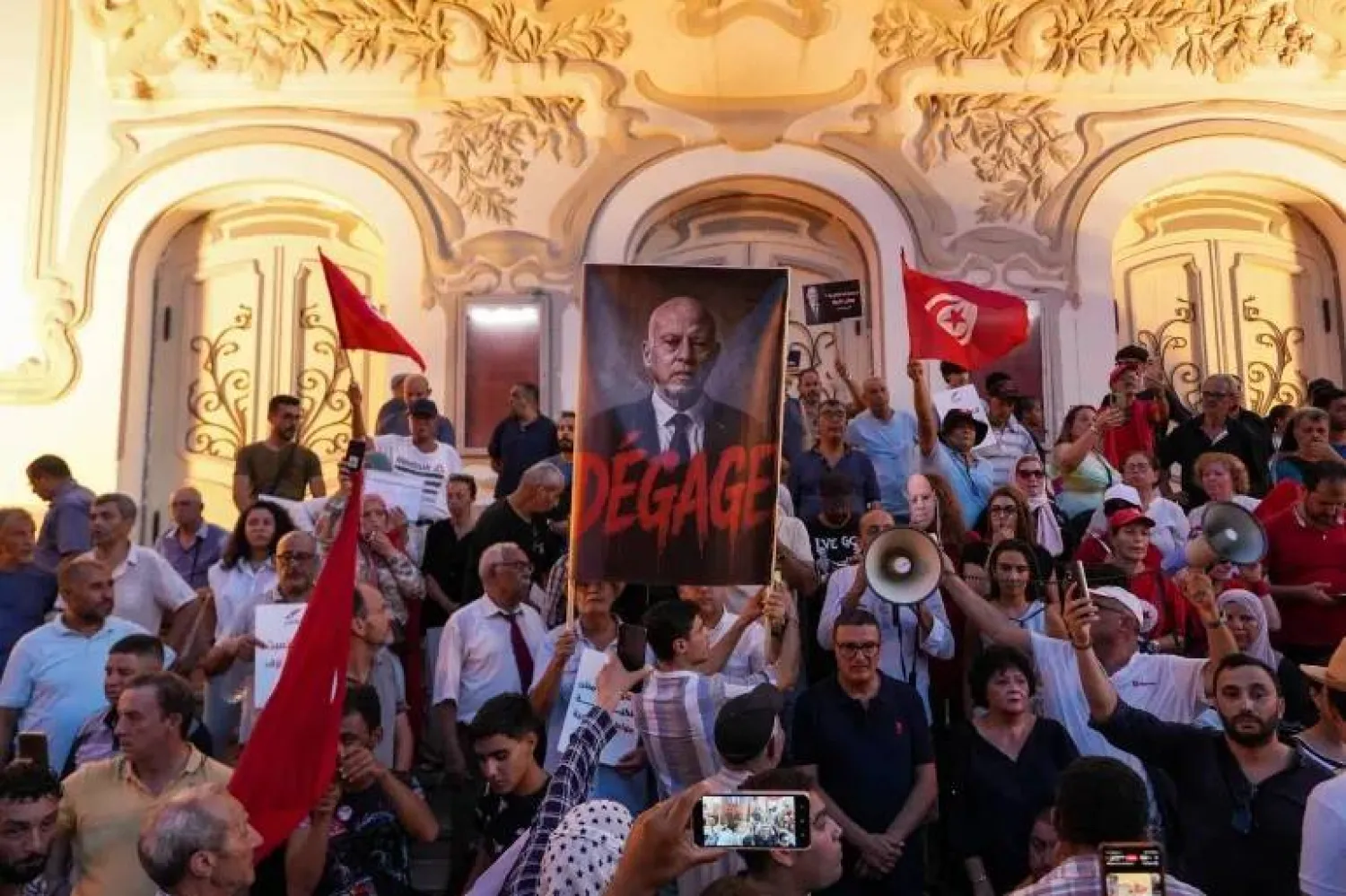
Protesters chant against President Kais Saied, in Tunis, Tunisia, August 20, 2026, demanding the restoration of democracy and calling for the release of jailed activists and journalists amid a worsening economic and social crisis (Jihed Abidellaoui/Reuters)
TT

Tunisian Journalists Protest Over Media Crackdown

Protesters chant against President Kais Saied, in Tunis, Tunisia, August 20, 2026, demanding the restoration of democracy and calling for the release of jailed activists and journalists amid a worsening economic and social crisis (Jihed Abidellaoui/Reuters)

Tunisian journalists protested on Tuesday to demand the release of prominent journalist Mohamed Yousfi, whose arrest has become a new flashpoint amid accusations that President Kais Saied is cracking down on the country's ‌remaining independent voices.


The protesters, who also included activists, gathered outside a court where a judge was questioning Yousfi over illicit enrichment and money laundering charges, which critics say were fabricated to punish him for his outspoken journalism.


Yousfi, a fierce critic of Saied and the editor-in-chief of investigative news website ⁠Al-Qatiba, was arrested last Friday as he was preparing to enter Express FM Radio to take part in a radio program.


His arrest prompted widespread condemnation of Saied’s government, with rights groups saying the case was aimed at increasing a climate of fear among journalists.


“The situation is dark and difficult. Journalists who disturb the authorities are facing legal persecution and fabricated charges,” Zied Dabbar, the head of journalists' syndicate SNJT, told Reuters.


“Today journalists either end up in exile or in ‌prison... ⁠But we will resist,” he added.


Several media figures have been jailed this year, including Zied Heni, Mourad Zghidi and Borhen Bsaies, while Khaoula Boukrim was sentenced in absentia in June to four years.


Free speech initially flourished following the 2011 uprising that toppled Zine El Abidine ⁠Ben Ali and ignited pro-democracy protests known as the “Arab Spring.”


But critics say Saied's accumulation of power in 2021 and decrees he has issued since then have dismantled democratic safeguards ⁠and enabled the authorities to pursue many journalists.


The leaders of Tunisia's main opposition parties have been jailed in the last three years, along with dozens of ⁠politicians, activists, journalists and businessmen, on charges of conspiring against state security, of money laundering and corruption.


Saied says he will not be a dictator and that freedoms are guaranteed in Tunisia.