


US Renews Russian Oil Waiver for a Month to Curb Global Energy Prices

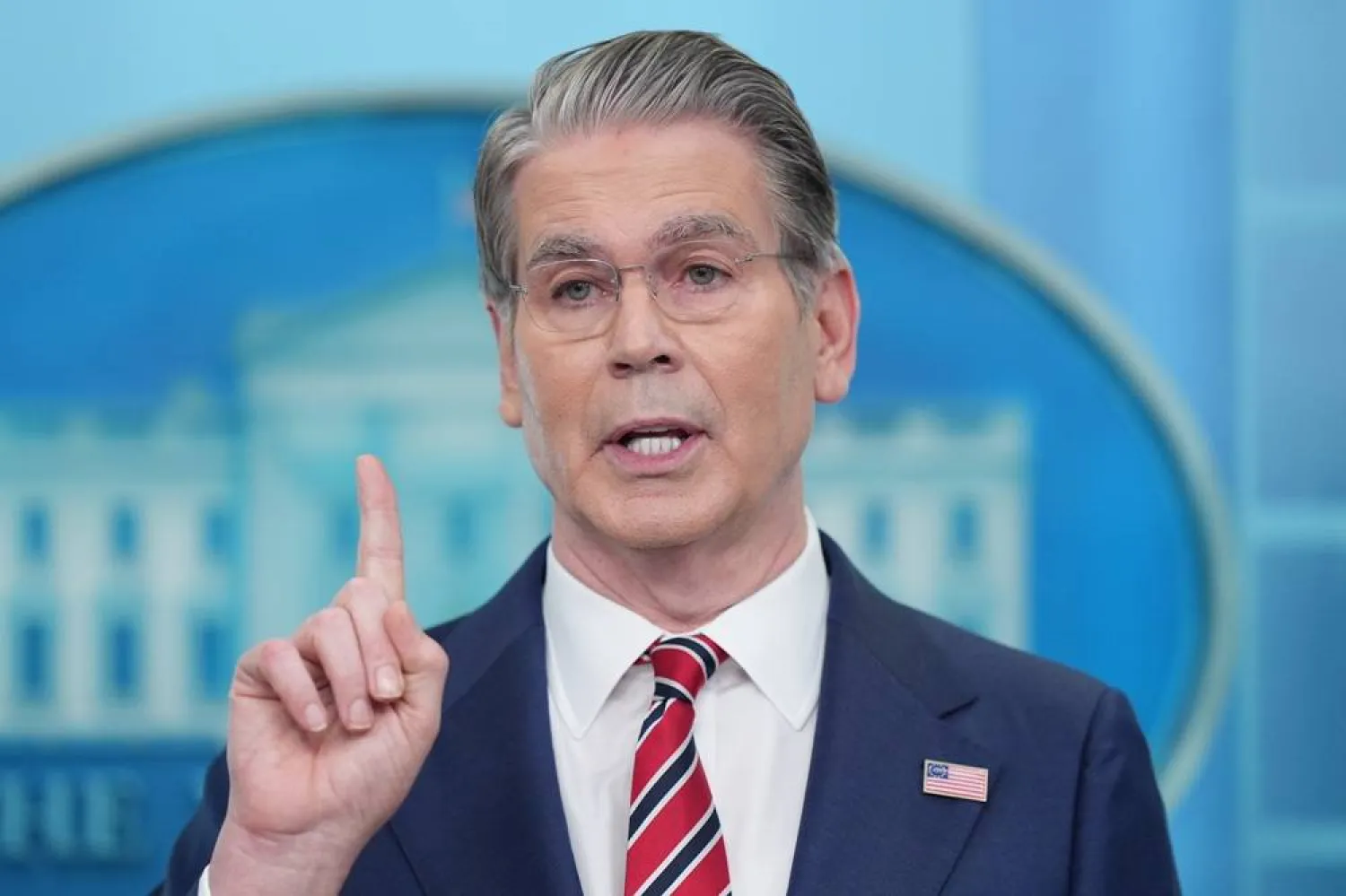
US Treasury Secretary Scott Bessent speaks with reporters in the James Brady Press Briefing Room at the White House, Wednesday, April 15, 2026, in Washington. (AP)
TT

US Renews Russian Oil Waiver for a Month to Curb Global Energy Prices

US Treasury Secretary Scott Bessent speaks with reporters in the James Brady Press Briefing Room at the White House, Wednesday, April 15, 2026, in Washington. (AP)

Washington renewed on Friday a waiver allowing countries to buy sanctioned Russian oil at sea for about a month, even as lawmakers accused the government ‌of going easy on Moscow as its war on Ukraine grinds on.

The Treasury Department's waiver lets countries purchase Russian oil and petroleum products loaded on vessels as of Friday through May 16.

It replaces a 30-day waiver that expired on April 11 and excludes transactions involving Iran, Cuba and North Korea.

Reversal

The move is part of the administration's effort to control global energy prices that have shot higher during the US-Israeli war with Iran.

It came after countries in Asia, suffering from the global energy shock, pressed Washington to allow alternative supplies to reach markets.

“As negotiations (with Iran) accelerate, Treasury wants to ensure oil is available to those ⁠who need it,” a Treasury Department spokesperson said.

Last Wednesday, Treasury Secretary Scott Bessent said Washington would not be renewing the waiver for Russian oil and another for Iranian oil, which is set to expire on Sunday.

Global oil prices tumbled 9% on Friday to about $90 a barrel after Iran temporarily reopened the Strait of Hormuz, an oil choke point in the Gulf. But the war has already created the worst global energy supply disruption in history, the International Energy Agency has said.

The war, which enters its eighth week on Saturday, has damaged more than 80 oil and gas facilities in the Middle East, and Tehran has warned it could close the strait again if the recent US Navy blockade of Iranian ports continued.

High oil prices are a threat to President Donald Trump's fellow Republicans ahead of November's midterm elections.

Trump has also faced pressure from partner countries on the oil price.

A US source told Reuters partner countries on the sidelines of Group of 20, World Bank and International Monetary Fund meetings ‌in Washington ⁠this week had requested the US extend the waiver. Trump also spoke about oil this week in a call with Prime Minister Narendra Modi of India, a big purchaser of Russian oil.

The waiver on Iranian oil, which the Treasury Department issued on March 20, allowed about 140 million barrels of oil to reach global markets and helped relieve pressure on energy supply, Bessent said last month.

Lasting damage

US lawmakers from both political parties had slammed the administration over the sanctions waivers, saying they stood to help the economy of Iran while it was at war ⁠with the US and of Russia as it was at war with Ukraine.

The waivers could impede the West's efforts to deprive Russia of revenue for its war in Ukraine and put Washington at odds with its allies. European Commission President Ursula von der Leyen has said now is not the time to relax sanctions against Russia.

Russian President Vladimir Putin's special envoy Kirill Dmitriev ⁠said an extension of the US waiver will affect another 100 million barrels of Russian oil, bringing the total volume affected by both waivers to 200 million barrels.

Dmitriev, who travelled to the US on April 9 for meetings with members of the Trump administration ahead of the previous waiver expiry, said on his Telegram channel that the ⁠extension faced “active political opposition.”

Brett Erickson, a sanctions expert at the consulting firm Obsidian Risk Advisors, said Friday's renewal is likely not the last waiver Washington will issue.

“The conflict has done lasting damage to global energy markets, and the tools available to stabilize them are nearly exhausted,” Erickson said.



Official: Iraq Has Not Yet Applied for an IMF Loan

A floating oil export platform in Basra port, Iraq (Reuters)
TT

Official: Iraq Has Not Yet Applied for an IMF Loan

A floating oil export platform in Basra port, Iraq (Reuters)

Financial Advisor to the Iraqi Prime Minister Mazhar Mohammed Saleh revealed on Saturday that Iraq has not yet submitted a formal request for a loan from the International Monetary Fund (IMF).

The Iraqi News Agency quoted Saleh as saying that “Iraq enjoys close relations with the IMF, and since 2003, it has concluded more than five agreements, three of which were Stand-by Arrangements, while the other agreements related to emergency support.”

Iran's war has caused significant disruptions in supply chains, especially in the energy sector, which was severely affected by a near-complete closure of the Strait of Hormuz, through which about 20 percent of global oil supplies pass.

Saleh stated that “the Fund has played a significant role in supporting the Iraqi economy over the past 23 years, especially since Iraq is now considered one of the biggest victims of the ongoing war in the region, considering that 85 percent of its oil exports pass through the Strait of Hormuz. This has caused significant harm and international concern, given that Iraq is an important and active member in the stability of the region and world markets.”

He pointed out that there is an Iraqi government team in contact with the IMF, meeting with Fund officials for consultations twice a year.

He clarified that “Iraq signed an agreement with the IMF on July 7, 2016, for a Stand-by Arrangement by providing a significant loan, which played a major role in supporting the general budget,” noting that “signing an agreement with the Fund is a matter decided by the Iraqi government, and this does not prevent consultations between the two parties, as Iraq is a member of this institution responsible for global stability.”

Saleh mentioned that “Iraq will borrow from the International Monetary Fund if the need arises, but there is no formal request from the government yet, and the current need is for the war in the region to stop, and for its geopolitical impacts on oil exports to cease.”

He added that “technical assistance from the IMF is available now, unlike the issue of financing, which requires the approval of a program by the Iraqi government.”

He explained that “the loan itself represents a reform program to support the budget or to achieve social goals, such as supporting the health and education sectors, because it is a human investment that must be subject to conditions defining expenditure directions and commitment to a reform program agreed upon by the Iraqi state and the IMF.”


Mawani Adds CMA CGM’s Ocean Rise Express Service to Jeddah Port

Mawani Adds CMA CGM’s Ocean Rise Express Service to Jeddah Port
TT

Mawani Adds CMA CGM’s Ocean Rise Express Service to Jeddah Port

Mawani Adds CMA CGM’s Ocean Rise Express Service to Jeddah Port

The Saudi Ports Authority (Mawani) has added CMA CGM's Ocean Rise Express (OCR) shipping service to Jeddah Islamic Port, aiming to strengthen maritime connectivity between Saudi Arabia and global markets, support the smooth flow of supply chains, and increase the efficiency of port operations.

The OCR service will connect Jeddah to key international ports, including Kobe, Nagoya, and Yokohama in Japan; Xiamen, Yantian, and Nansha in China; Rotterdam in the Netherlands; Hamburg in Germany; and Southampton in the United Kingdom.

The route will utilize vessels with a capacity of up to 10,000 TEUs, according to SPA.

This addition aligns with Mawani’s efforts to enhance Jeddah Islamic Port’s global competitiveness and support international trade.

By enabling access to new markets, the initiative reinforces the Kingdom's position as a global logistics hub in line with the National Transport and Logistics Strategy and Saudi Vision 2030.


Lebanon's Financial Battles Persist Despite War Priorities

Lebanese President Joseph Aoun meets with a delegation from the Association of Banks in Lebanon (Lebanese Presidency)
TT

Lebanon's Financial Battles Persist Despite War Priorities

Lebanese President Joseph Aoun meets with a delegation from the Association of Banks in Lebanon (Lebanese Presidency)

Lebanon's unresolved financial and monetary issues continue to generate new and pressing obligations for the executive, legislative and monetary authorities. Although they have been partially overshadowed by the storm of war and its devastating human, reconstruction and social consequences, these issues remain high on both the political and economic agenda.

As the government's economic team works on amendments to the draft financial-gap law, including discussions over reservations raised by the central bank, newly proposed changes to the banking reform law, submitted by the government to parliament this month, have reignited the ongoing disputes within Lebanon's financial sector.

These disputes remain centered on the rescue plan and the treatment of structural crises that have persisted into their seventh consecutive year, most notably reflected in the repeated failure to meet reform commitments required to secure a financing agreement with the International Monetary Fund (IMF).

According to information obtained by Asharq Al-Awsat from a financial official, wartime developments and their repercussions have effectively granted Lebanon additional time, at least until the autumn meetings of international financial institutions, to complete legislation forming the roadmap for restoring financial stability and recovering deposits.

This includes the sought-after reforms of the banking sector, alongside compliance with anti-money laundering requirements, particularly measures aimed at curbing the informal economy, shutting down channels used for illicit financial flows, and addressing excessive cash circulation through enhanced source-to-beneficiary verification requirements.

A notable development is expected to influence future deliberations in parliamentary committees and the legislature's general assembly. In an updated report, the IMF classified the crisis affecting Lebanon's banking sector as a "systemic crisis," placing it alongside similar crises experienced by 13 countries worldwide over the past decade, from Angola in 2015 to Vietnam in 2022. This classification is expected to help align Lebanon's reform measures and responsibilities with international standards and draw on rescue plans implemented in comparable cases.

According to the financial official, the IMF's classification could help settle long-running domestic disputes that have prolonged the failure to adopt a comprehensive plan for exiting the financial and monetary crisis and containing its social and economic consequences. Such a plan remains the only viable pathway to restoring confidence in the financial sector and returning gradually to economic recovery, particularly after the enormous reconstruction and economic losses caused by successive destructive wars, estimated to exceed $20 billion at a minimum.

Lebanese President Joseph Aoun meets with Central Bank of Lebanon Governor Karim Souaid on May 7. (Lebanese Presidency)

Systemic Crisis and Financial Sector Restructuring

The official added that this approach takes on added importance amid discussions surrounding the restructuring of the financial sector, particularly the draft law on restoring financial order and recovering deposits submitted by the government to parliament.

"The recognition of the systemic nature of the crisis requires reconsidering some of the proposals currently on the table in a way that ensures a fairer distribution of responsibilities and burdens among all parties concerned, rather than reducing what happened to a narrow framework and placing the full cost of the collapse on depositors and banks," the official said.

This international reassessment is consistent with an opinion issued by Lebanon's State Council more than two years ago, which concluded that Lebanon was not facing an ordinary banking crisis but rather a systemic one, assigning primary responsibility for the financial crisis to the state because of its reliance on borrowing from the central bank to finance budget deficits.

Banks Ready to Shoulder Responsibilities

The issue resurfaced during a meeting between President Joseph Aoun and the board of the Association of Banks in Lebanon, headed by Salim Sfeir. The association conveyed the banking sector's readiness to assume its responsibilities and participate in absorbing losses, provided that reform does not amount to liquidation and that restructuring does not unfairly burden both banks and depositors. It stressed the need for a fair allocation of responsibilities and costs while safeguarding depositors' rights and preserving the sector's viability.

Aoun emphasized "the importance of reaching a fair and comprehensive solution to the banking crisis that satisfies all parties and preserves rights equally."

He stressed the importance of reform without destroying or undermining the sector, adding that "it is the state's duty to stand by the banking sector, reform it and restructure it in order to safeguard the economy and guarantee depositors' rights."

He further noted that "without a sound banking sector, there will be no investment, and there will be no country."

A general view of Beirut, Lebanon. (Reuters/File Photo)

Central Bank Governor Voices Reservations

Earlier, Central Bank Governor Karim Souaid openly expressed reservations about key provisions in the government's proposal, stating that "the draft requires further clarification and strengthening regarding the state's obligations. Since the state is ultimately the entity that used these funds over many years, its contribution must be explicitly defined, measurable, legally binding, and linked to a clear and credible timetable."

In several remarks, Souaid highlighted the challenge of distributing financial burdens and responsibilities among the state, the central bank and commercial banks. He additionally stressed the need to reduce the fiscal deficit by eliminating irregular claims, categorizing deposits into clearly defined groups, and carrying out repayments through a combination of cash payments and asset-backed financial instruments in phases and within available liquidity limits.

Banks continue to insist on their right to participate in discussions that will determine their future. They have outlined an approach that seeks to balance depositor protection with the sector's continued viability. In a memorandum submitted to officials, they argued that "instead of ensuring a fair distribution of responsibilities, the draft law submitted to parliament exempts the state, which bears primary responsibility for the financial gap, from making any clear contribution toward losses. Moreover, the proposal harms both the banking sector and depositors alike."

For instance, the draft law, despite objections from the monetary authorities, requires the removal of impaired assets, meaning assets deemed unrecoverable for depositors, and proposes deducting them from deposits without returning them to their owners. At the same time, banks would be required to absorb their value as losses. In practice, this would impose losses on both depositors and banks, pushing banks toward liquidation rather than enabling them to repay deposits.

Consequently, if banks are burdened with obligations that exceed their responsibilities and capacities, the outcome will be clear: the liquidation of the majority of banks.

The financial official noted that international experience shows that systemic crises, regardless of their severity, can become a starting point for rebuilding stronger and more modern financial systems when political will and serious reforms are present. The current period therefore represents an opportunity to redesign a new economic and financial model that can restore Lebanon's regional financial role and rebuild confidence both domestically and internationally.

In this context, the official said, it is essential to adopt a balanced and inclusive approach that rebuilds confidence in the financial and banking sectors while safeguarding the rights of depositors and investors and ensuring the continuity of financial institutions.

Economic recovery cannot be achieved through confrontational policies or temporary solutions, but rather through a comprehensive reform vision that recognizes the true scale of the crisis and lays the groundwork for a gradual and sustainable recovery.